
Motivation
8 Reasons You Should Be Happy When You Fail

Have you failed at something lately? If you have, great job. There isn’t anyone on this planet who can truthfully say they haven’t failed at something at some point in their life.
Failing is a natural part of the growing, maturing and development process of the human race. We fail because we are growing, we are exploring and we want solutions to life’s problems. We were meant to be curious, and curiosity will eventually lead us to success, but failure is a part of it all.
Unfortunately, we were taught that our failures were a sign weakness, bad luck and bad attempts at trying to improve our lives. The very same mistakes that are a sign of our ongoing attempt at living have been used to discourage and undermine our efforts to become better people.
Whenever we fail, we are tempted to fall apart, get down on ourselves and feel like our lives are over. We question our intelligence and reason for doing what we did in the first place.
“Failure is an event, not a person.” – Zig Ziglar
Since we all make mistakes, you must remember that the mistake is never the issue it’s the way you choose to deal with your emotions when you do. You will feel bad when you fail, and that is normal but giving up on your dreams is never the right thing to do.
Below are 8 steps that will help to free you from the fear of making mistakes or assist you in forgiving yourself! Share this video if it resonates with you!
1. If you are not making mistakes, you aren’t trying
To improve and succeed at any task, you must be willing to take the risk and taking risk means you might fail. It is only natural for you to feel bad when you do, but you must remember, that is a sign you are making an attempt to find solutions to life’s problems. Do not dwell on those mistakes but use them as a learning tool. Learn the lessons and move on. If you learn the lessons from your mistakes, you won’t make them again, and you will become stronger, wiser and more experienced.
2. Everybody makes mistakes
As human beings, we are bound to mess up, and that does not exclude anyone. There are no road maps for dealing with life. We live our lives by trial and error, so we will make mistakes. Even if someone else has done the job before, to take it to another level you run the risk of making a mistake. Do not be deterred by that, but view it as an indication you are on to something and something special. Look at what you have done and work harder, but do not give up. You will eventually succeed if you do not quit.
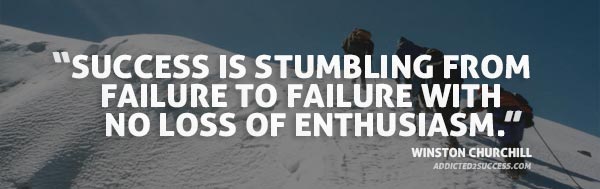
3. Your failures are signs you are improving
When you find that you are making mistakes doing the right thing, do not become disheartened, it could mean you are on the right track. Be encouraged and motivated knowing that your mistakes are helping you to become better at what you are doing. You will also become stronger and more knowledgeable. Work hard to make sure your mistakes are better every time.
4. Your failure means you are very courageous
It takes courage to make an attempt at something you have no idea will work or not. You are investing your time, energy and money into something you have no idea what the results will be. Even though you might have failed, the fact that you gave it everything you’ve got says a lot about who you are as a person. Being courageous doesn’t mean you won’t be afraid, it only means even though you are scared to death you are courageous enough to make an attempt.
5. Your failures make you much stronger
After you have failed a few times, you would have become so much more resilient. When you have failed it is normal to be discouraged, frustrated and even angry but if you choose to get over your disappointment and anger, you will realize how much stronger you are. You will also be more determined to succeed and to prove to yourself and others that you can indeed succeed.
“Winners are not afraid of losing. But losers are. Failure is part of the process of success. People who avoid failure also avoid success.” – Robert T. Kiyosaki
6. Your failures help you to grow
When you have failed and have gotten over your disappointment, you are much more likely to dig deeper within you for strength you didn’t even know you had. You will realize what you are truly made of and how resilient you are. To become stronger and to grow you have to be stretched, and failure will help you to find within you the strength to continue. Failure helps you move away from what is comfortable.
Many of us understand that sometimes things happen for a reason, and even though when we have failed the reasons aren’t necessarily clear at the time we know it does. People who are open, will understand that their failure offers several other opportunities for them. The saying when one door closes many more open is so true. You must be willing to see the opportunities and go after them. Failure is just one door closing with many more opening because of it. Failure is never the end of your dream but the beginning of something bigger and better.
7. Your failures provide an opportunity for you to learn new things
Look at some of the most important people in history and see how they view failure. Thomas Edison said he didn’t fail he only found thousands of ways to solve the problem. He was saying he was learning several other ways to solve the same problem. This is the mentality you should develop. Failure is not the end but an opportunity to learn something new and to try another method to solve the problem.
8. Your failure provides you with other solutions you never saw coming
If you never try you will never know if your ideas will work or not. If you do not try, you will never know that you would have failed either, but it is better to have failed than to have regrets that you didn’t at least try. Sometimes you are attempting to achieve something but the result is something totally different but even greater. Sometimes your failures turn out to be your best success story.
You will fail and continue to fail as long as you are prepared to attempt something foreign to you but do not give up. Use your failures as stepping stone to your goals as the normal course of life and they should never be seen as a misfortune.
Use your failures as opportunities for further growth.
When you have hit a bad patch dig deeper, and you will eventually succeed if you do not give up.















Most men I know are not lazy.
They are tired of paying full price.
That is why “easy” still works on people who should know better. Easy money. Easy scale. Easy morning routine. Easy relationship with God. The pitch is always the same: you can have the outcome without the weight.
If you have built anything real, you already know that sentence is a lie. You still lean toward it. I do too. Hard has a cost you can feel today. Easy hides the invoice until later.
We did not used to talk like this
“Trigger words” were not part of the air when a lot of us were coming up. Then the culture found the phrase and applied it to everything. Almost nothing actually triggers me.
One word does.
Easy.
The second someone needs that word to sell you a path, you are being offered a smaller life. Not a better one. A quieter one. Less friction. Less becoming.
Founders hear it in business. Believers hear it in faith. Same bait, different packaging.
Faith gets sold as the spiritual shortcut
A lot of men do not come to God because they are wrestling with the meaning of the universe. They come because life is heavy and they want someone to take the edge off.
Then it stays heavy.
That is when the disappointment starts. If I am going to let God have a say, He should at least make this smoother. If it stays hard either way, I might as well stay in charge. At least then the pain is mine.
That deal sounds rational. It is how you stay unchanged.
A relationship with God is not something you earn. You receive it. That part is not a grind. What comes after is. Love when you would rather win. Tell the truth when a cleaner story would protect you. Stay when leaving would be simpler. Forgive when your memory still has evidence.
None of that is an easy button. If you walked into faith looking for one, you were going to tap out the first time the pressure did not drop.
Easy is not rest. It is drift.
There is a default setting in a man. Do nothing unusual and you do not stay neutral. You slide.
You already know this in your body. One “off” day becomes a week. You know it in your work. Stop making the hard calls and the company gets sloppy in places customers cannot see yet. You know it in your home. Presence takes effort. Checking out is available all day.
People call that a cheat day. Funny definition. The cheat is the day you stop doing what makes you better. Why isn’t the cheat the day you do the thing you did not feel like doing?
Watch the pattern and it gets embarrassing. What we want sits in the easy pile. What we say we want sits in the hard pile. Then we act shocked when our results match the first list.
The easy version of you is expensive
There are two versions of a man, and they are not equally priced.
The easy you is what forms when you stop choosing. It feels like oxygen. Later it feels like regret. Emptiness. That low-grade sense you are living next to your own life instead of in it. Soft decisions build a hard life.
The other version has to pick something. Not a heroic speech. A hard thing while nobody is clapping. The easy you only needs you to delay. That is why it wins so often.
This is why unused potential is so common in high performers. Capacity is not the issue. Road is the issue. You can have power sitting in you and still crawl, because you keep choosing the route with no demand on it.
Do hard things you already like and you get fitter at the game you already chose. Do the thing you resist — the apology, the restraint, the extra mile, the conversation you have rewritten ten times — and something in you actually expands. Avoid that long enough and you do not just lose a habit. You get smaller inside the life you already built.
Erwin McManus shares a great talk about Doing Hard Things that you should check out:
Doing the right thing will not make this week easier
That part gets skipped.
People do the right thing for a stretch and wait for the atmosphere to change. The deal did not close. The relationship did not soften. The money did not move. So they conclude integrity does not work.
Integrity was never a vending machine.
Sometimes the honest path is the slower path. Sometimes leading well is not taking a team to a clean win. It is teaching them how to stand up inside a disappointment without becoming bitter. Smooth weeks do not always grow you. The week that breaks the plan often does.
Revenge is easy. So is contempt. So is the speech you want to give. Love, patience, and keeping your word when you are tired are not. They do not get cheaper with practice either. You do not forgive once and then get a discount the next time someone fails you. You choose it again at full price.
Refuse the word
If I could hand you one filter, it would be this.
When a person, a product, or a preacher needs “easy” to get you in the door, leave.
Building is not easy.
Staying a man of your word is not easy.
Becoming the person you keep talking about is not easy.
The good news is not that God came to flatten the road. The good news is you were never supposed to become someone on the flat road.
Receive what you cannot earn. Then stop hunting for a life with no weight. The version of you that can hold a family, a company, and a clean conscience is not waiting on easier circumstances.
He is waiting on a harder yes.

Most people are not living up to what they’re actually capable of. Not even close.
This isn’t a motivation problem. It’s a design problem. Your brain’s main job is to keep you alive, not to help you build something meaningful. It constantly looks for the path of least resistance, the safest option, the version of the day that burns the least energy. Researchers call this the Central Governor. You feel it every time you hesitate before a hard conversation, delay a decision, or lower the standard because “it’s fine for now.”
Comfort is the enemy of potential. If you want to perform at a high level for a long time, you have to deliberately work against your own biology. Here’s how the people who actually do it operate.
1. Action Comes First. Belief Follows.
Most people try to think their way into a better life. They wait to feel ready. They wait for confidence. They wait for the right mindset.
John Dewey saw through this years ago: “We don’t think our way into a pattern of living. We live our way into a pattern of thought.”
You become the person by doing the things that person does. Not by journaling about it first.
Want to write a book? Sit down and write badly. Keep writing until the quality improves. Want to build something that matters? Make the uncomfortable call. Ship the imperfect version. Have the conversation you’ve been avoiding. The action itself rewires the brain. Waiting for belief is just another form of delay.
Identify the one comfortable habit that is quietly limiting you and remove it.
2. Mastery Lasts. Ego Burns Out.
Look at people who stay excellent for decades and you’ll notice two different reasons they do the work.
Some are driven by ego. They want the money, the status, the recognition, the proof that they matter. This fuel works for a while. Then the friction gets high, the applause slows down, or the results stop matching the effort. Burnout follows. Almost every time.
Others are oriented toward mastery. They do the work because the work itself is the point. The daily practice, the quiet progress, the craft. These people protect the purity of what they do. They fall in love with the boring parts. That love becomes a serious competitive advantage.
The question worth answering is simple: Why are you really doing this?
3. Flow Requires You to Stay Present
Peak performance almost always happens in a state of deep focus. Time disappears. Difficulty becomes secondary. You’re so absorbed in the work that outcomes and other people’s opinions fade into the background.
The problem is that your brain is constantly scanning the future for threats. It generates “what if” scenarios designed to keep you safe. In modern life those same mental patterns mostly create anxiety and scatter your attention.
You have to train the ability to stay with the task in front of you. When the mind starts projecting catastrophe or drifting toward distraction, notice it and return. Clear the mental noise. Create enough psychological space to actually get lost in the work. Flow is not a mystical state. It is the result of sustained, deliberate presence.
4. Shrink the Gap
Confidence is not a personality trait. It is evidence. It comes from a track record of doing hard things and surviving them.
Because failure hurts more than success feels good, most people overweight their past mistakes. Those mistakes become an anchor.
When you’re in a difficult stretch, stop measuring yourself against the final destination. Shrink the gap. Lost a major client? Don’t try to replace the entire revenue in one move. Figure out how to generate the next $100. Then the next. Small, visible wins rebuild the evidence that you can handle what’s in front of you. That evidence changes how you see risk. Threat-based thinking starts to give way to opportunity-based thinking.
Stack the wins. The confidence follows.
5. Stop Running on Old Wounds
A surprising number of high-achieving people are still trying to outrun something from childhood. They were made to feel small, overlooked, or not enough. So they decided they would build something large enough that no one could ever make them feel that way again.
That fuel can produce extraordinary drive for years. It is also unstable. External success never fully satisfies a wound that was never addressed. You keep chasing. The goalposts move. Eventually the same intensity that built the thing starts to damage the relationships and the person who built it.
Real success is not the biggest number or the most impressive title. It is knowing what actually makes you come alive—deep work, physical training, building something useful, raising strong children, creating work that matters—and removing the need to prove yourself to people who will never be satisfied anyway.
Look at what is driving you right now.
Is it mastery, or is it still an old wound trying to protect itself?
Here’s a video I filmed for you to teach you how to get unstuck:

You wake up with massive goals. You have a project to finish, a presentation to prep, and high-priority work that needs your absolute best energy. But before you can touch any of it, your morning gets hijacked by logistics.
Picking out clothes, figuring out what to eat for breakfast, checking emails, and answering texts—these activities silently transform your morning from a work block into a coordination block. And according to peak performance experts, this is the biggest disaster imaginable for your productivity.
Rian Doris, founder and CEO of Flow Research Collective—who has trained teams at Audi, Accenture, and the US Air Force—argues that those first few hours of the day are capable of producing more output than the rest of your day combined. But only if you know how to leverage your biology.
Here is the neuroscience behind why your current morning routine is killing your productivity, and the radical protocol you need to adopt instead.
The Neuroscience of the First 90 Seconds
Flow state is that elusive zone of total absorption. It is the state where your inner critic goes quiet, hours feel like minutes, and you produce your most creative, high-leverage work.
The absolute best time to drop into a flow state is 60 to 90 seconds after you wake up. There are two neurological reasons for this:
- Your Cognitive Load is at Absolute Zero
Cognitive load refers to the amount of information you are holding in your working memory. Think of it like your computer’s RAM. To access a flow state, you need maximum RAM available. When you first wake up, your cognitive load is naturally empty. You haven’t had any conversations, checked any emails, or learned about any new problems.
- You Are in the “Hypnopompic Window”
When you sleep, your brain waves oscillate between deep delta and theta states. Research suggests that the brain waves of a flow state hover right on the borderline between alpha and theta—which is incredibly close to the brain waves of sleep.
In sleep research, the first 1 to 5 minutes upon waking is called the hypnopompic window. During this tiny window, your brain waves are perfectly primed for flow, and your “flow proneness” (your ability to access and sustain the zone) is at its absolute peak.
The Coordination Trap
So, what destroys this sacred biological window? Coordination.
The moment you start wondering what to make for breakfast, doing quick admin tasks, or checking Slack, you instantly spike your cognitive load. Worse, these logistical decisions drive your brain waves into a high-frequency beta state, pulling you further and further away from flow.
You wake up perfectly primed for genius-level deep work, and you ruin it by deciding what color shirt to wear.
| The Coordination Block (Average) | The Flow Block (Elite) |
| Action: Checking emails, planning breakfast, coordinating kids. | Action: Sliding instantly into a pre-planned, high-leverage task. |
| Brain Waves: Forced quickly into stressful Beta waves. | Brain Waves: Seamless transition from Theta sleep to Alpha/Theta flow. |
| Cognitive Load: High (RAM is maxed out immediately). | Cognitive Load: Low (100% of RAM dedicated to deep work). |
| Result: Distracted, reactive, playing catch-up all day. | Result: 3 hours of output that beats a normal 12-hour workday. |
The “Wake Up and Flow” Protocol
If you want to get three times more done in your first three hours than you currently do in a 12-hour day, you have to adopt the “Wake Up and Flow” protocol. Here is how to redesign your life for it.
Step 1: Ruthlessly Eliminate Morning Coordination
This might take you 6, 12, or even 18 months to achieve, but it requires a radical redesign of your life. Negotiate with your spouse to handle the morning school run while you do the afternoon pickups. Tell your team you will not be available online or in the office until 11:00 AM. Do whatever it takes to recapture your morning and turn it back into a pure work block.
Step 2: Prep the Night Before
“Wake up and flow” does not mean waking up and figuring out what to do. You must identify your most sacred, high-priority work the night before. Set everything up so that when you wake up, your laptop is open, the specific document is loaded, and your water bottle is full. The goal is to slide directly into the task within 60 seconds of opening your eyes, without breaking the hypnopompic window.
Step 3: Move Your “Morning Routine” to Later
Delay the standard morning routine. Do not meditate, exercise, or shower first thing. Drop straight into your flow block for two to four hours. Then, use your meditation, workout, and shower as a tool to reset your brain and boost your flow proneness back up for the second half of the day.
Save all coordination—email checking, admin, logistics, and trivial decision-making—for the late afternoon. Those tasks do not benefit from flow, so they should never be allowed to steal your most valuable cognitive window.
Protect the first 90 seconds of your day, and it will completely change your life
Checkout this great video by Rian Doris on how to tap into your flow state


Exam season has a way of revealing something most students only realize when it’s already too late: motivation is unreliable when you actually need it. At the start of a semester, everything feels under control. There’s energy, clear intentions, and the belief that this time will be different. Studying feels manageable because there’s no pressure yet, and it’s easy to imagine staying consistent.
But as exams approach, that changes. Stress builds, time feels tighter, and the motivation that once felt natural starts to fade. Students begin relying on willpower, then guilt, and eventually last-minute panic just to get through everything. The pattern is familiar, yet it keeps repeating.
The problem isn’t that students are lazy or incapable. It’s that most people try to build consistency on something that was never meant to last. Motivation is emotional, and exam season is stressful by nature. Those two rarely coexist for long.
That’s why high-performing students don’t depend on motivation. They rely on structure instead.
The illusion of “I’ll study when I feel like it”
Most students fall into the same trap without even realizing it. They tell themselves they’ll start when they feel ready, or when they’re in the right mood, or when they’re a bit more focused later in the day. It sounds reasonable in the moment because waiting for the “right mindset” feels natural.
The problem is that this thinking slowly breaks consistency. You wait for motivation, it doesn’t show up, so you delay studying. Pressure builds, then you cram at the last minute, feel guilty afterward, and promise to do better next time. Then the cycle repeats.
What makes this so difficult to notice is that it still feels like effort is happening. You’re thinking about studying, planning it, and stressing about not doing it. But none of that translates into actual progress. When studying depends on how you feel, it will always be inconsistent because emotions are not stable under pressure.
High performers approach this differently. They remove emotion from the decision entirely. Instead of asking whether they feel like studying, they decide in advance when studying will happen and treat it as non-negotiable. That shift alone changes the entire dynamic.
Systems always outperform willpower
There’s a point most students only understand after struggling for a while: you don’t rise to the level of your motivation, you fall to the level of your systems.
A system is anything that makes the right behavior easier to repeat than the wrong one. It reduces friction, removes unnecessary decisions, and eliminates the need to rely on willpower throughout the day.
For example, studying for a set block of time with a clear plan will always outperform waiting for motivation and then rushing through material under stress. Consistency isn’t a personality trait; it’s the result of design.
When systems are in place, performance becomes predictable instead of emotional. You stop depending on how you feel in the moment and start relying on a structure that carries you through.
This idea also shows up outside academics. In real life, people often struggle with long-term decisions because everything feels overwhelming when there’s no structure behind it. For instance, when managing education-related debt, people often look into options like private student loan consolidation as a way to simplify repayment and create more clarity around their financial situation. The goal isn’t just financial relief but reducing decision complexity so it becomes easier to stay consistent over time. The same principle applies everywhere: structure reduces pressure, while emotion increases confusion.
Why motivation breaks under pressure
Motivation works well when life is light and flexible, but it tends to collapse under pressure. During exam season, the mind is already dealing with overload. Multiple deadlines and responsibilities make it harder to think clearly, and everything starts to feel heavier than it actually is.
On top of that, pressure creates emotional resistance. The more important something becomes, the more overwhelming it feels, and the more likely you are to avoid it. It’s not a lack of care; it’s a natural response to stress.
Then there’s decision fatigue. Even small choices like what to study or where to start slowly drain mental energy. By the time students finally sit down to work, they’re already mentally exhausted from deciding how to begin.
This combination is why even motivated students struggle. The issue isn’t effort, it’s the absence of a system that removes these mental barriers.
What actually works instead
Students who perform consistently don’t wait for motivation to show up. They build routines that function regardless of how they feel.
One of the simplest changes is setting fixed study times. Instead of deciding every day when to start, the time is already defined. When that time arrives, studying begins automatically. There’s no negotiation and no delay because the decision has already been made.
For a subject that builds in a strict sequence, like algebra, this works even better with outside structure. A weekly Algebra 2 help online session is a block that happens whether or not you feel like reviewing functions or logarithms that day, and it keeps you moving forward instead of catching up the week before the test.
Another important shift is lowering the pressure for every session to be perfect. On days when energy is low, the goal isn’t to push harder; it’s to stay consistent. Even a short focused session is enough to maintain the habit. What matters more than intensity is continuity.
Environment also plays a bigger role than most students realize. When distractions are everywhere, every study session becomes a battle. But when the environment is structured in advance, same place, fewer distractions, everything ready, starting becomes significantly easier.
Planning ahead removes another major obstacle. When students decide what they’ll study before sitting down, they eliminate the hesitation that often leads to procrastination. The work becomes execution instead of decision-making.
The identity shift that changes everything
At a deeper level, consistency stops being about habits and becomes about identity. Struggling students often think they need to try harder, but high performers think differently. For them, studying isn’t something they negotiate with every day; it’s simply part of who they are.
That shift changes behavior in a powerful way. When something becomes part of your identity, you stop debating whether to do it. It becomes automatic.
And once that happens, motivation is no longer necessary.
Final thoughts
Motivation feels important, but it was never designed to handle pressure. During exam season, it rises and falls constantly, which makes performance unpredictable if you depend on it.
Systems don’t behave that way. They don’t depend on mood or energy. They simply run in the background and keep you consistent even when things get difficult.
The students who perform best aren’t the ones who feel the most motivated. They’re the ones who no longer rely on it.
Because in the end, success in exams isn’t about studying when you feel ready. It’s about making sure it happens even when you don’t.

How to Get Your Startup Noticed Without a Big Ad Budget

How Seasonal Trends Affect the Fall Real Estate Market

Stop Acting Like a Creator: How to Get Real Clients on Social Media

A Guide to Inheritance Tax Thresholds and How They Affect Your Estate as an Entrepreneur

Enclomiphene and Sex Drive: What Men Should Understand about the Connection
5 Ways For Startups To Succeed Making Acquisitions

77 Inspirational Quotes That Will Change Your Life
57 Memorable Kobe Bryant Quotes

(Images) 52 Motivational Picture Quotes For An Epic Year Of Success

40 Rare Motivational and Inspirational Picture Quotes
3 Prince EA Videos To Change Humanities Path To Greatness
(Video) What Is Success? An Entrepreneurial Story To Inspire You
(Inspirational Video) What If Today You Knew You Were Going To Take Your Last Breath?
How To Make Enough Money From A Blog To Quit Your Job – Kate McKibbin
How Finding Your Passion And Becoming An Entrepreneur Can Lead To Happiness – Chiquita Searle
-

 Life2 years ago
The 5 Stages of a Quarter-Life Crisis & What You Can Do
-

 Did You Know1 year ago
7 Surprising Life Lessons Video Games Taught Me That School Never Did
-

 Success Advice1 year ago
Stephen Covey’s 8 Leadership Habits That Will Change How You Lead Forever
-

 Life1 year ago
How to Stop the War in Your Head and Find Peace
-

 Featured2 years ago
The Psychology of Motivation: How to Keep Moving Forward Every Day
-

 Personal Development1 year ago
The Three-Second Pause That Changes How People Perceive You
-

 Explode Your Social Media1 year ago
Want More Views? Master These 6 YouTube Growth Tactics
-

 Change Your Mindset1 year ago
You Become What You Absorb: How Input Shapes Your Life
22 Comments