
Lifestyle
How to Find a Genuine Artisan Jewelry Brand for Your Engagement Ring


Anyone can print “handcrafted” on a product page. Far fewer brands can actually back it up. If you’re trying to find a genuine independent jewelry maker instead of a mass-market label wearing a handmade tag, the difference shows up in details most shoppers never think to check.
This guide breaks down what separates a genuine artisan jewelry brand from a marketing claim, why that distinction matters most when you’re buying an engagement ring, and exactly what to look for before you spend real money on something you’ll wear every day for decades.
What Makes a Brand Genuinely Artisan
An artisan jewelry brand is one where a person, not a machine, makes the meaningful decisions in a piece’s construction, shaping the metal, setting the stone by hand, and finishing each ring individually rather than pulling identical castings off an assembly line.
The term gets misused constantly. A brand can hand-set a stone into a factory-cast band and still call the result “handmade,” which is technically true but misleading. A genuine artisan jewelry brand controls more of the process by designing the piece, often casting it in-house, and finishing it by hand rather than outsourcing the build and adding a final polish.
Why This Distinction Matters for Engagement Rings
An engagement ring isn’t a casual purchase. It’s worn daily for decades, and it needs to hold up. Rings from an independent, hands-on studio tend to be built with that in mind – heavier metal where it matters, settings shaped by someone who has actually watched prongs wear down over time, not just a CAD file optimized for casting speed.
There’s also the matter of story. Handmade engagement rings carry a traceable origin: a specific studio, a specific maker, sometimes a specific batch of recycled gold. That traceability is increasingly what buyers care about, alongside price and design.
Key Benefits of Buying From a Handmade Jewelry Studio
- One-of-a-kind character. Hand-finished pieces carry small variations mass production can’t replicate – part of the appeal, not a flaw.
- Better material transparency. Smaller studios usually know exactly where their metal and stones came from, since they source directly rather than through several supplier layers.
- Repair and resize support. A brand that makes rings in-house can resize or repair them faster and more accurately than one that never touched the original casting.
- Design flexibility. Custom tweaks – a different stone shape, a wider band – are easier when a human is making the decisions.
- Slower, more considered production. Handmade engagement rings go through more manual quality checks simply because each piece gets individual attention.
Important Factors to Consider Before You Buy
Where the work actually happens. Ask directly whether rings are made in-house or by a third-party factory that the brand then relabels as its own. A transparent studio will answer this without hesitation.
Metal sourcing. Recycled gold and silver from certified refiners is now common among smaller studios and worth asking about specifically, not just assuming.
Stone origin and ethics. Conflict-free diamond sourcing and traceable colored gemstones are standard questions to ask any brand claiming artisan credentials.
Turnaround time. Genuinely handmade pieces take longer to produce than factory rings. If a site promises next-day shipping on a fully custom design, something in that claim doesn’t add up.
Resizing and warranty policy. A confident maker stands behind its work with clear resize and repair terms, since they know their own construction well enough to service it.
Best Practices When Shopping for Handmade Engagement Rings
Start with the “about” page and studio photos, not just product listings – real workshops look different from stock photography. Ask for in-progress photos if the brand offers made-to-order pieces. Compare price against material cost; if a “handmade” 14K gold ring costs less than the gold alone, the labor claim doesn’t hold up.
Common Mistakes to Avoid
Don’t assume “handcrafted” and “handmade” always mean built from scratch – read the language carefully. Don’t skip questions about metal purity and stone certification just because a brand’s branding feels artisanal. Don’t confuse a large customization catalog with real handmade production; some brands offer hundreds of “custom” combinations built from the same factory-cast components.
Expert Insight
Jewelers who run small studios will tell you the same thing: the biggest tell isn’t the marketing copy, it’s the maker’s willingness to talk specifics. Ask which bench jeweler will work on your ring, how long the casting-to-finishing process takes, and where the metal came from. A brand with nothing to hide answers quickly. One that stalls is usually reselling factory stock.
Real World Examples
The strongest signals come from brands that show their process openly – behind-the-scenes studio content, named goldsmiths, clear statements about recycled metal sourcing. Brands built around a single founder-designer, rather than a faceless catalog, tend to deliver more genuinely handmade engagement rings, since the person whose name is on the label has direct oversight of quality.
Industry Trends Worth Knowing
Recycled precious metal sourcing is close to standard practice among smaller studios now, driven by cost and buyer demand for lower-impact materials. Alternative center stones – moissanite, lab-grown diamonds, colored gemstones like black onyx or sapphire – are also growing fast in the handmade space, since small studios can experiment with unconventional stones more freely than manufacturers locked into standardized product lines.
Buying Guide: Step-by-Step
- Shortlist two or three brands that explicitly describe in-house production.
- Ask each one directly about metal sourcing, stone certification, and where the piece is physically made.
- Compare turnaround times – genuine handmade engagement rings rarely ship in 24 hours.
- Check resize and repair policies before ordering.
- Request in-progress photos if you’re commissioning a custom piece.
- Confirm return and warranty terms in writing before paying.
FAQs
What’s the difference between handmade and handcrafted jewelry?
The terms are often used interchangeably, but “handmade” usually implies the piece was built from raw material by hand, while “handcrafted” can mean a factory-cast piece was finished or assembled by hand. Always ask a brand to clarify which applies to their process.
Are handmade engagement rings more expensive than mass-produced ones?
Often, yes, because labor time is higher and production runs are smaller. The difference isn’t always dramatic, though, especially with studios that keep overhead low.
How do I verify a jewelry brand is actually artisan-made?
Ask specific questions about who makes the piece, where, and how long it takes. Studio photos, named jewelers, and clear sourcing information are good signs; vague answers are not.
Do handmade jewelry studios use real diamonds and gold?
Most do, alongside lab-grown diamonds and moissanite as increasingly common alternatives. Ask about certification for any stone above a modest size.
Can I get a custom design from a small studio?
Yes, this is one of the main advantages of buying from a smaller maker rather than a large retailer, since a human designer can adjust the piece directly.
Final Verdict
Choosing an artisan jewelry brand comes down to how much you value traceability, craftsmanship, and the ability to actually reach the person who made your ring. For something worn every day for the rest of your life, that’s worth the extra questions before you buy. Ask directly about sourcing and process, compare turnaround times honestly, and you’ll end up with handmade engagement rings that hold up to both daily wear and closer scrutiny.











Business
Desk Job Survival: Why Your Office Chair Is Quietly Wrecking Your Posture (and How to Fix It)

Picture this. It’s 3pm, you’ve been at your desk since morning, and you suddenly realise you’re kind of folded over your keyboard like a wilting houseplant. Sound familiar?
Most people who work at a desk don’t think much about how they sit. Why would they? A chair is a chair. You plonk yourself down, you get to work, and you don’t give it a second thought until your lower back starts complaining somewhere around Thursday afternoon.
But here’s the thing. That chair might be doing more damage than a decade of skipped gym sessions.
The Slow Creep of Bad Posture
Bad posture doesn’t happen all at once. It sneaks up on you.
One day you’re sitting tall and confident. Fast forward a few months of hunching toward a screen, and your shoulders have crept forward, your neck’s poking out like a curious turtle, and your spine has taken on a shape it was never meant to hold.
The tricky part is that your body adapts. Muscles get used to being short and tight. Others get weak from doing nothing. And before long, sitting badly actually feels more comfortable than sitting well, which is kind of a cruel joke when you think about it.
Ever noticed how you can’t seem to sit up straight for more than a few minutes without it feeling like hard work? That’s not laziness. That’s your body telling you it’s been trained into a shape it doesn’t love.
Your Chair Is Probably Part of the Problem
Look, a lot of office chairs just aren’t built for real bodies doing real work.
The cheap ones with no lumbar support? They practically encourage slouching. The seat’s too deep, so you either perch on the edge or slide back and let your lower back curve the wrong way. The armrests are either missing or set at some random height that makes your shoulders hunch up toward your ears.
And don’t get started on chairs that don’t adjust. Everyone’s built differently. A chair that suits a six foot four bloke is going to be all wrong for someone shorter, and vice versa. When the chair can’t move to fit you, you end up contorting to fit it. That’s backwards.
The truth is, your body spends roughly eight hours a day in this thing. Maybe more. If it’s not supporting you properly, those hours add up fast.
What Good Support Actually Looks Like
So what makes a chair genuinely good for your posture?
A few things matter more than the rest. You want proper lumbar support that fills the natural curve of your lower back. You want a seat you can raise or lower so your feet sit flat and your knees land at roughly a right angle. And you want a backrest that moves with you when you lean, rather than one that keeps you frozen upright like you’re at a job interview all day.
Armrests help too, when they’re set right. They take the load off your shoulders and neck, which is exactly where most desk workers carry their tension.
The other day someone mentioned they’d swapped their old chair for a properly adjustable one and the difference in their afternoon energy was almost weird. Less fidgeting. Fewer headaches. Turns out sitting well frees up a surprising amount of brainpower you didn’t know you were spending on discomfort.
If you’re in the market for something that won’t quietly punish your spine, decent office chairs are worth every dollar. Think of it less as furniture and more as a piece of gear you actually use all day.
Small Habits That Make a Big Difference
A good chair is half the battle. The rest is on you, and it’s simpler than you’d think.
Get up and move every half hour or so. Even a quick stretch or a lap to the kettle resets things, which is the same idea as getting the work done from the house without the day disappearing.
Keep your screen at eye level so you’re not craning down. And check in with yourself now and then. Are your shoulders creeping up? Are you slumping again? Just noticing is the first step.
Your posture didn’t fall apart overnight, and it won’t fix itself overnight either. But start with where you sit, add a few better habits, and give it a bit of time.
Future you, the one without the sore neck and grumpy lower back, will be pretty grateful you did.

There’s something about walking barefoot across a stretch of proper grass that fake stuff just can’t touch. You know the feeling. That slightly cool, springy softness underfoot on a warm afternoon. Artificial turf, for all its convenience, tends to feel a bit like walking on a doormat by comparison.
And yet, more and more people are ripping out their lawns and rolling out plastic. The pitch sounds tempting. No mowing, no watering, no fuss. But here’s the thing, real turf brings a whole lot to the table that the synthetic version simply can’t replicate, no matter how clever the marketing gets.
The Feel Test Nobody Talks About
Picture this: it’s the middle of summer, and someone lets the kids loose in the backyard. On real grass, that’s a pretty comfortable setup. On artificial turf? That stuff can get properly hot. Like, “ouch, my feet” hot. Plastic absorbs heat and holds onto it, which is why a synthetic lawn on a scorcher can feel closer to a frying pan than a play area.
Real grass does the opposite. It actually cools the air around it. Ever noticed how much fresher a garden feels on a hot day compared to a paved courtyard? That’s not your imagination. Living grass releases moisture and knocks the temperature down naturally.
It’s Actually Doing Something for the Planet
Here’s a bit most people don’t think about. A healthy lawn works away quietly in the background, pulling carbon dioxide out of the air and releasing oxygen. It filters rainwater before it soaks into the ground. It gives insects, worms and all sorts of tiny creatures a place to live.
Artificial turf does none of that. It sits there. And when it eventually wears out, usually after a decade or so, it heads straight to landfill because it can’t be recycled easily. Not exactly the eco-friendly choice some folks assume it to be.
The truth is, a well-kept patch of real grass is a small ecosystem doing real work. That’s worth something.
Yes, There’s Effort. Let’s Be Honest About It.
Nobody’s going to pretend real turf looks after itself. It needs mowing. It needs a drink now and then. Every so often it wants a bit of feeding. This part’s a bit of a commitment, no getting around it.
But the effort tends to get exaggerated. A lot of the hard work happens at the start, when you’re choosing the right variety for your climate and soil. Get that bit right and the ongoing care becomes almost second nature. Some grass types are surprisingly tough and need very little water once they’ve settled in.
That’s where doing your homework pays off. Different varieties suit different conditions, and picking the wrong one is how people end up frustrated. If you want a proper look at what actually works where you live, the folks at All Year Round Turf have a solid rundown of options worth checking out before you commit to anything.
The Long Game
Artificial turf usually costs more upfront than most people expect. Then there’s the replacement cost down the line. Real turf, once established, keeps going year after year with just a bit of regular attention.
And it kind of improves with age, oddly enough. A lawn that’s been cared for develops this thick, healthy quality that new turf takes time to reach. It becomes part of the place. Somewhere the dog naps, the kids build forts, and you flop down on a Sunday afternoon with zero regard for grass stains.
Can you say that about plastic? Not really.
So, Is It Worth It?
Look, if someone genuinely can’t spare ten minutes a week for a bit of garden care, artificial turf might tick their box. Fair enough. But for most people, the trade-off leans heavily toward the real thing.
The smell of fresh-cut grass. The cool patch under a tree in summer. The way a proper lawn just feels alive. These aren’t things you can fake, however hard the synthetic stuff tries.
A little effort goes a long way here. And the payoff, honestly, is one of those simple pleasures that’s easy to forget until you’re lying on it, looking up at the sky, thinking yeah, this was the right call.

Yoga studios manage teaching, client care, memberships, payments, staffing, and daily administration. Each responsibility affects the next. A timetable change can alter room capacity, instructor coverage, income, and member communication within minutes. Dedicated class management tools bring these tasks into one coordinated system. Clear records help owners protect service quality, support instructors, reduce avoidable errors, and create more time for meaningful relationships with members.
One Central Booking Hub
A dedicated yoga class software platform connects schedules, registrations, payments, attendance, and client profiles in one location. Members can check class times, reserve places, join waitlists, and manage cancellations without calling reception. Staff see updates immediately, reducing duplicate entry and preventing conflicting records. Instructors also receive dependable rosters before sessions begin, helping each class start with accurate information.
Fewer Scheduling Errors
Timetables change because of instructor absences, public holidays, workshops, room limits, or seasonal demand. Manual edits can leave different versions across websites, social channels, and front-desk notes. A shared calendar lets staff update one schedule and promptly notify affected members. Capacity controls limit overselling, while room details help teachers prepare equipment and spacing before participants arrive.
Better Member Access
Members often book outside reception hours, particularly before work or late in the evening. Online registration gives them immediate access through a phone or computer. Waitlists can fill spaces after cancellations without repeated staff calls. Confirmation messages, reminders, and cancellation notices also set clear expectations. That consistency supports attendance habits and reduces preventable gaps in busy classes.
Stronger Staff Coordination
Instructors need current rosters, attendance information, and schedule notices before entering the studio. Staff profiles can record qualifications, availability, assigned sessions, and access permissions. Managers can share relevant details without unnecessarily exposing financial or administrative data. A clear allocation of duties also helps cover absences, coordinate substitutions, and keep reception responsibilities visible throughout the day.
Clearer Financial Control
Studio income may come from memberships, class passes, single visits, workshops, private instruction, and retail sales. Separate payment records slow reconciliation and increase the risk of missed transactions. Connected payment functions link purchases with individual accounts. Owners can review balances, refunds, recurring charges, and sales activity without comparing several spreadsheets or handwritten notes.
Useful Performance Data
Accurate reporting helps owners make decisions based on attendance and revenue patterns rather than instinct alone. Useful measures include filled spaces, cancellations, membership activity, pass usage, income, and instructor hours. These figures can show which sessions maintain demand and which periods need adjustment.
More Personal Communication
Members need timely information about bookings, schedule changes, renewals, workshops, and studio policies. Email and text messages can deliver those notices without requiring staff to contact every person manually. Client histories give reception teams useful context during conversations. A record of preferences, attendance, and previous contact can support more considerate service without relying on memory.
Support for Workshops and Online Sessions
Many studios add teacher training, retreats, intensives, special events, or virtual instruction. Separate registration methods can create duplicate profiles, unclear payment records, and fragmented attendance lists. Event tools bring fees, capacity, rosters, and reminders into one process. Virtual class options also help instructors serve members who are traveling, recovering, or unable to attend in person.
Better Retention Practices
Members are more likely to continue when booking feels simple, and support remains consistent. Attendance records can flag reduced participation before someone cancels. Staff may then send a thoughtful check-in, suggest a suitable class, or explain a new membership option. Recognition also matters. Milestones, loyalty rewards, and personal follow-up can reinforce progress without making communication feel automated.
Room for Sustainable Growth
A studio’s administrative needs increase with additional teachers, larger schedules, new services, or a second location. Cloud-based management can support several timetables, shared reports, online payments, and role-based permissions. Connections with accounting, marketing, booking channels, and entry systems reduce repeated data entry. Owners can then spend more time on instruction, staff development, and member care.
Conclusion
Dedicated class management tools give yoga studios stronger control over bookings, staffing, payments, communication, and reporting. Members receive easier access, while instructors work from current schedules and attendance records. Owners gain reliable evidence for timetable changes, retention efforts, and new services. Better coordination can reduce administrative strain without weakening personal care. For a growing studio, that balance supports dependable operations and healthier long-term performance.

Usually, buying a new set of tires is not part of anyone’s monthly budget plan. Yet, tires wear down, blow out, or simply age past the point of safety. When this happens, most drivers face the same unwelcome reality: the expense of buying a set of four new tires. This is also how drivers typically choose between two paths. They either pay the full amount upfront, or they spread the cost through financing.
That choice raises a question worth thinking through before making a decision. Is it smarter to pay cash, or does financing actually make more sense? The simple answer is that there is no “one” right choice for every buyer. Paying cash means avoiding interest and walking away debt-free. However, tire financing can protect your savings and turn a high, sudden cost into something far more manageable.
What Is Tire Financing?
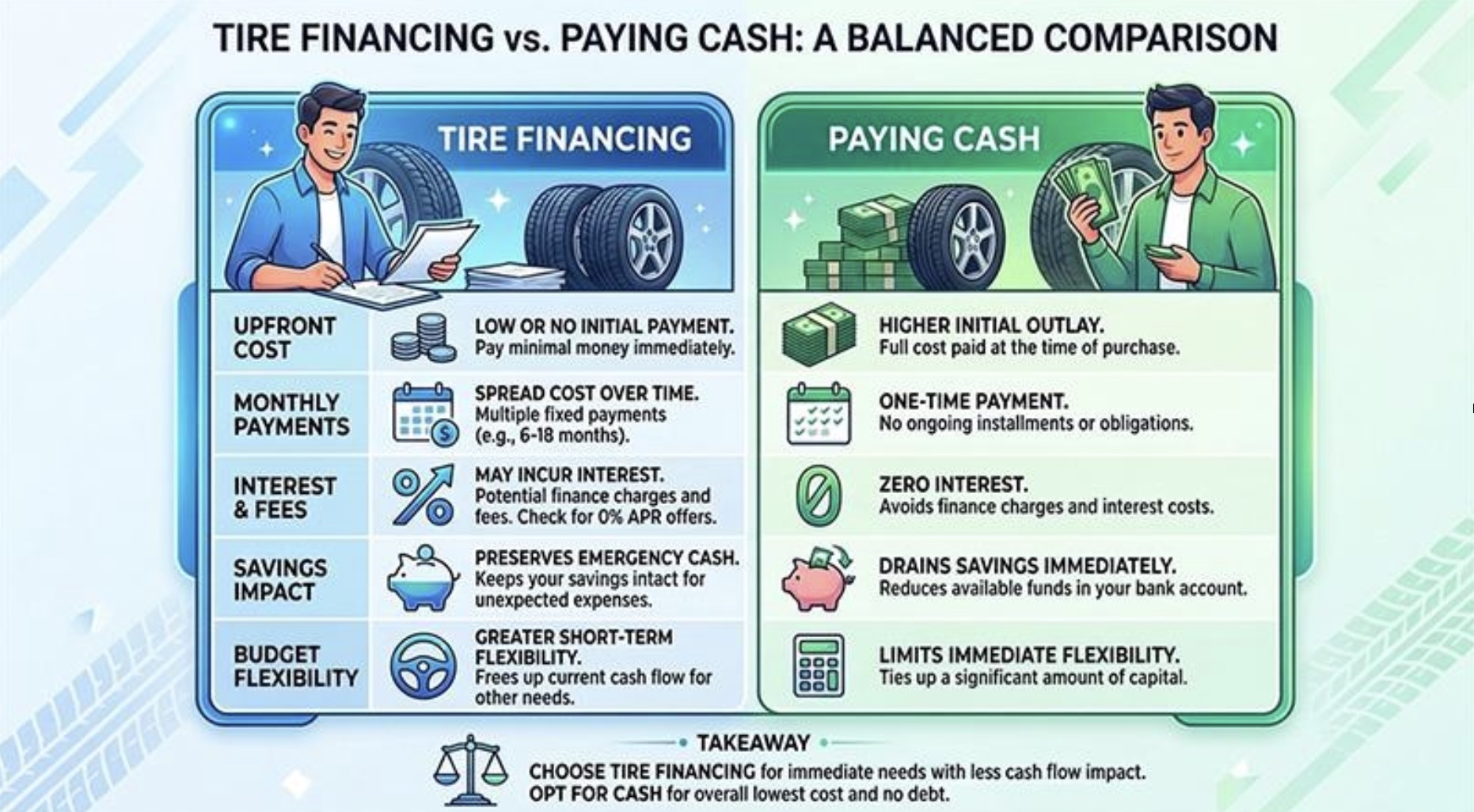
Tire financing works the same way as financing any other major purchase. Instead of paying the full price upfront, you split the cost into payments over an agreed period, often through the retailer directly or a third-party lender. The appeal here is clear: a smaller monthly payment feels easier to manage than one large sum. But the purchase price and the total amount you eventually repay aren’t always the same. Interest and fees can add up depending on the terms.
That’s exactly why you should read past the monthly figure and understanding the terms in front of you. The APR determines how much interest accrues over time, and some plans include origination fees, late penalties, or promotional terms, like zero-interest periods. Simply put, a low monthly payment can seem appealing at first, but it doesn’t tell the full story right away. What matters is the total repayment cost, not just what shows up each month.
The Benefits of Paying Cash for New Tires
For many buyers, paying cash feels more straightforward, and it comes with real advantages. Here is everything you need to know about your tire financing options:
You Can Avoid Interest
When you pay the full cash price, you completely eliminate financing charges. No APR works against you, and there’s no risk of the total creeping higher over time. The amount on the receipt is the amount you pay, and nothing more.
There Is No New Monthly Payment
Once the purchase is done, there’s no lingering balance. You are not adding another recurring line item to a household budget that may already be stretched across a mortgage, car payment, or other bills. For buyers who value simplicity and are able to pay the full amount, this can be worth considering.
You Know Exactly What You’re Spending
Paying cash keeps the cost immediate and transparent. There’s no repayment schedule to track, no fine print to revisit, and no chance of misjudging what you’ll owe later. That clarity can make it easier for some buyers to avoid taking on additional debt in the first place.
That said, paying cash isn’t automatically the more responsible choice for every buyer.
Draining savings to cover a tire purchase can leave less money available if a real emergency comes up, whether that’s a medical bill, a job loss, or another unexpected car repair. A cash purchase that empties your safety net can create more financial stress than it solves, even without a single dollar of interest attached.
The Benefits of Tire Financing
This is where financing tends to shine, especially for drivers who need new tires now but don’t want to disrupt their finances to get them.
You Can Preserve Your Savings
Tire financing lets you get the tires you need without dipping too much into your savings. That means that you’ll still have access to your savings in case of essential expenses that may come up without warning.
You Can Spread Out the Expense
Instead of paying the full cost in one transaction, financing lets you split the purchase into scheduled payments over time. This can make a necessary but sizable expense feel far more manageable, particularly for buyers who would otherwise need to rework their budget just to cover the cost in one shot.
You Can Replace Tires When You Need Them
Delaying the necessary replacement of damaged or old tires is a safety issue, not only a financial one. Waiting to replace them simply because you don’t have the full cash amount means driving longer than you should on tires that no longer perform the way they need to. Financing removes that pressure by letting you get new tires as soon as you need them.
Financing Can Provide More Budget Flexibility
For drivers with a steady income and some breathing room in their monthly budget, financing can turn a difficult, one-time expense into a manageable, predictable one. Instead of feeling the full impact of the purchase all at once, the cost is absorbed gradually, which can make it easier to simultaneously stay on top of other financial obligations.
The Downsides of Tire Financing
One big misconception is that financing does not have trade-offs, when in reality interest can raise the total cost beyond the original price. Not to mention that some plans add fees on top of that. Missing your payment will bring penalties and can hurt your credit, while promotional offers often come with conditions that work against you if the balance isn’t paid off on time.
For example: $600 in tires financed at a high APR over a year could mean repaying $650 or more once interest is factored in. That gap between sticker price and true cost is quite easy to miss when you only consider the monthly payments. Thus, before accepting a financing plan, you should know exactly how much you’ll have to pay in total, and not just how much shows up each month.
When Paying Cash Makes More Sense
If you have enough savings to cover the purchase without straining your emergency fund, then paying in cash makes a lot more sense. This is especially true if financing terms also come with a high interest or steep fees. Simply put, if you can absorb the cost comfortably, then paying upfront is often the simpler route. Just make sure not to empty your savings entirely to sidestep financing.
When Tire Financing May Be the Better Choice
Financing usually makes more sense when tires need to be replaced immediately and paying cash would dip significantly into your savings. If your income is reliable, the monthly payment fits comfortably into your budget, and the terms are reasonable, financing can turn a large expense into something manageable, as long as you understand the total amount you’ll repay is higher than the total amount you would’ve paid upfront.
How to Choose the Right Option for Your Budget
- Start with the full cost, including installation, not just the tire price itself.
- Figure out what your savings will look like if you choose to pay upfront.
- Look closely at the APR, any fees, and the full terms of the financing offer.
- Add up what you’d actually repay over the life of the plan, not just the monthly number.
- Check whether that monthly payment realistically fits your budget without strain.
- Go with whichever option covers what you need without putting your finances under unnecessary stress.
Conclusion
There’s no universal right answer between paying cash and financing. You should pay cash if you can comfortably afford the tires without touching your financial cushion, and if financing would only add unnecessary cost. Consider financing if paying the full amount upfront would strain your budget, and the terms available to you are manageable. Either way, the goal is the same: get the tires you need without creating financial stress you don’t need.

Strategic Career Moves: How Top Talent Stays Ahead in a Fast-Changing Market

Building an Enterprise Mobile App: What Separates the Ones People Keep From the Ones They Delete

The Hidden Vulnerabilities of Small Business IT (And How Managed Services Fix Them)

What to do when you are busy and nothing is moving

How AI and Tech Are Quietly Reshaping the Way Students Learn

5 Ways For Startups To Succeed Making Acquisitions

77 Inspirational Quotes That Will Change Your Life
57 Memorable Kobe Bryant Quotes

(Images) 52 Motivational Picture Quotes For An Epic Year Of Success

40 Rare Motivational and Inspirational Picture Quotes

3 Prince EA Videos To Change Humanities Path To Greatness

(Video) What Is Success? An Entrepreneurial Story To Inspire You

(Inspirational Video) What If Today You Knew You Were Going To Take Your Last Breath?

How To Make Enough Money From A Blog To Quit Your Job – Kate McKibbin

How Finding Your Passion And Becoming An Entrepreneur Can Lead To Happiness – Chiquita Searle
-

 Life2 years ago
The 5 Stages of a Quarter-Life Crisis & What You Can Do
-

 Did You Know1 year ago
7 Surprising Life Lessons Video Games Taught Me That School Never Did
-

 Success Advice1 year ago
Stephen Covey’s 8 Leadership Habits That Will Change How You Lead Forever
-

 Life1 year ago
How to Stop the War in Your Head and Find Peace
-

 Featured2 years ago
The Psychology of Motivation: How to Keep Moving Forward Every Day
-

 Personal Development1 year ago
The Three-Second Pause That Changes How People Perceive You
-

 Explode Your Social Media1 year ago
Want More Views? Master These 6 YouTube Growth Tactics
-

 Change Your Mindset1 year ago
You Become What You Absorb: How Input Shapes Your Life