
Success Advice
10 Reasons Why Mark Cuban Is Worth Billions of Dollars

Mark Cuban has successfully built and sold multiple businesses over the years. He is worth an estimated $2.5 billion after selling his business “Broadcast.com” for $5.9 billion in Yahoo stock and also is the owner of the Dallas Mavericks NBA Basketball team, Landmark Theatres and Magnolia Pictures.
Cuban is a self made billionaire and is a great example of how you can construct a successful business from the ground up.
Here are ten of the most important reasons why Mark Cuban is a super successful entrepreneur.
What Makes Mark Cuban So Successful
1) Cuban Knows How To Sell
Mark Cuban has the saying “sales cure all”. What this means is that if a business is struggling the real cause can invariably be traced back to a lack of sales. Cuban said he learned this important lesson when he was working for “Your Business Software“. Cuban closed a deal for $15,000 that he had been told by his CEO not to do. His boss was furious and this deal ended Cubans job at the company.
Cuban realized that although the CEO of the company might be in charge he didn’t know how to sell and that this was his weakness and could possibly be one of Cubans newly found strengths.
2) He Is Good At Spotting Potential
When Mark was starting out with “MircroSolutions” he once visited a business called “PCDirect”. Talking to the young owner of the business he was impressed by his vision and talent. He told the young man that he thought they were both going places. That young man was Michael Dell, and Michael Dell’s future, well became quite amazing as he earned billions and secured a spot between the big boys Apple & Microsoft in the market.
As a venture capitalist Cuban continues to look for that potential for greatness and is even featured on the Startup Investor TV Show on ABC called Shark Tank, where he invests in new ideas and ventures that he sees great potential in.
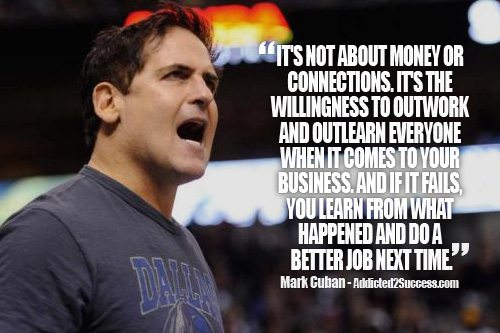
3) He Understands That He MUST Work Harder Than The Next Guy
The one thing that you can control is your work ethic and Mark makes sure that he is a beast in his field. Cuban says that you need to know the industry that you are in better than anyone else, to study, live and breathe it.
Earlier in his career when he was first working for MicroSolutions he was making around $60,000 a year. He was doing well but he wanted more. Cuban says he dedicated himself to learning everything he could so that he would be able to get an edge over his competitors. More recently Cuban says that he spends as much time as he can reading everything and anything about the cable industry. Cuban is always on the hunt to be the expert in his industry.
He understands that persistence most definitely pays off.
Sweat equity is the most valuable equity there is. Know your business and industry better than anyone else in the world. Love what you do or don’t do it. – Mark Cuban
4) Mark Cuban Focuses On REAL Results
While Cuban strongly believes in the importance of having a strong work ethic, he also suggests that we need to focus where we direct our energy. Working to produce real results is far more important than working simply for the sake of it.
He is also skeptical about start-ups who waste their money. He says if he receives too much “swag” from a company then he is immediately suspicious about how they are allocating their resources.

5) He Is Always Looking For Long Term Business Relationships
Cuban advises businesses not to be too focused on squeezing the maximum profit out of a single deal at the expense of the relationship with that customer. Real value for a company is created by maximizing the life time value of the customer.
As Cuban points out, business relationships are built over years, not on a single deal.
6) He Always Learns On The Job
If you are willing to learn your job can pay you twice.
– Firstly there is the money that you receive for working your job.
– Secondly there is the knowledge that you gain from working at your company.
This second form of payment is in Cubans opinion the most important one. When Cuban first started out working at “Your Business Software” he was only making $18,000 a year. But more importantly he was learning about the PC industry and how to sell. It was this knowledge that would allow him to build MicroSolutions into a company that did $30 million in sales only a few years later.
He took the risks when necessary and kept his eyes on the prize ahead of him, he discovered that he must always strive “to learn, create and grow.”
Because if you’re prepared and you know what it takes, it’s not a risk. You just have to figure out how to get there. There is always a way to get there. – Mark Cuban
7) Cuban Extends Himself To Get A Customer
Mark Cuban’s first customer was the $15,000 deal that lost him his job working at “Your Business Software“. After losing his job he went to the customer and asked if he could do the job for him personally. The client agreed and it launched MicroSolutions.
For his first clients Cuban would take no money for providing the service, the client was only charged for the software. Cuban did this because he realized that customers only want to work with you if you already have other customers and a great reputation.
8) He Doesn’t Believe In Hierarchy
Mark Cuban keeps a careful eye out for people he perceives as being “Empire Builders”.
These are senior executives who don’t want to make sales calls and require lots of perks. He believes in making the organizational structure as flat as possible. He also says that open offices work best and that executives should not be able to lock themselves away.

9) He Builds Companies To Last
Mark believes that many entrepreneurs are too focused on the idea of an exit strategy. He believes that the best way to build a company that will sell for a great price is to build a company that is designed to last. He also remarks that if you have your eyes on the exit then the company is not enough of an obsession for you.
10) He Knows When To Sell
Mark Cuban built his businesses because of his relentless sales drive and persistence, but he also become a billionaire because he knew the best time to sell. This has proven to be the key in many industries, many times over. Cuban sold Broadcast.com to Yahoo in 1999 for $5.9 billion in stock. One year later following the dot com crash the company’s value was worth a fraction of that.
He cashed out when the deal was good and didn’t hang on too long in hopes for a greedy “more”. Know when to sell, and learn when to walk away from something you feel does not do a sale justice either. Mark has mastered this and it has rewarded him dearly.
Mark Cuban is the definition of a hard working entrepreneur who isn’t afraid to hustle. Learn how to adopt some of his winning success traits and you may have what it takes to build your own fortune.





When we talk about modern success, it is hard to ignore the astronomical rise of Drake. Beyond the Grammy awards, the record-breaking Billboard hits, and the sold-out stadium tours, there is a masterclass in mindset, manifestation, and relentless work ethic.
For entrepreneurs, creators, and visionaries looking to leave a mark, Drake’s approach to his craft offers invaluable lessons.
Here are six core principles extracted from Drake’s journey that you can apply to your own pursuit of greatness.
1. Cherish the “Who Is This?” Moment
When you are first starting out, it is easy to become impatient. You want the accolades, the recognition, and the massive audience right out of the gate. But skipping the struggle means missing out on the most vital part of the journey.
“Don’t ever not be present in your ‘who is this’ moment, because you’re going to be chasing that moment for the rest of your career—trying to keep people as interested as they were when they felt like they were one of the only people listening to you.”
The Takeaway: If you are a new artist or a budding entrepreneur, embrace the grind of obscurity. The hunger and innovation you possess when you are trying to get noticed are the exact tools that will build your empire. Be present.
2. Aim to Be the “First You”
Society often measures success by comparison. We try to become the “next” Steve Jobs, the “next” Jay-Z, or the “next” big disruptor. True success, however, requires unparalleled authenticity and an unwavering desire to be at the top of your own category.
Drake’s mentality was never about following in someone else’s exact footsteps. He didn’t want to be the next Kanye West or Lil Wayne; he wanted to be the first Drake.
- Refuse to settle: Never aim for second place.
- Build your own lane: If you see someone else achieving greatness, use it as proof of concept. If they can do it, you can do it—but do it your way.
3. Obsessive Manifestation
Success is rarely accidental. It is the result of holding a clear, almost obsessive vision of the future in your mind until it becomes reality.
Before the fame, Drake used to drive his uncle’s drop-top Audi through the exact same three streets where he wanted to buy a house, bringing people along to physically show them the life he was going to build.
The Takeaway: You have to see it before you can hold it. Speak your goals into existence, visualize your destination daily, and align your actions with that specific future.
4. Master Your Craft and Take Your Time
In a world that celebrates “hustle culture” and the sheer volume of output, it is easy to forget that quality is the ultimate differentiator. You don’t have to crank out 50 projects a week to prove your worth.
“I can do two verses, not finish the song, and feel proud… It’s an individual creative process. There is no standard.”
Know your strengths. For Drake, it has always been his writing. He takes his time, researches, writes on his phone, and refuses to sacrifice the quality of his work just to meet an arbitrary deadline. Discover what your greatest talent is—whether it’s coding, writing, speaking, or strategizing—and take the time required to make it undeniably great.
5. Disconnect From the End Goal
This might sound counterintuitive to goal-setting, but becoming too attached to a final destination can be self-destructive. If your only focus is hitting a massive financial number or a specific milestone, what happens when you get there? You risk stalling out.
The Strategy for Continuous Growth:
- Set the target, but focus on the daily steps. 2. Live in the “right now.” Do the absolute best you can in the present moment.
- Celebrate the learning, not just the wins. Mistakes are necessary for growth. If you are always right, you can never learn.
6. Let the Product Speak
Many creators complain about not getting noticed or blame the algorithms for their lack of traction. The hard truth? If your product is potent enough, the world will let you know.
You no longer need to move to New York or Los Angeles to “make it.” You can build an empire from your laptop, in your hometown, using the internet as your stage.
“If you have the music, that’s all it takes. Present it to the world, and the world will tell you if it’s worth their time or not… There are people who scour the internet every day looking for the next big thing, and I promise you if that product you have is potent enough, you will be the next big thing.”
Final Thoughts
Success is an addiction to growth. It requires sacrificing immediate gratification, tuning out the critics, and focusing solely on the quality of what you are putting out into the world. You don’t have to be a loud, loose cannon to make an impact. You just have to be relentless, competitive, and completely dedicated to your craft. Keep your head down, do the work, and let your results make the noise.
Here’s a Drake success advice compilation for your to learn more:


Doing well at something is not the same as wanting it. Plenty of people are steady at their jobs and still feel hollow at the end of the day. Nothing looks wrong from the outside. Colleagues respect you, the pay lands on time, and you handle whatever gets thrown your way. What builds underneath is harder to name.
A dullness sets in, or a restlessness, or the sense that you’re watching your own work from across the room. It doesn’t mean everything needs to be torn down. Often it just means you’ve stopped growing, and once that happens, what counts as worthwhile work quietly changes shape.
When work shifts
There is usually no announcement. One day the tasks that once demanded your full attention take almost nothing out of you. Some people notice their focus sliding away from the work and toward the people around it. Wanting to mentor, listen, and help someone untangle a problem tells you something real about where your attention wants to go.
This lands hard in teaching. Class sizes and schedules leave little room for one student who needs an hour, and administrative work swallows the time you’d rather give them. Many educators respond by shifting from a teacher to a counselor, a role built around emotional and social support instead of lesson plans. The work runs deeper with each student and puts their wellbeing at the center of the day.
Changes like this rarely announce themselves loudly. They start as a small nudge you can brush off. Ignoring it gets harder as the months go by.
What purpose feels like
Most of the time it arrives quietly. A small exchange leaves you feeling like you were actually needed. You break down something complicated and watch it land. You steady someone who was spiraling. You point a person toward a way forward when they couldn’t see one. The tiredness afterward sits differently from the kind that flattens you.
Notice when you feel most switched on. Some people run best on targets, numbers, and systems that click into place. Others come alive guiding, backing someone up, keeping them going. Neither ranks above the other. They simply pull from different places.
Work that feels worthwhile usually reflects what you already care about. Value connection, trust, and steady growth, and a people-centered job will sit better than one measured purely in output. Perfection isn’t the goal. Honesty is.
Clues in your strengths
Patterns show up long before certainty does. Consider what people bring to you without being asked. Do friends start unloading before they’ve taken their coat off? Do colleagues mention how calmly you explain things? Are you the steady one while everyone else scatters like startled pigeons?
Pay attention to that. Support and guidance roles tend to grow out of qualities like these:
- Patience when someone needs time
- Empathy without absorbing everything
- Clear communication
- Real listening
- Steadiness under pressure
- Encouragement that doesn’t take over
Calling these soft undersells them. They carry weight because they help actual people get through difficult stretches. Technical knowledge can be added later. A steady, caring way with people is harder to teach, and having it already puts you closer to a new path than you might assume.
Why helping can grow
Roles built around helping tend to keep demanding more of you as a person. There’s no clocking in and ticking off a list. You get better at hearing what someone isn’t saying, at answering with more care, at reading people accurately. Growth like that outlasts any promotion.
Your motivation changes shape too. Pay and status stop being the whole scoreboard, and impact starts to matter. Did that person feel understood today? Did something hard get lighter because you were there? Questions like those keep the work from going flat.
None of which makes it effortless. The emotional load is real. Boundaries hold everything together, and so does proper rest. Choose a helping career with clear eyes, because meaning doesn’t cover lunch, sleep, or a life outside the job.
Testing the next step
Nothing has to be decided by next Tuesday. Small, low-stakes experiments beat dramatic leaps almost every time. Walk around in the shoes before entering the marathon.
Try a few of these:
- Talk to someone doing the job now
- Ask about ordinary days, not the highlights
- Volunteer somewhere support is the point
- Shadow a professional if you can arrange it
- Sign up for one course
- Note down what leaves you energized
Each one separates the imagined version from the real one. Occasionally a role loses its shine once you hear what the hours involve. Just as often, seeing it up close confirms what you suspected.
Stay curious rather than urgent. No contract is being signed. You’re collecting evidence, and evidence beats panic when a career decision is on the table.
Making change less scary
Fear arrives even when the change is a good one. Money, timing, family obligations, the thought of being a beginner again. None of that is irrational. Your brain is doing its job, protecting you, just with more theatrics than the situation calls for.
Size is usually the problem. “Should I change my whole life” is an unanswerable question, and holding it in your head produces nothing but dread. Narrow it until it becomes something you can act on this month. Build savings first. Find out what training actually requires. Set a six-month window and see what you learn inside it.
The fear rarely disappears entirely, and it doesn’t need to. It shrinks once the decision stops being one enormous leap and becomes a series of ordinary moves you can reverse if they don’t work.
Choosing a better fit
Borrowed definitions of success cause most of the trouble. Looking impressive while feeling depleted is a trade that stops paying off quickly. Your own version asks harder questions. Does this line up with what you care about? Does it draw on what you’re actually good at? Could you do it without performing a version of yourself all day?
Alignment matters more than ambition here. The goal is work that fits, that spends your energy well, that lets you be useful without straining for it.
That pull toward something more meaningful deserves attention rather than dismissal. Look into it. Give it time. The full map isn’t required. One honest step forward is usually enough to start.

A first planned video conversation feels easier when the technical setup and basic expectations are handled in advance. A few practical checks reduce distractions and leave more attention for clear, respectful communication.
Prepare Before the Conversation
Before joining a scheduled conversation through a service such as Aveola, review the meeting details, your account profile, and the subjects you intend to discuss. Early preparation prevents last-minute searches for links, passwords, headphones, or background information.
Confirm the Time and Access
Check the date, time zone, expected duration, and correct access link. Add the appointment to a calendar with a reminder, then open the platform early enough to complete any sign-in or permission requests.
Confirm that your email address or phone number is verified when the service requires account verification. Use a unique password and activate two-factor authentication when that option is available.
Plan a Few Topics
Prepare two or three simple subjects that fit the reason for the conversation. For a professional call, these subjects might include responsibilities, project goals, or next steps. For a social discussion, hobbies, travel, books, music, or daily routines provide comfortable starting points. Avoid writing a full script. Short notes keep the exchange natural while giving you a reference if the discussion pauses.
Check Your Connection
A stable internet connection supports clearer sound and smoother video. Close large downloads, cloud backups, streaming services, and unused browser tabs before joining.
The table identifies common connection issues and practical responses:
|
Issue |
Visible effect |
Preparation step |
|
Weak Wi-Fi signal |
Frozen picture |
Move closer to the router |
|
Busy home network |
Delayed sound |
Pause other high-bandwidth activity |
|
Outdated browser |
Missing features |
Install the current version |
|
Low device power |
Sudden disconnection |
Charge the device beforehand |
Set Up a Comfortable Space
The physical environment affects how clearly both people see and hear each other. Camera placement, light, sound, privacy controls, and personal limits deserve separate attention before the conversation begins.
Position the Camera
Place the camera close to eye level so your face remains centered without requiring you to look sharply upward or downward. A laptop stand, stable box, or adjustable monitor provides a better angle than holding a phone throughout the session.
Leave a small amount of space above your head and keep the lens clean. Look toward the camera while speaking, then return your attention to the screen while listening.
Improve the Lighting
Face a window or place a lamp in front of you, slightly above eye level. Strong light behind your chair creates a silhouette, while overhead lighting alone produces deep shadows around the eyes.
Review the preview screen before joining. Adjust the lamp, curtain, or seat position until facial details appear clear without excessive brightness.
Test the Sound
Use the platform preview or device settings to test the microphone and speakers. Speak at a normal volume and listen for echo, background noise, or distortion. Headphones reduce feedback when speakers sit close to the microphone. A quiet room with curtains, rugs, or soft furniture also limits reflected sound.
Protect Your Privacy
Review what the camera reveals before the conversation begins. Remove documents, photographs, screens, packages, or personal items that display sensitive information.
Five additional checks help protect your account and surroundings:
- Disable location details that are unnecessary for the session.
- Review camera and microphone permissions in the browser.
- Use a background blur when the room contains private material.
- Keep account recovery codes outside shared devices.
- Sign out after using a borrowed computer or tablet.
Privacy settings also control profile visibility, notifications, and contact options. Read each setting carefully instead of relying on its default value.
Set Personal Boundaries
Decide in advance which subjects and personal details remain outside the discussion. A planned conversation does not require sharing an address, workplace schedule, financial information, private documents, or account credentials.
Set a clear time limit when your schedule requires one. A simple statement at the beginning, such as having 30 minutes available, gives both participants a shared expectation.
Keep the Conversation Comfortable
Preparation continues during the exchange through attentive communication and a calm response to technical interruptions. A small problem with sound or video does not need to disrupt the entire session.
Communicate Respectfully
Speak clearly, allow the other person to finish, and ask direct questions when something is unclear. Muting the microphone during unavoidable background noise keeps the conversation easier to follow. Consent remains relevant throughout live communication. Respect a request to change the topic, pause, disable a feature, or end the session.
Finish With Clear Next Steps
Before leaving, confirm any agreed action, future date, document, or contact method. This step prevents confusion after professional, educational, or project-related discussions.
End the session through the platform controls, close unnecessary tabs, and verify that the camera and microphone are no longer active. A brief review of what worked gives you a stronger routine for the next conversation.


After enough years in medicine, you start to notice a pattern that has nothing to do with biology and everything to do with psychology. The most driven, capable people in the room are often the last ones to deal with a problem.
Not because they are careless. Usually it’s the opposite. They have built successful lives by pushing through discomfort, solving problems, and staying in motion when other people stop.
I still think about one patient from time to time, although the truth is I’ve seen versions of her story more times than I could count. She was building a company, or maybe it was her career, I don’t remember anymore, and she’d been ignoring a symptom for months. She knew it wasn’t normal. She’d caught it early, but there was always a reason to put it off. A launch, a deadline, an important meeting she couldn’t miss. In her mind, stopping even for a day felt like falling behind.
By the time she finally came in, the problem had grown into something much harder to treat than it needed to be. I never thought of her as careless, and I don’t think denial is the right word either. She was doing what had always worked for her: keep pushing, don’t get distracted by small problems, and deal with them later.
That habit that serves you so well at work doesn’t always serve you everywhere else. When it comes to your health, it can become part of the problem.
Why Ignoring Small Problems Feels Like Discipline
People who accomplish a lot usually learn early on that not every ache, inconvenience, or setback deserves their attention. If they stopped every time something felt a little off, they’d never get anything done. After a while, pushing through just becomes second nature, and that habit doesn’t stay at work. It follows them everywhere else.
The problem is that this instinct doesn’t know the difference between grit and denial. Grit is choosing to endure something hard that you understand and have decided is worth enduring. Denial is ignoring a signal you never actually evaluated. They can feel identical in the moment, which is exactly why so many capable people confuse them.
This happens constantly, and not just when it comes to personal health. A founder notices the same customer complaints showing up every month, but keeps writing them off because fixing them would mean admitting there’s a problem with the product. An executive is surviving on four hours of sleep because it’s “just a busy season,” even though that season has lasted the better part of a year. Someone else has been living with the same symptom for months because making an appointment feels like one more thing they don’t have time for.
None of them are being careless. They’re using the same mindset that helps them succeed at work in a situation where it just doesn’t fit.
The Hidden Cost of Living Reactively
The real cost of reactive living isn’t the eventual crisis. It’s everything that happens before the crisis, which is usually invisible even to the person paying for it.
Living reactively means a portion of your attention is always spent managing something you haven’t dealt with yet. That’s a tax you pay daily, in the form of decisions made from a place of low-grade dread instead of clarity, in the form of energy that should be going toward your best work instead going toward keeping a problem contained. You don’t usually notice this tax because it doesn’t announce itself. It just quietly reduces how much of you is available for the things that matter.
This pattern plays out with health the same way it does in business. Very few of the serious conditions I’ve treated appeared overnight. Most started small, were easy to dismiss, and stayed that way for longer than people expected. Your body usually gives you plenty of chances to notice something is wrong before it forces you to pay attention.
Prevention Is the Highest Leverage Work You’ll Ever Do
Meanwhile, we celebrate the comeback, the turnaround, the crisis survived. Nobody publishes a book about the disaster that never happened because someone handled it early.
But prevention is the harder, more advanced skill. Crisis response gets you sympathy and a story. Prevention requires you to act on something before it’s demanding your attention, with no audience and no applause, purely because you understand what will happen if you don’t. That takes a kind of self-management that most people never develop, because it isn’t rewarded the way heroics are.
The best leaders and founders don’t actually handle crises better than everyone else, they just have fewer of them because they treat maintenance as a strategy rather than as something to get to eventually. They ask what a version of themselves with more information would already know, and then they go find that information instead of waiting for it to force its way in.
What This Looks Like in Practice
If any of this sounds familiar, you don’t need to turn your life upside down. Start small. Every few months, take a little time to think about the things you’ve been putting up with instead of dealing with. It could be your health, something at work, your finances, or even a relationship that’s been quietly wearing you down.
The most useful question to ask yourself is a simple one: Am I choosing to put up with this, or am I just avoiding it? Those two things can feel surprisingly similar when you’re in the middle of them, but they aren’t the same. One is intentional. The other usually catches up with you sooner or later.
A Different Definition of Strength
We tend to define strength as the ability to endure. I’d argue the more useful definition is the ability to notice early and act before you have to endure anything at all.
The people I’ve seen build businesses, careers, and even healthy lives over the long term usually aren’t the ones who can take the biggest hit. More often than not, they’re the ones who dealt with small problems before those problems had a chance to grow. It isn’t the most exciting approach or the one that tells the grandest story, but it’s the reason they stay healthy and keep moving forward.
Next time you brush off a small warning sign, ask yourself why you’re ignoring your body’s signals. Most of the time, you’ll likely find that it has less to do with your schedule and more to do with clinging to the identity of being someone who never needs to slow down.

Preparing Your Child for Stem Cell Treatment Abroad: A Travel and Comfort Checklist

5 Sales Moves That Quietly Fill a Startup Pipeline

The Entrepreneur’s Guide to Investing in Bali Real Estate Without Getting Burned

How Strategic Thinkers Use Home Equity as Smart Leverage

Why Resume Screening Is Only Half the Battle: The Entrepreneur’s Guide to Verifying Who You’re Actually Hiring

5 Ways For Startups To Succeed Making Acquisitions

77 Inspirational Quotes That Will Change Your Life
57 Memorable Kobe Bryant Quotes

(Images) 52 Motivational Picture Quotes For An Epic Year Of Success

40 Rare Motivational and Inspirational Picture Quotes

3 Prince EA Videos To Change Humanities Path To Greatness

(Video) What Is Success? An Entrepreneurial Story To Inspire You

(Inspirational Video) What If Today You Knew You Were Going To Take Your Last Breath?

How To Make Enough Money From A Blog To Quit Your Job – Kate McKibbin

How Finding Your Passion And Becoming An Entrepreneur Can Lead To Happiness – Chiquita Searle
-

 Life2 years ago
13 Meaningful Ways to Show Someone They Matter
-

 Life2 years ago
The 5 Stages of a Quarter-Life Crisis & What You Can Do
-

 Did You Know1 year ago
7 Surprising Life Lessons Video Games Taught Me That School Never Did
-

 Success Advice1 year ago
Stephen Covey’s 8 Leadership Habits That Will Change How You Lead Forever
-

 Life1 year ago
How to Stop the War in Your Head and Find Peace
-

 Featured1 year ago
The Psychology of Motivation: How to Keep Moving Forward Every Day
-

 Shift Your Mindset2 years ago
10 Hidden Psychological Barriers That Are Killing Your Success
-

 Personal Development1 year ago
The Three-Second Pause That Changes How People Perceive You
8 Comments