
Success Advice
How To Influence People Through Not Giving A F**k


We all want to be cookie cutter good citizens that pay our tax’s, get married young, have two perfect kids, drive a perfect car, say the right thing at the right time, be able to make people laugh, and make lots of money so we can buy useless crap that we don’t need.
This dream is a joke and all of you reading this know it. My eyes have been opened recently as to how you can break out of the mold and be you. The gentlemen I have to thank for this is the well-known blogger Mark Manson.
Frankly I had never heard of Charles Manson’s brother until a few weeks ago, but despite his family’s bad name, I was willing to listen to what the guy had to say (he’s not Charles Manson’s brother by the way I’m only trying to liven things up a bit with some drama).
Now the guys’ got a potty mouth like you’ve never heard before and that’s partly why this article has the F-word in its title which is very unlike me. I guess I wanted to try out this not giving a F thing for myself, and I have to admit, the guy’s got me hooked just a little bit.
Usually, I would talk about why Mark Manson is the greatest thing since sliced bread but today I’m not going to bother doing that. What I am going to do is highlight how is attitude and the way he communicates is influencing millions of people to learn from him how they can succeed.
So today’s lesson is all about the 6 ways you can influence people through not giving a F#@& like Mark Manson:
1. Break out of your shell
What Mark does so well is speak his mind and be real. The internet has become flooded with written articles and video’s that all look the same. The language is polished, the grammar is impeccable, the photos are amazing, etc.
Mark sticks his middle finger up at all of that and posts imperfect photos, writes sentences that are so bloody long there is no way they can be grammatically correct, speaks his mind and raises controversial topics, talks about himself in the third person, and a host of obnoxious antics.
He doesn’t do all of this because he’s a horrible person; he does it because he is trying to influence people to change their life, and change requires a different approach. By breaking out of his shell and going against the grain, he is speaking a language that under 35’s understand and that’s important to note.
For you to duplicate his results, you need to do the same and break open the turtle shell that’s been stuck to your back since you were a kid and your mommy strapped it onto you. Show the world who you are and speak in a voice that’s comfortable. That’s how you will inspire people.
2. Be confident
As I read more and more of Mark’s work, I began to see his confidence shine through.
“I’ve realised that you are never going to inspire or motivate someone to change their life unless you truly believe that you’re the person to make them change”
If the next president of the United States Of America got up and said: “I think I can protect you all and make this country prosper, but I’m just not sure because you know, I haven’t done this before, and it’s kind of like my first time – you know?”
Would you vote for this person? Absolutely no way in the world and neither would I. What I’ve learned from Mark is that confidence, without ego, plus vulnerability, is a cake that is worth baking if you want to inspire people.
Confidence is where it all starts and that can only come from you believing that you have something worth sharing. Mark gives dating advice on his blog and to be honest; it could be easy to wonder how he has any skills in this area what so ever.
It doesn’t really matter at the end of the day. He believes that there is an audience for his advice (and there is), and so he delivers as much value as he can, in a confident writing tone, in the hope that he can genuinely help others. What’s wrong with that?
Nothing at all, as long as the intent comes from the art of giving and not out of some form of selfishness to win the popularity contest that is social media.
3. Take action when you have no idea
The whole point of not giving an F is to take action despite of the fear and uncertainty you might have. Mark has these same feelings, and so do I, and so do you; the difference between those that influence and those that do not, is that the influencers take action.
What I mean by this is that Mark has consistently written the best blog posts he can for the last five years. He’s the first to admit that quitting his job and going out on his own was probably a bold move. But, he used his own advice and didn’t give a F.
What we can all learn from this approach is that we don’t need to know what the road to success looks like. The path is uneven, filled with dog poo, it has giant trucks heading right for you that shouldn’t even be on the path, there are snakes hiding in the bush’s as you walk, and there is so much bloody fog that you can only see a few meters ahead of you.
That’s what the path to success looks like boys and girls. All we need to do, and what Mark demonstrates through his work, is that we just need to start walking on the path, and adjust our approach as the obstacles come out of nowhere and nearly blow our eyes out of our sockets.
Forget trying to wait until everything is right and stop giving a F. Start something, anything, and then pivot as you need to like any Uber-like startup would. This way of being is what inspires people to do the same.
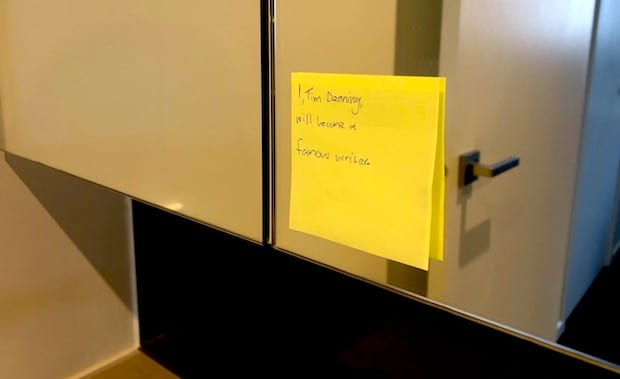
“When people can see that you are just as blind, deaf, dumb, and imperfect as them, they start to rally around you and seek your advice so they can be inspired” – Tim Denning
4. Be okay with your individuality
I’m the first to admit that I’m a bit quirky. I mean, what’s not to love; I eat mostly veggies, watch 100% documentaries about success and motivational topics, sip caffeine free tea, wear clothes that stand out, attend events that may look like a cult, and I try to always have a big, stupid smile on my face.
Compared to the rest of the world I probably look like some self-help guru obsessed, vegan loving, Side Show Bob dressing, overly positive, psychopath dressed in a slim-fitting, overpriced suit.
Guess what? That’s probably who I mostly am, and that’s okay. Just like it’s okay that you are who you are. Mark teaches us through his blogging that the more individual we are, the more people will respond to our message.
By being you and revealing all of your faults, you become relatable and someone that people admire. You cannot inspire anyone unless you find out who you are and be okay with sharing the whole package – scratches, damage and all.
5. Don’t take life too seriously
Especially in the world of personal development, it’s easy to become obsessed with a life that is way too serious. A life where you have to be up early every single day, work until you pass out, and be constantly growing at 300% every day.
This is not true personal development, and Mark shows us why we need to not take life too seriously. Yes, you need to be focused and know what your goals are, but there is no way you can be awesome 24/7.
What I love about Mark’s work is that he makes me laugh and below all of his humor is a genuine message to try and get you to look at life differently. When you change the lens that you are using to view the world, you start to see things that you haven’t seen before.
All of the public speaking books I have read say that adding humor to what you do will help to solidify your message and get people to pay attention. This doesn’t mean that you need to become the Jim Carey of coming up with jokes; it just means that you should attempt to see the humor in things. Most of all, you should attempt to see the humor in yourself once in a while.
6. Lose the fixed mindset and learn to be wrong
Through all of the blog posts I have read of Mark’s, I’ve noticed that he changes his opinion or interpretation of events frequently. This is because rather than having a fixed mindset, he has a growth mindset.
With a growth mindset, we can learn to adapt and understand that no idea stays true forever. The Earth and our success are changing every single day. To inspire people you need to be constantly changing what you can teach and having new messages to spread.
Otherwise, you become washed up, out of date, and irrelevant. People that think they know everything really piss me off, and I’m sure they do the same to you. That’s why sometimes I have to take a chill pill, take my own advice, and not take everything so seriously.
A lot of what personal development teaches us is that we can’t inspire others unless we change ourselves first. The only way we can change ourselves is by becoming open to everything that we come into contact with.
There are so many old models of the world that people continue to live by for no good reason. Mark regularly pokes fun at these models in his work and encourages people to learn to be wrong. It’s okay if you always thought that diet soda was healthy and then you figured out it wasn’t.
Don’t forget, I’m the guy that drank too much, went to too many nightclubs, and ate the highest sugar foods known to humankind. It’s okay to be wrong ladies and gentlemen. We’re never going to be right 100% of the time, and if we were, then I’d give you a Nobel Prize, and tell you to retire (not going to happen by the way).
It’s time we get over our ego and ourselves and adopt a growth mindset. We can do anything we put our minds to and nothing is impossible.
How are you going to change you and influence the world? Let me know on my website timdenning.net or my Facebook.









Life often feels finished. That is usually when it starts costing you.
Last week I spoke with a man who seems to have it figured out. A nice business, a team that does not need him in every meeting, the house sorted, a wife who still likes him, which is more than a lot of the men I talk to can say. Halfway through he went quiet and admitted he feels like he is managing a life he signed up for ten years ago. Not miserable. Done growing. A little embarrassed to say it, because what is he supposed to complain about.
The scoreboard does not notice
I knew the feeling before he finished the sentence. Addicted2Success started as a blog in Perth when I was young enough to think the answer to everything was more output. It worked. The site grew, the audience grew, the coaching grew, and for a long time the scoreboard was kind enough to tell me I was on the right track. What it never does is send a note when you have started hiding. You can be posting, closing, travelling, and saying true things on the internet while becoming a slightly smaller man than you were two years ago. Nobody around you is going to flag it. They are responding to the results, and results only show what you already pulled off, not what the last year has been doing to you.
The men in these conversations are not stuck at the starting line. They have the income, the title, the reputation. Under it, a low-grade sense that they have been repeating themselves. The advice they grew up on does not touch that. Wake up earlier. Want it more. Outwork the room. I gave a version of that advice for years, and some of it was fair when someone had not started. It is useless once the room already knows your name. Past a certain point, more effort just maintains the life you have already outgrown.
It looks like leadership
When they are honest, it is ordinary. They are carrying the whole thing alone, not because nobody would help, but because letting someone close enough to challenge them would mean admitting a few decisions have gone soft. So they stay the smartest person in their own week. That feels like leadership. It functions like a closed loop. I did a long stretch of this. If someone disagreed with me I could usually out-talk them, and I mistook that for being right. The business did not collapse, which is what makes it hard to catch. Things can be working while you remain basically unaccountable. A lot of the signs people read as failure are the early version of this.
Home gets what is left
Work got the sharp hours. My wife got the man who had already spent the best of himself on a laptop. You can narrate that as provision for a long time. Tell yourself you are building something for them. Some days that is even true. It still does not change what they receive, which is a tired person who needs the room to be quiet. It holds until you have a kid who does not care what you shipped, or until you lose someone and realise the hours were never coming back. After Harper I stopped being able to treat time like something I could earn more of. Fatherhood finished whatever argument I had left. My son does not experience my ambition. He experiences whether I was in the room. He cannot tell the difference between a father who is building a legacy and a father who is on his phone. Neither can yours.
Reasonable is how it gets boring
Then there is the comfort, which everyone dresses up as wisdom. You postpone the move. You keep the offer that is fine. You say you are being strategic when you are mostly avoiding the feeling of being a beginner again. The edge does not vanish in a week. It goes over a year of reasonable decisions, and reasonable is how a lot of good lives get boring. I have watched men research a change for a year and a half. A new model, a new city, a new standard at home. The research becomes the thing they do instead of the change. It feels responsible. It has notes.
I used to have a clean system for this. It looked good in a carousel. What actually changed things was smaller and more annoying, and it only worked when I got specific.
Write the sentence you would not post
Not “I need better balance.” That is a sentence you can hide in. One line, the way you would say it if nobody was going to screenshot it. I am building in public and going missing at home. I have known this offer is done and I keep running it because the cash is easy. I have not let anyone challenge me since the last person who did, and I pushed them out. Put it where you will see it. The point is to stop negotiating with a foggy version of the problem. You cannot fix a foggy version. You will just buy another course about it.
Look at that sentence when you are not already fried. I wasted years making big calls late, after a full day of other people’s needs, then wondering why I always chose the option that protected the current setup. You are not wise when you are depleted. You are conservative. Pick a pocket of time this week when you still have a brain, phone in another room, and ask what you are protecting by leaving it as it is, and what it costs the people who do not get a vote in your calendar. If you catch yourself performing the answer, like you are drafting a caption, delete it and start again.
Take back one hour that has a name
Not a new morning routine. Men at this stage love a routine, because a routine feels like progress and does not threaten the life. Pick a repeatable hour that is already losing and give it a job. Dinner with the phone in a drawer. A walk with your wife where you do not steer it back to the business. Time with your kid before the laptop opens. The tactic is the boundary, not the activity. Tell one person what the hour is. If you miss it, you tell them the same day, without a story. The story is how it dies. A client emergency three weeks in a row is the old life collecting its rent. Being the person who agrees is how that hour gets given away before you notice.
Have the conversation, then date the move
There is almost always a conversation you have been drafting. A spouse you have been managing instead of talking to. A partner you have been working around. A number you have not said out loud, because saying it makes the next move real. Do not workshop it into a speech. Two sentences of what you have been avoiding, then stop talking long enough for them to answer. The men who stay stuck are usually eloquent about the problem and silent in the room where it could change. Eloquence is a delay tactic I have used plenty.
Then date the move that makes the current income nervous, and put it sooner than feels comfortable. One move. Kill the offer, raise the price, hire the person, have the hard no, book the conversation you have been waiting on the right week for. If it needs more than a couple of weeks of preparation, you are probably preparing past the point of usefulness. Let it be clumsy. The old identity will have a very reasonable case for why this stretch is not the one. It always does. It has been getting paid to keep things as they are.
You need one person who is not impressed
None of that works alone, which is inconvenient, since alone is the setup that got you here. You need one person who is not impressed by you. Not a mastermind. Not an audience. Not a coach you are performing progress for. Someone who can ask whether the phone actually stayed in the drawer, and who will not clap if the answer is no. Most of the men I know have plenty of people who benefit from them staying impressive. Employees, followers, friends who like the version that has it together. Almost nobody who is allowed to interrupt it. Ask someone specific if you can send them one sentence about whether you did the thing. If you do not send it, they chase you. That is the whole agreement. If you cannot think of a person, that is not a small detail. That is the closed loop, and finding the person is the first move.
I am not interested in telling you to burn the life down. A lot of what you built is worth keeping. The business can stay. The standard has to change, or you will spend the next ten years maintaining a life you already know you are done growing inside. What I care about is whether the man who benefits from it can still sit at the table with the people who paid for it. Your wife. Your kids. Whatever you say you believe when the content needs a spine. If those do not survive the win, the win was just a very well-paid way of leaving.
You already know which of these you have been talking yourself out of. Start with the sentence. The rest gets easier to see once you stop describing the problem in a way that lets you keep it.
In this video I speak about how you may be keeping yourself stuck in high achiever patterns and what you can do to change it:


You know the story. A guy gets wings made of feathers and wax, dad tells him not to fly too close to the sun, guy ignores dad, wings melt, guy falls into the sea. Classic.
But here’s the thing about Icarus. He didn’t crash because he failed. He crashed because he was doing so well.
That’s the part we don’t talk about enough.
What Icarus Syndrome Actually Looks Like
Icarus Syndrome isn’t some official diagnosis you’ll find in a medical textbook. It’s more of a pattern. And once you spot it, you start seeing it everywhere.
Picture this: someone lands the promotion they’ve been chasing for years. Suddenly they’re saying yes to everything. More projects, more travel, more risk. The confidence that got them there starts to tip over into something else. Overreach, maybe. A bit of arrogance. That quiet voice that used to say “hang on, is this a good idea?” goes strangely silent.
And then it all comes tumbling down.
The tricky bit is that success and self-destruction can look almost identical from the outside. Both involve ambition. Both involve pushing hard. The difference is usually invisible until it’s too late.
Why Winning Can Set You Up to Lose
Ever noticed how a winning streak makes people a little reckless? There’s actually a reason for that.
When things go well, our brains get a hit of confidence that doesn’t always match reality. We start believing our own hype. The wins feel like proof that we can’t lose, which is exactly the moment we’re most likely to.
Turns out, success shrinks your awareness. You stop questioning yourself. You stop listening to feedback because, well, look at all this evidence that you’re right. The people who used to challenge your thinking? You might start tuning them out.
The other day someone told me they’d made their worst decisions not when they were struggling, but when everything was going great. That stuck with me. Because it makes a weird kind of sense.
Struggle keeps you humble. Success can make you forget.
The Warning Signs Worth Watching For
So how do you catch yourself before the wax starts dripping?
It usually starts small. You notice you’re brushing off advice you’d normally take seriously. You’re taking on more than you can realistically handle, but telling yourself you’ve got it. You feel a bit untouchable, like the normal rules don’t apply to you anymore.
Sleep goes out the window. You’re running on adrenaline and calling it drive.
And maybe the biggest one: you stop asking for help because asking for help feels like admitting you’re not as on top of things as everyone thinks.
This part’s a bit uncomfortable, but the very traits that fuel success, the ambition, the drive, the refusal to quit, are the same ones that can quietly steer you off a cliff. Same wings, different outcome.
Pulling Yourself Back From the Sun
Okay, so what do you actually do about it?
First, get honest about the story you’re telling yourself. Are you flying high because things are genuinely solid, or because you’ve stopped checking? There’s a difference, and only you can tell which one it is.
Keep people around who’ll tell you the truth. Not the yes-people who clap at everything, but the ones who’ll gently say “mate, are you sure about this?” Those people are worth their weight in gold, and they get rarer the more successful you become.
Slow down enough to notice how you’re actually feeling. Success can mask burnout for a surprisingly long time. You feel great right up until you don’t.
And look, sometimes catching yourself isn’t something you can do alone. If you’re feeling stretched thin, if the pressure of keeping it all up is starting to weigh on you, talking to someone helps more than people expect. Getting proper psychological support in Western Sydney or wherever you are isn’t a sign you’re falling apart. It’s usually a sign you’re paying attention.
Flying Smart Instead of Flying High
Here’s the thing Icarus never got told. The problem was never the flying. It was the ignoring.
His dad gave him a middle path. Not too high, not too low. He just got carried away.
You can enjoy your success without letting it make you stupid. You can keep climbing without pretending you’re invincible. The trick is staying awake to yourself, especially when everything looks like it’s going right.
Because that’s exactly when the sun feels closest.

Finding time to give back can feel overwhelming. Many people want to help others but think it takes a lot of time and planning. The truth is, simple, effective ways to support charity fit into busy lives. Whether you have a few minutes or a couple of hours, you can make a positive impact in your community. Helping others benefits those in need and gives you a sense of fulfilment and connection.
First, understand that charitable efforts can be quick and meaningful. You don’t need to organize a big event or donate a lot of money to make a difference. Small actions can make significant changes in others’ lives. Here are some ways to show generosity today.
Food Bank Donations
One of the simplest ways to help is by donating to a food bank. A food bank donation helps people facing food insecurity by redistributing surplus food and providing healthy meals. When you donate, you nourish someone’s day and ease their burden.
Local food banks often rely on donations from individuals and businesses. You can donate non-perishable items or fresh produce from your garden. If that’s not possible, consider making a monetary donation, which food banks can use to buy the needed food items. Every contribution counts and helps ensure families receive meals.
Volunteering your time at a local food bank is another great way to get involved. Many food donation organizations need help sorting donations, packing food boxes, or distributing meals. This hands-on work lets you see the positive impact of your efforts. You can also build friendships with staff and other volunteers as you work toward shared goals.
No-Cost Options
Charity doesn’t always have to cost money. You can donate your skills or time. If you’re good at graphic design or enjoy writing, your expertise can support local nonprofits’ outreach efforts. You might create promotional materials, manage social media, or offer training sessions.
Another no-cost option is to share charitable organizations on your social media. Inform friends and family about the causes you care about. Increased visibility can lead to more donations and volunteers. Sometimes, raising awareness matters as much as giving money.
Used Goods Donations
Decluttering your home is a great way to support charity. Look around. What items do you no longer use? Clothing, household goods, and toys can help someone in need. Local shelters, thrift stores, and nonprofits often welcome gently used items. By clearing out what you don’t need, you can provide useful items to those who can’t afford them.
You can enhance this experience by organizing a donation drive in your community. Involve friends and neighbours to gather more items together. This can become a fun community event that promotes giving.
Random Acts of Kindness
Doing random acts of kindness each day is an easy way to help others. Simple actions, like buying someone a coffee, leaving a nice note, or helping a neighbour carry groceries, can spread goodwill. These acts not only brighten someone’s day but also promote kindness in your community.
Try setting a goal to do a certain number of kind acts each week. This can become a good habit that changes how you interact with others. It doesn’t matter how big or small the act is. What matters is the intention behind it.
Skill-Based Volunteering
Using your professional skills to help a charity can foster personal growth while supporting those in need. Whether you are a teacher, marketer, lawyer, or accountant, your skills can greatly benefit nonprofits. Many nonprofits need help in areas where they can’t afford to hire professionals.
Some food donation organizations specifically seek volunteers with certain skills, so look for a nonprofit that matches your background. You can create change by using your expertise and meet others who share your interests.
Getting involved in charitable activities allows you to help create a better world. The good news is you don’t need much time or money to make a difference. Whether you volunteer at a local food bank, donate items, or do random acts of kindness, your efforts can lead to real change. These small actions can bring great fulfillment, improving not just the lives of those you help but your own, too.

Most people can remember a moment when someone pointed out that they were getting better at something. It might have been a teacher who mentioned that an essay read more clearly than the last one, or a manager who noticed that a task was finished sooner than usual. The comment may have lasted only a few seconds, but it changed how the person felt about the work in front of them. That small shift in feeling is often what separates someone who keeps going from someone who quietly gives up.
Progress is easy to overlook. Improvement usually arrives in pieces that are too small to feel impressive on their own, and the person making the effort is rarely the one who sees it first. When nobody names those pieces out loud, the effort starts to feel pointless. When somebody does name them, the effort starts to feel worth repeating. Understanding how that works, and learning to do it on purpose rather than by accident, is one of the most useful skills anyone in a teaching or leading role can develop.
How Noticing Good Behavior Changes What Happens Next
People repeat what works for them, and very little works better than being noticed by someone whose opinion matters. Many teachers and managers, though, were never taught how to use positive reinforcement in a steady, deliberate way, so their encouragement arrives at random moments and slowly loses its meaning. Practical, well-structured methods for recognizing and encouraging good behavior solve that problem by giving praise a shape and a purpose instead of leaving it to chance. Anyone looking for a clear starting point can review this article on positive reinforcement techniques by Youngstown State University. Studying this kind of material online also makes it easier for working teachers and professionals to build new skills around a full schedule, without stepping away from the classrooms and teams that they already serve.
Why Setbacks Are Easier to See Than Improvement
Problems announce themselves. A missed deadline, a failed test, a disrupted lesson, or an argument in a meeting all demand attention immediately, because something has to be done about them. Improvement makes no noise at all. A student who reads a little more fluently this week than last week does not interrupt anyone, and a colleague who has stopped arriving late does not create a situation that anybody needs to handle.
The result is that attention flows toward what is going wrong. Over time, people learn that the quickest way to be noticed is to struggle, and that doing well simply means being left alone. That is a discouraging lesson, and it is taught without anyone meaning to teach it. Deliberately looking for improvement corrects the balance.
The Link Between Small Wins and Lasting Habits
A habit is built from repetition, and repetition depends on how the last attempt felt. When an attempt ends with a sense of having moved forward, the next one starts more easily. When it ends with nothing at all, the next one takes more willpower, and willpower runs out. This is why recognizing progress is not simply a kindness. It is one of the practical mechanics of habit formation.
Small wins also make a long goal feel possible. Someone who wants to improve their writing, their fitness, or their grades is looking at a destination that is months away. If the only measure of success is arrival, then every day before that is a day of failure. If the measure is movement, then almost every day can end in something worth acknowledging.
What Makes Encouragement Actually Land
Not all encouragement has the same effect. A vague comment like “good work” is pleasant to hear and forgotten within minutes, because it does not tell the person anything they can use again. Naming the specific thing that improved gives the comment weight. Saying that someone explained their reasoning clearly, or handled a difficult question patiently, tells them exactly which behavior to repeat.
Timing matters as well. Recognition that arrives while the effort is still fresh connects clearly to the action that earned it. Recognition that arrives weeks later feels like a formality. Honesty matters most of all.
Recognizing Progress in a Learning Environment
Classrooms show all of this very clearly, because students are constantly forming opinions about what they are capable of. A student who believes they are bad at a subject will read every difficulty as proof, and a student who has been shown evidence of their own improvement has something to weigh against that belief. Pointing to a specific piece of earlier work and comparing it with a recent one is often more persuasive than any amount of general encouragement.
This also affects how a class behaves as a group. When students see that steady effort and cooperation are noticed, those become the normal ways to act. When the only things that draw comment are disruptions and mistakes, the classroom slowly organizes itself around those instead.
Recognizing Progress at Work and at Home
The same pattern holds well beyond school. In workplaces, people frequently leave roles they are good at because nobody ever indicated that the work was valued. A manager who regularly names the specific things a team member has done well builds trust that survives harder conversations later, because criticism from someone who also notices success is easier to accept.
At home, the effect is much the same. Children, partners, and family members respond to being seen accurately. Mentioning that someone has been more patient recently, or that a difficult task was handled calmly, does more for the relationship than a general compliment ever could.
Building the Habit of Looking for Improvement
Like any habit, this one needs a structure until it becomes automatic. Setting aside a few minutes at the end of a day or a week to think about who has improved, and in what specific way, is usually enough to begin. Writing it down helps, because memory tends to favor the problems. The next step is simply to say it to the person involved, in plain words, as soon as there is a reasonable moment.
None of this requires a new system or a great deal of time. It requires paying attention to the right things and then being willing to mention what was seen. People who feel that their progress is visible tend to keep making progress, and that is true in classrooms, in workplaces, and in ordinary life.

Why Founders Keep Their Personal Number Out of the Business

What the AI memory boom is doing to Micron’s pay

6 Reasons You Keep Restarting and Never Finish

The Training Data You Outsourced Is Why the AI Model Still Looks Dumb

What an AI Video Generator Covers When There’s Nothing to Film

5 Ways For Startups To Succeed Making Acquisitions

77 Inspirational Quotes That Will Change Your Life
57 Memorable Kobe Bryant Quotes

(Images) 52 Motivational Picture Quotes For An Epic Year Of Success

40 Rare Motivational and Inspirational Picture Quotes

3 Prince EA Videos To Change Humanities Path To Greatness

(Video) What Is Success? An Entrepreneurial Story To Inspire You

(Inspirational Video) What If Today You Knew You Were Going To Take Your Last Breath?

How To Make Enough Money From A Blog To Quit Your Job – Kate McKibbin

How Finding Your Passion And Becoming An Entrepreneur Can Lead To Happiness – Chiquita Searle
-

 Life2 years ago
The 5 Stages of a Quarter-Life Crisis & What You Can Do
-

 Did You Know1 year ago
7 Surprising Life Lessons Video Games Taught Me That School Never Did
-

 Success Advice1 year ago
Stephen Covey’s 8 Leadership Habits That Will Change How You Lead Forever
-

 Life1 year ago
How to Stop the War in Your Head and Find Peace
-

 Featured2 years ago
The Psychology of Motivation: How to Keep Moving Forward Every Day
-

 Personal Development1 year ago
The Three-Second Pause That Changes How People Perceive You
-

 Explode Your Social Media1 year ago
Want More Views? Master These 6 YouTube Growth Tactics
-

 Change Your Mindset1 year ago
You Become What You Absorb: How Input Shapes Your Life
7 Comments