
Success Advice
Are You Ambitious Enough For Success?


Ambition and courage are synonymous, and admirable qualities.
The ambitious, ‘Those who have the courage to work hard and sacrifice other areas of their lives in the pursuit of a goal’, are admired. But is hard work, making a lot of money, and sacrificing other areas of your life really the sum of ambition? Or is ambition something more, and of far greater importance?
“Ambition, I have come to believe, is the most primal and sacred fundament of our being. To feel ambition and to act upon it is to embrace the unique calling of our souls. Not to act upon that ambition is to turn our backs on ourselves and on the reason for our existence.” ~ Steven Pressfield, Turning Pro
Ambition isn’t merely working long hours, conquering tribulation, and seeing a journey to its end, although that’s a reality that many ambitious people face. Ambition is “the reason for our existence“, as Pressfield puts it. It’s our soul telling us where meaning in life is found. It’s a large part of what gives our life purpose.
Where most fail to heed their soul’s ambitious call is in a lack of courage, and eventually a lack of persistence.
“Nothing in this world can take the place of persistence. Talent will not; nothing is more common than unsuccessful people with talent. Genius will not; unrewarded genius is almost a proverb. Education will not; the world is full of educated derelicts. Persistence and determination alone are omnipotent. The slogan “press on” has solved and always will solve the problems of the human race.” ~ Calvin Coolidge
Your Ambitious Barter for Success
Success can mean many things. For us, a large part of success is accomplishing our audacious goals and dreams. Success can be happiness, a good family life, and a life full of purpose and meaning. But few could argue that true success is found in a life lived, not dreamed. One dominated by action, not the desire to act. A life filled with fears faced, limits pushed, and relationships cultivated. A successful life is one filled with experience and action, not wishes.
For the ambitious, success – or at least a large part of it – exists in following our dreams and seeing them to fruition. But to see our dreams realized we have to give something in return.
I used to think that to be successful, and as audaciously successful as I want to be, I had to forego relationships, that I had to put my work first and live a completely unbalanced life. This past weekend, however, I was shown otherwise as I ventured from Vancouver to New Jersey to see Bruce Springsteen in his home state.
As the concert began, the 63 year-old legend stood in front of me, and the 55,000 others who hung on his every note. A man truly in pursuit of “the most primal and sacred fundament” of his being. I’ve never seen a person so in love with what they do. He’s one of the hardest working people in the business. Yet his life is without scandal. He has a wife and children, and a mother he loves. He has balance. While he gives his craft the most hours and effort, his family gives him an escape and meaning that the object of his ambition doesn’t, and can’t.
For some of us, however, our ambitions may lead us to a solitary existence, and a solo pursuit of greatness. A lifetime spent perfecting our craft.
Success demands different things from each experience. But it does require one thing from all of us: effort, both in quality and quantity.
To perfect our craft we have to give to it the time it deserves and requires to blossom. We have to wake up earlier and work harder than others. We have to be willing to sacrifice partying and drinking, even sleep, all for our craft.
Task
Where most fail isn’t in setting goals that are too high and missing, but in setting goals that are too low and succeeding. In a perfect world, devoid of limitation, what would you want to do, who would you want to be, and what would you like to accomplish? To take it a bit deeper is there one thing – whether it’s a job, a way of life, or a career you’d be willing to cut your life short 10 years to achieve?
Write it down. Then answer this:
In the next 10 years, what are you willing to give up to accomplish it? How many hours a day, how many days a week, how many vacations missed and parties are you willing to give?
The bigger the goal, the greater the sacrifice.
If you want to become a published author, you need to study. You need to read anything and everything. If you want to be a billionaire, waiting around for a great idea won’t get you there. Spend the next 5 years working, saving, and learning about other billionaire’s and their road to success. What did they do to get their billions?
You may need to sacrifice other areas of your life as well. You may need:
- Strict budgeting of finances.
- A 7-day a week work schedule of 12+ hours a day.
- To identify earlier on than most if a relationship is right. If it’s wrong, it can be toxic to your success.
- To learn how to say no, and say it a lot.
- To figure out a strict routine – not leaving your energy levels or ability to focus to chance.
- To recharge your batteries on weekends by not getting drunk then having to struggle to get back into a routine.
- To go above and beyond what you’ve done before. Pushing boundaries. Actively getting out of your comfort zone.
- Facing your fears at every opportunity.
The Courage To Follow Your Ambition
By visiting this site, you have ambition. Success will happen in matching that ambition with what you desire most in life, and then having the persistence and courage to see it through to its end.
If the road to success is wrought with peaks and valleys, – usually more valleys than peaks – failure, pain, uncertainty, and brutish hard work, are the ambitious cursed? This burning desire that fuels an early wake up and the 16-hour workday, does it stand in the way of happiness?
There are those who want nothing more than a simple life, and I’m not looking down or degrading their goals or viewpoint. If anything, I envy them. To be satisfied with something they’re virtually born with leads to a life that will surely by successful. However, I don’t think the ambitious are cursed, rather blessed. It’s when we realize that within the journey lies the lessons, the personal development, the suffering, the fun, and the growth, that we will see this struggle, hustle, and battle as a blessing.
To have that burning desire, even if we don’t know where to focus it, is a gift. It’s beautiful. It’s your ability to hear what your soul truly wants. Have the courage to be who you are and pursue it with passion. Be different. Be bold. Embrace your ambition.













To define success for yourself, strip out every goal you borrowed from someone else, then ask what you actually want the money, the title or the attention to give you. Usually it’s freedom, security, significance or power, and some of that doesn’t need a bank balance at all. Write your own version down, then check that you’re ready, willing and able to go after it.
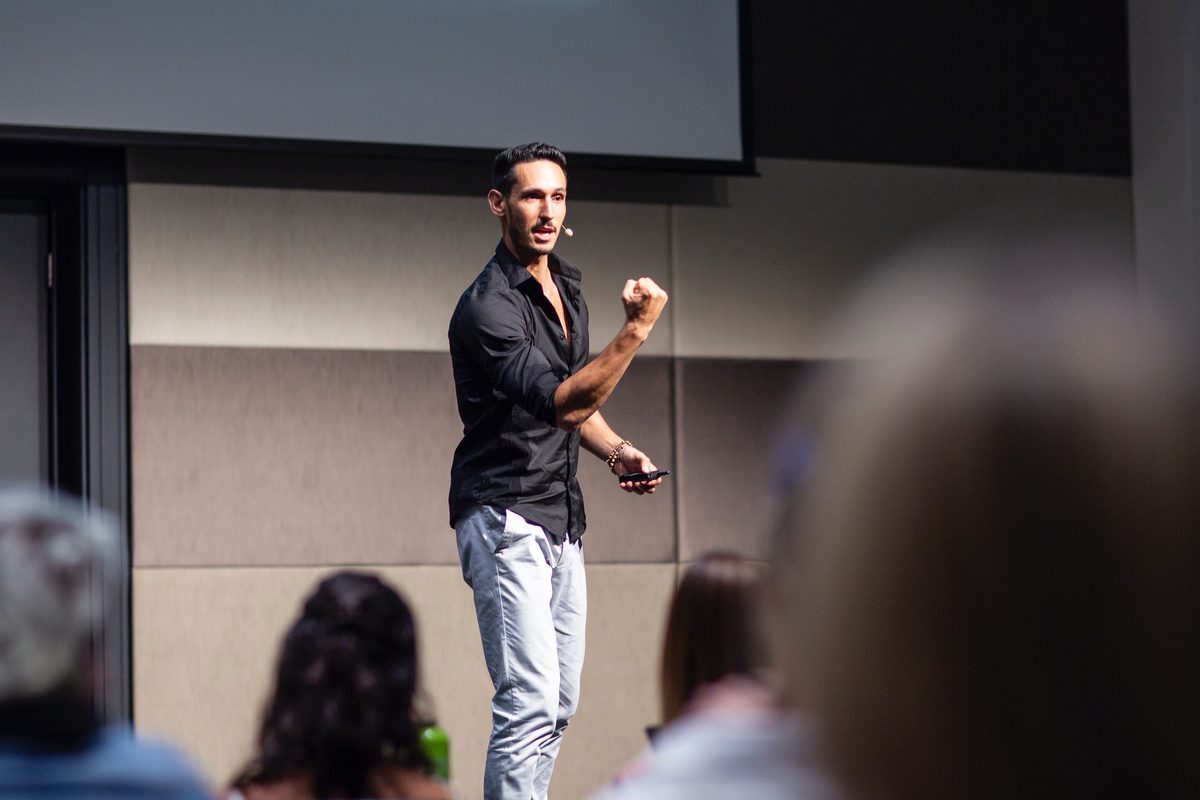
I gave the talk above when I was 29, with no notes and no structure. People always asked me for the techniques and the hacks. Here’s what I told that room instead. “A lot of people see the glory, but they don’t actually see the story.” The website, the movies, the magazine covers are just the highlight reel. The lessons are in the hard yards before any of that, and a lot of mine came from chasing success that wasn’t mine.
Before my story, I asked the room how old they were when they first fell in love with self-development. One man said four. He’d sat on the porch of his great-grandmother’s school teacher, a woman born a slave, and she told him nothing could stop him. It didn’t come from a book. It came from one person who meant it.
Why you keep chasing someone else’s definition of success
The line I want you to take from that speech is this: stop chasing unicorns, AKA somebody else’s definition of success.
For years I put successful people on a pedestal because I hadn’t developed my own story yet. When you don’t know what you want, you grab the nearest picture of success and run at it.
The people you admire are great. But ask the better question: where does that greatness lie in them, and where does it lie in you? Go for that. Whatever you call it (your personal definition of success, what success means to you), it has to come from inside, or you’ll get there and feel nothing.
The glory vs the story: how I got it wrong first
My story starts at about seven years old with Space Jam. I got my mum to buy me a plastic six-foot ring and jumped off bricks to dunk on it. I told her I wanted to be like Michael Jordan. She told me I could be Joel. She handed me Michael Jordan’s Rare Air, my first exposure to training your mind and surrounding yourself with people better than you.
She also gave me a book called 50 Ways to Make Pocket Money. I tried about 20 of them. The one that hit: I earned $50 working for the next-door neighbor over the holidays, spent it on Toblerone bars and mint patties, and knocked on doors selling them back to the neighbors at double the price. I think they felt sorry for me. Then I put the profit into limited-edition NBA cards and traded them at school. I didn’t feel like I had limits.
Then I hit year eight, still 12, and Mum started saying the same thing every morning when I jumped out of the car: “Take a risk. Try something different.” So that year I punched someone out for messing with my mates, let off a flamethrower in the middle of science class and stole chocolates from the grocery store across the road and got arrested. She pulled me aside and explained that wasn’t the kind of risk she meant.
Her next move was Robert Kiyosaki’s Rich Dad Poor Dad. A lot of it went over my head at 12, but two ideas stuck. A nine-to-five job is less stable than it looks, because you can lose it and the economy can crash. And you don’t have to work for money, you can make money work for you.
I got the dream job and felt empty
As a teenager I went all in on hip-hop. I knocked on a radio station’s door week after week until they let me intern for free. Then I told American record labels I could get their music played on one of Australia’s biggest hip-hop and R&B stations. I couldn’t, really. But the exclusives arrived, and eventually the station manager gave me my own midnight show. It took off. I interviewed big artists, shopped beats from producer friends, and at about 20 I scored a record deal with Atlantic Records and moved to Miami.
That was the glory. Within about two years I was waking up every day feeling empty. I had no control. That line about making money work for you kept coming back, so I walked away, and my friends and family thought I’d lost it.
Flying home to Perth, I missed my connection and ended up in a San Francisco motel at 2 a.m., asking myself if I’d made the right decision. A Tony Robbins infomercial was on the TV. I went home, got into his books, put them down because I wasn’t ready yet, and took a sales job because I was driven by money.
The CEO brought in Jordan Belfort, the Wolf of Wall Street, who by then was teaching sales the ethical way. In a workshop he challenged me to write down my vision for success, my strengths, my passions and the solution I was bringing to the world, then read it out in front of everyone. My answer: I love self-development and I’m good with computers, so I could share inspiring ideas with the world. That’s how Addicted2Success started.
Freedom, not money: the desert job that showed me the difference
I got Ds and Fs in high school English, so I believed I couldn’t write. Then my first article for the site went viral. So did the next one. People didn’t want a research paper. They wanted it straight and simple.
Money was still my motivation, though. I took a job up north in the Australian desert with an environmental team clearing land for Chevron, catching snakes, lizards and kangaroos in heat I remember as about 132 degrees Fahrenheit. It was 28 days on, a week off, and a lot of negative people around me. So I’d jump in the car and play Tony Robbins tapes to unplug from it. His message was that when your back’s against the wall, you burn the boats. There’s no other option.
I doubled my content and started networking. In about three months back then, the site jumped from around 400,000 views to over a million, and I was making about $6,000 a month from advertising. Then I walked in and fired my boss.
Here’s the part that matters. Driving home that day, I booked a trip to Italy. I’d never been to Europe. And it hit me: “I was looking for freedom, not money itself.”
Get out of the paper prison
A lot of people are in what I call the paper prison. They’re trapped in the idea of why they need money, and they’ve never asked how they actually value it. Some people want money for significance. Some want power. Some want security. Some want freedom. What they don’t realize is they can find some of those things without the physical money itself.
This isn’t a wealth-building lesson. If you want that side, read how to change your money blueprint before it caps your income. This is about your definition of success. If what you really want is freedom, then a job that pays more but owns every hour of your week isn’t success, no matter how it looks on paper. Name what the money is standing in for, then look for the most direct way to get that thing.
Commit long enough for the truth to show up
About three years in, the site had reached around 40 million views worldwide and over 2 million followers on social media, and I got to interview Tony Robbins. I asked him how the real people stand apart from the flood of coaches, bloggers and YouTubers. As I remember it, he said the cream rises to the top. A lot of people aren’t willing to master, they dabble. Even if you work slowly, if you commit to something for ten years minimum, you’ll be the one who hung in there and the one who gets remembered.
Then I asked what we could actually act on. His answer, as I recall it, was that the biggest advantage you can have in business and in life is truth, and the only way to get truth is through experience. You have to get your hands dirty.
I was a guy behind a blog doing little podcast interviews, so I had to ask myself if I was really getting my hands dirty. I started stretching. Not so much that I’d snap, but enough to grow. I jumped in front of a camera. At first it took a bunch of takes. Now it’s one take. That’s why I’m blunt about people being addicted to information instead of execution. You can’t read your way into your own definition of success. You have to test it.
Ready, willing and able: the three zones of excellence
After interviewing hundreds of successful people, I kept looking for the pattern under what they said. I boiled it down to three zones of excellence:
- Beliefs (ready). Your mindset, and knowing the direction you’re going in.
- Habits (willing). The daily energy bolts of action. Fifty swings at a big tree in one day won’t knock it down. Swing at it every day and eventually it falls.
- Skills (able). Mechanical skills, like learning Photoshop or speaking better, and emotional skills, like how you communicate with people.
You can’t skip one. Imagine you’re ready and willing to be a doctor, and someone comes in who needs a leg amputated a certain way. You’ve got a chainsaw and no skill. You’re going to make a mess. When a client tells me they can’t make something happen, I run the three zones and we can usually pinpoint it. Usually it’s the habits or the mindset they haven’t followed through on.
Turn up the volume on the whispers of wisdom
Looking back from seven years old to 29, my purpose kept giving me little nudges. The books. Tony on a motel TV. Jordan Belfort making me write it down. I call them whispers of wisdom. My friend Peta Kelly calls it the quiet tap on the shoulder. I fought them for years because I thought I knew best.
Everyone has heard them. Some of you just have the volume turned down. Crank it up.
The Christian speaker Myles Munroe, who died in a plane crash in the Bahamas in 2014, made a point I love. A manufacturer doesn’t build a product and then say, let’s see what it’s for. The purpose comes first. The way I heard it, God made us the same way, with a purpose already inside us. Your job is to keep listening for it.
The one-week-to-live test
I live up in the mountains in Santa Barbara, and in the mornings my friend Joe and I stand on the balcony and practice our gratitudes. Gratitude, meditation and networking are the habits I’ve seen come up again and again with the people I interview. One morning, out of nowhere, Joe asked me: if you had one week to live, what would you do?
Nobody had ever asked me that. I told him I’d spend 24 hours with someone filming me, spilling out everything I know for anyone to use, kind of like Randy Pausch’s Last Lecture. I’d been offered millions for Addicted2Success at that point, but if nobody would pay that on the day, I’d sell it for something like $500,000 and fly my friends from around the world to the southwest coast of Australia for a final party on a big boat.
Joe said, “Isn’t that interesting?” All the things I was doing to make more money and build the business didn’t matter in my final days. “You’re not going for the money, are you?” Then he asked how I could start operating from that place a little more. Not fully, because that would be irresponsible. Just more.
That’s the best tool I’ve found to define success for yourself. Answer Joe’s question honestly and you’ll see which goals you borrowed.
How to define success for yourself in 5 steps
- Answer the one-week question. Write what you’d do with seven days left. That list is closer to your real definition of success than your vision board.
- Name what money is standing in for. Significance, power, security or freedom. Then find a way to get some of it now, without waiting for a number.
- Audit your unicorns. List the people whose lives you’re chasing. For each one, write the greatness you see in them and where that same thing lives in you.
- Check ready, willing and able. Is your belief there? Are your daily habits there? Do you have the mechanical and emotional skills? Fix the weakest zone first.
- Commit and stretch. Pick a timeline long enough for truth to show up, think years rather than weeks, and stretch enough to grow without snapping.
It would be a damn shame to die without giving the world your unique gifts and your unique greatness. Stop chasing the glory you saw on someone else’s page, and start writing your own story.
FAQ
How do you define success for yourself?
Remove the goals you borrowed from other people, then ask what you want money, status or attention to give you. Write that down in your own words. Test it with one question: if you had one week to live, would you still want it?
What does it mean to chase someone else’s definition of success?
It means copying another person’s goals, lifestyle or numbers without knowing whether they fit you. I call it chasing unicorns. You can admire someone, but look for where their greatness also lives in you and build from that instead.
What is the paper prison?
The paper prison is being trapped by your need for money without knowing what you value it for. People usually want significance, power, security or freedom. Some of those can be found without the physical money itself, which changes what success looks like.
What are the three zones of excellence?
Beliefs, habits and skills, or ready, willing and able. Beliefs give you direction, habits are the daily action, and skills are both mechanical and emotional. You need all three. Being ready and willing with no skill still makes a mess.
Is it wrong to define success by money?
No, but money is usually a stand-in for something else. When I fired my boss and booked a trip to Italy, I realized I’d been chasing freedom, not money itself. Name the feeling you want, and you’ll make better decisions about how to get it.

Confidence vs ego comes down to where your belief comes from. Confidence is earned: it rests on work you’ve actually done, like knowing you can run five miles today because you ran five yesterday. Ego is stolen: it’s belief you haven’t earned yet, borrowed at a very high interest rate, and it cuts you off from the feedback and reality you need to get better.
That’s the distinction Ryan Holiday gave me when he came on my podcast in 2016, right after Ego Is the Enemy came out. He was about to turn 29. I was reading the book at the time and told him it felt like my whole world was in it. My first question was simple: why is ego the enemy? His answer didn’t give me a definition to memorize. It gave me a test I could run on myself. “Confidence is earned,” he said, “and ego is stolen.”
What’s the difference between confidence and ego?
Ryan was clear he wasn’t talking about Freud. He meant ego in the everyday sense, and he leaned on the football coach Bill Walsh, who described it as the point where “self-confidence becomes arrogance.” In Ryan’s words on the show, ego is the line we cross when “our confidence, our assuredness, our ambition stops being a productive fuel and starts becoming a form of self-sabotage.”
Then he made it concrete. “I’m confident I could run 5 miles this afternoon because I ran 5 miles yesterday and I’ve been training.” Ego is the other voice: “Of course I could run a marathon. I’m the best there ever was.” The first is based on evidence. The second, as Ryan put it, is “what we wish was true rather than what actually is true.”
Here’s the quick version:
| Confidence | Ego | |
|---|---|---|
| Built on | Work you’ve already done | What you wish were true |
| Sounds like | I’ve trained for this | “I’m the best there ever was.” |
| Hears feedback as | Information | An attack |
| After a win | Gets back to work | Feels invincible |
| After a loss | Looks at what to fix | They’re out to get me |
Psychologists draw a similar line. Researchers separate authentic pride from hubristic pride: the first comes from effort and real skill, the second from feeling superior. Same idea. One is earned, one is taken.
When ego does the most damage
Ryan said ego is dangerous at two very different points in a career. The first is the start. You tell yourself, “I got this. Of course, this is going to be easy.” You underestimate how much real work it takes, and you quit halfway because it turned out harder than you thought. The person who expected it to be hard is the one who keeps going.
The second point is worse. It’s right after some success, when you start believing “everything we do turns to gold” and that it can never be taken away. That’s when people implode and wreck the thing they worked so hard to build.
What struck me is that ego doesn’t only talk when things go well. Ryan said when we fail, the same voice whispers, “They screwed you over. This isn’t fair.” I said it sounded like it’s on the same volume but just changes channel depending on where you are in life. Ryan brought up Anne Lamott, who calls that station KFKD, and said to turn it off. If the praise puffs you up, the trolls will flatten you. Ignore both and do work you’re proud of.
Purpose vs passion: why Ryan said don’t be passionate
Chapter four of the book is called “Don’t Be Passionate,” which sounds strange when everyone’s been told to follow their passion. Ryan’s point was that passion without direction is chaos. Purpose is “organized and deliberate,” and it’s aimed at something.
He gave two examples. George Bush was passionate about invading Iraq. Christopher McCandless was passionate about going into the wild, and he died out there. Then he made it practical. If you were hiring, you wouldn’t take someone unqualified, in debt and unreliable just because they’re “really passionate.” You’d want someone mature who shows up on time and is ready to learn. “I think you’ve got to apply that standard to yourself.”
That reminded me of something a friend had told me about relationships. He said love isn’t enough; effort is what’s required. “I love airplanes, but I don’t know how to fly one. I love sports cars, but I don’t know how to fix one.” You need a manual. You have to study, sit the test and do the practical. Business is the same. A lot of people get into it on love alone, without the effort, and the difference between being interested and being committed shows up the moment the work gets boring.
Ryan’s version for writers was blunt. Passion for an idea gets you to about chapter five. After that the words stop coming easily, and you need a deep love of the practice plus a real goal to get you through the editing, the marketing and the next book.
How to take feedback without letting ego defend the work
This is where the confidence vs ego test really earns its keep. Ryan said you need “enough confidence to be sure of what you know you absolutely need to have in the project but then enough humility and open-mindedness that you can take input.”
He lived it on this book. Early readers told him the intro and conclusion were basically in the wrong order, and he restructured it. Then he sent a galley, the near-final version, to Tim Ferriss. By that stage you’re not really supposed to make changes. Tim sent back a long list anyway. Ryan said it would have been easy to say it’s too late and the publisher will be mad. Instead he looked at the notes honestly and decided Tim was right. His estimate: the book got about 15% better.
I told him what I believe about this: “You’ve got to always be in the student chair.” You sit there and say, okay, I don’t know everything, and that’s fine. Ryan added that it’s easier when the feedback comes from someone you respect, which is one more reason to keep people around who are better than you.
Then he gave me a filter he credited to Neil Gaiman. Gaiman’s own wording, from his rules for writing in The Guardian, is: “when people tell you something’s wrong or doesn’t work for them, they are almost always right. When they tell you exactly what they think is wrong and how to fix it, they are almost always wrong.” So keep the first part and question the second. Something isn’t landing. Your job is to figure out why, not to argue.
Impatience is ego in disguise
Ryan sold his first book, Trust Me, I’m Lying, when he was 24. He was so convinced it had to come out right now that they didn’t even do galleys. Looking back, with the book still selling five years later, he said he obviously could have waited. “We want people to recognize how smart we are and before the work is out, that can’t happen.” That rush is ego. Every reader who picked up a weaker version is someone you have to work hard to win back.
I’d had a conversation with John C. Maxwell, who told me your first book is probably your worst. Ryan agreed and said he’s proud of that. Getting better with each thing you make is the point. He also said you have to be OK with a world where the book sells one copy, because the only thing you control is the work. If you can think that way, two readers feels lucky and a thousand feels like a miracle.
4 ways to keep confidence from turning into ego
When I asked Ryan for steps people could use right now, he didn’t give me affirmations. He gave me habits.
- Train plus, minus and equal. Ryan borrowed this from Frank Shamrock, the mixed martial arts pioneer and UFC champion. Every fighter trains with someone better (plus), someone equal and someone they’re teaching (minus). The plus shows you what you’re doing wrong. The equal keeps you honest. The minus makes you explain it, and teaching is often the best way to learn. Ryan said you should have all three at work, at home and among your friends.
- Turn dead time into live time. This one came from Robert Greene. Stuck in traffic, waiting out a contract or sitting in a dead-end job, you decide whether that time is dead or alive. “Often times we waste time out of ego,” Ryan said. If someone’s 30 minutes late, you can spend it calling them a rude jerk or you can read. He showed me a note card from his desk about Ian Fleming, who was forbidden a typewriter while recovering from a heart attack and wrote Chitty Chitty Bang Bang by hand in the hospital.
- Get small on purpose. Ryan quoted Bertrand Russell, who wrote in The Conquest of Happiness that “one of the symptoms of approaching nervous breakdown is the belief that one’s work is terribly important.” A couple of times while writing, Ryan had to tell himself, “It’s just a book, man.” He started spending more time walking in the woods, on a beach in the middle of the night, on top of a mountain. It’s hard to feel full of yourself there. He meditates, too, and said it’s hard to have ego when you’re focused on the present moment. Back then I was living in Santa Barbara out in the mountains, and I spun the camera around to show him the view of the ocean and the valleys where I’d sit and meditate. He also said his relationship keeps him honest: if the book is amazing but it costs the person you love, is that really winning?
- Take pride only in what you control. Ryan pointed to Michael Bloomberg, who has said, “I’m not smarter than anybody else, but I can outwork you.” You don’t control your IQ. You control your hours, your research and how much you put in. That’s where confidence should live.
You choose the ending of every story
Near the end I brought up a picture quote my friend Alexi had shared that morning. It went something like: was it really a bad day, or did you just milk a five-minute problem?
Ryan tied it straight to the Stoics. “You choose the ending to every story.” If someone’s rude to you at breakfast, you decide whether that ruins your day or stays an insignificant moment. They don’t get the other 23 hours unless you hand them over.
Here’s how I see it play out. We give an event a meaning. Keep repeating that meaning and it becomes a mood. Hold the mood long enough and it solidifies into a belief, and now it’s part of your programming, running your life without you noticing. Ryan took it one step further: you start making decisions from that belief. You’re in a bad mood, so you’re rude to someone who works for you, they stop trying as hard, they make a mistake, and now things really are bad. Ego turns a five-minute problem into a self-fulfilling prophecy.
If you want the practical side of that, the Stoic dichotomy of control is the tool. Ryan’s last 30 seconds came back to the same place. He reached for Kurt Vonnegut, whose advice boils down to be kind, and then the Stoic line he tries to live by: you don’t control what happens to you, you control how you respond.
Here’s where I land
Ego is sneaky because it feels like confidence. It even sounds like it. The difference is the receipt. Before you back yourself, ask what work you’re standing on. If you can point to the miles, the reps, the drafts and the notes you took, that’s confidence and you should use it. If all you’ve got is a feeling that you’re special, you’re borrowing, and the bill always comes.
So this week, find your plus, your equal and your minus. Pick one stretch of dead time and make it live. And the next time someone tells you something isn’t working, say thank you before you say anything else.
FAQ
What is the difference between confidence and ego?
Confidence is belief backed by real work and evidence, like knowing you can run five miles because you ran five yesterday. Ego is belief you haven’t earned, based on what you wish were true. As Ryan Holiday put it, confidence is earned and ego is stolen.
Is confidence the same as arrogance?
No. Confidence stays connected to reality and stays open to feedback. Arrogance is what happens when confidence goes past what you’ve earned. Bill Walsh described ego as the point where self-confidence becomes arrogance.
How do I know if I’m acting from ego or confidence?
Check how you react to feedback. If notes feel like an attack, or you’re rushing to be recognized before the work is ready, that’s ego. If you can point to the work behind your belief and still take notes, that’s confidence.
How do you build confidence without ego?
Train with someone better, someone equal and someone you teach. Use waiting time to read or think instead of complaining. Spend time in nature, and take pride only in what you control, like the hours and research you put in.
What did Ryan Holiday say about confidence vs ego?
On my podcast in 2016, Ryan Holiday said confidence is based on what’s real and earned through work, while ego is stolen, borrowed at a very high interest rate. He warned that ego does the most damage at the start of a career and right after success.


You sit down to study with the best intentions. The textbook is open, the assignment is due soon, and you know exactly what needs to be done. Then a notification appears. You check it “just for a second,” open another tab, reply to a message, and suddenly twenty minutes have disappeared.
An hour later, the page is still blank. You feel behind, frustrated, and convinced that you simply lack discipline. But focus is not a personality trait or a measure of intelligence. It is a skill shaped by your environment, energy, habits, and the way you approach difficult work.
For university students, poor concentration is rarely caused by one thing. It usually comes from a mix of digital distractions, procrastination, exhaustion, stress, and unclear planning. The good news is that each of these can be addressed with practical changes. You do not need to become a different person overnight. You need a system that makes focus easier than distraction.
Why Students Struggle With Focus
Digital distractions train your attention to scatter
Phones, social media, messaging apps, and endless browser tabs are designed to capture attention quickly. Every notification creates a small interruption, and every interruption makes it harder to return to deep work.
The problem is not only the time spent scrolling. It is the mental switching. When you move between a lecture reading, a group chat, a video, and an assignment, your brain repeatedly changes direction. That makes even short study sessions feel fragmented and unproductive.
A student may spend three hours at their desk but complete only twenty minutes of meaningful work because of constant digital distractions. Learning to manage technology is essential, but it is equally important to recognize when additional academic support can make a difference. For students struggling with demanding assignments, searching for ways “to pay someone to write my research paper online” may lead them to professional essay writing services that offer expert guidance, well-structured content, and help with challenging academic tasks. By providing tailored academic assistance, expert insights, and well-organized research materials, these services can help students strengthen their understanding, improve the quality of their assignments, and achieve better academic results.
Procrastination often comes from fear, not laziness
Many students procrastinate because a task feels too large, unclear, or emotionally uncomfortable. Writing a dissertation, preparing for a difficult exam, or starting a long reading assignment can trigger thoughts such as, “What if I do it badly?” or “Where do I even begin?”
Perfectionism makes this worse. If you believe every sentence, calculation, or revision session must be excellent from the start, beginning becomes intimidating. So you delay. Then the deadline gets closer, pressure increases, and the task feels even harder.
Procrastination is usually an attempt to avoid discomfort. The most effective response is to make the first step so small that discomfort cannot stop you. Instead of “write the essay,” begin with “open the document and write three rough bullet points.” Instead of “study biology,” begin with “review one topic for fifteen minutes.”
Fatigue makes concentration harder
Focus requires mental energy. When you are sleep-deprived, physically drained, or constantly moving between classes, work, and social commitments, your brain has less capacity available for sustained attention.
Lack of sleep can make simple tasks feel overwhelming. It becomes harder to remember information, follow an argument, solve problems, and resist distractions. In that state, checking your phone or postponing work can feel like relief, even when you know it will create more stress later.
Many students try to compensate with caffeine, late-night study sessions, or weekend sleep catch-up. These strategies may help briefly, but they do not replace consistent rest. A stable sleep routine gives your brain a better foundation for learning and concentration.
Anxiety turns studying into a threat
Stress and anxiety can make focus difficult even when you genuinely want to work. When your mind is occupied by deadlines, grades, finances, relationships, or fear of failure, part of your attention is always pulled away from the task in front of you.
This can create a cycle: you feel anxious about falling behind, so you avoid the work; avoiding the work creates more pressure; the pressure makes the next study session feel even more intimidating.
The answer is not to demand that you “stop worrying.” It is to reduce the size of the immediate task and give your mind a clear place to start. A manageable plan lowers the emotional weight of studying. It turns a vague source of stress into a sequence of actions you can complete.
Poor organisation creates unnecessary decisions
Sometimes the issue is not a lack of effort. It is a lack of clarity. You sit down to study but spend the first twenty minutes deciding what to read, which assignment to start, where your notes are, or whether you should answer messages first.
Every small decision uses mental energy. When you have no plan, your brain looks for the easiest option, which is often distraction. A cluttered desk, an overloaded calendar, and a vague to-do list can make even motivated students feel stuck.
Strong focus begins before you open a book. It starts with knowing what you will work on, why it matters, and what “done” will look like for that session.
How to Fix It
Use the Pomodoro Technique
The Pomodoro Technique is one of the simplest ways to rebuild focus. It works because it gives your brain a clear beginning, a defined endpoint, and regular recovery.
Here is how to use it:
- Choose one specific task, such as reading a chapter, drafting an essay section, or reviewing lecture notes.
- Set a timer for 25 minutes.
- Work only on that task until the timer ends.
- Take a five-minute break away from your screen.
- After four focused sessions, take a longer break of 15 to 30 minutes.
This method is useful because it makes starting less intimidating. You do not need to commit to five hours of studying. You only need to commit to 25 minutes.
Apply it differently depending on the task. When preparing for an exam, use one Pomodoro to review a single topic and another to test yourself with practice questions. When writing a coursework assignment, use one session to create an outline, another to draft a section, and another to edit. When reading, set a realistic page or chapter target for each session.
The key is to protect the 25 minutes. No messages, no social media, no switching to another assignment. One task, one timer, one clear outcome.
Create a digital detox routine
You do not need to disappear from social media to improve focus. You need to make distraction less automatic during study time.
Try these boundaries:
- Turn on “Do Not Disturb” or Focus mode before you begin.
- Put your phone in another room, a drawer, or a bag during study blocks.
- Turn off non-essential notifications, especially social media and group chats.
- Close unrelated browser tabs and use only the materials required for the task.
- Set specific times to check messages, such as after a study session or during a scheduled break.
- Keep a notepad nearby for sudden thoughts, so you can write them down instead of acting on them immediately.
The goal is to remove the decision from the moment. If your phone is within reach, checking it requires willpower. If it is in another room, choosing focus becomes the default.
Plan before you sit down
Focus improves dramatically when you know exactly what to do. Before each study session, take two minutes to define one to three priorities for the day.
A useful format is:
- One priority task that must be completed today.
- One secondary task that would move an assignment forward.
- One small task that builds momentum, such as reviewing notes or organising materials.
Break large projects into concrete actions. “Finish psychology assignment” is too broad. “Find three sources,” “write the introduction,” “create an essay plan,” and “edit the first draft” are actionable steps.
Schedule study blocks in advance rather than waiting for a free moment. Put them in your calendar like appointments. Start with the most important or most difficult task while your energy is highest. Completing it early reduces stress and makes the rest of the day feel more manageable.
Protect sleep like it is part of studying
Sleep is not lost time. It is when your brain consolidates learning, restores energy, and prepares you to concentrate the next day. When sleep suffers, focus, memory, mood, and motivation usually suffer too.
A few practical habits can help:
- Aim for a consistent sleep and wake time, even on weekends.
- Avoid using your phone in bed, especially in the final 30 to 60 minutes before sleep.
- Create a simple evening routine: dim the lights, prepare clothes or materials for tomorrow, and do something calming.
- Avoid treating weekends as a time to “catch up” on several days of lost sleep.
- If you study late, stop before you become so tired that the work becomes inefficient.
You do not need a perfect routine. You need a repeatable one. A consistent bedtime, a quieter evening environment, and fewer screens before sleep can make a noticeable difference in your ability to focus during the day.
Examples
Preparing for an exam
Suppose you have an exam in three days and several topics to cover. Instead of telling yourself to “study all day,” choose three priority topics. Use a 25-minute Pomodoro to review the first topic, then a second to answer practice questions. Take a five-minute break, then repeat.
Keep your phone outside the room and write down any unrelated thoughts for later. After four sessions, take a longer break. By the end of the day, you will have made measurable progress without relying on a marathon study session.
Writing a coursework assignment
A long assignment can feel impossible when you view it as one enormous task. Divide it into stages: understand the question, gather sources, create an outline, write a rough draft, and revise.
Start with a 25-minute session devoted only to creating an outline. Do not try to write perfectly. Your goal is momentum. In the next session, draft one section. In another, improve the argument or add supporting evidence. Small sessions turn a frightening project into a series of achievable steps.
Studying after a busy day
After lectures, work, commuting, and social commitments, evening study can feel impossible. Do not begin by asking yourself to complete everything. Choose one meaningful task, set a timer for 25 minutes, and remove your phone from reach.
Even one focused session can maintain momentum. If energy is low, make the task smaller: review notes for 15 minutes, summarise one concept, or prepare tomorrow’s priority list. Consistency matters more than intensity.
Focus Checklist for Students
Before your next study session, use this checklist:
- Choose one specific task, not a vague goal.
- Define what you will complete by the end of the session.
- Remove your phone from your immediate workspace.
- Turn on “Do Not Disturb” or Focus mode.
- Close unrelated tabs and apps.
- Prepare the materials you need before starting.
- Set a timer for a 25-minute Pomodoro.
- Begin with the most important or most difficult task.
- Take a proper break after each focused session.
- Review what you accomplished and plan the next step.
Final Thoughts
Struggling to focus does not mean you are lazy, unmotivated, or incapable of succeeding at university. It usually means your environment, energy, and systems are working against you. Digital distractions, procrastination, fatigue, anxiety, and poor planning can all pull attention away from the work that matters.
The solution is not more pressure. It is better structure. Use the Pomodoro Technique to make starting easier, create digital boundaries to protect your attention, plan one to three priorities each day, and treat sleep as part of your academic performance.
Choose one method and apply it within the next 24 hours. Put your phone in another room, set a 25-minute timer, and complete one focused study session. That single decision can interrupt the cycle of distraction and show you that focus is something you can build, one deliberate session at a time.

For most of the last century, women’s football was treated as a sideshow. In England it was effectively banned for fifty years. Players trained after full-time jobs, paid their own travel costs and played in front of a few hundred people, if they were lucky.
Today, women’s matches sell out the biggest stadiums in the world. In 2022, 87,192 fans packed Wembley for the Women’s Euro final, a record for any European Championship game, men’s or women’s. A year later, nearly two million people attended the Women’s World Cup in Australia and New Zealand.
That turnaround did not happen by accident. It is one of the best comeback stories in modern sport, and it is full of lessons for anyone trying to build something from nothing, whether that is a business, a career or a personal goal. Here are seven of them.

Wembley Stadium before the Women’s Euro 2022 final, watched by a record 87,192 fans. Photo: Daniel from Glasgow, United Kingdom, CC BY 2.0, via Wikimedia Commons
1. Start Before Anyone Gives You Permission
On Boxing Day 1920, a women’s team called Dick, Kerr Ladies played at Goodison Park in Liverpool in front of around 53,000 people. Less than a year later, the Football Association banned women from playing on its members’ grounds. The ban stayed in place until 1971.
The women who kept playing during those decades did not wait for approval. They organised their own matches on public parks, raised their own money and kept the game alive for the next generation.
Most big goals start the same way. Nobody hands you a stadium, a budget or a green light. You start with what you have, where you are, and you build the proof that eventually makes people take you seriously.
2. Small Stages Build Big Careers
When Benfica launched its women’s team in 2018, it did not start at the top. The club entered Portugal’s second division and spent its first season playing on small grounds against part-time sides. Within three seasons, Benfica were national champions, and soon after they were playing in the Champions League.
That pattern repeats right across the women’s game. Look at the women’s league fixtures and scores in a second tier like Portugal’s II Divisão and you will find players who are working day jobs, studying and training in the evenings. Some of them will be international players within a few years.
The lesson is simple: the small stage is not a waste of time. It is where you sharpen your skills while the pressure is low, make your mistakes cheaply and build the habits that carry you when the spotlight finally arrives.
3. Consistency Beats Hype
Women’s football did not grow because of one viral moment. It grew because leagues kept playing, clubs kept investing and players kept turning up, week after week, long before the crowds and TV deals arrived.
The headline moments, such as the 91,553 fans who watched Barcelona play Real Madrid at Camp Nou in 2022, were built on years of unglamorous work that nobody filmed.
It is the same in any field. One great launch, one big client or one good month will not make you successful. Showing up consistently, even when nobody is watching, is what makes the big moments possible.
4. Turn Doubters Into Fuel
For years, women footballers were told the same things: nobody will watch, nobody will pay, nobody will sponsor it. Every packed stadium since then has been an answer to those doubters.
Criticism hurts, but it can also give you clarity. When someone says something cannot be done, it tells you exactly what you need to prove. The players who changed the women’s game did not argue with the critics. They simply kept performing until the argument was over.
If people doubt your idea, do not waste energy trying to convince them with words. Let your results do it.
5. Build a Team, Not Just a Talent
Football is a team sport, and the rise of the women’s game was a team effort too. Players, coaches, volunteers, club owners, journalists and fans all played a part. No single star could have done it alone.
Even the greatest individual players rely on the people around them. If you have ever read through some motivational Lionel Messi quotes, you will notice how often he puts the team ahead of his personal records.
Whatever you are building, surround yourself with people who share the mission and bring skills you do not have. Talent opens the door, but a strong team is what keeps you in the room.
6. Invest When Others Won’t
The clubs and organisations that backed women’s football early, when it looked like a risk, are the ones reaping the rewards now. Governing bodies have also shifted their thinking. FIFA’s women’s football programmes now fund development, leagues and coaching around the world, something that would have been hard to imagine a few decades ago.
Being early is uncomfortable. People question your judgement and the returns take time. But the biggest opportunities are usually found where others are not looking yet.
Whether it is a skill, a market or a relationship, be willing to invest before the crowd arrives. By the time something is obviously a good idea, the best opportunities have often gone.
7. Play for the Next Generation
Ask many of today’s top women players why they kept going in the hard years, and you will often hear the same answer: they wanted girls coming after them to have it easier.
That bigger purpose is powerful. It gets you through the early mornings, the rejections and the setbacks, because the goal is bigger than you.

Spain celebrate winning the 2023 Women’s World Cup in Sydney. Photo: Storm machine, CC BY-SA 4.0, via Wikimedia Commons
When your motivation is only about yourself, it is easy to quit when things get tough. When you are doing it for your family, your community or the people who will follow you, quitting becomes much harder.
Final Thoughts
The rise of women’s football shows what is possible when people refuse to accept the limits other people set for them. A game that was once banned and ignored now fills the world’s biggest stadiums.
You do not need a stadium to apply these lessons. Start before you feel ready, respect the small stages, stay consistent, use doubt as fuel, build a strong team, invest early and keep a purpose that is bigger than you. Do that for long enough, and the crowds tend to show up.
Frequently Asked Questions
Why was women’s football banned in England?
In 1921, the Football Association banned women’s teams from playing on its members’ grounds, claiming the game was unsuitable for women. The real effect was to stop a sport that was drawing huge crowds. The ban was not lifted until 1971.
What is the biggest crowd for a women’s football match?
One of the best-known records is the 91,648 fans who watched Barcelona play Wolfsburg at Camp Nou in April 2022, a few weeks after 91,553 had watched Barcelona play Real Madrid at the same stadium.
What can entrepreneurs learn from women’s football?
Mainly that lasting success is built slowly. Consistent effort, a strong team, early investment and a clear purpose turned women’s football from an afterthought into a global sport, and the same principles apply to building a business.

How to Define Success for Yourself Before You Chase Someone Else’s

W-2 vs 1099: The Misclassification Shortcut That Can Cost You the Business

Burn Rate and Runway: How to Calculate How Long Your Startup Has Left

Confidence vs Ego: Why One Is Earned and the Other Is Stolen

How to Change Your Money Blueprint Before It Caps Your Income
5 Ways For Startups To Succeed Making Acquisitions

77 Inspirational Quotes That Will Change Your Life
57 Memorable Kobe Bryant Quotes

Motivational Picture Quotes: 52 Images to Inspire a Successful Year

40 Rare Motivational and Inspirational Picture Quotes
3 Prince EA Videos To Change Humanities Path To Greatness
(Video) What Is Success? An Entrepreneurial Story To Inspire You
(Inspirational Video) What If Today You Knew You Were Going To Take Your Last Breath?
How To Make Enough Money From A Blog To Quit Your Job – Kate McKibbin
How Finding Your Passion And Becoming An Entrepreneur Can Lead To Happiness – Chiquita Searle
-

 Did You Know1 year ago
7 Surprising Life Lessons Video Games Taught Me That School Never Did
-

 Life2 years ago
The 5 Stages of a Quarter-Life Crisis & What You Can Do
-

 Success Advice1 year ago
Stephen Covey’s 8 Leadership Habits That Will Change How You Lead Forever
-

 Featured2 years ago
The Psychology of Motivation: How to Keep Moving Forward Every Day
-

 Life1 year ago
How to Stop the War in Your Head and Find Peace
-

 Personal Development2 years ago
The Three-Second Pause That Changes How People Perceive You
-

 Explode Your Social Media1 year ago
Want More Views? Master These 6 YouTube Growth Tactics
-

 Change Your Mindset1 year ago
You Become What You Absorb: How Input Shapes Your Life
22 Comments