
Success Advice
Why It Is Important To Fail


A lot of us are afraid to fail. We believe it as a sign of weakness and can even come to regret ever taking that leap of faith. Well, contrary to this belief, a number of highly successful achievers often credit a failure or two, to their success.
Read on as we break down the fundamental reasons why failure should be important to you.
Welcoming Failure
“Eventually, we all must come to a decision, for ourselves, about what represents failure; however, the world is very keen to put failure on a schedule, and give you a set of decisive factors, if you allow it. A meager seven-years following my graduation, failure had hit me on a grand scale. A fleeting marriage was dissolved, I had no job, a single parent, and as destitute as anyone could possibly be without living on the streets. My parent’s fears for me, and those I had for myself, had finally transpired, and according to the book of failure, I was the biggest.” This paragraph is a summation of a speech given by J.K. Rowling at the, AMHAA, the Annual Meeting of the Harvard Alumni Association. If any of you are not familiar with the name J.K. Rowling, she is the creator of Harry Potter. A fable filled with unbelievable characters and imaginary. Yet, at one time, she had considered herself a failure.
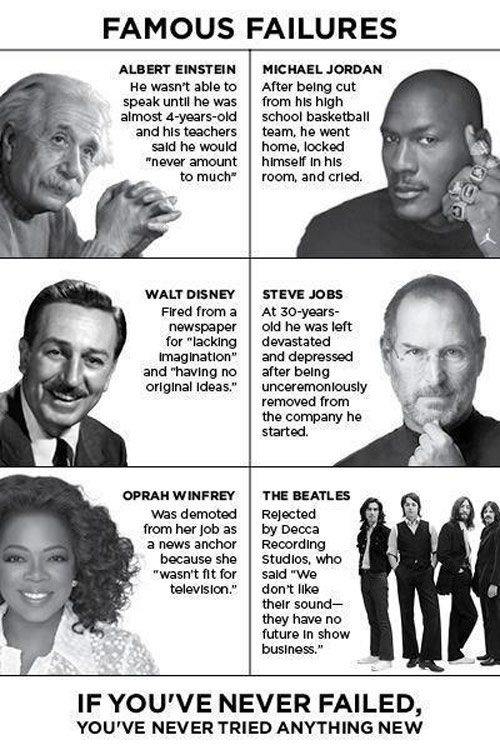
The premise of using J.K. Rowling as an example about the importance of failure is to emphasize the point that, failure is not unusual. Being an author worth billions of dollars is not a prerequisite in order to learn from our failures and to attain success. Success means something different to different people. However, there is something everyone has in common who has succeeded at what they set out to do; they have failed at one time or another. In fact multiple times. Henry Ford, the great automaker, went bankrupt four times. Google tried to sell itself for one million dollars! Thomas Edison produced thousands of light bulbs that gave no light at all!
Failure is a type of freedom. Why? Because the worst has happened. Now, you can relax and rebuild your life. You do not have to fail on a large scale, but failure in life is inevitable. There is no way to live life without failing from time to time. The only way you won’t fail is if you live so guardedly that you are barely living at all, wherein, you fail by default. A wise thinker once stated, “Avoiding danger is no safer in the long run than out-and-out exposure, and the fearful are captured just as frequently as the bold.” Failure is not something to shun, but something to embrace.
The Importance of Failure
Okay, it’s clear; we all will face failures in life. However, this does not mean we should “chase failure” in order to get it over with, so to speak. It’s a funny thing, but failure is never planned. It’s the companion of success. An unwanted companion for sure, but nevertheless, a very important one.
When we resist failure, it attaches itself to us. You don’t solve an issue by resisting it. We overcome failure by accepting it, analyzing it, dissecting it, and looking at it from every possible angle. Without failure, there is no growth.
The Business of Failure
The United States, SBA, Small Business Administration, states that more than half of small businesses fail during the initial five years in service. However, failed entrepreneurial pursuits are as vital as successful ones. One trade that thrives on failure is the technology industry. There’s hardly anyone over the age of 25 who is not familiar with the late Steve Jobs, the founder of Apple Computers. He was the perfect example of courage in failure. In his first attempt at a mobile gadget, it failed. In fact, it failed pretty badly and he was thrown out of the company. Nonetheless, he is one of the greatest comeback stories of all time.”
Unfortunately, failure in entrepreneurial activity is frowned upon. During Steve Job’s attempts at success in the 70s, failure was par for the course. Markets are certainly sought-after not because they are “failure proof.” It’s because they offer a procedure for gaining from mistakes along with the inducement to correct them. Entrepreneurs have to be crafty. They are not only good at getting things right, they, like the rest of us, can understand when they have it wrong and work on correcting their mistakes.
The More You Fail, the More You Win
Failure drives us to change. Without it, where would we be today? Thomas Edison produced tons of light bulbs that did not work. If he had not tried again and again, well, we all know the answer to that one. Winston Churchill once stated, “Success is based on going from failure to failure without losing eagerness.” Of course, some individuals are sardonic. These types of people never pick themselves up from failure because they did not grow from a previous failure. Failure is the most wonderful teacher if we are willing to learn from it.
Success does not come easy. Everyone must face one hurdle after another. It’s the only way to reach success. The reason being is that success must be maintained. If you think that once you have the success you crave and it’s time to relax, you are sadly mistaken. For example, you’ve always wanted to buy a home. You finally purchase the home of your dreams. However, your home must be maintained. Once a goal is reached, you must have the tenacity to remain there and move higher if you wish. Without repeated failures, you do not have the know-how of sustainability.
Even though success is the power that hastens us en route to our goals, it is failure that guides us to those goals that count. When failure is acknowledged as being just as vital as success, it’s easier to accept it freely and carry on with searching for a resolution.
Plan B
A very well known fellow stated, “the most successful people are those who are good at Plan B.” Individuals who are good at “brushing failure off their shoulders” take the necessary steps to try again, usually with Plan B. In fact, Plan B may not even be a plan at all! Plan B is the “I can do it attitude.” Plan B, is the transition from failure to success. We can comprehend the function for failure if we acknowledge that human beings prefer to “dispel the uneasiness of failure.” Human beings are forever determined to achieve their loftiest goals as frequently as time permits. However, failure surrounds us and no person ever experiences a total lack of uneasiness. There is always that smidgen of the unknown. Regardless of our best efforts, we are never 100% sure of success! There is always that lingering doubt in the back of our minds; in spite of this, our will is stronger than failure and doubt inevitably loses.
“The desire to succeed, must be great than the fear of failure.” This statement was made by well-known actor and comedian Bill Cosby. In our personal and professional lives, the aforementioned quote states the significance of failure and how big a part it plays in each of our lives. Consider this. During the day, where is your energy focused? Is it focused on succeeding or failing? Is the glass half-empty or half full? Our thoughts have us on leash. Eventually, we go where they lead.
If you focus on negativity, then your world become cynical. If you focus on positivism, even the harshest defeat is only a stepping-stone. A mother was speaking with her daughter who was despondent about repeated failures. She spoke about well-known personalities and how they succeeded because they “tried that one last time.” This gave her daughter the incentive to try again. After reading about the importance of failure she stated, “you never know what waits beyond failure; therefore, I will try again.” Failure is the stratagem that leads to success. Without it, where would we be?
Here are some examples of those who failed before reaching amazing success:















The early stages of building a business often reward resourcefulness. Founders learn to handle sales, administration, marketing and customer service because there is nobody else to do them. Over time, however, the habit of doing everything can become its own constraint. The calendar fills up, attention fragments and important decisions are squeezed between errands.
Getting time back is not simply a matter of working faster. It requires deciding where your attention makes the greatest difference and creating support for the rest. Small, thoughtful changes at work and at home can create more room for the activities that matter most.
Audit Your Week Honestly
For several days, note how you spend your time. Include the small tasks that rarely appear in a formal schedule: chasing an invoice, responding to routine questions, sorting laundry or making repeated trips for supplies. You do not need a sophisticated tracking system. A simple list can reveal patterns.
Next to each activity, write whether it must be done by you, can be simplified or could be delegated. Be realistic about commitments that are personally important. The aim is not to turn every hour into billable work; it is to understand which obligations are consuming energy without a deliberate choice.
Protect The Work That Needs Your Attention
Identify a few activities where your involvement is especially valuable. That might be building relationships with key customers, setting direction or developing a new offer. Reserve time for those priorities before the week fills up with reactive tasks. A clear boundary around a short block of focused work can be more useful than an ambitious schedule that is never followed.
Tell colleagues when you are available for questions and when you need uninterrupted time. Where possible, group routine decisions into designated check-in periods. The goal is not to become inaccessible, but to reduce the constant switching that makes meaningful work difficult.
Decide What To Delegate
Delegation begins with a clear outcome. Explain what needs to be done, what good work looks like and when a decision should come back to you. Start with a repeatable task and give the person responsible enough context to succeed. If the result is not quite right, improve the instructions rather than immediately taking the task back.
The same principle can apply outside the business. For example, someone looking for support with a recurring household chore could explore services such as The Laundry Lady Canada. Check current availability, pricing and service details before booking, and decide whether the convenience fits your circumstances.
Calculate Value In Context
When considering help, compare the cost with what you gain, not just with the time it takes to complete the task yourself. The benefit may be an hour for a client project, a calmer evening with family or simply less mental clutter. Those outcomes are not identical, and only you can decide which are worth paying for.
Keep the budget realistic. Delegation should not create financial pressure that outweighs the relief it provides. Consider testing a service or arrangement for a limited period, then review whether it genuinely improved your week.
Create Systems That Are Easy To Maintain
A system does not need to be complicated. A shared checklist for opening the shop, a template for common customer questions or a regular household collection point can prevent repeated decisions. Document the steps in language that another person can understand and keep the instructions where they will actually be used.
Review these systems occasionally. If a checklist has become longer than the task itself, simplify it. If a delegated job still generates a stream of questions, clarify the boundaries. The best process is the one that makes reliable action easier, not the one with the most detail.
Communicate the change with the people who share your responsibilities. A new household routine or workplace process is more likely to stick when everyone understands what has changed and where to find the details. Keep expectations modest at first, and invite feedback about anything that creates new work for someone else. Saving your own time should not simply move an invisible burden onto another person.
Make Space For Recovery
It can be tempting to fill every hour you recover with more work. Resist making that the automatic choice. Rest, relationships and unstructured time are part of a sustainable life, not rewards that must be earned after everything else is finished. Decide in advance how you want to use at least some of the space you create.
You do not have to delegate everything at once. Choose one recurring task, make a plan and review the result after a few weeks. Building a business is demanding; building a life that can support it is a worthwhile project too.

Success rarely comes from talent alone. It often develops through consistent effort, a willingness to learn, and the ability to overcome challenges. While many people associate personal development with reading books, attending seminars, or practicing mindfulness, learning hands-on skills can be equally valuable.
Learning these practical activities encourages you to think differently:
- Woodworking
- Welding
- Automotive repair
- Home improvement
They challenge your patience, strengthen your problem-solving skills, and teach you to see mistakes as opportunities to improve. Over time, these experiences can help you develop a stronger growth mindset that extends beyond the workshop and into everyday life.
Understanding The Connection Between Practical Skills And A Growth Mindset
A growth mindset is the belief that abilities and intelligence can develop through effort, learning, and experience. Rather than viewing challenges as evidence of personal limitations, people with a growth mindset see them as opportunities to improve.
Hands-on activities naturally encourage this mindset because progress rarely happens immediately. Learning to weld two pieces of metal together or build a wooden table requires practice, concentration, and repeated adjustments.
Each attempt provides feedback about what works and what needs improvement. As your abilities develop, you begin to recognize that persistence and deliberate practice can produce meaningful results.
This realization can change how you approach other challenges. Instead of assuming something is beyond your capabilities, you become more willing to explore solutions and develop the necessary skills.
Learning To Embrace Challenges Instead Of Avoiding Them
One of the biggest obstacles to personal growth is the fear of doing something difficult. Many people avoid unfamiliar activities because they worry about making mistakes, wasting time, or appearing inexperienced.
Practical skills encourage you to confront these concerns directly. When you begin learning a trade or tackling a DIY project, you quickly discover that challenges are unavoidable.
A beginner learning woodworking might struggle to make accurate measurements or assemble pieces correctly. Someone learning automotive repair might spend hours identifying the cause of a mechanical problem.
Although these situations can feel frustrating, overcoming them builds confidence and resilience. Every challenge you successfully navigate reinforces your ability to handle unfamiliar situations.
Eventually, you may begin approaching difficulties with curiosity rather than hesitation. This shift can positively influence your career, relationships, and personal ambitions.
Building Confidence Through Visible Progress
Confidence often develops when you have tangible evidence of your capabilities. Hands-on activities provide this evidence because they allow you to see the results of your efforts.
Imagine starting a project with little knowledge and gradually developing the skills needed to complete it. The finished product becomes a physical reminder of your progress and determination.
Unlike some personal development activities, practical work often provides immediate feedback. As you gain experience, you can identify improvements in accuracy, efficiency, craftsmanship, and overall quality.
These small achievements build a stronger sense of self-efficacy, or your belief in your ability to accomplish specific tasks. Greater self-efficacy can encourage you to pursue more ambitious goals.
The key is to recognize progress rather than expect perfection. Celebrating small improvements helps maintain motivation while reinforcing the value of consistent effort.
Developing Patience And Long-Term Discipline
Modern life often encourages immediate results. From instant communication to convenient digital services, people have become accustomed to getting what they want quickly.
However, mastering a hands-on skill requires a different approach. You must spend time learning techniques, practicing movements, and correcting mistakes.
For example, becoming proficient in welding involves learning about materials, equipment, safety procedures, and different welding techniques. These abilities develop through structured learning and repeated practice, not shortcuts.
This process teaches you to appreciate gradual improvement. Instead of focusing exclusively on the final result, you learn to value the effort required to reach it.
The discipline developed through practical activities can support other areas of personal development. Whether you’re building a business, improving your fitness, or learning a new language, consistent effort remains essential.
Strengthening Problem-Solving And Critical Thinking Skills
Hands-on projects rarely go exactly as planned. Unexpected complications force you to analyze situations, consider alternatives, and make informed decisions.
For example, a metalworking project might require you to adjust measurements, reconsider your design, or change your approach. Rather than abandoning the project, you must identify the problem and determine how to resolve it.
This process strengthens critical thinking by encouraging experimentation and independent decision-making. You learn to evaluate different solutions instead of relying on a single approach.
These abilities are valuable in professional environments where adaptability and creative thinking are essential. Entrepreneurs, managers, and employees regularly encounter situations that require practical solutions.
Developing problem-solving skills through hands-on activities can make you more confident when facing uncertainty. You become better prepared to assess challenges and respond constructively.
Understanding The Importance Of Preparation And Safety
Personal growth involves more than developing technical abilities. It also requires responsibility, preparation, and an understanding of potential risks.
Practical activities reinforce these qualities because success depends on using appropriate techniques and equipment. Welding, for example, requires proper training, protective clothing, suitable eye protection, and careful attention to workplace safety.
Companies such as Ridge Products Welding offer welding helmets and lenses designed for different welding applications. Those exploring suitable protective equipment can shop now while considering their projects’ specific requirements.
Prioritizing safety encourages thoughtful decision-making rather than unnecessary risk-taking. This responsible approach can carry over into professional and personal situations where preparation makes a meaningful difference.
Turning Mistakes Into Opportunities For Improvement
Mistakes are an unavoidable part of learning something new. However, your response to those mistakes often determines whether you continue improving or become discouraged.
When developing practical skills, errors provide valuable information about your technique and understanding. An uneven cut, inaccurate measurement, or unsuccessful repair can reveal exactly where adjustments are necessary.
Instead of seeing these setbacks as failures, treat them as feedback. This perspective encourages reflection and helps you develop more effective strategies.
Over time, you become less concerned about making mistakes and more focused on learning from them. This mindset supports continuous improvement and encourages you to pursue challenges beyond your current abilities.
Applying A Growth Mindset To Everyday Life
The lessons learned through hands-on activities extend far beyond practical projects. Confidence, patience, discipline, and problem-solving abilities can influence how you approach personal and professional goals.
Someone who develops the persistence needed to master woodworking may apply that same determination to starting a business. Similarly, learning to troubleshoot mechanical problems can strengthen the analytical thinking required to overcome workplace challenges.
You can begin developing these qualities by choosing a practical activity that interests you. Set achievable goals, seek guidance from experienced individuals, and gradually increase the difficulty of your projects.
Most importantly, focus on consistent improvement rather than comparing your progress with others. Everyone develops skills at a different pace, and meaningful growth requires patience.
Conclusion
Mastering hands-on skills offers more than the satisfaction of completing practical projects. It creates opportunities to develop confidence, resilience, discipline, and a willingness to embrace challenges.
Every new technique you learn, and every obstacle you overcome, reinforces the belief that improvement is possible through effort. These experiences can gradually transform how you approach unfamiliar situations and personal ambitions.
A stronger growth mindset develops when you consistently challenge yourself and value learning. By investing time in practical skills, you can build capabilities that support success in nearly every area of life.
Success Advice
JP Conte Took Up Surfing After Decades in Private Equity. Here’s What It Taught Him About Risk


According to the Outdoor Industry Association’s 2026 participation report, a record total of 183.2 million participants took part in outdoor activities — or 59% of Americans ages 6 and older.
JP Conte is one of them.
Learning to Surf After a Career in Private Equity
Conte, founder and managing partner of his family office, Lupine Crest Capital, is credited with “more than three decades of experience building and transforming companies.” Water sports were not part of that record.
“After decades in private equity, I started sailing my boat around the world and learning to surf and kite surf,” he wrote in a column for Forbes Business Council.
“That unfamiliarity was precisely the point,” he wrote.
The Ski Slope and Risk
In Conte’s column, he breaks risk into three categories. “Smart risk requires understanding what you’re getting into while accepting incomplete information,” he wrote.
Reckless risk is taken when available facts are ignored. Playing it safe, in his telling, means you may never learn anything at all. His rule for staying out of both traps is simple: “Respect the uncertainty, but don’t let incomplete information paralyze you.”
He compared it to approaching a ski run. “You assess conditions, check equipment and commit once you start,” he wrote.
“Hesitation mid-slope is more dangerous than committed execution,” JP Conte wrote.
Real danger sits in the middle, he argued, where a person is neither prepared nor committed. Leaders can get stuck in the same spot.
Building Risk Tolerance One Wave at a Time
Boldness is not something people are simply born with, in JP Conte’s view. “Risk tolerance isn’t a fixed trait; it’s a developed skill,” he wrote.
His method is to practice on small choices and ones that provide rapid feedback. Water works well for that. A surfer who picks the wrong wave finds out within seconds, paddles back out and tries the next one.
“Physical activities like cycling, mountain biking, kiting or surfing involve constant micro-decisions with immediate feedback,” Conte wrote.
Carrying the Habits Back to Business
Executives were the column’s intended readers, and the advice is aimed at people who have spent years getting good at one thing. Conte argued that the core work of running a company, from analyzing data to building teams, carries over to nearly any industry.
He gave an example from two very different fields. A healthcare technology company adopting new ways to run clinical trials and a financial services firm rolling out digital platforms face similar problems, he wrote, even though the products have little in common.
“Many executives stay within their comfort zones because they fear looking inexperienced or making mistakes in new domains,” he wrote.
Before a big move, he urged readers to learn the territory. “Knowledge doesn’t eliminate uncertainty, but it converts wild uncertainty into calculated probability.”
Keep more than one effort going, he advised. “It ensures a setback in one area doesn’t eliminate your ability to take appropriate risks in others.”
And treat a bad outcome, whether it’s a wipeout on the slopes or a project that misses, as information for the next attempt.
“Failure becomes input for better future choices rather than evidence of inadequacy,” JP Conte wrote.
Success Advice
Success Is Not a Solo Journey: Why Entrepreneurs Grow Faster Through the Right Connections

Success is often described as the result of hard work, discipline, and the ability to keep moving forward when things become difficult. These qualities are important, but there is another factor that can influence an entrepreneur’s journey just as much: the people they surround themselves with.
Building a business requires more than individual ambition. Entrepreneurs need fresh perspectives, honest feedback, useful knowledge, and relationships that encourage them to think beyond their current limitations. While personal determination provides the motivation to begin, the right professional connections can help turn ideas into meaningful progress.
Personal Growth Begins With the People Around You
The people we interact with regularly can influence how we think, approach challenges, and define success. Spending time with individuals who are curious, ambitious, and willing to learn can encourage us to raise our own standards.
For entrepreneurs, this influence can be especially valuable. Business ownership involves constant decision-making, and having conversations with people who understand similar responsibilities can introduce ideas that might not emerge when working alone.
A founder who regularly exchanges experiences with other business owners may discover a better way to manage a team, approach a customer problem, or evaluate a new opportunity.
Personal development is not limited to books, courses, or individual routines. It also happens through conversations and shared experiences.
Why Entrepreneurs Should Look Beyond Their Own Industry
It is natural for business owners to focus most of their attention on their particular industry. However, limiting professional relationships to people doing similar work can restrict the range of ideas they encounter.
Some of the most useful business lessons come from completely different fields.
A technology entrepreneur might learn valuable customer service practices from a hospitality business. A marketing professional could discover new approaches to leadership by speaking with someone managing a growing manufacturing company.
Different industries may operate under different conditions, but many challenges remain similar. Hiring, communication, customer retention, leadership, and business development are concerns shared by companies of all sizes.
Connecting with people outside one’s immediate professional circle can help entrepreneurs question familiar approaches and consider new possibilities.
The Difference Between Networking and Building Real Relationships
Networking is often associated with attending events, exchanging contact information, and adding new connections on professional platforms. These activities can create opportunities, but they do not automatically lead to meaningful relationships.
Strong professional connections require consistency and mutual interest. People need time to understand each other’s goals, experience, and working styles.
A valuable relationship is not built around asking what someone can do for your business. It develops when both individuals are willing to share knowledge, offer support, and contribute to each other’s progress.
This is why entrepreneurs should focus on the quality of their connections rather than the number of people in their contact lists.
Finding a Community That Encourages Entrepreneurial Growth
Building meaningful professional relationships can be challenging when most of an entrepreneur’s time is spent managing daily operations. A structured environment that brings business owners together can make it easier to connect with people who understand the realities of entrepreneurship.
For those seeking an entrepreneur community in Los Angeles, a focused professional network can offer opportunities to exchange ideas, learn from other founders, and develop relationships beyond occasional business events.
A strong Los Angeles entrepreneur community can also bring together people from different industries and business backgrounds. These interactions can create opportunities for collaboration and expose entrepreneurs to perspectives they might not encounter within their usual circles.
The most valuable communities encourage participation rather than passive membership. Members should feel comfortable discussing challenges, sharing lessons, and learning from one another.
How the Right People Can Improve Decision-Making
Entrepreneurs often face situations where there is no obvious answer. Expanding a company, hiring a senior employee, changing a pricing strategy, or entering a new market can involve considerable uncertainty.
Discussing these decisions with experienced peers can help business owners examine different possibilities before taking action.
For example, a founder considering expansion may benefit from speaking with someone who has already managed a similar transition. Another entrepreneur might share lessons about an unsuccessful decision, helping others recognize potential risks earlier.
This does not mean every suggestion should be followed. Each business has its own customers, resources, and priorities. However, additional perspectives can help entrepreneurs make more informed choices.
Building a Stronger Professional Circle in Los Angeles
Los Angeles offers opportunities across industries such as entertainment, technology, real estate, professional services, and digital business. For entrepreneurs operating in such a diverse business environment, building relationships with people outside their immediate industry can be especially useful.
A private entrepreneur network in Los Angeles can provide a more focused setting for connecting with other business owners who value meaningful conversations and professional development.
Entrepreneurs can make the most of these relationships by following a few simple practices:
- Be genuinely interested: Ask about other people’s experiences instead of focusing only on introducing your own business.
- Share knowledge: Offer useful insights or resources when they can help someone else.
- Stay consistent: Keep in touch after initial conversations and make an effort to develop lasting connections.
- Welcome different opinions: Constructive feedback can reveal weaknesses in an idea before they become costly mistakes.
- Look beyond immediate benefits: Some of the strongest professional relationships take time to become valuable.
These habits help turn introductions into relationships that can support long-term professional growth.
Success Requires Both Individual Effort and Collective Learning
Ambition and personal discipline remain essential to entrepreneurial success. No professional network can replace the effort required to build a company, serve customers, and overcome difficult situations.
However, individual effort does not mean working in isolation. Learning from others, exchanging experiences, and developing trusted relationships can make the entrepreneurial journey more informed and rewarding.
A LA founders community can give business owners opportunities to connect with people who understand their ambitions and challenges. These connections may lead to new ideas, valuable conversations, and collaborations that develop over time.
Ultimately, success is not only about how far someone can go independently. It is also about the knowledge they gain, the relationships they build, and the people who contribute to their growth along the way.
The right circle will not do the work for an entrepreneur, but it can help them see new possibilities and approach their goals with a stronger perspective.

The Entrepreneur’s Guide to Getting Time Back Without Doing Everything Yourself

Before You Build: A Practical Guide to Validating Your Next Business Idea

Why Thoughtful Celebrations Matter When You’re Building a Business

The Small Operational Details That Shape a Better Business Environment

Why Better Measurement Is a Competitive Advantage for Growing Businesses
5 Ways For Startups To Succeed Making Acquisitions

77 Inspirational Quotes That Will Change Your Life
57 Memorable Kobe Bryant Quotes

Motivational Picture Quotes: 52 Images to Inspire a Successful Year

40 Rare Motivational and Inspirational Picture Quotes
3 Prince EA Videos To Change Humanities Path To Greatness
(Video) What Is Success? An Entrepreneurial Story To Inspire You
(Inspirational Video) What If Today You Knew You Were Going To Take Your Last Breath?
How To Make Enough Money From A Blog To Quit Your Job – Kate McKibbin
How Finding Your Passion And Becoming An Entrepreneur Can Lead To Happiness – Chiquita Searle
-

 Did You Know1 year ago
7 Surprising Life Lessons Video Games Taught Me That School Never Did
-

 Life2 years ago
The 5 Stages of a Quarter-Life Crisis & What You Can Do
-

 Success Advice1 year ago
Stephen Covey’s 8 Leadership Habits That Will Change How You Lead Forever
-

 Featured2 years ago
The Psychology of Motivation: How to Keep Moving Forward Every Day
-

 Life1 year ago
How to Stop the War in Your Head and Find Peace
-

 Personal Development1 year ago
The Three-Second Pause That Changes How People Perceive You
-

 Explode Your Social Media1 year ago
Want More Views? Master These 6 YouTube Growth Tactics
-

 Change Your Mindset1 year ago
You Become What You Absorb: How Input Shapes Your Life
31 Comments