
Change Your Mindset
101 Robert Kiyosaki Quotes That WILL Inspire You

The famous “Rich Dad, Poor Dad” author has written some of the world’s top financial books. He has shared the stage with some of the world’s most influential entrepreneurs and has changed the way that we look at acquiring wealth.
I was fortunate enough to sit front stage at Robert’s event in Australia and soak in as much inspiring information that my mind would allow me that day. I was blown away by the advice he would share and was moved to make a massive change in the way that I made money and invested.
I would love to share with you today; 101 inspiring quotes by Robert Kiyosaki that will transform the way that you think about creating wealth in your life.
“In the real world, the smartest people are people who make mistakes and learn. In school, the smartest people don’t make mistakes.” – Robert Kiyosaki
“It’s not what you say out of your mouth that determines your life,it’s what you whisper to yourself that has the most power!” – Robert Kiyosaki
“It’s more important to grow your income than cut your expenses. It’s more important to grow your spirit that cut your dreams.” – Robert Kiyosaki
“The most successful people in life are the ones who ask questions. They’re always learning. They’re always growing. They’re always pushing.” – Robert Kiyosaki
“Don’t be addicted to money. Work to learn. don’t work for money. Work for knowledge.” – Robert Kiyosaki
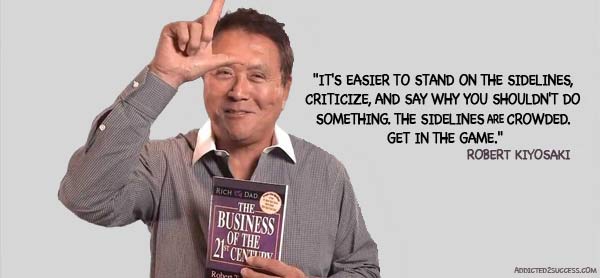
“It’s easier to stand on the sidelines, criticize, and say why you shouldn’t do something. The sidelines are crowded. Get in the game.” – Robert Kiyosaki
“The trouble with school is they give you the answer, then they give you the exam. That’s not life.” – Robert Kiyosaki
“Complaining about your current position in life is worthless. Have a spine and do something about it instead.” – Robert Kiyosaki
“The fear of being different prevents most people from seeking new ways to solve their problems.” – Robert Kiyosaki
“Winners are not afraid of losing. But losers are. Failure is part of the process of success. People who avoid failure also avoid success.” – Robert Kiyosaki
“Successful people ask questions. They seek new teachers. They’re always learning.” – Robert Kiyosaki
“If you want to be rich, you need to develop your vision. You must be standing on the edge of time gazing into the future.” – Robert Kiyosaki
“If you’re still doing what mommy and daddy said for you to do (go to school, get a job, and save money), you’re losing.” – Robert Kiyosaki
“Often, the more money you make the more money you spend; that’s why more money doesn’t make you rich – assets make you rich.” – Robert Kiyosaki
“The most life destroying word of all is the word tomorrow.” – Robert Kiyosaki
“The size of your success is measured by the strength of your desire; the size of your dream; and how you handle disappointment along the way.” – Robert Kiyosaki
“I’d rather welcome change than cling to the past.” – Robert Kiyosaki
“The most successful people are mavericks who aren’t afraid to ask why, especially when everyone thinks it’s obvious.” – Robert Kiyosaki
“Hoping drains your energy. Action creates energy.” – Robert Kiyosaki
“The more a person seeks security, the more that person gives up control over his life.” – Robert Kiyosaki
“Everyone can tell you the risk. An entrepreneur can see the reward.” – Robert Kiyosaki
“A plan is a bridge to your dreams. Your job is to make the plan or bridge real, so that your dreams will become real. If all you do is stand on the side of the bank and dream of the other side, your dreams will forever be just dreams. – Robert Kiyosaki
“You’ll often find that it’s not mom or dad, husband or wife, or the kids that’s stopping you. It’s you. Get out of your own way.” – Robert Kiyosaki
“The only difference between a rich person and poor person is how they use their time” – Robert Kiyosaki
“Your choices decide your fate. Take the time to make the right ones. If you make a mistake, that’s fine; learn from it & don’t make it again.” – Robert Kiyosaki
“Money is really just an idea.” – Robert Kiyosaki
“Talk is cheap. Learn to listen with your eyes. Actions do speak louder than words. Watch what a person does more than what he says.” – Robert Kiyosaki
“The moment you make passive income and portfolio income a part of your life, your life will change. Those words will become flesh.” – Robert Kiyosaki
”You will make some mistakes but, if you learn from those mistakes, those mistakes will become wisdom and wisdom is essential to becoming wealthy.” – Robert Kiyosaki
“If you realize that you’re the problem, then you can change yourself, learn something and grow wiser. Don’t blame other people for your problems.” – Robert Kiyosaki
“Workers work hard enough to not be fired, and owners pay just enough so that workers won’t quit.” – Robert Kiyosaki
“As I said, I wish I could say it was easy. It wasn’t, but it wasn’t hard either. But without a strong reason or purpose, anything in life is hard. ” – Robert Kiyosaki
“The single most powerful asset we all have is our mind. If it is trained well, it can create enormous wealth in what seems to be an instant.” – Robert Kiyosaki
“Find the game where you can win, and then commit your life to playing it; and play to win.” – Robert Kiyosaki
“The power of “can’t”: The word “can’t” makes strong people weak, blinds people who can see, saddens happy people, turns brave people into cowards, robs a genius of their brilliance, causes rich people to think poorly, and limits the achievements of that great person living inside us all.” – Robert Kiyosaki
“One of the great things about being willing to try new things and make mistakes is that making mistakes keeps you humble. People who are humble learn more than people who are arrogant.” – Robert Kiyosaki
“Intelligence solves problems and produces money. Money without financial intelligence is money soon gone.” – Robert Kiyosaki
“Start small and dream big.” – Robert Kiyosaki
“Emotions are what make us human. Make us real. The word ’emotion’ stands for energy in motion. Be truthful about your emotions, and use your mind and emotions in your favor, not against yourself.” – Robert Kiyosaki
“You’re only poor if you give up. The most important thing is that you did something. Most people only talk and dream of getting rich. You’ve done something.” – Robert Kiyosaki
“If you want to be financially-free, you need to become a different person than you are today and let go of whatever has held you back in the past.” – Robert Kiyosaki
“The philosophy of the rich and the poor is this: the rich invest their money and spend what is left. The poor spend their money and invest what is left.” – Robert Kiyosaki
“Sight is what you see with your eyes, vision is what you see with your mind.” – Robert Kiyosaki
“In school we learn that mistakes are bad, and we are punished for making them. Yet, if you look at the way humans are designed to learn, we learn by making mistakes. We learn to walk by falling down. If we never fell down, we would never walk.” – Robert Kiyosaki
“Never say you cannot afford something. That is a poor man’s attitude. Ask HOW to afford it.” – Robert Kiyosaki
“F.O.C.U.S – Follow One Course Until Successful” – Robert Kiyosaki
“Your future is created by what you do today, not tomorrow” – Robert Kiyosaki
“I find so many people struggling, often working harder, simply because they cling to old ideas. They want things to be the way they were; they resist change. Old ideas are their biggest liability. It is a liability simply because they fail to realize that while that idea or way of doing something was an asset yesterday, yesterday is gone.” – Robert Kiyosaki
“The more I risk being rejected, the better my chances are of being accepted.” – Robert Kiyosaki
“One of the most stupid things to do is to pretend you are smart. When you pretend to be smart, you are at the height of stupidity.” – Robert Kiyosaki
“Find out where you are at, where you are going and build a plan to get there.” – Robert Kiyosaki
“I am concerned that too many people are focused too much on money and not on their greatest wealth, which is their education. If people are prepared to be flexible, keep an open mind and learn, they will grow richer and richer through the changes. If they think money will solve the problems, I am afraid those people will have a rough ride.” – Robert Kiyosaki
“Most people want everyone else in the world to change themselves. Let me tell you, it’s easier to change yourself than everyone else.” – Robert Kiyosaki
“People who dream small dreams continue to live as small people.” – Robert Kiyosaki
“The richest people in the world build networks; everyone else is trained to look for work.” – Robert Kiyosaki
“There are those who make things happen, there are those who watch things happen and there are those who say ‘what happened?” – Robert Kiyosaki
“Skills make you rich, not theories.” – Robert Kiyosaki
“Losers quit when they fail. Winners fail until they succeed.” – Robert Kiyosaki
“When you come to the boundaries of what you know, it is time to make some mistakes.” – Robert Kiyosaki
“People without financial knowledge, who take advice from financial experts are like lemmings simply following their leader. They race for the cliff and leap into the ocean of financial uncertainty, hoping to swim to the other side.” – Robert Kiyosaki
“The ability to sell is the number one skill in business. If you cannot sell, don’t bother thinking about becoming a business owner.” – Robert Kiyosaki
“Too many people are too lazy to think. Instead of learning something new, they think the same thought day in day out.” – Robert Kiyosaki
“Education is cheap; experience is expensive.” – Robert Kiyosaki
“There are no mistakes in life, just learning opportunities.” – Robert Kiyosaki
“The love of money is not the root of all evil. The lack of money is the root of all evil.” – Robert Kiyosaki
“We all have tremendous potential, and we all are blessed with gifts. Yet, the one thing that holds all of us back is some degree of self-doubt. It is not so much the lack of technical information that holds us back, but more the lack of self-confidence.” – Robert Kiyosaki
“When you are forced to think, you expand your mental capacity. When you expand your mental capacity, your wealth increases.” – Robert Kiyosaki
“Making mistakes isn’t enough to become great. You must also admit the mistake, and then learn how to turn that mistake into an advantage.” – Robert Kiyosaki
“In today’s rapidly changing world, the people who are not taking risk are the risk takers.” – Robert Kiyosaki
“Tomorrows only exist in the minds of dreamers and losers” – Robert Kiyosaki
“Excuses cost a dime and that’s why the poor could afford a lot of it.” – Robert Kiyosaki
People need to wake up and realize that life doesn’t wait for you. If you want something, get up and go after it.” – Robert Kiyosaki
“If you want to be rich, simply serve more people.” – Robert Kiyosaki
“You’re only poor if you give up. The most important thing is that you did something. Most people only talk and dream of getting rich. You’ve done something.” – Robert Kiyosaki
“When people are lame, they love to blame.” – Robert Kiyosaki
“Inside each of us is a David and a Goliath.” – Robert Kiyosaki
“It is easy to stay the same but it is not easy to change. Most people choose to stay the same all their lives.” – Robert Kiyosaki
“It does not take money to make money.” – Robert Kiyosaki
“Face your fears and doubts, and new worlds will open to you.” – Robert Kiyosaki
“A mistake is a signal that it is time to learn something new, something you didn’t know before.” – Robert Kiyosaki
“There are no bad business and investment opportunities, but there are bad entrepreneurs and investors.” – Robert Kiyosaki
“A winning strategy must include losing.” – Robert Kiyosaki
“If you want to go somewhere, it is best to find someone who has already been there.” – Robert Kiyosaki
“Success is a poor teacher. We learn the most about ourselves when we fail, so don’t be afraid of failing. Failing is part of the process of success. You cannot have success without failure.” – Robert Kiyosaki
“The wealthy buy luxuries last, while the poor and middle-class tend to buy luxuries first. Why? Emotional discipline.” – Robert Kiyosaki
To be a successful business owner and investor, you have to be emotionally neutral to winning and losing. Winning and losing are just part of the game.” – Robert Kiyosaki
“The problem with having a job is that it gets in the way of getting rich.” – Robert Kiyosaki
“When times are bad is when the real entrepreneurs emerge.” – Robert Kiyosaki
“Sometimes you win, sometimes you learn.” – Robert Kiyosaki
“You get one life. Live it in a way that it inspires someone.” – Robert Kiyosaki
“The biggest challenge you have is to challenge your own self doubt and your laziness. It is your self doubt and your laziness that defines and limit who you are.” – Robert Kiyosaki
“When I started my last business, I didn’t receive a paycheck for 13 months. The average person can’t handle that pressure.” – Robert Kiyosaki
“Getting rich begins with the right mindset, the right words and the right plan.” – Robert Kiyosaki
“Sometimes, what is right for you at the beginning of your life is not the right thing for you at the end of your life.” – Robert Kiyosaki
“Business is like a wheel barrow. Nothing happens until you start pushing.” – Robert Kiyosaki
Starting a business is like jumping out of an airplane without a parachute. In mid air, the entrepreneur begins building a parachute and hopes it opens before hitting the ground.” – Robert Kiyosaki
“Business and investing are team sports.” – Robert Kiyosaki
“If you want to be rich the rule of thumb is to teach others how to be rich.” – Robert Kiyosaki
“The hardest part of change is going through the unknown.” – Robert Kiyosaki
“Financial struggle is often the direct result of people working all their lives for someone else.” – Robert Kiyosaki
“Being an entrepreneur is simply going from one mistake to the next. You must have the fortitude to continue on.” – Robert Kiyosaki
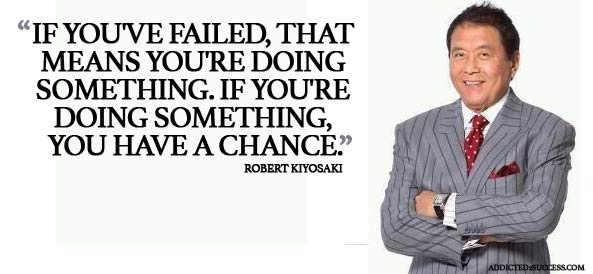
I hope you enjoyed these inspiring Robert Kiyosaki Quotes.
If I have missed any great gems of wisdom out, please leave your favorite Robert Kiyosaki Quote in the comments section below. Thanks!









Change Your Mindset
Stop Trying to “Think Positive”: The Cognitive Framework to Break Free From Resentment

For decades the personal development industry has sold high achievers a massive, toxic lie… and that is… If you just think positively enough, your life will be perfect. We are taught to suppress our negative thoughts, avoid uncomfortable emotions, and paste a smile over our deepest setbacks. But for entrepreneurs and practical operators, this forced positivity isn’t just exhausting—it is actually the source of our suffering.
You cannot out-affirm reality. Running your illusions until you burn out doesn’t work. The only thing that sets you free from the heavy emotional baggage of betrayal, failure, or resentment is the raw, unfiltered truth.
If you want to build a bulletproof mindset, you have to stop trying to force a one-sided, perfectly positive life. Here is the cognitive reframing framework you need to finally neutralize your emotional baggage and turn resentment into highly effective fuel.
The Futility of Forced Positive Thinking
Imagine dedicating two full years of your life to chanting the 2,000 most positive words and affirmations in the English language, 108 times a day. If you tracked your emotional state throughout that entire experiment, what do you think the net result would be?
Zero. Your emotional highs and lows would remain exactly the same. Why? Because of a biological and psychological principle called hedonic adaptation. Our brains are hardwired with a set point that automatically balances our positives and negatives.
When you get overly arrogant, you subconsciously do something to cause yourself shame to bring you back to equilibrium. When you try to force total positivity, your brain’s negativity steps in to ground you.
The second you experience a negative emotion, it is there to break your addiction to its opposite pole. Your brain wants a positive without a negative, a pleasure without a pain. It is trying to get a one-sided world that simply does not exist.
The Law of Contrast: Why You Need Your Negativity
To build true emotional resilience, you have to accept a difficult truth: There is no such thing as a one-sided person, and there is no such thing as a one-sided event.
You cannot have a magnet with only a positive pole. If you cut it in half, you just get two smaller magnets, each with their own positive and negative poles. Human beings and business dynamics are the exact same. We are all both kind and cruel, supportive and challenging, nice and mean.
When we become infatuated with a mentor, a partner, or a business deal, we put them on a pedestal and artificially blind ourselves to the downside. When we deeply resent a former friend, a toxic boss, or a bad client, we put them in a pit and artificially blind ourselves to the positive value they brought to our lives.
Both states are illusions that rob you of your focus.
The “Resentment Audit” in Action
Let’s look at a raw, real-world coaching scenario. A successful woman—let’s call her Sarah—harbored an intense, burning resentment toward a former friend. Out of jealousy, this friend had betrayed Sarah’s confidence and revealed a devastating secret to Sarah’s husband, which ultimately destroyed the marriage.
Most traditional self-help advice would validate Sarah’s anger, label the friend as toxic, and encourage Sarah to “cut her out and heal.” But that keeps you in a victim mindset.
To neutralize the trauma, Sarah had to be put through a rigorous “Resentment Audit.” Here is how you execute it.
Step 1: Accountability (The Mirror)
Whatever we aggressively judge in others, we have usually done ourselves. To break Sarah’s self-righteous anger, she was forced to identify specific moments in her own life where she had betrayed confidences, spoken behind people’s backs, and tried to bring others down.
By acknowledging her own capacity for the exact same behavior, her illusion of pure victimhood began to crack. You cannot be destroyed by something you also possess.
Step 2: Finding the Hidden ROI (The Benefits)
Next comes the hardest question in psychology. You look at the exact moment of your deepest betrayal or failure and ask: “How did this exact event benefit me?”
Initially resistant, Sarah began to uncover the brutal truth:
- She had been deeply unfulfilled in her marriage for years but lacked the courage to end it herself.
- The friend’s betrayal was the exact catalyst that forced the truth into the open.
- Because the marriage ended, Sarah got a massive financial settlement, bought her own house, refocused intensely on her career without living in her husband’s shadow, and ultimately found the freedom to live authentically.
Step 3: Integrating the Opposites
Finally, you integrate the two sides. What would Sarah’s life look like if the friend had never betrayed her?
Sarah realized she would still be trapped in a miserable dynamic, playing small. By running this audit, Sarah’s deep-seated hatred evaporated. When asked what she would say to the friend who “ruined” her marriage if she were in the room right now, Sarah didn’t ask for an apology. She simply replied, “Thank you.”
You Are Not a Victim of History
The core philosophy of a high-performance mindset is absolute, uncompromising empowerment.
Anything you cannot say “thank you” for is your baggage. It weighs you down, clouds your judgment, and steals your energy. Anything you can say thank you for is your fuel.
You can decide to be a victim of history because you are comparing your current reality to a fantasy of how it “should” have been. Or, you can choose to be a master of your destiny by finding the hidden ROI in every disaster.
When you stop demanding that the world be perfectly positive, you stop being a victim when it isn’t. The quality of your life is determined entirely by the quality of the questions you ask yourself. Are you ready to stop running your illusions and finally ask for the truth?
Follow me Joel Brown on Instagram if you want to know about how I can coach and support you.

There is a dark cycle that most high achievers in our fast paced society are quietly trapped in.
You spend your weekdays running on adrenaline, caffeine and pressure. Then, when the weekend hits, you turn to distractions to numb the exhaustion. You drink, you smoke, you eat heavy comfort foods, you scroll endlessly, or you get high just to escape your own head. But the escape comes with a heavy price tag: splitting hangovers, wasted Sundays, and a sickening feeling in your gut that you are leaving massive potential on the table.
For years, I lived that exact cycle. But over the last three years, I aggressively audited my life. I quit the alcohol, the weed, the nicotine, and the mindless consumption.
I didn’t do it to be self-righteous. I did it because I realized those vices were just clever cover-ups for the uncomfortable reality hiding beneath the surface: I lacked true emotional control. When you strip away the distractions, you are forced to confront who you actually are.
To bridge the gap between where I was and the elite level I wanted to operate at, I studied the psychological frameworks of ancient warrior… specifically the samurai and adapted them for the modern entrepreneur. I built a system designed to maintain peak focus, effortless balance, and ruthless execution.
If you are ready to stop being reactive to the world around you and build a bulletproof presence, here are the six pillars of the modern samurai mindset.
1. Master the Art of Stillness (Say)
In a traditional samurai duel, everything is decided in a fraction of a second. If a warrior’s focus flickers for even 0.1 seconds, they lose.
In Japanese culture, we call this absolute immobility Say (stillness). Western business culture is incredibly proficient in movement—the grit, the hustle, the loud display of force. But the ultimate threat to a warrior (and an entrepreneur) is Ski—a microscopic gap in your breathing or a sudden lapse in attention that gives an opponent an opening.
In modern business, your Ski is procrastination, panic, and digital distraction. A moment of reactive anger can destroy a negotiation or kill a brilliant strategy. To master stillness, you must train your mind to sit with its own emptiness. This requires 20 to 30 minutes of deep, device-free reflection or meditation every single day. When you can sit in a room alone with your thoughts without needing to reach for your phone, you develop an emotional shock absorber. The market can crash, but your core remains entirely unmoved.
2. Practice Radical Non-Resistance (Nagas)
Nagas means to flow. In physical martial arts, it is the act of never meeting force with force; instead, you absorb your opponent’s momentum and let it slip harmlessly past you.
Imagine standing deep in a rushing river. If you lock your legs and fight the current, the water slams into you with immense pressure. You exhaust yourself just trying to stay upright. But if you lift your feet and float, you become one with the current, moving effortlessly.
The river is your startup. The current represents criticism, toxic clients, economic stress, and unforeseen setbacks. The more you emotionally resist these realities, the more rational thinking you lose. When a negative event hits you, don’t fight it emotionally. Observe it like an outsider, analyze the data, and execute the logical next step.
3. Forge a Dual-Engine Discipline
Discipline is the ultimate architect of self-worth. But true discipline requires two distinct engines: one for the mind, and one for the body. If you only train your intellect, your weapon is incomplete.
-
For the Body: Push your physical boundaries daily. Lift heavy weights, run when you don’t want to, take freezing cold showers, or sit in an intense sauna. This teaches your physiological nervous system to remain calm under extreme stress.
-
For the Mind: Learn to control your deepest biological impulses, specifically your dopamine cravings. Stop opening social media the second you feel bored.
When you conquer your own internal temptations, your energetic presence shifts completely. People will literally feel your authority, your gravity, and your calmness before you even open your mouth to speak.
4. Achieve the Mind of No-Mind (Mushin)
In high-stakes environments, the greatest enemy to execution is overthinking. The samurai called the ideal psychological state Mushin—translated literally as “the mind without mind.”
When a master swordsman enters a battle, they are not consciously planning their next movement or worrying about failure. Their mind is a mirror: it simply reflects the reality of the moment and acts automatically.
Most entrepreneurs fail to accomplish their goals because they are paralyzed by internal dialogue. They analyze a business plan for months, rewrite an email ten times, or wait for the “perfect” moment to launch. This mental chatter is just fear disguised as preparation. Mushin is the practice of closing the gap between thought and execution. When you know what needs to be done, eliminate the debate. Act immediately and let your training take over.
5. Maintain Unbroken Awareness (Zanshin)
Zanshin is the state of continuous, relaxed alertness. Even after a samurai defeated an opponent, they never dropped their guard to celebrate; they remained completely present, balanced, and prepared for the next threat.
In our current world, society suffers from a massive crisis of fragmented attention. Founders hit a major revenue milestone, get comfortable, drop their guard, and immediately get outpaced by a hungrier competitor.
By practicing Zanshin, you consciously choose to live outside the post-success slump. Pay absolute attention to your environment. Notice the body language of the people in your meetings. Listen to the subtle shifts in tone when your partners speak. When you cultivate unbroken awareness, you anticipate risks before they destroy your progress.
6. Embrace Your Battle Scars (Kintsugi)
When you choose to quit your vices and live a highly disciplined life, you will inevitably look back at your past with a degree of pain. You might think about the money you burnt, the failed businesses, or the relationships you damaged while distracting yourself.
The Japanese art of Kintsugi involves repairing broken pottery with lacquer dusted with powdered gold. Instead of hiding the fractures, the artisan illuminates them, making the repaired object significantly more valuable than it was before it broke.
Your past struggles, your bankruptcies, and the moments you fell into self-sabotage are not things to be ashamed of. They are your golden seams. A person who has never been broken cannot understand the depth of true strength. By owning your past shadows, you transform your old vulnerabilities into fierce, entrepreneurial wisdom.
The Ultimate Control
You cannot always control the battlefield of business. The economy will shift, competitors will attack, and plans will fall apart.
But you can always control the warrior. Strip away the numbing agents, master your stillness, stop resisting the natural flow of life, and ruthlessly commit to the discipline of your mind and body. The world is waiting for your presence.


There is a version of starting out that most young people know well. The hand-me-down couch that came from a friend’s parents. The mattress on a frame that wobbles. The spare air mattress rolled up in the closet for the occasional guest, slowly losing air through the night. The plan was always to upgrade later, once things were more settled, once money was less tight, once life felt less temporary.
For a lot of people, later never comes. The temporary setup becomes the permanent one by default.
The decisions you make about how you set up your first real space, including what you buy, what you skip, and what you prioritize, are early signals about how you think about value, longevity, and yourself.
The Real Cost of the Cheap Approach
There is a number that gets ignored when young people furnish apartments on the cheap: replacement cost. A sofa bought for $300 that lasts 12 months before the frame collapses or the fabric pills and stains beyond recovery costs more over five years than a $900 piece that holds up through all of it. The cheap version also costs in ways that don’t show up on a receipt, including the low-grade frustration of living in a space that feels provisional, and the effort of sourcing, buying, and moving replacement furniture every year or two.
This pattern shows up clearly in the data. The top furniture buying category for both Millennials and Gen Z in 2024 was sofas, which makes sense: a sofa is the piece that anchors how a living space feels and functions. And yet the same generations are increasingly vocal about a shift in approach. Consumer research from 2024 found that the “less is more” mindset is growing, with younger buyers favoring durability over quantity and investing in pieces built to last rather than filling a space quickly with things that won’t.
That shift is worth applying deliberately, especially when it comes to the one piece that has the most functional range in a small space: the sleeper sofa.
Why a Small Space Demands Smarter Choices
Millennials and Gen Z together make up 57% of all renters in the U.S., with Gen Z alone adding 6.7 million households to the rental market between 2019 and 2024. Most of those households are in apartments, and apartments in cities, where most young people building careers tend to concentrate, are not getting larger. They are getting smaller and more expensive.
In that context, every piece of furniture has to work harder. A sofa that only functions as a sofa is a luxury in a studio or a one-bedroom. A sofa that also converts into a real sleeping surface for an overnight guest pulls double duty in a way that makes the square footage go further.
A quality sleeper sofa is not just a piece of furniture. In a small apartment, it is a guest room. It is the solution that lets you have a friend stay from out of town without either of you suffering through a night on an air mattress on the floor.
What Intentional Looks Like in Practice
The standard version, a pull-out with a thin mattress folded over a metal bar, has a reputation for being uncomfortable to sleep on and awkward to open. That reputation is accurate for the low-end versions, which are built to hit a price point rather than to perform.
The distinction between that category and a quality sleeper sofa comes down to three things: the mattress, the mechanism, and the upholstery.
A quality pull-out mattress runs at least five inches thick and uses pocket coil or high-density foam construction rather than the thin batting that ships in budget versions. The difference is felt in about the first 30 minutes of a night’s sleep, which is when the bar running across the center of a cheap mattress makes itself known. The mechanism should extend flat and lock without requiring two people and some degree of force to operate. And the upholstery should be chosen for the reality of a piece that gets used daily, not for how it photographs.
Full-grain leather is the right call for a piece that will see this level of use. It does not trap odors or allergens the way fabric does, spills wipe clean from the surface rather than absorbing into the material, and it develops a patina over years of use that makes it look better rather than worn out. For someone in their first real apartment who is buying one sofa that needs to serve them for the next five to seven years through multiple moves and different living situations, leather’s durability advantage over fabric is the most important factor.
The Mindset Shift That Makes This Decision Easier
One of the quieter challenges of early adulthood is learning to make purchases based on long-term value rather than short-term cost. It is a muscle that takes time to develop, because every early financial constraint pushes in the opposite direction.
Spending more on fewer, better things is the more economical approach over any realistic time horizon. Nearly 24.7% of Millennials say they plan to rent indefinitely, and Gen Z is following a similar path as affordability barriers remain high. That means a quality sofa bought at 24 or 26 is not going to sit in one apartment for two years before being replaced by a house full of new furniture. It is going to move with you, through multiple apartments, through different cities, into whatever configuration your life takes for the next decade.
A piece that holds up through that is the economical choice wearing a higher price tag.
Setting the Standard Early
The decisions you make when setting up your first real space have a compounding effect on how you inhabit it. A space that is put together with intention, where the pieces were chosen because they serve a real purpose and are built to last, changes the experience of being in it every day. It signals to yourself that you are not waiting to arrive somewhere before you deserve to live well.
That is not a small thing. Motivation researchers have documented for years that environment shapes behavior, not just the other way around. The space you work in, rest in, and bring people into affects how you think and how you show up. Building that space well from the start, rather than patching it together with whatever is cheapest and closest, is itself a form of investing in the person you are becoming.
The sleeper sofa is one piece, but it represents the broader decision: to buy fewer things of real quality rather than more things that will need replacing. That choice, made early, is one most people look back on without regret.

A profound philosophy often requires a simple metaphor. The following article distills the core teachings of leadership expert Simon Sinek into five actionable rules for developing an “infinite mindset”—a perspective that prioritizes long-term resilience, deep relationships, and meaningful work over short-term burnout.
There are two ways to see the world.
Some people see the thing that they want. Other people see the thing that prevents them from getting the thing that they want.
There is a great story of two lumberjacks. Every morning, they start chopping wood at the exact same time. Every evening, they stop at the exact same time. But every day, one of the lumberjacks disappears for an hour in the middle of the day. Yet, at the end of the day, the lumberjack who took a break always chops more wood than the one who worked straight through.
After months of this, the exhausted lumberjack finally asks, “I don’t understand. Every day you disappear for an hour, and every day you chop more wood than me. Where do you go?”
The other lumberjack smiles and says, “I go home and sharpen my axe.”
If you adopt an infinite mindset, you realize that success is not about how much you can blindly grind out each day. It is about how much you can achieve over the course of a career or a lifetime. You have to take vacations. You have to turn off your phone. You have to sharpen your axe.
Here are five rules to help you find your spark, sharpen your axe, and bring your infinite mindset to life.
Rule #1: See the Bagel, Not the Line
Years ago, a friend and I ran a race in Central Park. At the finish line, a sponsor was giving away free bagels. On one side, volunteers handed out the food; on the other, a massive, snaking line of exhausted runners waited.
I said to my friend, “Let’s get a bagel.” He looked at the crowd and said, “The line’s too long.” I said, “Free bagel?” He shook his head. “I don’t want to wait in line.”
That is when I realized the divide in how people view opportunities. He could only see the line. I could only see the bagels. I walked up to the line, leaned in between two people, reached into the box, and pulled out two bagels.
No one got mad. Why? Because you can go after whatever you want in life, as long as you do not deny anyone else the ability to go after what they want. You don’t have to wait in line. You can break the rules. You can do it your way, as long as you aren’t getting in the way of others.
Rule #2: Be the Last to Speak
Nelson Mandela is universally regarded as one of the greatest leaders in modern history. When asked how he learned to lead, he credited his father, a tribal chief. Mandela remembered two things about his father’s tribal meetings: they always sat in a circle, and his father was always the last to speak.
You will be told your whole life that you need to learn to listen. But the true master skill is learning to be the last to speak.
In boardrooms across the world, leaders walk in and say, “Here is the problem, here is what I think, but I’m interested in your opinion.” By then, it is too late. The room has been biased.
Holding your opinion until everyone else has spoken accomplishes two things:
-
It gives everyone else the feeling that they have been heard and have contributed.
-
You get the immense benefit of hearing all the data and perspectives before you render your final opinion.
Do not nod in agreement or shake your head in disagreement while others talk. Sit, take it all in, ask clarifying questions, and wait your turn.
Rule #3: The Ceramic Cup is Not for You
A former Under Secretary of Defense was invited to speak at a massive conference. He stood on stage holding a cheap styrofoam cup of coffee, went off script, and shared a story.
“Last year,” he said, “I was still the Under Secretary. They flew me here in business class. A car was waiting for me at the airport. They checked me into my hotel, and the next morning, a driver brought me to the backstage entrance where someone handed me a beautiful ceramic cup of coffee.”
He took a sip from his styrofoam cup. “I am no longer the Under Secretary. I flew coach, took a taxi, checked myself in, and walked through the front doors of this venue. When I asked for coffee, someone pointed to a machine in the corner, and I poured it myself into this styrofoam cup.”
His lesson was profound: “The ceramic cup was never meant for me. It was meant for the position I held. I deserve a styrofoam cup.”
As you gain fortune, seniority, and success, people will treat you better. They will open doors and give you free things. Enjoy the perks, but remain deeply humble. Know that they are not meant for you; they are meant for your title. You will always only deserve a styrofoam cup.
Rule #4: Take Accountability (Sometimes, You Are the Problem)
In the 18th century, “purple fever” ravaged Europe and America. Women were dying within 48 hours of childbirth in horrific numbers—in some hospitals, the mortality rate was as high as 70%.
Doctors and men of science were baffled. They would conduct autopsies on the victims in the morning, and then deliver babies in the afternoon. It wasn’t until the mid-1800s that Dr. Oliver Wendell Holmes suggested the unthinkable: the doctors were the ones killing the women because they weren’t washing their hands.
The medical community ignored and mocked him for 30 years. Finally, they realized he was right. When they started washing their hands, the black death of childbirth vanished.
The lesson is harsh but necessary: sometimes, you are the problem. You cannot take credit for everything that goes right in your life if you refuse to take accountability for what goes wrong. If your entire team is struggling, maybe it isn’t them. Maybe it is your leadership.
Rule #5: Learn to Ask for Help
When a former Navy SEAL was asked what kind of person makes it through the brutal BUD/S selection process, he couldn’t answer. But he knew exactly who didn’t make it.
He said the guys with bulging muscles covered in tattoos who wanted to prove how tough they were never made it. The star college athletes who had never been tested to their core never made it.
The ones who made it were often scrawny, sometimes shivering with fear. But when they were physically and emotionally spent, when they had absolutely nothing left in the tank, they somehow found the energy to help the guy next to them.
The world is too dangerous and difficult to conquer alone. Practice asking for help when you are stuck, and immediately accept it when it is offered. When you drop the facade that you have everything under control, you will discover an army of people ready to rush in and support you.
The Bottom Line
Working hard for something we don’t care about is called stress. Working hard for something we love is called passion.
If you want to build a career defined by passion, stop waiting in line. Practice empathy, be the last to speak, ask for help, and remember to always sharpen your axe.
Checkout this video with Simon Sinek about an Infinite Mindset

Stop Trying to “Think Positive”: The Cognitive Framework to Break Free From Resentment

What Board Members Expect From a Modern Digital Governance Experience

The Copywriting Frameworks That Built an Empire (According to Sam Parr)

What Every Facility Manager Needs to Know About Safety Systems

10 Important Questions to Ask Before Starting Divorce Proceedings

5 Ways For Startups To Succeed Making Acquisitions

77 Inspirational Quotes That Will Change Your Life

(Images) 52 Motivational Picture Quotes For An Epic Year Of Success
57 Memorable Kobe Bryant Quotes

40 Rare Motivational and Inspirational Picture Quotes

3 Prince EA Videos To Change Humanities Path To Greatness

(Video) What Is Success? An Entrepreneurial Story To Inspire You

(Inspirational Video) What If Today You Knew You Were Going To Take Your Last Breath?

How To Make Enough Money From A Blog To Quit Your Job – Kate McKibbin

How Finding Your Passion And Becoming An Entrepreneur Can Lead To Happiness – Chiquita Searle
-

 Success Advice2 years ago
20 Creative Ways To Make Money From Home
-

 Success Advice2 years ago
7 Habits of Highly Effective Mediocre People
-

 Creativity2 years ago
176 Inspirational Pablo Picasso Quotes on Art, Creativity and Life
-

 Life2 years ago
10 Ways Your Life is Like a Video Game
-

 Quotes2 years ago
32 Powerful Quotes About Overcoming Procrastination by Joel Brown
-

 Life2 years ago
13 Meaningful Ways to Show Someone They Matter
-

 Life2 years ago
The 5 Stages of a Quarter-Life Crisis & What You Can Do
-

 Did You Know1 year ago
7 Surprising Life Lessons Video Games Taught Me That School Never Did
48 Comments