
Life
10 Simple Steps To Be Productive And Kill The Procrastination Beast

Have you ever experienced this? You are so tired and worn out after a long workday that some of your primary body functions have temporarily shut down.You are not able to think, speak or walk properly. Heck, let`s be honest. If your mother watched you limping towards the bathroom to brush your teeth, she would seriously be wondering about if she had given birth to a Quasimodo (hunchback).
The Problem? Even though you are putting in more hours at work, you somehow can`t seem to catch up. Your never-ending growing to do list is not the real problem. The real problem is what lurks behind it – the big and dreadful procrastination beast, which is growing more each day.
You feel that you are awfully close to the breaking-point…where you either will be drowned by your to do list or eaten alive by the procrastination beast. Can you relate? If so, it`s okay. I`ve been there too…Relax. Breathe. There is still hope.
Here’s the 10 Simple Steps To Be Productive And Kill The Procrastination Beast:
1. Setting a correct goal
It`s important that you have clarity, so you will be able to set a correct goal. Something that might be worse than failing to reach a correct goal, is to actually reach a wrong goal. Let`s say that you were going to learn to play ice hockey. That was your ultimate goal, and you knew that it was the path you wanted to take.
A good first step would for instance be learning how to skate. Instead of aiming for that goal, you somehow, don’t ask me why, found out you wanted to learn how to run faster. Even though, learning how to run faster might be a cool goal to reach, it will bring you nowhere closer to learning how to skate. You get the point.
Then over to one of the most underestimated steps…
2. Your BIG why
This will actually be the real make it or break it factor. It`s within our human nature to resist going out of our comfort zone. Why? Because we think it`s uncomfortable.
If your ´why´ is not big enough, you won`t be able to fend off the excuses when you have to push yourself doing the necessary tasks, whether you feel like it or not. The bigger your why, the greater your chance of actually sticking to plan and reaching your goal.
You should have a burning desire, which will make you unstoppable on your way to your goal. Have you found your real why?
Good, let`s move on.
“People don’t buy what you do, they buy why you do it.” – Simon Sinek
3. How?
Knowing how to reach your goal is crucial. If you don`t know how, then you could do research and google the topic. A good tip is to find someone who has already accomplished what you want to accomplish, and replicate the method. It can either be finding a mentor or just paying an expert to show you the way.
In the end you basically need to find out how to reach your big hairy goal, and then break it down into smaller manageable steps.
We got the how covered, then over to the…
4. When?
It`s essential that you set a deadline for your big hairy goal, and for your smaller goals. A deadline will make you push yourself out of the comfort zone in order to get cranking. And the most important thing?
If you set a deadline, you MUST do whatever is in your power to actually meet that deadline. If not, you are conditioning your mind to expect to fail the deadlines you set. The worst part? Setting a deadline will lose it`s effect. So how do we keep track of all the activities? Let`s answer that in the next step.
“A dream is just a dream. A goal is a dream with a plan and a deadline.” – Harvey McKay
5. The master to do list
You should have a master to do list. What does that mean? It means that you should have only ONE to do list, which contains all the tasks that need to be done.
When I was working for one of the biggest companies in Norway, some of the people who were perceived as the most valuable and productive employees by the company had several to do lists. I asked them two simple questions: how many to do lists they had and if they had full control of all their to do tasks.
The answers were always the same, they were never 100% sure how many lists they actually had nor if they had full control of all the tasks. If you don`t know how many to do lists you actually have, you certainly don`t have full control of all your to do tasks.
How many to do lists should you have? If you answered one, a high five to you.
6. Support
They say that when it comes to a fight, there is strength in numbers. That is also the case when it comes to reaching our goal. And let`s face it, you are really preparing for a fight against the procrastination beast.
When you have mapped out the necessary tasks in order to reach your goal, sticking to the plan can be hard.
That is why it can be a good idea to share your goal with people you trust, and which you know will support you. If your goal was to start with mixed martial arts and to compete in the UFC, your mother would probably not be the biggest supporter. And it`s understandable. Who wants to see their child being beaten into a pulp?
It is important to actually pick the right supporters. Nothing is worse than having people who don`t really support you, being a part of your cheerleading crew. That negative person might poison and demotivate the rest of the cheerleading crew, and last but not least, you.
The next point is also very important. By mastering that skill, you can truly become unstoppable.
7. Laser focus
They say that the person who has the ability to focus on only one single thought for 2 minutes straight, will have the ability to accomplish anything. You want to be that person, right? It`s okay. Just start practicing.
So the real key to focusing is really to remove ALL distractions.
A crash course on how to laser focus:
- Mute or turn off your cellphone. If it`s muted, put it away and don`t look at it until you are finished completing your task at hand.
- Turn-off the Internet connection. You think that you are doing research by googling stuff, but what you are really doing, is ruining your own focus.
- Let people around you know that you are busy, so you won`t get interrupted
The next step might be the hardest part…
8. Self-discipline
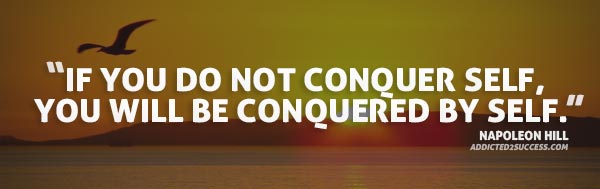
Self-discipline is about doing the necessary tasks no matter what, whether your feel like or not. You have to brainwash yourself. You have to put your feelings aside, program your mind and become an unstoppable machine.
The good news? It will become a little bit easier, the more you practice it. However, be prepared that it will be a constant battle. Do you want to know a little secret? By learning the skill of self-discipline it will become a catalyst for all other activities you need to do in order to stop procrastinating and become more productive.
Kop Kopmeyer wrote about 1000 success principles (4 books). At the end of the last book he wrote that the most important principle for success is self-discipline, without that none of the other principles will work. Yeah, you know the importance of self-discipline by now.
Then it`s time to…
9. Grow some courage
In order to achieve your goals and get the success you dream of in your life and business, you need to be able to move out of the comfort zone. You need to stop worrying about what everyone else will think about you. It`s scary, right? Yeah, I know.
What if you make a fool out of yourself and what if people will be talking about you? You have probably heard the cliché “It`s better to have tried and failed than to never have tried at all.” It`s a cliché, we can all agree on that, nevertheless, it`s still true.
I will let you in on one more secret. People will be talking about you no matter what. Whatever you do, you can`t stop it. So if people are going to talk about you anyway, you might as well build the future you want. Stop whining and stop trying to think about excuses.
Just grow some courage. Okay, so you are all pumped up now? And your self-esteem is on it`s peak? Awesome. What`s next?
Use your good self-esteem and…
10. Take action now!
When you have done all the steps above, there is no need for more analyzing or thinking. You have already done that. Enough talk. It`s time to do the actual walk and kill the procrastination beast once and for all!
You can do it. Just remove your butt from your chair and just do it! Take action now!
Now is the time to kill the procrastination beast before it kills you. Please leave your comments below!
















The first week of a new plan is always pristine.
You buy a fresh notebook. You color-code the calendar. You set an uncompromising rule about your phone. You tell a friend over dinner, which makes the ambition feel real for about four days.
Then a bad night happens. The notebook ends up buried under a magazine, the phone rule acquires an asterisk, and by the following Monday, you aren’t continuing what you started. You are founding something new.
Founding feels infinitely better than continuing. Founding comes with a speech.
Many of us have run this exact loop… with physical fitness, with morning routines, or with a business idea that didn’t need a new name; it just needed another month of work. The speech is almost always better than the month. But that speech isn’t a moral failing; it is a psychological maneuver your mind pulls when the middle of a project stops being flattering.
1. The Start is the Only Part That Compliments You
A beginning comes with visible proof. You showed up. You bought the gear. You told your partner your grand plan. Those actions are noticeable, and visibility feels like progress even when nothing of substance has moved.
The middle doesn’t compliment you. The middle is an unglamorous repetition that looks, from the outside, like you’re simply doing the exact same small task again. Yet that repetition is precisely what finishing requires… and precisely what pride resists.
So you change the strategy. A new strategy offers a new start, and a new start gives you the compliment back. You get to feel like the serious, ambitious person again without having to endure week six of the old routine.
Week six is where most plans die. Not in a dramatic crash, but in a quiet redesign.
2. You Are Negotiating With a Mood
The plan was designed during a peak, high-energy hour. The actual labor takes place in an ordinary one.
Ordinary hours rarely match the high-minded energy of the person who wrote the plan. So you wait for that inspired feeling to return, calling the delay “maintaining standards.” Standards are vital. Using them to skip the work isn’t maintaining standards—it’s a veto.
Instead of asking whether you feel like the person who wrote the plan, ask a simpler question: Is the plan still the right one?
Most days, the plan is entirely fine and your mood is completely irrelevant. On the rare days something actually needs changing, you should be able to point to a specific variable in the work itself, not a shift in your chest. If you cannot name a concrete change in the work, you aren’t revising. You’re escaping.
Anyone who has navigated a prolonged season of career uncertainty will recognize this impulse. It stems from the same restlessness as the quarter-life stretch, where the old trajectory stops fitting and announcing a new direction feels far easier than living through it. Announcing is cheap. Living the next month is where the real price is paid.
3. The Audience in Your Head Needs a Plot
A lot of restarting isn’t even done for yourself; it’s done for the imaginary audience watching your life. A clean slate makes for a far better story than a messy, slow continuation.
You can pitch a clean slate over dinner. You can’t pitch week nine… because week nine sounds like, “I did the basic thing again today,” and that sentence doesn’t get applause.
This trap frequently shows up in digital projects: launching a new series or pivoting tone when the original approach hadn’t actually failed. It had simply become familiar, and familiarity was mistaken for decline.
Yet, familiarity is often the beginning of results. The outcome doesn’t care that you’ve grown bored of the method.
- Boredom is not data.
- A metric moving in the wrong direction for a full quarter is data.
Throwing out methods out of boredom is a trap; keeping methods you dislike because the data is honest is the habit that actually finishes things.
4. You Made the Plan Too Loud for a Normal Week
A system that requires a flawless morning will collapse the day your child wakes up sick, a flight gets rescheduled, or a poor night’s sleep wipes out your first productive hour. That isn’t a character flaw… it’s an architectural flaw. If your workflow only succeeds on days you are proud of, it isn’t a strategy; it’s a costume.
Shrink the execution threshold until it can survive a terrible day. Don’t treat that smaller version as a consolation prize… treat it as the core system. The ambitious version is an optional bonus. The bad-day version is what builds momentum, because bad days make up most of life when you’re actively building something real.
If you have a young child, the morning routine you once guarded like a sacred ritual becomes a daily negotiation. The work that survives that reality is the work designed with a smaller door. Ten minutes that actually happen are worth vastly more than an hour that requires a silent house.
If even the smaller door won’t open, the friction usually isn’t the plan itself—it’s the internal noise beneath it. It’s the ongoing mental war over whether you’re falling behind, an argument that consumes your focus before you even sit down. Silencing that internal noise long enough to execute an ordinary task is a completely separate skill, the same work as stopping the war in your head, and buying another notebook won’t solve it.
5. Quitting and Restarting Feel Like the Same Act
This is the most deceptive loop. You abandon the gym, the draft, the diet, or the offer, and within a week you replace it with an “upgraded” version. Because it looks like an upgrade, it doesn’t feel like quitting.
Stacked upgrades are how entire years disappear. You can accumulate polished beginnings indefinitely until you’re left with a drawer full of starts and nothing that has survived in the real world long enough to be judged.
Give every plan a strict term before you write its obituary. Ninety days is long enough to yield data and short enough to endure.
Write that timeframe down where you will see it when the urge to pivot hits. On that day, the question isn’t whether a better system exists—a better system always exists. The question is whether your current system has served its agreed term. If it hasn’t, the urge to switch is just an emotion. Emotions are valid, but they don’t get to rewrite the strategy.
6. You Haven’t Defined What “Finished” Looks Like
Restarting thrives when the finish line is defined by a mood:
- “When I feel confident.”
- “When it’s good enough to show.”
- “When I become the kind of person who does this.”
These aren’t finish lines; they are moving goalposts. You cannot walk through a moving door, so you construct a new hallway and label it “strategy.”
Instead, define a finish line that an objective stranger could verify:
- Published, not polished.
- Four completed sessions in a month, not a life transformation.
- One offer sent, not a complete brand overhaul.
The stranger doesn’t need to be there; the criteria just needs to be that clear. If you cannot state precisely what counts as done, you will keep restarting—because starting is the only phase that doesn’t demand a clear definition.
Breaking the Cycle
The itch to reset will still happen: a new morning routine, a new batching framework, or an internal narrative that this time is different.
Sometimes this time is different—and the proof is that you can clearly state what you are stopping, not just what you are starting. If you can only describe the excitement of the start, wait a week. Most reset ideas will not survive those seven days. The ones that do are usually much smaller than the speech you prepared for them.
If restarting has become your default loop and your week is consumed by internal debate, that calls for an honest conversation rather than another planner. Some people work through it with a peer who refuses to applaud the speech. Others work through it with a mentor. Some utilize online therapy when that dedicated hour needs an objective professional with a calendar: BetterHelp is often the name that comes up when you need a structured environment with a professional. The tool itself matters far less than the act of telling the raw truth about your restart loop to someone who doesn’t need you to pretend you’re on track.
If you coach people through this exact cycle, or if you’ve broken out of it and can articulate what shifted without pitching a program in line one, our Write for Us page is open for those insights. Our readers are standing on the edge of another start of the week. Help them stick with the old plan, or leave the page alone.
The notebook under the stack of mail isn’t a verdict. It’s simply a draft that hasn’t finished its term. Pick it up, cross out the speech, and walk through the smaller door today. Tomorrow is the part you’ve been skipping.. and it’s the only part that actually counts.
What is one goal you’ve repeatedly restarted that you can commit to keeping on its current plan for the next 90 days without redesigning it?

Most people are not stuck. They are occupied and occupation has become the proof that their life is going somewhere.
A full calendar, a cleared inbox, a course left open in a tab. From the inside it feels like motion. From the outside it is a person maintaining an identity. The identity is “someone who is working on it.” That identity is comfortable, because it never has to finish. Finishing would force a result into the world, and a result can be judged. Busyness cannot… Busyness can only be respected.
This is why a year can pass and look identical to the one before it. You did not waste it on the couch. You spent it protecting the story that effort and progress are the same thing. They are not. Effort is energy spent. Progress is a change in the world that was not there before you sat down. An invoice sent. A page that exists. A skill you can perform without the tutorial beside you. A decision that used to live in your head and now lives in someone else’s. If none of those appeared, you rehearsed. Rehearsal feels like training. It does not move the life.
The mind will argue with this, because the mind is loyal to the identity. It will offer the meetings, the late nights, the fact that you care. Caring is not evidence. Tired is not evidence. The only evidence is an artifact, something a stranger could encounter without you explaining how hard the week was. When that artifact is missing, people reach for a harsher story. They decide they are the kind of person who does not follow through. A lot of the signs people read as failure are this misreading. The pattern is real. The verdict is early. You have been reinforcing a self that stays in motion so it never has to become a self that ships.
Attention is the material. Not time. You can have twelve hours and still produce nothing, if those hours are leased out to whoever asked last. Other people’s urgency is a drug. It lets you feel necessary without choosing. Choice is heavier. Choice means one outcome for the week, named before the noise arrives, small enough to finish and specific enough that you will know if you lied. A theme is not an outcome. “Get healthier” and “work on the business” can survive any week unchanged. “The page is live” cannot.
When the smaller request shows up, and it will, with a person attached and a tone that implies you are difficult if you decline, that is the test. Saying yes keeps the identity intact. You remain the reliable one, the one who responds, the one whose calendar proves they are in demand. The cost of being that person is the outcome you named, quietly deleted so you can stay liked. One refusal is not a personality. It is how the chosen thing survives.
The rest is almost dull, which is why people skip it for another system. Preparation without a point at which it must become the thing is a sophisticated form of delay. Research feels like virtue. A draft, even a bad one, is a commitment. Before you leave the work, leave a trace of the outcome, not a trace of your responsiveness. A paragraph. A number. A message that asks for the decision. The trace is what your future attention will be able to build on. A memory of having been busy will not be there. Memory keeps the stress and misplaces the output.
Do this long enough and the identity starts to lose. Not in a speech. In a pile. Weeks that each left one finished thing do not feel like a reinvention while you are inside them. They feel like slightly less drama. Later, the life is different, because you stopped using activity as a substitute for becoming the person who completes.
Busy was never the problem. Busy was the costume. The work moves when you are willing to be seen with a result, instead of with a schedule.
Here is a video I shot on YouTube about how you can get unstuck:
Enjoy!


A wrongful death case is not a story most founders expect to be in. It arrives as a call, a name, and a stack of questions that do not wait until the business is quieter. Who is allowed to file, who else may be responsible, what can be proved, what the family has lost, and how long the law gives you all sit underneath the outcome. The piece below is the plain version of those questions, before anyone is asked to guess at a result.
Several legal questions sit behind a wrongful death lawsuit long before the case reaches a final outcome. The people involved, the party who may be responsible, the evidence available, the losses that can be documented, and the deadline for taking legal action can all affect how the case is handled. Pursuing a wrongful death lawsuit therefore involves more than presenting the basic facts surrounding a death.
Each detail has its own place in the legal process, and some issues may require closer review than others. Looking at these details together helps show what can shape the case from its foundation through the stages that follow.
Establishing Who Can Bring the Lawsuit
The first legal detail is identifying who has the right to bring a wrongful death lawsuit. The answer is not the same in every situation because state laws can set specific rules about who may file and how the case may be handled.
A surviving spouse, child, parent, or another eligible person may have a role under the law that applies to the case. In some situations, a personal representative of the estate may also be involved.
The relationship between the person who died and the person bringing the case can therefore matter. Legal records may be needed to establish that relationship and the person’s role in the lawsuit.
Identifying the Parties Connected to the Death
A wrongful death case also requires attention to the parties connected to what happened. The person responsible may not always be the only party involved. Depending on the circumstances, a business, employer, property owner, driver, or another organization may have a connection to the events.
The available facts help identify which parties need to be considered. Accident reports, workplace records, property information, medical records, and other documents may provide useful details about the circumstances.
Identifying the right parties early can help keep the case focused. It also gives the legal process a clearer record of who may be connected to the events being examined.
Building the Case Around Evidence
Evidence gives structure to the facts of a wrongful death case. Without a clear record, important parts of the circumstances may be difficult to establish.
Relevant evidence can include:
- Police or accident reports
- Medical records
- Photographs and video
- Witness statements
- Employment and financial records
Each source can provide a different part of the account. A photograph may show conditions at an accident scene, while a witness statement may describe what was seen. Medical records can provide information about the injuries and treatment that followed.
The strength of the record depends on the facts and evidence available. Each document needs to be reviewed in relation to the circumstances of the death.
Understanding the Losses That May Be Part of the Lawsuit
The legal details do not stop with the cause of death. A wrongful death case may also involve losses connected to the person who died and the surviving family members.
Depending on the law that applies, these losses may include funeral expenses, medical costs related to the final injury or illness, lost income, and other documented losses. Some laws may also recognize other types of damages.
The records supporting these losses can be important. Bills, income records, employment documents, and other financial information can help show the amounts involved.
The types of losses that may be considered depend on the applicable law and facts of the case, so each matter requires its own review.
Paying Attention to the Filing Deadline
Time can become one of the most important legal details in a wrongful death lawsuit. Laws often set a deadline for starting legal action, commonly known as a statute of limitations.
That deadline is not necessarily the same for every case. It can depend on the state, the type of claim, and other facts surrounding the death. Certain circumstances may also affect how the deadline is calculated.
Because missing a legal deadline can affect the ability to pursue a case, the applicable time limit needs to be identified as part of the legal review.
Preparing for Disputes Over Fault or Damages
A wrongful death lawsuit may involve disagreements about responsibility or the losses being claimed. The opposing side may challenge the facts, question the evidence, or disagree about the amount of damages.
These disputes can bring more attention to the records supporting the case. Witness accounts may need to be compared, documents may need further review, and certain facts may remain contested.
A disagreement does not mean every part of the case is unclear. It means the disputed points need to be separated from the facts that can be supported by available evidence.
Bringing the Legal Details Together
By the end of the review, the strength of the case often comes down to how well its separate details fit together. Who can bring the lawsuit, which parties may be involved, the evidence available, the losses that can be documented, and the applicable deadlines all have a place in the process.
Pursuing a wrongful death lawsuit means keeping these details connected while paying attention to anything that could affect the case later. A careful review can help keep the focus on the facts, the available evidence, and the circumstances surrounding the death.

I was 31, in a rental with a desk by the window, and a man I had gone to school with had just posted a photo from the driveway of a house I could not have paid the deposit on.
I did the thing you are not supposed to admit. I opened his profile and went back two years. Then I opened another one. Then I sat there with the laptop warm on my legs and did a silent audit of people who were not in the room. One had a title. One had a kid on his hip and a caption about being tired and grateful, which is a kind of wealth even when the tired part is true. One had sold something. I had a draft, a half-finished offer, and a week that had gone to other people’s emergencies. By the time I closed the laptop I had talked myself into being late for a race nobody had entered me in.
That feeling has a public name now. People call it a quarter-life crisis, and the piece we already have on the five stages of that stretch is the cleaner map. This is the messier part. The part where you are not in crisis so much as in a group chat, watching other lives render in higher resolution than yours.
The trick the feed plays is small and mean. It shows you the outcome and hides the Tuesday. The house does not come with the argument about the mortgage. The job title does not come with the Sunday night dread. The company that “just closed a round” does not come with the founder awake at 1 a.m. wondering if the round was a delay, not a win. You compare your unedited week with their edited year, and then you call the gap a fact about you.
I have done this with money, with work, and with the age I thought I would be married by. None of those clocks were mine. They were borrowed from an uncle, a podcast, and a man on the internet who got lucky in 2016 and has been explaining it as a system ever since. The system part is what gets you. If his life is a system, then your life is a failure of discipline. That is a very expensive story to believe, because it sends you into a month of frantic catching up that does not move the thing you actually wanted.
What I started doing, after too many of those nights, was writing the comparison down in a boring way. Not a mood journal. Three lines. Whose life I had just measured myself against. What I had actually seen. What I had invented. The invented column was always longer. A photo of a kitchen became a marriage that worked. A conference badge became a career that was settled. I was filling in a whole house from a door.
There is a related panic that sounds more practical. The sense that you are not behind other people so much as behind the version of you that was supposed to have arrived by now. That one is harder, because it does not require a feed. It only requires a promise you made at 23. We have a harsher page on the signs people read as failure, and a lot of the traffic on it is this exact hour. Someone is up, searching, trying to find out if the feeling is a forecast. Most of the time it is a forecast they wrote themselves, then forgot they were the author.
The useful question is not “am I behind.” It is “behind relative to what, and did I agree to that clock.” A man who wanted a company by 30 and has a job he does not hate is not late. He changed his mind, or the market did, and he has not updated the sentence. A man who wanted a company and has spent two years performing busyness for an audience of classmates is late for his own work, which is a different problem and a more fixable one.
I still keep a record of the week, because the feed is a liar and my memory is loyal to it. A plain note is enough. Some people want the note to argue back with a chart, sleep, training, the hours that actually went to the work. Whoop will do that if you already wear one. A paper line on the fridge will do it if you will not. The tool is not the point. The point is having something in the room besides the photo from the driveway.
If you are in the year I was in, the house is not evidence. It is a photo. Your week is the thing you can still edit, and it will not look like his driveway even when it is going well. That is not you failing the timeline. That is the timeline being a collage of other people’s endings, pasted over the middle of your ordinary Thursday.
Here is a talk I delivered LIVE in Capetown on how you can stop comparing yourself to others

Which AI Meeting Tools Are Best for Client Calls in 2026?

A Practical Guide to Successful Research Paper Writing

Why Founders Keep Their Personal Number Out of the Business

What the AI memory boom is doing to Micron’s pay

6 Reasons You Keep Restarting and Never Finish
5 Ways For Startups To Succeed Making Acquisitions

77 Inspirational Quotes That Will Change Your Life
57 Memorable Kobe Bryant Quotes

(Images) 52 Motivational Picture Quotes For An Epic Year Of Success

40 Rare Motivational and Inspirational Picture Quotes
3 Prince EA Videos To Change Humanities Path To Greatness
(Video) What Is Success? An Entrepreneurial Story To Inspire You
(Inspirational Video) What If Today You Knew You Were Going To Take Your Last Breath?
How To Make Enough Money From A Blog To Quit Your Job – Kate McKibbin
How Finding Your Passion And Becoming An Entrepreneur Can Lead To Happiness – Chiquita Searle
-

 Life2 years ago
The 5 Stages of a Quarter-Life Crisis & What You Can Do
-

 Did You Know1 year ago
7 Surprising Life Lessons Video Games Taught Me That School Never Did
-

 Success Advice1 year ago
Stephen Covey’s 8 Leadership Habits That Will Change How You Lead Forever
-

 Life1 year ago
How to Stop the War in Your Head and Find Peace
-

 Featured2 years ago
The Psychology of Motivation: How to Keep Moving Forward Every Day
-

 Personal Development1 year ago
The Three-Second Pause That Changes How People Perceive You
-

 Explode Your Social Media1 year ago
Want More Views? Master These 6 YouTube Growth Tactics
-

 Change Your Mindset1 year ago
You Become What You Absorb: How Input Shapes Your Life
40 Comments