
Change Your Mindset
88 Motivational Michael Jordan Quotes


Michael Jordan is a basketball legend. He has unparalleled accomplishments including 6 NBA championships, 5-time Most Valuable Player, 6-time Finals Most Valuable Player, 10-time All-NBA First Team, NBA Rookie of the Year, 2-time Olympic Gold Medal Winner, and a NCAA National Championship, just to name a few. Most recently, Michael’s career was documented in the documentary, The Last Dance.
Michael Jordan is the greatest basketball player that has ever played the game.
Here are 88 Motivational Michael Jordan Quotes:
1. “I’ve missed more than 9000 shots in my career. I’ve lost almost 300 games. 26 times, I’ve been trusted to take the game winning shot and missed. I’ve failed over and over and over again in my life. And that is why I succeed.” – Michael Jordan
2. “Talent wins games, but teamwork and intelligence wins championships.” – Michael Jordan
3. “I can accept failure, everyone fails at something. But I can’t accept not trying.” – Michael Jordan
4. “My attitude is that if you push me towards something that you think is a weakness, then I will turn that perceived weakness into a strength.” – Michael Jordan
5. “You must expect great things of yourself before you can do them.” – Michael Jordan
6. “To be successful you have to be selfish, or else you never achieve. And once you get to your highest level, then you have to be unselfish. Stay reachable. Stay in touch. Don’t isolate.” – Michael Jordan
7. “Obstacles don’t have to stop you. If you run into a wall, don’t turn around and give up. Figure out how to climb it, go through it, or work around it.” – Michael Jordan
8. “If you quit once it becomes a habit. Never quit!” – Michael Jordan
9. “Always turn a negative situation into a positive situation.” – Michael Jordan
10. “Everybody has talent, but ability takes hard work.” – Michael Jordan
11. “To learn to succeed, you must first learn to fail.” – Michael Jordan
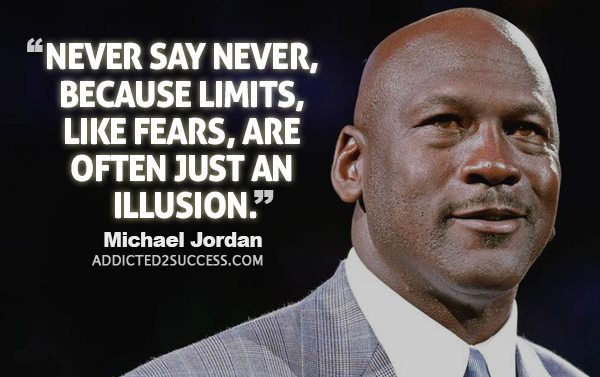
12. “Never say never, because limits, like fears, are often just an illusion.” – Michael Jordan
13. “Don’t let them drag you down by rumors just go with what you believe in.” – Michael Jordan
14. “Make it happen” – Michael Jordan
15.“If you do the work you get rewarded. There are no shortcuts in life.” – Michael Jordan
16. “I’ve failed over and over and over again in my life and that is why I succeed.” – Michael Jordan
17. “Once I made a decision, I never thought about it again.” – Michael Jordan
18. “The minute you get away from fundamentals – whether it’s proper technique, work ethic or mental preparation – the bottom can fall out of your game, your schoolwork, your job, whatever you’re doing.” – Michael Jordan
19. “The key to success is failure.” – Michael Jordan
20th Michael Jordan Quote – “Some people want it to happen, some wish it would happen, others make it happen.”
21. “Learning’s a gift, even when pain is your teacher.” – Michael Jordan
22. “Failure is acceptable. but not trying is a whole different ball park.” – Michael Jordan
23. “There is no “I” in team but there is in win.” – Michael Jordan
24. “I play to win, whether during practice or a real game.” – Michael Jordan
25. “You have to expect things of yourself before you can do them.”- Michael Jordan
26. “Every time I feel tired while I am exercising and training, I close my eyes to see that picture, to see that list with my name. This usually motivates me to work again.” – Michael Jordan
27. “The best come from the worst.” – Michael Jordan
28. “I never looked at the consequences of missing a big shot… When you think about the consequences you will always think of the negative result.” – Michael Jordan
29. “I’ve never lost a game I just ran out of time.” – Michael Jordan
30. “I’m not out there sweating for three hours every day just to find out what it feels like to sweat.” – Michael Jordan
31. “My body could stand the crutches but my mind couldn’t stand the sideline.” – Michael Jordan
32. “The game is my wife. It demands loyalty and responsibility, and it gives me back fulfillment and peace.” – Michael Jordan
33. “I know fear is an obstacle for some people, but it is an illusion to me. Failure always made me try harder the next time.” – Michael Jordan
34. “It’s heavy duty to try to do everything and please everybody. My job was to go out there and play the game of basketball as best I can. People may not agree with that. I can’t live with what everyone’s impression of what I should or what I shouldn’t do.” – Michael Jordan
35. “If it turns out that my best wasn’t good enough, at least I won’t look back and say I was afraid to try.” – Michael Jordan
36. “I realized that if I was going to achieve anything in life I had to be aggressive. I had to get out there and go for it.” – Michael Jordan
37. “Be true to the game, because the game will be true to you. If you try to shortcut the game, then the game will shortcut you. If you put forth the effort, good things will be bestowed upon you. That’s truly about the game, and in some ways that’s about life too.” – Michael Jordan
38. “Heart is what separates the good from the great.” – Michael Jordan
39. “I would tell players to relax and never think about what’s at stake. Just think about the basketball game. If you start to think about who is going to win the championship, you’ve lost your focus.” – Michael Jordan
40th Michael Jordan Quote – “You can practice shooting 8 hours a day, but if your technique is wrong, then all you become is very good at shooting the wrong way. Get the fundamentals down and the level of everything you do will rise.”
41.“I own the guy guarding me.” – Michael Jordan
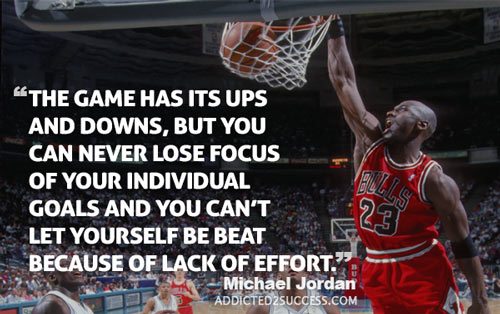
42. “The game has its ups and downs, but you can never lose focus of your individual goals and you can’t let yourself be beat because of lack of effort.” – Michael Jordan
43. “There is no such thing as a perfect basketball player, & I don’t believe there is only one greatest player either.” – Michael Jordan
44. “If you accept the expectations of others, especially negative ones, then you never will change the outcome.” – Michael Jordan
45. “You have competition every day because you set such high standards for yourself that you have to go out every day and live up to that.” – Michael Jordan
46. “You have to expect things of yourself before you can do them.” – Michael Jordan
47. “I mean we all fly. Once you leave the ground, you fly. Some people fly longer than others.” – Michael Jordan
48. “Sometimes, things may not go your way, but the effort should be there every single night.” – Michael Jordan
49. “Best evaluation I can make of a player is to look in his eyes and see how scared they are.” – Michael Jordan
50. “Winning isn’t always championships.” – Michael Jordan
51. “Sometimes you need to get hit in the head to realize that you’re in a fight.” – Michael Jordan
52. “I want to wake up every day and do whatever comes in my mind, and not feel pressure or obligations to do anything else in my life.” – Michael Jordan
53. “Enjoy every minute of life. Never second-guess life.” – Michael Jordan
54. “I believe greatness is an evolutionary process that changes and evolves era to era.” – Michael Jordan
55. “If I had been playing for money I would have complained a long time ago that I was underpaid.” – Michael Jordan
56. “Being Michael Jordan means acting the same as I always have.” – Michael Jordan
57. “My father used to say that it’s never too late to do anything you wanted to do. And he said you never know what you can accomplish until you try.” – Michael Jordan
58. “I want to be the bridge to the next generation.” – Michael Jordan
59. “When I will lose the sense of motivation and the sense to prove something as a basketball player, it’s time for me to move away from the game.” – Michael Jordan
60th Michael Jordan Quote –“I hope the millions of people I’ve touched have the optimism and desire to share their goals and hard work and perseverance with a positive attitude.”
61. “Sometimes, things may not go your way, but the effort should be there every single night.” – Michael Jordan
62. “In reality, I never want to grow up.” – Michael Jordan
63. “How many times have your parents told you not to do things, and the next thing you know, you go do it? And you realized you shouldn’t have done it.” – Michael Jordan
64. “My heroes are and were my parents. I can’t see having anyone else as my heroes.” – Michael Jordan
65. “In college I never realized the opportunities available to a pro athlete. I’ve been given the chance to meet all kinds of people, to travel and expand my financial capabilities, to get ideas and learn about life, to create a world apart from basketball.” – Michael Jordan
66. “In any investment, you expect to have fun and make money.” – Michael Jordan
67. “For a competitive junkie like me, golf is a great solution because it smacks you in the face every time you think you’ve accomplished something. That to me has taken over a lot of the energy and competitiveness for basketball.” – Michael Jordan
68. “My challenge when I came back was to face the young talent, to dissect their games, and show them maybe that they needed to learn more about the game than just the money aspect.” – Michael Jordan
69. “Do I need my number retired throughout the course of the league to acknowledge what I’ve done? No.” – Michael Jordan
70. “I want to be perceived as a guy who played his best in all facets, not just scoring. A guy who love challenges.” – Michael Jordan
71. “I built my talents on the shoulders of someone else’s talent.” – Michael Jordan
72. “Even when I’m old and gray, I won’t be able to play it, but I’ll still love the game.” – Michael Jordan
73. “I know the signs of scaredness.” – Michael Jordan
74. “It’s absolutely wrong that I don’t want guys to challenge me. And the people who say that aren’t in the room.” – Michael Jordan
75. “Live the moment for the moment.” – Michael Jordan
76. “I will not quit this game because of what the media has done to me.” – Michael Jordan
77. “When I was young, I had to learn the fundamentals of basketball. You can have all the physical ability in the world, but you still have to know the fundamentals.” – Michael Jordan
78. “People ask me if I could fly, I said, ‘yeah…. for a little while.” – Michael Jordan
79. “Champions do not become champions when they win an event, but in the hours, weeks, and months, and years they spend preparing for it. The victorious performance itself is merely a demonstration of their championship character.” – Michael Jordan
80th Michael Jordan Quote – “My mother is my root, my foundation. She planted the seed that I base my life on, and that is the belief that the ability to achieve starts in your mind.”
81. “The game of basketball has been everything to me. My place of refuge, place I’ve always gone where I needed comfort and peace. It’s been the site of intense pain and the most intense feelings of joy and satisfaction. It’s a relationship that has evolved over time, given me the greatest respect and love for the game.” – Michael Jordan
82. “As athletes, we’re used to reacting quickly. Here, it’s ‘come, stop, come, stop.’ There’s a lot of downtime. That’s the toughest part of the day.” – Michael Jordan
83. “It’s hard to say if the NBA is hurt by the influx of younger players, but it’s definitely impacted the league.” – Michael Jordan
84. “I think the players win the championship, and the organization has something to do with it, don’t get me wrong. But don’t try to put the organization above the players.” – Michael Jordan
85. “The basketball court for me, during a game, is the most peaceful place I can imagine. On the basketball court, I worry about nothing. When I’m out there, no one can bother me.” – Michael Jordan
86. “I can’t speak for the future. I have no crystal ball.” – Michael Jordan
87. “There’s only one Michael Jordan.” – Michael Jordan
88. “The good part about being famous is being able to help people. The hard part is every day you have to be in a good mood, because that is what people expect. You learn to get good at it.” – Michael Jordan
What’s your favorite Michael Jordan Quote? Share your favorite quote in the comment section below.









Communication shapes nearly every part of daily life. It affects how we learn, build relationships, succeed at work, and express our thoughts and emotions. So when speaking, understanding language, or swallowing becomes difficult, the impact can extend far beyond a single conversation. Fortunately, speech therapy offers support for people of all ages, from young children developing language skills to adults recovering from illness or injury.
One of the most helpful things you can do before seeking support is understand what speech therapy involves. Knowing the different approaches available makes it easier to recognise when professional help may be beneficial and what you can expect along the way.
Not Every Communication Challenge Needs The Same Approach
Many people are surprised to learn that there are different types of speech therapy, each designed to address specific communication or swallowing needs. According to Cleveland State University’s guide to speech-language pathology, speech-language pathologists work across a broad range of areas, including speech sounds, language, fluency, voice, cognitive communication, swallowing disorders, and social communication, tailoring treatment to each individual’s goals and challenges.
This personalised approach is one of the reasons speech therapy can be so effective. Rather than following a one-size-fits-all program, therapists assess each person’s strengths and identify the techniques most likely to support meaningful progress.
Early Support Can Make A Lasting Difference
Many communication difficulties become easier to manage when they’re identified early.
For children, speech therapy may help improve pronunciation, vocabulary development, sentence structure or social communication before these challenges begin affecting learning and confidence at school. Early intervention can also help parents better understand how to encourage communication during everyday activities at home.
Adults benefit from early support as well. Whether difficulties appear after a stroke, traumatic brain injury or another medical condition, beginning therapy promptly may improve recovery and help rebuild important communication skills.
Seeking help early doesn’t necessarily mean the problem is severe. Sometimes it simply prevents small difficulties from becoming larger obstacles later on.
Speech Therapy Isn’t Just About Speaking Clearly
When people hear the term “speech therapy,” they often think about pronunciation.
In reality, speech-language pathologists help with much more.
Some people need support in understanding language rather than producing it. Others experience stuttering that affects their confidence during conversations. Voice disorders may cause someone to sound consistently hoarse or strained, while swallowing disorders can create safety concerns during meals.
Cognitive communication is another important area. Following neurological conditions, individuals may need assistance with memory, attention, problem-solving or organising thoughts for effective communication.
This broad scope allows therapists to support communication in many different ways depending on each person’s needs.
Progress Often Happens Through Everyday Practice
Speech therapy sessions are important, but improvement rarely happens during appointments alone.
The greatest progress often comes from practising new skills between sessions.
Children might play games that encourage language development, while adults recovering from injury may complete exercises that strengthen communication or swallowing abilities. Families frequently play an important role by reinforcing strategies at home and celebrating small improvements along the way.
Consistency matters more than perfection.
Even short periods of regular practice can gradually build confidence and create meaningful long-term progress.
Every Age Group Faces Different Challenges
Speech therapy isn’t limited to one stage of life.
Toddlers may need help reaching developmental language milestones. School-aged children often work on speech sounds, reading-related language skills or social communication. Teenagers may focus on fluency or confidence during presentations and conversations.
Adults seek speech therapy for many different reasons as well. Some experience voice strain from professional speaking, while others receive therapy following neurological illnesses, surgery or injuries affecting communication.
Older adults may also benefit from treatment addressing cognitive communication or swallowing changes associated with ageing or medical conditions.
Because communication needs change throughout life, therapy evolves alongside them.
Families Play A Bigger Role Than They Realise
Parents, partners and caregivers often wonder whether they should simply leave therapy to the professionals.
In reality, they’re an important part of the process.
Therapists frequently provide practical strategies that families can incorporate into ordinary routines. Reading together, asking open-ended questions, slowing conversations or creating opportunities for meaningful interaction can all reinforce what happens during therapy sessions.
Support doesn’t require complicated exercises.
Sometimes the most valuable progress comes from making everyday communication feel positive, patient and encouraging.
Choosing A Therapist Is About More Than Qualifications
Professional credentials matter, but they’re only part of the picture.
A good speech-language pathologist also understands how to build trust, explain goals clearly and adapt therapy as progress develops. Every person learns differently, so flexibility and communication are just as important as technical knowledge.
When choosing a provider, consider asking about their experience with your specific concerns, how progress is measured and what role family members will play throughout treatment.
Feeling comfortable with your therapist encourages open communication and helps create a stronger partnership from the beginning.
Small Improvements Often Lead To Big Changes
Speech therapy rarely produces dramatic overnight transformations.
Instead, progress tends to arrive through small, consistent victories.
A child pronounces a difficult sound correctly for the first time. Someone recovering from a stroke completes a conversation with greater confidence. A person who once avoided social situations begins participating more comfortably again.
These moments may seem small individually, but together they represent meaningful improvements in independence, confidence and quality of life.
Communication influences almost everything we do. Investing time in developing those skills, whether for yourself or someone you love, can create benefits that extend well beyond words alone.

Discipline collapses in a single phone call. A calendar built with military precision, a morning routine dialed in for years — none of it survives the moment a doctor walks in with bad news or a car door won’t open. Real high performance isn’t about dodging the hit. It’s about what happens in the ninety seconds after it lands, and how fast the recovery system kicks in.
The First Move Is Always Delegation Not Control
Something strange happens to people who’ve built serious success. The instinct isn’t to grab the wheel harder. It’s the opposite — hand off everything that isn’t survival, and hand it off fast.
Picture this. A regional sales director gets T-boned by a commercial box truck on a highway outside Palm Springs. Shoulder shattered, concussion, three weeks of hospital before physical therapy even starts. The old playbook says fight through it, answer emails from the hospital bed, negotiate the insurance claim between painkiller doses. High performers don’t do that anymore. Not the sharp ones, anyway.
What they actually do is triage. Medical care goes to doctors. Legal exposure and insurance headaches go to specialists who deal with exactly this kind of wreck every single week — someone like the team behind Desert Injury Law, because commercial vehicle accidents come loaded with layers of liability, corporate insurance policies, and paperwork that eats healthy people alive, let alone someone in a sling. Handing that off isn’t weakness. It’s resource allocation. The brain only has so much bandwidth for stress before decision quality tanks across the board, and a person negotiating with a trucking company’s legal team while also trying to heal a shoulder is going to lose on both fronts.
That’s the real skill nobody talks about at leadership conferences. Knowing what to let go of, immediately, before ego gets in the way.
Compartmentalized Thinking Keeps The Mind From Flooding
Here’s the thing about crisis. It doesn’t arrive as one problem. It arrives as forty problems wearing a trench coat. The mortgage, the kids’ school pickup, the client presentation, the physical pain, the insurance forms, the missed gym sessions — all screaming at once.
High performers build a mental triage system almost instinctively. Split everything into two buckets.
Bucket one — controllable right now:
- Today’s pain management and physical needs
- The next single work task that actually requires personal input
- One decision that moves the day forward, nothing more
Bucket two — waiting, parked, not forgotten:
- Legal and financial matters already handed to professionals
- Long-term business strategy that can pause for thirty days
- Relationship conversations that need energy the person doesn’t have yet
Why does this matter so much? Because trying to hold all forty problems in active memory at once is what causes the burnout spiral, not the crisis itself. Athletes recovering from career-threatening injuries use this exact method. Ask any NFL player who’s torn an ACL — the ones who bounce back fastest aren’t obsessing over the whole season. They’re obsessing over today’s rehab set. That’s it. Nothing else gets airtime.
Rebuilding The Routine Looks Nothing Like The Old One
Forget bouncing back to the exact schedule that existed before. That version of the routine is gone, and pretending otherwise just delays the real adjustment.
Take a founder recovering from spinal surgery after a fall. Before the injury, sixty-hour weeks, back-to-back meetings, red-eye flights twice a month. After? The whole operating rhythm gets rebuilt from the studs up.
What Actually Changes During Recovery
- Morning meetings shift to voice memos reviewed at whatever hour the body allows
- A COO or trusted second gets temporary signing authority on anything under a set dollar threshold
- Client-facing work gets condensed into two focused days instead of spread thin across five
- Physical therapy gets blocked on the calendar with the same seriousness as a board meeting, no exceptions, no rescheduling for “urgent” calls that usually aren’t
Notice something here — none of this is about pushing through. It’s about redesigning the machine so it still runs while one part of it heals. Companies that survive a founder’s medical crisis almost always share this trait. Someone built redundancy into the system long before it was needed, or built it fast once the crisis hit.
Skip The Toxic Positivity Lean Into Cold Facts Instead
There’s a particular breed of advice that sounds good on a motivational poster and does real damage in a hospital room. “Everything happens for a reason.” “Stay positive, it’ll all work out.” High performers who actually recover well tend to reject that script almost entirely.
What replaces it is a blunt, fact-based assessment. What’s the actual prognosis. What’s the realistic timeline. What’s the worst-case financial exposure if the business stalls for two months. Nobody heals faster by lying to themselves about the size of the problem.
This is where outside support earns its keep. A therapist who specializes in trauma recovery. A financial advisor who can run the real numbers instead of comforting guesses. A business partner willing to say “this quarter is a write-off, plan accordingly” instead of pretending the wheels aren’t wobbling.
Practical tools worth building into the recovery process:
- A written daily non-negotiable list, capped at three items
- A weekly check-in call with one accountability partner who isn’t afraid of hard truths
- A standing rule that any decision made in acute pain or under six hours of sleep gets revisited in 48 hours before it’s finalized
- Permission, explicitly stated out loud, to say “not today” to anything outside the top three priorities
Makes sense, right? The goal was never invincibility. It was never about pretending the crash, the diagnosis, or the lawsuit didn’t happen.
Recovery Is The Real Performance Metric
Anyone can look disciplined when life is smooth. That’s not hard. The actual test — the one that separates people who build lasting success from people who burn out chasing it — shows up in the middle of the mess. In the delegation calls made from a hospital bed. In the routines rebuilt from scratch instead of forced back into an old shape that no longer fits.
High performers don’t get a pass on crisis. Nobody does. What they get is a system, built long before disaster strikes, for putting themselves back together without losing the business, the relationships, or the mind along the way. That’s the whole game.

Scroll through your feed for five minutes, and you’ll probably start measuring your life against someone else’s highlight reel. Comparison culture does that. It creeps in through every like, every filtered photo, and every “perfect” life update, quietly chipping away at how you feel about yourself.
But real confidence doesn’t come from beating someone else’s score. Instead, it grows from your own internal standard. That’s why in this piece, we’ll cover how to spot your comparison triggers, build a personal benchmark, practice self-compassion, focus on your own growth, and make choices rooted in self-respect.
Recognizing What Triggers Comparison
You can’t fix what you don’t notice, so the first step is figuring out where comparison sneaks in. For most people, social media leads the list.
Every scroll puts you face to face with someone else’s best moment, and your brain treats that curated snapshot like the full picture. You start measuring your life against a highlight reel instead of a real one, and that gap is where the doubt creeps in.
But it’s not just apps. Milestones do it too. When you measure your career, relationship, or finances against someone else’s timeline, you ignore that your journey has its own pace, setbacks, and wins.
Building Internal Standards for Success
Once you stop measuring yourself against other people, you need something else to measure against. That’s where internal standards come in.
Start by defining what success actually looks like for you. Maybe it’s financial freedom, maybe it’s a flexible schedule, or maybe it’s just waking up without dreading your day. Whatever it is, it has to come from you, not from what looks impressive on someone else’s feed.
From there, track your progress against your own past, not against a stranger’s highlight reel. Are you handling stress better than you did last year? Did you learn a skill you didn’t have six months ago? Those wins count, even if nobody else sees them.
Practicing Self-Compassion as a Confidence Tool
Confidence built on constant self-criticism doesn’t hold up, so this is where self-compassion comes in.
Start by catching the voice in your head that jumps straight to blame. Instead of telling yourself you failed because you’re not good enough, try asking what you’d say to a friend in the same spot. That alone turns a harsh inner critic into someone who actually helps you improve.
From there, treat yourself with the same patience you’d offer anyone else. You wouldn’t tell a friend they’re worthless for messing up a presentation, so don’t say it to yourself either. Over time, that consistency builds a version of confidence that doesn’t crumble the moment things go wrong.
Focusing on Personal Growth Over External Validation
Once you’ve got your own standards in place, the next step is choosing goals that actually reflect them. A comparison-based goal sounds like “get a better job than my friend.” A growth-based goal sounds like “get better at my job than I was six months ago.”
The second one keeps you focused on your own progress, so you’re not stuck chasing a moving target that depends on someone else’s life.
From there, celebrate the small wins along the way, not just the big ones. Finished a tough project? Handled a hard conversation without losing your cool? Those moments add up, and they build real momentum. Confidence grows from noticing your own progress, not from waiting for a finish line that never really arrives.
Making Personal Decisions From Self-Respect, Not Comparison
Your body is part of this conversation too, and the decisions you make about it deserve the same self-respect as everything else. The tricky part is telling the difference between a goal that’s really yours and one that only exists because someone else set the bar.
Say a coworker drops two dress sizes, and suddenly you want to lose weight too. That’s pressure talking, not self-respect. But if the goal fits your own health plans, and it existed before anyone else’s results showed up, that’s a different story.
Cosmetic decisions work the same way. If you’re considering a tummy tuck, you’d want to consult a tummy tuck surgeon in Manhattan for the same reason you’d consult a doctor for any other personal choice. It moves you toward your own goals, not someone else’s idea of what your body should look like.
And that’s the real test for any decision, big or small. Ask yourself whether you’re doing this for yourself or to keep up. When the answer is self-respect, you already know it’s the right call.
Final Thoughts
Real confidence never depended on anyone else’s life, and it never will. It comes from the standards you set, the growth you notice in yourself, and the decisions you make because they’re right for you, not because they keep up with someone else’s pace.
Start small. Notice when comparison creeps in, treat yourself with the same patience you’d give a friend, and measure your progress against your own past. Do that consistently, and confidence stops feeling like something you chase. It becomes something you already have.
Change Your Mindset
Stop Trying to “Think Positive”: The Cognitive Framework to Break Free From Resentment


For decades the personal development industry has sold high achievers a massive, toxic lie… and that is… If you just think positively enough, your life will be perfect. We are taught to suppress our negative thoughts, avoid uncomfortable emotions, and paste a smile over our deepest setbacks. But for entrepreneurs and practical operators, this forced positivity isn’t just exhausting—it is actually the source of our suffering.
You cannot out-affirm reality. Running your illusions until you burn out doesn’t work. The only thing that sets you free from the heavy emotional baggage of betrayal, failure, or resentment is the raw, unfiltered truth.
If you want to build a bulletproof mindset, you have to stop trying to force a one-sided, perfectly positive life. Here is the cognitive reframing framework you need to finally neutralize your emotional baggage and turn resentment into highly effective fuel.
The Futility of Forced Positive Thinking
Imagine dedicating two full years of your life to chanting the 2,000 most positive words and affirmations in the English language, 108 times a day. If you tracked your emotional state throughout that entire experiment, what do you think the net result would be?
Zero. Your emotional highs and lows would remain exactly the same. Why? Because of a biological and psychological principle called hedonic adaptation. Our brains are hardwired with a set point that automatically balances our positives and negatives.
When you get overly arrogant, you subconsciously do something to cause yourself shame to bring you back to equilibrium. When you try to force total positivity, your brain’s negativity steps in to ground you.
The second you experience a negative emotion, it is there to break your addiction to its opposite pole. Your brain wants a positive without a negative, a pleasure without a pain. It is trying to get a one-sided world that simply does not exist.
The Law of Contrast: Why You Need Your Negativity
To build true emotional resilience, you have to accept a difficult truth: There is no such thing as a one-sided person, and there is no such thing as a one-sided event.
You cannot have a magnet with only a positive pole. If you cut it in half, you just get two smaller magnets, each with their own positive and negative poles. Human beings and business dynamics are the exact same. We are all both kind and cruel, supportive and challenging, nice and mean.
When we become infatuated with a mentor, a partner, or a business deal, we put them on a pedestal and artificially blind ourselves to the downside. When we deeply resent a former friend, a toxic boss, or a bad client, we put them in a pit and artificially blind ourselves to the positive value they brought to our lives.
Both states are illusions that rob you of your focus.
The “Resentment Audit” in Action
Let’s look at a raw, real-world coaching scenario. A successful woman—let’s call her Sarah—harbored an intense, burning resentment toward a former friend. Out of jealousy, this friend had betrayed Sarah’s confidence and revealed a devastating secret to Sarah’s husband, which ultimately destroyed the marriage.
Most traditional self-help advice would validate Sarah’s anger, label the friend as toxic, and encourage Sarah to “cut her out and heal.” But that keeps you in a victim mindset.
To neutralize the trauma, Sarah had to be put through a rigorous “Resentment Audit.” Here is how you execute it.
Step 1: Accountability (The Mirror)
Whatever we aggressively judge in others, we have usually done ourselves. To break Sarah’s self-righteous anger, she was forced to identify specific moments in her own life where she had betrayed confidences, spoken behind people’s backs, and tried to bring others down.
By acknowledging her own capacity for the exact same behavior, her illusion of pure victimhood began to crack. You cannot be destroyed by something you also possess.
Step 2: Finding the Hidden ROI (The Benefits)
Next comes the hardest question in psychology. You look at the exact moment of your deepest betrayal or failure and ask: “How did this exact event benefit me?”
Initially resistant, Sarah began to uncover the brutal truth:
- She had been deeply unfulfilled in her marriage for years but lacked the courage to end it herself.
- The friend’s betrayal was the exact catalyst that forced the truth into the open.
- Because the marriage ended, Sarah got a massive financial settlement, bought her own house, refocused intensely on her career without living in her husband’s shadow, and ultimately found the freedom to live authentically.
Step 3: Integrating the Opposites
Finally, you integrate the two sides. What would Sarah’s life look like if the friend had never betrayed her?
Sarah realized she would still be trapped in a miserable dynamic, playing small. By running this audit, Sarah’s deep-seated hatred evaporated. When asked what she would say to the friend who “ruined” her marriage if she were in the room right now, Sarah didn’t ask for an apology. She simply replied, “Thank you.”
You Are Not a Victim of History
The core philosophy of a high-performance mindset is absolute, uncompromising empowerment.
Anything you cannot say “thank you” for is your baggage. It weighs you down, clouds your judgment, and steals your energy. Anything you can say thank you for is your fuel.
You can decide to be a victim of history because you are comparing your current reality to a fantasy of how it “should” have been. Or, you can choose to be a master of your destiny by finding the hidden ROI in every disaster.
When you stop demanding that the world be perfectly positive, you stop being a victim when it isn’t. The quality of your life is determined entirely by the quality of the questions you ask yourself. Are you ready to stop running your illusions and finally ask for the truth?
Follow me Joel Brown on Instagram if you want to know about how I can coach and support you.

Finding The Right Speech Therapy Support Starts With Understanding Your Options

What to Do When Another Business Has a Similar Name

How an LLC Can Help Shield Your Personal Assets

How To Launch Your Business Successfully With Your Company Formations Support

Difference Between SMM and SEM: Ultimate Guide

5 Ways For Startups To Succeed Making Acquisitions

77 Inspirational Quotes That Will Change Your Life
57 Memorable Kobe Bryant Quotes

(Images) 52 Motivational Picture Quotes For An Epic Year Of Success

40 Rare Motivational and Inspirational Picture Quotes

3 Prince EA Videos To Change Humanities Path To Greatness

(Video) What Is Success? An Entrepreneurial Story To Inspire You

(Inspirational Video) What If Today You Knew You Were Going To Take Your Last Breath?

How To Make Enough Money From A Blog To Quit Your Job – Kate McKibbin

How Finding Your Passion And Becoming An Entrepreneur Can Lead To Happiness – Chiquita Searle
-

 Success Advice2 years ago
20 Creative Ways To Make Money From Home
-

 Success Advice2 years ago
7 Habits of Highly Effective Mediocre People
-

 Creativity2 years ago
176 Inspirational Pablo Picasso Quotes on Art, Creativity and Life
-

 Life2 years ago
10 Ways Your Life is Like a Video Game
-

 Life2 years ago
13 Meaningful Ways to Show Someone They Matter
-

 Life2 years ago
The 5 Stages of a Quarter-Life Crisis & What You Can Do
-

 Did You Know1 year ago
7 Surprising Life Lessons Video Games Taught Me That School Never Did
-

 Success Advice1 year ago
Stephen Covey’s 8 Leadership Habits That Will Change How You Lead Forever
3 Comments