
Health
Clear Vision After 40: What Changes, and What It Means for Your Productivity


You hold your phone at arm’s length to make out a contract clause, bump your laptop text to 140 percent before a pitch, and finish the screen-heavy day with a throbbing temple.
That extra stretch, squint, and sigh aren’t about fading ambition; they’re the small taxes that mid-career eyes quietly charge your momentum. Learn what actually shifts after forty, strip away avoidable strain, and know precisely when professional care becomes the most productive next step. Clear, comfortable vision is not a luxury; it is workflow infrastructure.
What Actually Changes in Your Eyes After 40
Vision changes after 40 rarely hit like a plot twist. Instead, you notice small stalls in focus—phone messages blur unless the screen sits farther away, and bouncing from spreadsheet to colleague takes a beat longer. Those hiccups trace back to presbyopia: the clear lens inside your eye stiffens with age, trimming its ability to zoom at will. Presbyopia often becomes noticeable shortly after 40, so your near zone starts to drift just as career demands peak.
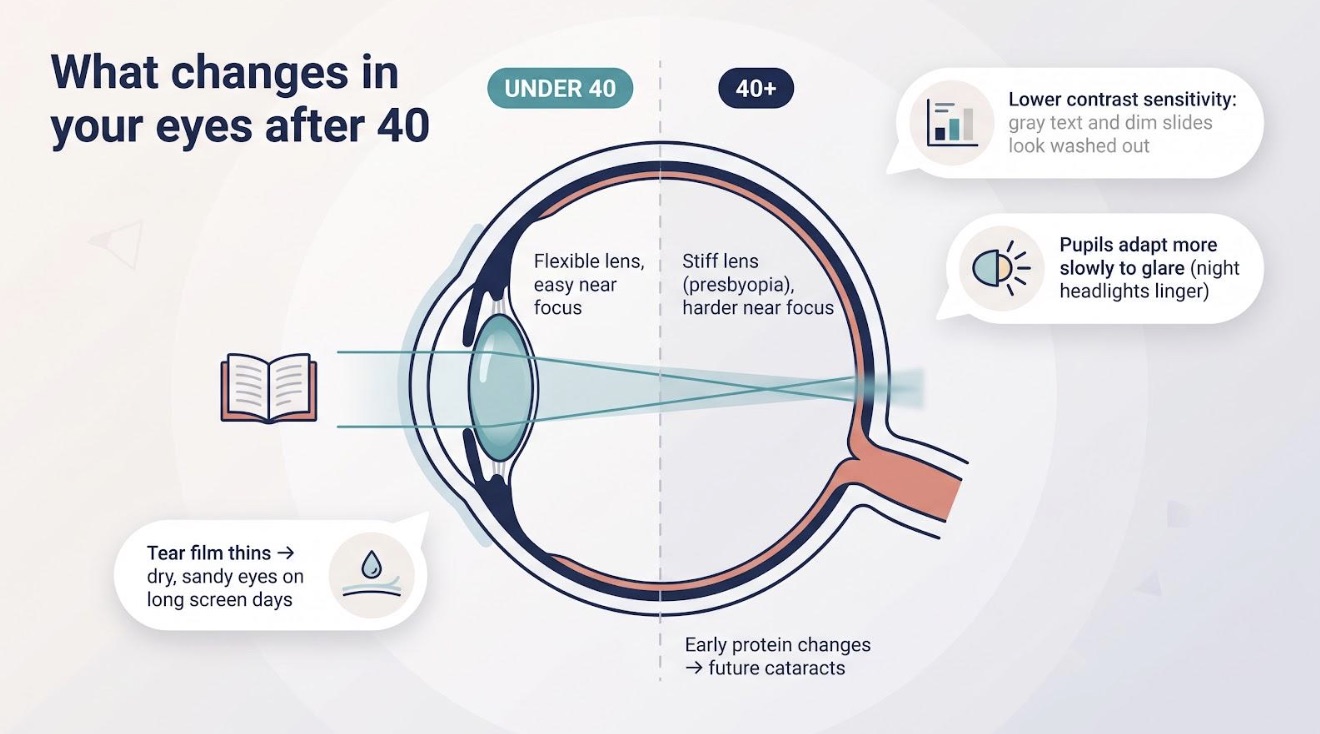
The lens is only part of the story. Contrast sensitivity dips, so gray text on a dim conference-room screen feels washed out. Pupils react more slowly to lighting swings, making evening drive-time glare stick around. Tear production eases off while screen time climbs, leaving you with sandy irritation that steals focus. Protein changes within the lens also begin now, laying groundwork for cataracts that show later.
These shifts are normal, yet any sudden blur, flashes, or eye pain warrants an immediate exam.
How Those Changes Quietly Tax Your Workday
Words blur on the contract, so you zoom in, reread, and lose your train of thought.
Dim conference rooms amplify the problem. Lower contrast sensitivity turns gray charts into ghosts, and slower pupil response makes every projector slide feel under-lit. You lean forward, squint, and the conversation slips a step ahead.
Screen-driven days add dryness to the mix, one more reason a regular digital detox can lift your productivity. Reduced blinking brings sandy irritation, fleeting blur, and a dull ache that spreads across your brow just as the afternoon meeting begins.
None of this looks dramatic, yet the interruptions stack up. Every squint, scroll, or shoulder hunch breaks momentum, pulling mental bandwidth away from strategy toward simple visual survival. Clear vision isn’t vanity; it is uninterrupted execution.
Your Options, From Reading Glasses to Lens Replacement
Start with the Simplest Correction
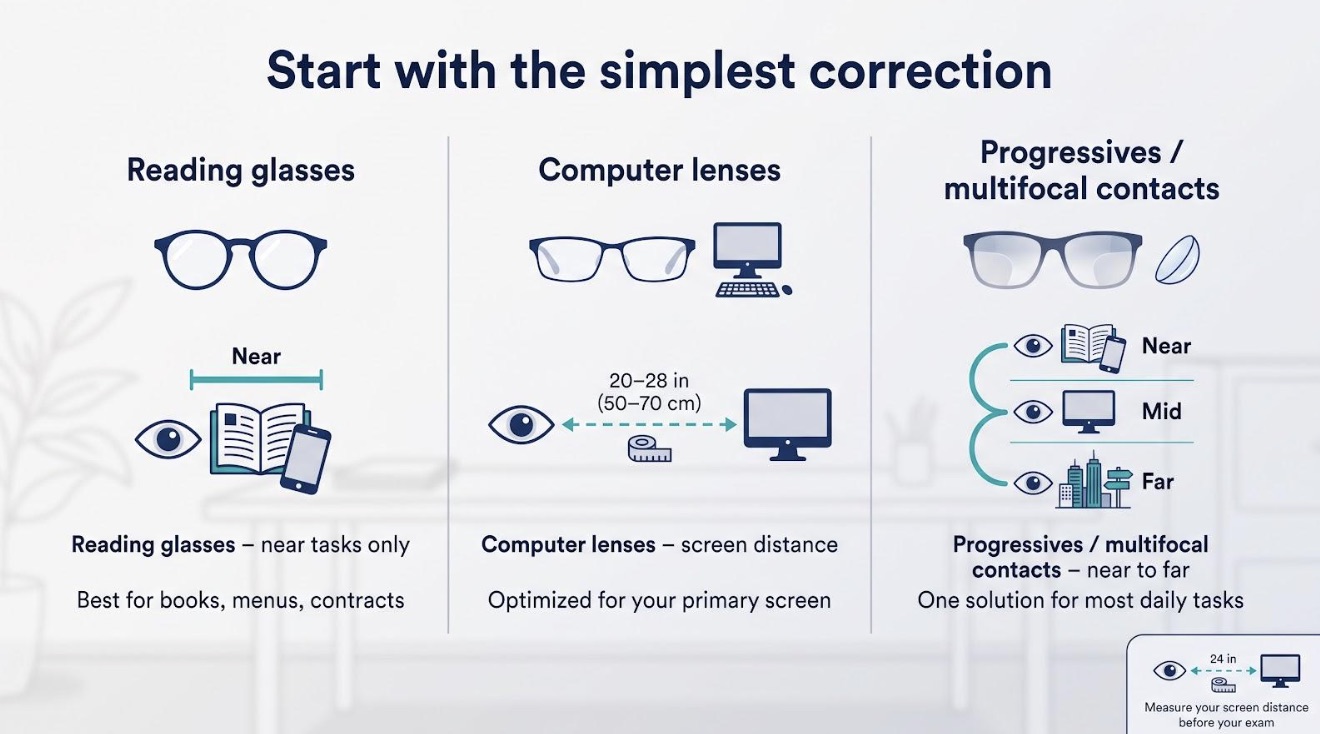
Reading glasses offer instant relief for contracts and menus, but they live only in the close-up lane. If your day swings between laptop and across-the-room whiteboard, computer glasses calibrated to your exact screen distance keep you from bobbing your head like a periscope. Practices such as Snead Eye Group in Southwest Florida offer care ranging from eye exams to lens replacement, so you can start simple and step up only if you need to.
Progressive lenses and multifocal contacts go further, stacking near, intermediate, and far power in one smooth view so you glide from dashboard to client without changing eyewear. The secret is measurement: pace off how far you sit from each screen, jot the numbers, and hand them to your eye care pro. A prescription based on real working distances always beats an eye-chart guess.
Build a Screen Setup Your Eyes Can Sustain
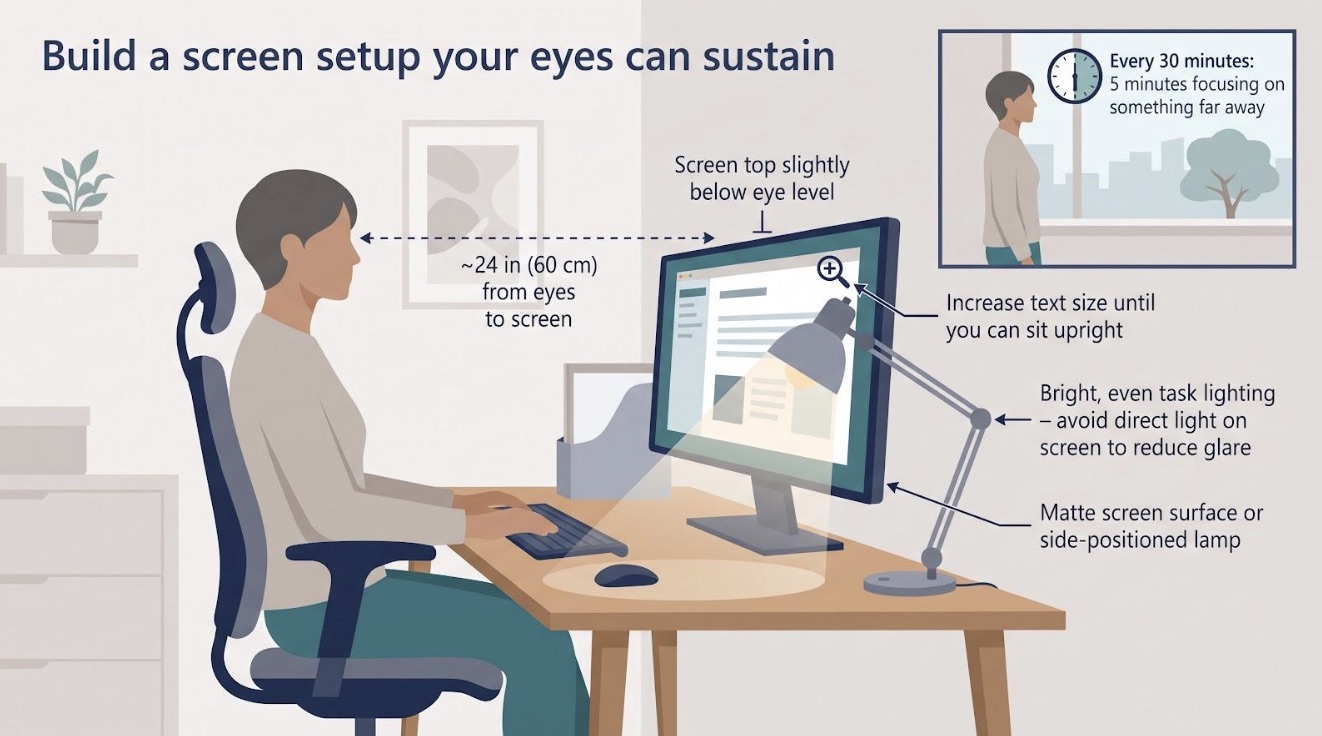
Start with scale: pump text size until you can read without leaning in. Match that with bright, even task lighting so your pupils stop straining like shutter blades in dusk.
Park the monitor an arm’s length away and nudge it a touch below eye level; that angle keeps lids partly closed, slowing evaporation. Kill reflections with a matte screen or a well-placed desk lamp, then take a five-minute horizon break every half hour to reset focus and blink rate.
Know When Surgery Enters the Conversation
If glasses or contacts feel like constant course corrections, lens replacement shifts the conversation. Surgeons remove your stiff natural lens and insert an artificial one tailored to your goals. A monofocal implant sharpens a single distance and often keeps you in reading specs, while premium multifocal, extended-range, toric, or light-adjustable lenses juggle zones but can introduce halos or night-glare trade-offs.
Not all surgical fixes swap the lens. EVO ICL, approved by the FDA for certain nearsighted adults ages 21–45, slides a small lens in front of yours and leaves focusing ability untouched—a myopia solution, not a presbyopia cure. Talk risks, visual side effects, and likely glasses needs before you book a date.
When to Book a Specialist, and What to Ask
The American Academy of Ophthalmology advises a baseline eye-disease screening at 40, even if your vision feels razor-sharp.
Book sooner when headaches or eye strain repeat, print or street signs smear despite current glasses, night headlights sprout halos, prescriptions swing often, or close relatives carry glaucoma, macular degeneration, or early cataracts.
Treat sudden vision loss, flashes, a storm of new floaters, or a curtain-like shadow as emergencies that cannot wait for the next open slot.
An optometrist handles routine exams and prescriptions; an ophthalmologist is a medical doctor who also treats disease and performs surgery. Bring three questions to the visit:
- What is driving my vision change?
- Which correction matches the distances I actually work at each day?
- If surgery is on the table, what risks, side effects, and post-op glasses needs should I expect?
Protect the Tool You Use All Day
Clear vision is infrastructure, not indulgence. It powers every instant read of a client’s expression and every late-night polish of a pitch deck.
Notice the friction points first: the squint at 4 p.m., the forehead pinch in dim light, the urge to rub gritty eyes halfway through a call. Fix your environment next—bigger text, brighter task lighting, strategic distance breaks—then book the exam that locks in an accurate prescription.
Choose correction that matches where you actually work, not where an eye chart sits. Update as demands evolve, and treat adjustments as performance tuning, not a concession to age. You drive results; your eyes deserve the same proactive care.












A gradual drop in sexual desire is one of the most common reasons men start asking questions about their hormones. It often arrives quietly, alongside lower energy or a flatter mood, and it can be easy to dismiss as stress or simply getting older. For men who are considering hormone support, many want to understand the connection between enclomiphene and sex drive before deciding whether this kind of treatment fits their situation.
How Enclomiphene Works in Plain Terms
Enclomiphene is a nonsteroidal medication that works upstream of testosterone itself. It binds to estrogen receptors in the brain, which changes the feedback signals the body uses to regulate hormone output. When those signals shift, the pituitary gland releases more luteinizing hormone and follicle-stimulating hormone, and the testes respond by producing more testosterone on their own.
This is the key difference from taking testosterone directly. Instead of adding hormone from outside, enclomiphene encourages natural testosterone production, which also means the testes stay active. That mechanism is the basis for most discussion of enclomiphene and sex drive, since testosterone plays a central role in sexual desire for most men.
Why Sexual Desire Can Change
Testosterone influences libido through several pathways, including motivation, energy, and how the brain responds to sexual cues. When levels are low, sexual desire often fades along with other low testosterone symptoms such as fatigue, reduced drive at work or in training, and a less stable mood.
If enclomiphene raises testosterone into a healthier range, some men notice that their interest in sex returns along with better energy and mood. Overviews of this topic often describe these as related improvements rather than a single isolated effect, because the same hormonal change that supports libido also tends to support general well-being.
What the Timeline May Look Like
Hormonal changes take time to translate into how a person feels. Testosterone levels can begin to shift within the first weeks of treatment, but the way that change shows up in mood, energy, and desire varies widely from one man to another. Some notice a difference relatively early, while others need several weeks or longer before any change is clear.
Any shift in libido tends to follow the hormonal change rather than arrive immediately, which is one reason early impressions can be misleading. Judging the effect on libido after only a few days usually says more about expectations than about the treatment itself. A more useful approach is to note changes week by week and compare them with lab results once follow-up testing is done.
Libido and Erectile Function Are Different Questions
Sexual desire and erectile function are often grouped together, but they are not the same thing. Libido describes interest and motivation, while erectile function depends heavily on blood flow, nerve signaling, and vascular health. A man can have strong desire and still experience erectile difficulties, or the reverse.
Testosterone has a stronger and more direct link to desire than to the mechanics of an erection. That means a hormonal treatment may improve interest in sex without fully resolving an erectile problem that has a circulatory or other cause. Separating these two questions early keeps expectations about enclomiphene and sex drive realistic, and it helps a provider decide whether additional evaluation is worthwhile.
Other Factors That Shape Libido
Hormones are only one part of the picture. Poor sleep, chronic stress, alcohol, certain medications, relationship dynamics, and general physical health all influence sexual desire. That is the same point in what actually reduces stress — sleep and recovery move the needle before any other fix does. If several of these factors are pulling in the wrong direction, a rise in testosterone may not be enough on its own to produce a noticeable change.
The body also depends on estradiol balance. Because enclomiphene acts on estrogen signaling and raises testosterone, the body’s conversion of testosterone into estradiol can also shift. Estradiol that is too low or too high can affect mood and libido, which is why providers look at both hormones together. All of this explains why the effect of enclomiphene on libido is rarely a simple one-to-one relationship.
What Monitoring and Follow-Up Labs Look At
A structured plan starts with a baseline hormone panel, typically including total and free testosterone, estradiol, luteinizing hormone, and follow-up markers chosen by the provider. Repeating these tests after treatment begins shows whether hormone levels are moving in the intended direction and whether the dose needs adjustment.
Regular follow-up lab work also provides context for how a patient feels. If testosterone has risen but desire has not changed, the next conversation may focus on sleep, stress, estradiol, or erectile health rather than the dose alone. These visits are where questions about enclomiphene and sex drive can be answered with data instead of guesswork, and where any side effects can be reviewed early.
For men who are concerned about fertility, the mechanism has an additional benefit. Because the testes remain active, published overviews note potential improvements in sperm count and motility alongside hormonal changes, a point that matters for men who may want children in the future.
Lifestyle Habits That Support the Results
Hormone treatment tends to work best when the basics are in place. Consistent sleep gives the body the recovery window it needs for normal hormone rhythms, and regular resistance training supports both testosterone levels and physical confidence. Limiting alcohol, managing body weight, and building in time to unwind all reduce the background stress that can suppress sexual desire regardless of hormone levels.
These habits also make lab results easier to interpret. When sleep, training, and diet are stable, a change in how a man feels is more likely to reflect the treatment itself than a busy month or a run of poor nights. That clarity helps the provider make better decisions about dosing and next steps.
Side Effects and Realistic Expectations
Like any medication, enclomiphene can cause side effects. Reported effects include hot flashes, mood fluctuations, and gastrointestinal discomfort, and long-term safety data for extended use is not yet fully established. Compounded versions are not approved or evaluated by the FDA for safety, effectiveness, or quality, which is one more reason treatment should only proceed under the care of a licensed provider who reviews history, labs, and goals first.
Individual responses differ. Some men experience a meaningful return of sexual desire, others notice modest changes, and some find that the main limiting factor lies outside their hormones altogether. Going in with that range of possible outcomes in mind makes it easier to evaluate progress fairly.
Starting the Conversation
Men exploring hormone support are usually best served by beginning with a clear description of their symptoms, a full hormone panel, and an honest discussion of other factors that may affect desire. Valhalla Vitality offers provider-led consultations and lab-guided enclomiphene therapy for men who want to look at these questions in a structured way, with follow-up testing built into the plan.
For men exploring the link between enclomiphene and sex drive, the most useful starting point is not the medication itself but an accurate picture of what is driving the change in desire. That picture is what allows any treatment plan to be built on evidence rather than assumptions.

Your dog is slowing down on the evening walk, and you’ve already started scrolling through supplement listings at midnight. I get it. I did the same thing when my Lab mix Rufus turned ten and stopped meeting me at the door. Somewhere between the third browser tab and the fourth “vet recommended” badge, the whole category starts to blur.
Here’s the short version before you spend a dollar. Mushroom supplements for dogs are not a magic fix, but the good ones are genuinely worth trying, especially for older animals dealing with mobility or focus issues. The catch is that the shelf is crowded with powders made from mycelium grown on grain, which is mostly starch. Learning to tell the difference takes about ten minutes and will save you a lot of money.
Most of what you’ll read about Mushrooms for Dogs splits into two camps: people who swear by them and people who call the whole thing a gimmick. Both are partially right, and the deciding factor is almost always what’s actually inside the bottle. So let’s talk about how to check that.
What functional mushrooms actually do for a dog
Functional mushrooms are the fungi people eat for a specific purpose rather than for flavor. Reishi, turkey tail, lion’s mane, chaga, cordyceps, and maitake each carry compounds called beta glucans and triterpenes that researchers have studied for decades in human contexts. In dogs, the interest centers on the same broad areas: normal immune response, joint comfort, digestion, and cognitive sharpness in seniors.
Notice the wording. Nobody credible claims these cure anything in your pet. A mushroom extract is a supporting player, not a treatment plan. If your dog has a diagnosed condition, that conversation belongs to your veterinarian, full stop. What the supplements can do is give an aging body some raw material it might use well.
My honest read after three years of using these with Rufus: the changes are quiet. He climbs the stairs a little easier. He’s more present in the evenings. If you’re expecting a different dog in a week, you’ll be disappointed and you’ll blame the product.
Why most mushroom powders are a waste of money
This is the part that made me angry the first time I learned it. Walk into any pet store and grab a random “mushroom blend.” Flip the bag over. If the first ingredient says mycelium, or “myceliated grain,” you’re largely holding ground-up oats or rice with a little fungus threading through it.
That’s not a scam in the legal sense. It’s cheap to produce, and the label isn’t lying. But you’re paying premium prices for filler, and the active compounds end up as a rounding error. According to the National Agricultural Library, mushrooms and their cultivation have been studied extensively for their nutritional and bioactive properties, and the research consistently centers on the fruiting body, which is the actual mushroom you’d recognize, not the root-like network it grows from.
What you want on that label is one phrase: 100% fruiting body. Two extraction methods, typically hot water and alcohol, matter too, because some compounds dissolve in water and others only in alcohol. A product using both is called dual extracted, and that’s the standard worth paying for.
A thirty-second label test
Before you buy anything, do this with the bag in your hand:
- Find the ingredient list. If “mycelium” or “myceliated grain” leads, put it back.
- Look for “fruiting body” and a mushroom species name, not a vague “mushroom blend.”
- Check whether the label mentions dual extraction or lists both water and alcohol on the process.
- Squint at the beta glucan figure. A number listed with no testing method behind it is decoration.
- Confirm there’s a way to reach the company with a real question. A contact form that goes nowhere tells you plenty.
That last one sounds trivial. It isn’t. The brands doing careful work tend to be the ones willing to talk about it.
Which mushroom fits your dog’s situation?
You don’t need a cabinet full of bottles. Match the fungus to the concern and give it several weeks before you judge anything.
|
Concern |
Mushroom to look for |
What pet parents usually notice
|
|
Stiff mornings, slower stairs |
Reishi, maitake |
Easier movement over weeks, not days |
|
Senior fog, staring at walls |
Lion’s mane |
More engagement and recognition |
|
Loose stools, picky eating |
Turkey tail |
Steadier digestion and appetite |
|
Low energy on walks |
Cordyceps |
A bit more stamina and interest |
|
Itchy, dull coat |
Chaga, reishi |
Less scratching and a shinier coat |
If your dog is healthy and middle aged, turkey tail is where I’d start. It’s the most studied of the group and the least likely to cause any upset. For a senior with cognitive changes, lion’s mane is the one I’d pick first, and I’d give it a solid two months before deciding.
How to introduce them without a mess
Start with a fraction of the suggested serving and hold it there for a week. Tinctures go under the tongue or into the food bowl, and most dogs don’t notice a few drops mixed into wet food. Powders are easier to hide but harder to dose consistently, so measure rather than eyeball it. Watch for loose stool, vomiting, or unusual lethargy. A small share of dogs react to new supplements, and stopping is the right call if that happens.
According to the American Kennel Club, any new addition to your dog’s routine is best introduced gradually and monitored, and supplements are no exception. Keep notes on the calendar so you’re judging behavior against something real instead of a vague memory.
One more practical thing. If your dog takes medication for a heart condition, seizures, or a clotting disorder, call your vet before adding anything. Mushroom extracts can interact with how the body processes certain drugs, and that’s a conversation worth having with someone who knows your specific animal.
What the regulatory picture looks like
Here’s the uncomfortable truth about this whole category. Supplements for pets don’t go through the same pre-market approval that drugs do. The U.S. Food and Drug Administration oversees animal supplements under a framework that puts most of the responsibility on manufacturers to label and market products honestly, which means a flashy bottle proves nothing on its own.
That’s not a reason to avoid the category. It’s a reason to buy from companies that publish their sourcing, name their growing region, and submit their formulas to independent testing. Several do. The ones that don’t tend to have beautiful websites and vague answers, and you can usually spot them in a five minute phone call.
My four rules for buying mushroom supplements for dogs
After a lot of trial and error, here’s what I actually do now. First, fruiting body only, no exceptions, even when the mycelium version costs half as much. Second, one mushroom at a time so I know what’s working. Third, at least eight weeks before I form an opinion, because that’s the realistic window. Fourth, a written record of what changed, because memory is a terrible witness when you’re hoping something worked. The same habit shows up in the ten minutes a dog gets before the laptop opens.
If you follow those four rules, you’ll waste less money than most people do, and you’ll have an actual answer about whether mushrooms help your dog instead of a feeling. Rufus still takes his lion’s mane every morning, mixed into a spoonful of wet food. He’s thirteen now, and last month he met me at the door again. Could be the mushrooms, could be the cooler weather, could be him deciding the couch was boring. I don’t need to know for certain, but I do want you to know what you’re buying before you start. Pull up the ingredient list on whatever’s in your cart right now and check the first word. What does it say?

Healthcare runs on far more than doctors, nurses, and medical equipment. Behind every smooth patient experience, there’s a layer of planning, budgeting, staffing, and policy work that keeps the system from turning into chaos. If you’re considering a leadership path in this field, a healthcare management MBA can look very appealing. The real question isn’t whether it sounds impressive. It’s whether it fits your goals, your timeline, and the kind of career you actually want.
What a Healthcare Management MBA Actually Prepares You to Do
A healthcare management MBA blends business training with healthcare-specific decision-making. You’re not training to diagnose patients or work bedside. You’re learning how hospitals, clinics, and health systems function as organizations with budgets, regulations, teams, and performance targets.
That usually includes coursework in finance, operations, leadership, strategic planning, healthcare law, and data-driven management. Think of it as learning the business side of medicine without needing to wear scrubs.
Programs like online MBA in hospital and healthcare management are designed for people who want to move into administrative or executive roles. That could mean managing a department, improving patient flow, overseeing budgets, or handling staffing strategy in a healthcare setting.
The Careers You Can Pursue After Graduation
This degree can open doors across several parts of the healthcare industry. Hospitals are the obvious destination, but they’re not the only option. Outpatient centers, long-term care facilities, insurance organizations, physician groups, and public health systems also need people who understand both business and healthcare operations.
Possible roles include:
– Healthcare administrator
– Operations manager
– Practice manager
– Hospital department director
– Healthcare consultant
– Quality improvement manager
– Compliance or risk management leader
Some roles focus on people management. Others center on budgeting, logistics, policy, or process improvement. You might spend one week analyzing staffing shortages and the next reviewing patient satisfaction metrics. Glamorous? Not always. Important? Absolutely.
Who Benefits Most From This Degree
Not every MBA makes sense for every person, and healthcare management is no exception. This path tends to work best if you already have some connection to healthcare or a clear interest in entering the field from the administrative side.
You may benefit if you’re:
– Working in healthcare and aiming for leadership
– Coming from business and wanting to specialize in healthcare
– Interested in hospital operations rather than clinical care
– Looking for a graduate degree with targeted industry value
If you love solving organizational problems, managing teams, and improving systems, this degree can line up well with your strengths. If you mainly want broad corporate flexibility across unrelated industries, a general MBA may offer more range. Specificity can be a strength, but it also narrows the lane.
The Real Advantages of Studying Online
Online learning has moved far beyond grainy lecture videos and discussion boards that feel like digital wallpaper. A strong online MBA can offer structure, expert faculty, and career-relevant content without requiring you to pause your life.
That matters if you’re working full time, raising a family, or trying to avoid relocating for graduate school. You can keep earning income while building qualifications, which changes the math in a big way.
A quality online format also helps you build practical time-management skills. In healthcare leadership, deadlines pile up fast, priorities change, and nobody hands you extra hours in the day. Managing graduate-level coursework while balancing work and life can function like a rehearsal for the job itself.
Convenience isn’t the only perk. Flexibility can make advancement possible for people who would otherwise be shut out.
What You Need to Watch Before Enrolling
The degree title may sound polished, but your decision should be based on substance. Program quality varies, and the wrong fit can leave you with debt, stress, and a credential that doesn’t move your career much.
Before enrolling, check these factors closely:
– Accreditation and institutional reputation
– Curriculum relevance to current healthcare challenges
– Faculty experience in healthcare leadership
– Tuition and total program cost
– Format, pacing, and support services
– Networking and career development opportunities
Also look at admissions requirements and your own bandwidth. An MBA asks for steady effort. If your work schedule is already brutal, adding graduate school may feel less like career growth and more like an endurance sport.
You don’t need perfection, but you do need a realistic plan.
How to Decide Whether the Investment Makes Sense
An MBA is an investment of money, time, and attention. The return depends on what you want it to do for you. If your target role requires leadership skills, strategic knowledge, or healthcare-specific business training, the value can be very real.
Start by asking practical questions:
– What roles am I aiming for in three to five years?
– Do job listings in my field prefer or require an MBA?
– Will this program help me earn more responsibility or better pay?
– Can I complete it without wrecking my finances or health?
Talk to managers, recruiters, or professionals in healthcare administration. Compare current openings. Look at actual qualification patterns, not just marketing language.
A degree should support a direction you’ve already started defining.
A degree should support a direction you’ve already started defining, the same way setting up payroll before the first hire is a direction, not a logo on a certificate. It shouldn’t act as a magic fix for a vague career crisis. Tuition is expensive enough without adding wishful thinking to the bill.
The Skills Employers Often Care About Most
Healthcare employers rarely hire leaders based on credentials alone. They want people who can make decisions, communicate clearly, and handle pressure without freezing when systems get messy.
A healthcare management MBA can help you build valuable skills such as:
– Budgeting and financial analysis
– Team leadership and conflict management
– Operational planning
– Regulatory awareness
– Strategic thinking
– Data interpretation and performance improvement
These skills matter because healthcare is one of the most complex industries to manage. Patient needs, reimbursement models, staffing shortages, technology systems, and legal requirements all collide in the same environment.
Employers notice candidates who can connect the dots between patient outcomes and business decisions. That balance is the whole game. Anyone can talk about leadership. Fewer people can lead when the spreadsheet, staffing roster, and compliance report are all screaming at once.
Final Thoughts on Choosing the Right Path
A healthcare management MBA can be a smart move if you want to lead inside one of the most essential and demanding industries in the economy. It offers a focused path for people who want to improve healthcare systems from the management side rather than the clinical side.
The best choice depends on your goals, your current experience, and your willingness to commit to graduate-level work with a clear purpose. A flashy degree name won’t build a career on its own. A well-chosen program, paired with a strong plan, can put you in a much better position.
If you’re serious about healthcare leadership, this option deserves a close look. Just make sure you’re choosing it for a destination, not for decoration.

Many people think about drinking less alcohol at some point in their lives. They may want to improve their health, feel clearer mentally, or save money. The reasons for cutting back vary from person to person. While drinking is often part of socializing or relaxing, it’s important to notice when your drinking habits increase. If you’re considering drinking less but don’t know how to start, you’re not alone. Many others are on a similar journey, and knowing the steps can help.
Changing your drinking habits takes time, and it’s okay to take small steps. Making changes requires planning and sometimes support from others. Let’s look at how you can manage your drinking and adopt a healthier lifestyle.
Understanding Your Triggers
Recognizing what makes you want a drink is essential. Things like your environment, social situations, or stress can greatly affect your alcohol use. Think about when and where you usually drink. Is it at parties, dinners, or when you’re feeling certain emotions? By figuring out these triggers, you can plan activities that don’t involve drinking. For example, consider meeting friends for coffee instead of going to bars, or doing hobbies like cooking, reading, or walking.
Keeping a diary to track your drinking habits can help you see patterns and reflect on your feelings before and after drinking. Realizing how you feel can inspire you to make better choices about your alcohol consumption.
Setting Realistic Goals
After identifying your triggers, set clear and realistic goals for reducing your drinking. Instead of trying to quit completely all at once, aim for gradual changes. If you usually have several drinks a week, try to cut back by one drink at a time. Choose specific days to drink nothing. This approach makes it easier to stay accountable and gives you a clear plan.
Remember, it’s not just about how much you drink; it’s also about what you drink. Opt for lower-alcohol or non-alcoholic drinks that can be just as enjoyable without the effects of traditional alcohol. Many tasty non-alcoholic options can make social gatherings fun.
Seeking Support
Finding support is an important part of reducing alcohol use. Friends, family, or support groups can offer encouragement. Sharing your goals with someone who cares can help keep you motivated. Sometimes, knowing someone is cheering you on can make a big difference.
Support doesn’t have to come just from your personal network. If you find it hard to manage your drinking, addiction treatment centres in BC can provide useful strategies and resources. These centres offer programs that focus on both the physical and mental sides of alcohol use. Whether you need coping strategies or want to join a support group, these facilities create a supportive environment where people work toward their goals together. Many find that community support helps them make positive changes they might struggle with on their own.
Making Lifestyle Changes
You can reduce your alcohol intake by adding healthier habits to your daily life. Focus on your overall well-being, which can help you think positively about living healthier. Regular exercise is a great way to handle stress and discomfort. It can also boost your mood, which may reduce your desire to drink.
Pay attention to what you eat, as your diet can influence your mood and cravings for alcohol. Try cooking more meals at home. Experiment with new ingredients and enjoy healthy foods. A balanced diet can give you more energy and help you avoid drinking out of boredom or habit.
Celebrating Small Wins
Remember to celebrate your progress! Every step you take to cut down on alcohol is an achievement. Reward yourself with something you enjoy, like a nice meal, a new book, or a day trip. Recognizing these victories keeps your mindset positive and motivates you to continue.
Positive reinforcement is key to building new habits. Instead of focusing on what you are giving up, think of what you are gaining: better health, clear thoughts, and deeper relationships with your addiction treatment centre as you find more meaningful activities without relying on alcohol. Name the small wins out loud. That is often what keeps a new habit from feeling pointless.
Taking control of your drinking is a personal journey, and it will look different for everyone. Be mindful of your choices and surround yourself with supportive people. This can lead to lasting change. Enjoy the process and embrace the new opportunities that come from reducing your alcohol intake.

Clear Vision After 40: What Changes, and What It Means for Your Productivity

How to Get Your Startup Noticed Without a Big Ad Budget

How Seasonal Trends Affect the Fall Real Estate Market

Stop Acting Like a Creator: How to Get Real Clients on Social Media

A Guide to Inheritance Tax Thresholds and How They Affect Your Estate as an Entrepreneur
5 Ways For Startups To Succeed Making Acquisitions

77 Inspirational Quotes That Will Change Your Life
57 Memorable Kobe Bryant Quotes

(Images) 52 Motivational Picture Quotes For An Epic Year Of Success

40 Rare Motivational and Inspirational Picture Quotes
3 Prince EA Videos To Change Humanities Path To Greatness
(Video) What Is Success? An Entrepreneurial Story To Inspire You
(Inspirational Video) What If Today You Knew You Were Going To Take Your Last Breath?
How To Make Enough Money From A Blog To Quit Your Job – Kate McKibbin
How Finding Your Passion And Becoming An Entrepreneur Can Lead To Happiness – Chiquita Searle
-

 Life2 years ago
The 5 Stages of a Quarter-Life Crisis & What You Can Do
-

 Did You Know1 year ago
7 Surprising Life Lessons Video Games Taught Me That School Never Did
-

 Success Advice1 year ago
Stephen Covey’s 8 Leadership Habits That Will Change How You Lead Forever
-

 Life1 year ago
How to Stop the War in Your Head and Find Peace
-

 Featured2 years ago
The Psychology of Motivation: How to Keep Moving Forward Every Day
-

 Personal Development1 year ago
The Three-Second Pause That Changes How People Perceive You
-

 Explode Your Social Media1 year ago
Want More Views? Master These 6 YouTube Growth Tactics
-

 Change Your Mindset1 year ago
You Become What You Absorb: How Input Shapes Your Life