
Success Advice
The Art Of Platforming – Using One Achievement To Reach Another

You are probably well aware of your best bowling score, dance move, marathon time, or pick-up line; however, you should know something about the call for perseverance, practice, patience, and vision as well. Those attributes helped you to achieve whatever you wanted to accomplish.
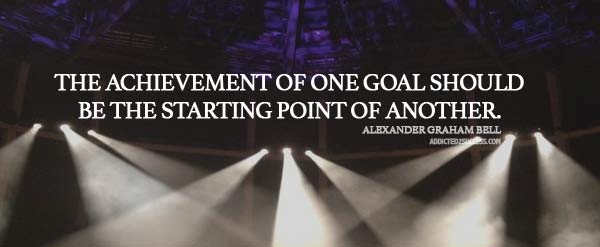
However, in order to achieve what we dream of, we must use one achievement to reach another.
How To Platform Your Way To Success
There are a number of essentials at work. Looking back at past achievements to decipher ways to reach new ones gives us the confidence to go forward and attain our next objective. As we reach one plateau after another, the will becomes stronger and our goals become more realizable. For example, successful leaders have frequently built a successful career by taking their achievements from their previous company and building on them in another.
In fact, climbing up the ladder or achievement building is quite common. Especially when building a company or individual brand. For example, famous rapper 50cent is a perfect example of using one achievement to reach another. He personifies the concept of starting from nothing and using each of his experiences as a stepping-stone to become a winner. Not only materially but in the heart as well.
1. Using Achievement Successfully
An individual coming from nothing and building an empire is exactly how building upon achievements work. Of course, you must have the vision and the will to accomplish. In addition, you don’t have to build an empire either. Building upon achievements can be as simple as starting out in a company and taking that experience to another company or within the same company.
The days when the CEO of a company started off in the mailroom seems to be long gone. However, those successes are what “achievement building” is all about. A fresh kid out of college, or in times gone by, only out of high school, took a job in a large company, perhaps being a “gofer” as they were called back in the day. They worked diligently and in two years, they are promoted to an office job. After a few more years, the company puts them in a special training class and the individual is promoted to assistant manager. After a few years of being an assistant manager, he/she is promoted to director and the achievement building continues until they reach CEO. However, you must have a vision of where you want to go or you will never get there.
Successful leaders frequently built a rewarding career by taking their achievements from one corporation and building on them in another. Either by a decision on their own, or from being recruited, these leaders frequently carry learning and perceptiveness from one experience and use it for another, with fantastic results.
2. Achievement and Outlook
Studies show that there are two varying kinds of achievement-associated attitudes. They are ego-involvement and task-involvement. Task-involvement is the stimulated phase where a person’s chief objective is to obtain proficiency and understanding. Ego-involvement is mainly to exhibit advanced abilities. One example of a pursuit where an individual endeavors to attain mastery and display advanced ability is when learning a skill. Nonetheless, an individual’s environment and surroundings can influence the triumph of achieving an aspiration at anytime.
Achievement can take various structures. It can be a mundane act such as getting the laundry done that’s been sitting for ages, finishing a puzzle, starting and finishing a diet, or beginning a new career. In addition, purpose shows that achievement is actually capricious and means something different to each individual. What may be an important achievement for one individual is a piece of cake to another. On the whole, achievement is whatever gives a person a sense of self-respect in a personal action or attained knowledge, regardless of its simplicity.
It is whatever makes an individual feel noble and whatever solidifies their competence to themselves. In addition, each gain builds confidence and motivates the individual to build on that confidence. Achieving is about having your desires satisfied, reinforcing your confidence, and boosting your sense of worth. In fact, the need to achieve is innate in each of us. Whether we take advantage of it is another story. Lack of confidence, negative thoughts, and a feeling of unworthiness creates a void. This void creates a lack of initiative and cannot be filled until the individual takes action. Afterwards, a well-rounded person is the result. One who feels worthy of achievement.
Consistent failure to achieve what we want thwarts confidence, making a person feel inadequate. It sets us up for failure and questions the significance of what we are doing. Therefore, while working on our achievements, and even before, we must convince ourselves that our efforts are worthwhile, that we are worthy of success.
3. Achievement and Faith
While on the road to achievement things may not always go as planned. If we feel the desire to “prove ourselves,” and things do not go as planned, this may lead many individuals to throw in the towel. Having an open mind is vital. As one great philosopher stated “everything may look like its going wrong, and it’s going right.” Achievement is built on faith in our abilities. Therefore, in order to build on one achievement after another, we must also build our faith.
In fact, what many call a “lack of confidence” is really a “lack of faith.” Continuously looking over our shoulders to see what the next person is doing to validate our worthiness, is a prerequisite to doubt our abilities to achieve what we set out to do. Living in the “now” is a perfect remedy for doubt and lack of confidence, and many times, it is our habit of “looking too far in the future,” that prevents us from working on what we can achieve “right now.”
4. Creating Your Own Opportunities Through Achievement
It is up to each person to develop their potential and create their own opportunities. Taking the initiative to “jump and catch our wings on the way down,” is a scary thought. However, that’s pretty much how it goes. The step forward is the leap into the unknown. As one great thinker said:
“boldness has magic in it.”
However, we should not confuse boldness with foolishness. A bold person has taken considerable thought into their next move. Even with a bit of doubt, they are willing to take the risk. A fool gives no forethought to their actions. They repeatedly repeat the same action expecting a different result each time. A lemon pie will not turn into a pumpkin pie, unless you change the ingredients.
Regardless of a person’s qualifications, a feeling of inadequacy to achieve can wipe out confidence and impede potential. By constantly looking to others to create our opportunities for success we undermine our part in its fruition. Many people are good at creating success for others; however, this scheme falls short when it comes time to create that success for themselves.
5. Achieving Your Best
By putting their best foot forward, a person can achieve the best out of life.
First of all, becoming a better individual allows you to take hold of your new experiences and abilities; therefore, manifesting a more harmonious life. Consider how your life is different than it was five years ago.
Have you achieved what you set out to do? Does your life have more clarity, perspective and depth than yesterday?
What may have been a straightforward day-to-day occurrence previously, has more importance to the new you today. In other words, looking back with wisdom, you see why certain things happened the way they did. If you can do this, it is an indication of true growth and achievement.
















After enough years in medicine, you start to notice a pattern that has nothing to do with biology and everything to do with psychology. The most driven, capable people in the room are often the last ones to deal with a problem.
Not because they are careless. Usually it’s the opposite. They have built successful lives by pushing through discomfort, solving problems, and staying in motion when other people stop.
I still think about one patient from time to time, although the truth is I’ve seen versions of her story more times than I could count. She was building a company, or maybe it was her career, I don’t remember anymore, and she’d been ignoring a symptom for months. She knew it wasn’t normal. She’d caught it early, but there was always a reason to put it off. A launch, a deadline, an important meeting she couldn’t miss. In her mind, stopping even for a day felt like falling behind.
By the time she finally came in, the problem had grown into something much harder to treat than it needed to be. I never thought of her as careless, and I don’t think denial is the right word either. She was doing what had always worked for her: keep pushing, don’t get distracted by small problems, and deal with them later.
That habit that serves you so well at work doesn’t always serve you everywhere else. When it comes to your health, it can become part of the problem.
Why Ignoring Small Problems Feels Like Discipline
People who accomplish a lot usually learn early on that not every ache, inconvenience, or setback deserves their attention. If they stopped every time something felt a little off, they’d never get anything done. After a while, pushing through just becomes second nature, and that habit doesn’t stay at work. It follows them everywhere else.
The problem is that this instinct doesn’t know the difference between grit and denial. Grit is choosing to endure something hard that you understand and have decided is worth enduring. Denial is ignoring a signal you never actually evaluated. They can feel identical in the moment, which is exactly why so many capable people confuse them.
This happens constantly, and not just when it comes to personal health. A founder notices the same customer complaints showing up every month, but keeps writing them off because fixing them would mean admitting there’s a problem with the product. An executive is surviving on four hours of sleep because it’s “just a busy season,” even though that season has lasted the better part of a year. Someone else has been living with the same symptom for months because making an appointment feels like one more thing they don’t have time for.
None of them are being careless. They’re using the same mindset that helps them succeed at work in a situation where it just doesn’t fit.
The Hidden Cost of Living Reactively
The real cost of reactive living isn’t the eventual crisis. It’s everything that happens before the crisis, which is usually invisible even to the person paying for it.
Living reactively means a portion of your attention is always spent managing something you haven’t dealt with yet. That’s a tax you pay daily, in the form of decisions made from a place of low-grade dread instead of clarity, in the form of energy that should be going toward your best work instead going toward keeping a problem contained. You don’t usually notice this tax because it doesn’t announce itself. It just quietly reduces how much of you is available for the things that matter.
This pattern plays out with health the same way it does in business. Very few of the serious conditions I’ve treated appeared overnight. Most started small, were easy to dismiss, and stayed that way for longer than people expected. Your body usually gives you plenty of chances to notice something is wrong before it forces you to pay attention.
Prevention Is the Highest Leverage Work You’ll Ever Do
Meanwhile, we celebrate the comeback, the turnaround, the crisis survived. Nobody publishes a book about the disaster that never happened because someone handled it early.
But prevention is the harder, more advanced skill. Crisis response gets you sympathy and a story. Prevention requires you to act on something before it’s demanding your attention, with no audience and no applause, purely because you understand what will happen if you don’t. That takes a kind of self-management that most people never develop, because it isn’t rewarded the way heroics are.
The best leaders and founders don’t actually handle crises better than everyone else, they just have fewer of them because they treat maintenance as a strategy rather than as something to get to eventually. They ask what a version of themselves with more information would already know, and then they go find that information instead of waiting for it to force its way in.
What This Looks Like in Practice
If any of this sounds familiar, you don’t need to turn your life upside down. Start small. Every few months, take a little time to think about the things you’ve been putting up with instead of dealing with. It could be your health, something at work, your finances, or even a relationship that’s been quietly wearing you down.
The most useful question to ask yourself is a simple one: Am I choosing to put up with this, or am I just avoiding it? Those two things can feel surprisingly similar when you’re in the middle of them, but they aren’t the same. One is intentional. The other usually catches up with you sooner or later.
A Different Definition of Strength
We tend to define strength as the ability to endure. I’d argue the more useful definition is the ability to notice early and act before you have to endure anything at all.
The people I’ve seen build businesses, careers, and even healthy lives over the long term usually aren’t the ones who can take the biggest hit. More often than not, they’re the ones who dealt with small problems before those problems had a chance to grow. It isn’t the most exciting approach or the one that tells the grandest story, but it’s the reason they stay healthy and keep moving forward.
Next time you brush off a small warning sign, ask yourself why you’re ignoring your body’s signals. Most of the time, you’ll likely find that it has less to do with your schedule and more to do with clinging to the identity of being someone who never needs to slow down.


Legacy systems are not only old software left by someone else. Many teams create their own legacy after a fast launch. The product still works, but every change takes longer. People work hard, and delivery still slows down.This article explains how that happens, how to spot it, and how to plan a rewrite without stopping the business.
What a Legacy System Looks Like in Practice
A legacy system is software that costs more to change than it should. Age is not the main test. The real test is whether the team can still deliver at a normal pace.
Common signs are practical. The tech stack is hard for the current team to work with. Unused parts of the product stay in place because nobody is sure what will break. Tests exist, but they do not catch real problems. Only a few people understand how the system works. Small features take several sprints, and the team spends more time fighting the system than improving the product.
When effort goes up and output goes down, the system has become legacy for your team.
How a Fast Start Turns Into Legacy
Many teams do not inherit legacy. They create it while trying to move fast.
A common path looks like this. You need users quickly, so you build on an existing solution instead of starting from scratch. In the first months, that works. You ship. You get feedback. The decision looks smart.
Later, the same decision slows you down. The base system was not built for your roadmap, your team’s skills, or your quality needs. What helped you launch now blocks simple changes.Teams often stay with that base too long because the early result was real. Rewriting feels like throwing away progress. So they keep the old foundation even after it stops helping.
Why Teams Keep Patching
Most teams do not decide to live with legacy. They decide to make one more fix.
A patch looks cheaper and safer than a rewrite. It also avoids a hard discussion about stopping work on the current system. For a while, that can be the right call.
After a point, patches add more complexity than they remove. Each fix creates new constraints. The team spends its best time keeping the old system stable instead of building useful product work.
One clear signal is when a basic feature can no longer reach production in a normal cycle. There may be no major outage. There is just steady delay. At that point, the choice is usually simple: keep paying the cost of the current system, or test a rewrite under clear rules. If delivery has already stalled, some teams also need help to stabilize a software project before the next big decision.
Treat a Rewrite as an Experiment
A full rewrite can fail if it has no limits. Some rewrites never reach users and waste months. That risk is real. Staying in legacy forever has a cost too.
A better approach is to treat the rewrite as an experiment. Set a clear scope for the first version. Review progress every week with demos people can see. Track how much work actually gets finished, not only how busy the team looks. Keep the old system running until the new one is ready. Do not freeze the business while the team rebuilds in private.
This makes the decision easier to manage. Stakeholders can judge real progress. If pace and quality improve, continue. If not, stop before the rewrite becomes its own long project with no end date.
Describe the Product You Want Before You Rebuild
Many rewrite projects fail because the team copies the old system as it is.
Legacy code shows how the product works today. It does not always show why a feature exists, or which parts are leftovers from old decisions. If you rebuild only from the old code, you may also rebuild old bugs and unused paths.
A clearer method is to describe the product you want first. Who uses it. What should happen. What you will leave out. Write that down so business and engineering share the same scope. Then decide how to build it.
This matters even more when teams can generate code quickly. Fast output without a clear product description can create a new legacy system sooner. Speed helps only when the goal is clear and shared.
Keep the Old System Running Until the New One Is Ready
Leaving a legacy system does not mean turning it off on day one. Customers still need a working product.Keep the old system live while the new one is built and checked. Release small pieces that prove the new system works. Review quality and pace often. Switch when the new product can support real use, not when the plan looks good on paper.
The goal is a clean handoff, not a dramatic shutdown.
Conclusion
Legacy is not only software you inherit. It is often software your own fast start created.If the team is busy and delivery keeps slowing down, do not assume another patch will solve it. Look at the cost of staying. If a rewrite makes sense, run it as a short, visible experiment. Describe the product you want. Keep the old system online until the new one can take over.
The useful skill is noticing when the system that once helped you launch now blocks progress, and changing course before that cost gets worse.

If you look at someone like Tim Ferriss, you might assume he is a hyper-productive, super-optimized efficiency machine. After all, he authored The 4-Hour Workweek and built a massive empire around deconstructing world-class performance.
But according to Ferriss, if you were to act as a fly on the wall in his house, he would often look like he is “doing a whole lot of nothing” or flailing like a “drowning monkey.”
The truth is, Ferriss isn’t obsessed with efficiency. He is obsessed with effectiveness. And there is a massive difference between the two.
In a recent deep-dive interview, Ferriss broke down how he structures his life, why he relies on “mini-retirements” to prevent burnout, and the exact protocols he uses to pull himself out of a low mood.
Efficiency vs. Effectiveness: The Ultimate Trap
Most people are trapped in the default mode of the universe: productivity theater. They do things that pass as productive to themselves and others (“Look at how busy I am!”), but they aren’t actually moving the needle.
- Effectiveness is what you do.
- Efficiency is how you do it.
As Ferriss explains, doing something well does not make it important. If you choose the wrong task and execute it flawlessly, you have wasted your time. It is far better to choose the absolute highest-leverage task (the “lead domino” that knocks over everything else) and execute it at a B-minus level than to efficiently accomplish tasks that don’t matter.
“If you’re running a marathon, you’re not going to take a taxi from point A to point B. Sure, that’ll be efficient, but that sort of defeats the purpose of the whole exercise,” Ferriss says.
How to Choose the Right Projects (The “Successful Failure” Method)
If what you work on is more important than how you work on it, how do you choose what to tackle? Ferriss uses a very specific filter for evaluating 3-to-6-month projects: “Can I succeed even if I fail?”
When evaluating opportunities, he chooses the projects that will allow him to develop rare skills or deepen valuable relationships, regardless of the external outcome.
When he launched his podcast in 2014, people told him it was too late. But he didn’t care about immediate external success; he used the podcast as a tool to reduce his verbal ticks, improve his interviewing skills for future books, and build deeper relationships with friends. Even if the podcast had “failed” commercially, he would have succeeded in leveling up his personal operating system.
The Architecture of a High-Leverage Day
Ferriss doesn’t rigidly structure every minute of his day. Instead, he focuses on a weekly architecture. By setting rigid days for specific tasks (e.g., all team calls on Tuesdays, all recordings on Mondays and Fridays), he creates a scaffolding that absorbs the chaos of daily life.
When it comes to his daily routine, he follows two main rules:
- Do Not Rush the First Hour: If he feels rushed in the morning, he will feel rushed all day.
- State, Story, Strategy: To change his mindset, he starts with his physical state. He uses a 3-to-5-minute cold plunge immediately upon waking to release norepinephrine, followed by a hot tub for hyper-dilation. This state change creates a more enabling internal “story,” which allows him to formulate a better “strategy” for the day.
“If you can single-task for two to three hours a day… you’re going to be ahead of 90% of the population,” Ferriss advises.
Managing Low Mood and Hypervigilance
Even top performers battle anxiety, rumination, and low mood. Ferriss refers to his mind as a “border collie”—if you leave it inside too long, it will chew the couch.
To prevent depressive spirals, Ferriss relies on a few non-negotiable protocols:
- Prophylactic Scheduling: An ounce of prevention is worth a pound of cure. Ferriss schedules regular group dinners with friends and multiple week-long group trips a year to ensure he always has something to look forward to.
- Identity Diversification: If your podcast, startup, or job is the sole barometer of your self-worth, you are incredibly vulnerable. Ferriss diversifies his identity through rock climbing, archery, writing, and investing. If his business has a terrible week but he hits a PR in the gym, his overall week is still a win.
- Protecting Sleep: Ferriss notes that his low moods are almost always preceded by compromised sleep and excessive caffeine intake.
Beware the “High Achiever Complex”
When operating in a permissionless environment (where you can work whenever and wherever you want), the biggest risk is that you will end up working all the time.
Ferriss combats this by taking mini-retirements—scheduling 3 to 4 weeks where he is entirely offline.
“If you do that, you have to set up systems and policies that will persist after you return,” Ferriss explains. If your business requires your constant input, it is broken. Stepping away forces you to build systems that scale, ultimately saving you from your own desire to constantly be in control.
In the end, you are going to die with items left on your to-do list. Stop trying to efficiently clear the deck, and start focusing on the few critical actions that actually make you feel alive.
I had the pleasure of interviewing Tim Ferriss 11 years ago:

Most highly ambitious people suffer from a dangerous illusion: the belief that if they can just achieve one more milestone—a funding round, a promotion, an exit—they will finally feel like they are enough.
Entrepreneurs and leaders will sacrifice their sleep, relationships, and sanity to reach that distant horizon. But when the big payday or the massive accolade finally arrives, a terrifying reality sets in: nothing changes. The external world shifted, but the internal emptiness remained. Trying to find internal validation through external achievement is like drinking saltwater to quench your thirst; it seems like it will work, but it only leaves you thirstier.
High achievers are always playing two games in parallel:
- The External Game: Your career, your income, your accolades, and your status.
- The Internal Game: Your relationship with yourself, your peace, and your self-worth.
You can have white-hot ambition, make incredible money, and build a meaningful legacy without burning out. But to win without crushing your soul, you must master metacognition—the ability to reflect on and control your own thinking.
Here are three profound internal shifts you must make to beat high achiever burnout and build a life you actually enjoy.
1. Fire Your Internal Coach
Most ambitious people are driven by a ruthless inner monologue. This internal “coach” constantly whispers that your value is strictly tied to your performance. If you fail, you are worthless.
Many high achievers justify this abusive inner voice. They believe it gives them their edge and keeps them motivated. But if you step back and truly observe that voice, you will notice something profound: your inner critic rarely offers actionable solutions or brilliant ideas. It only offers fear.
That toxic internal coach is simply your own fear incarnated—fear of failure, fear of rejection, and fear of not being enough. Worse, this doesn’t just hurt you. When you operate from a place of self-loathing and fear, you project that negativity onto your team, your business partners, and your family.
You cannot cultivate healthy relationships with others if your relationship with yourself is toxic. To reach the next level of leadership, you must fire that coach. Give yourself permission to stop beating yourself up, and consciously shift from being your own harshest critic to being your strongest ally.
2. Pull the Nails Out of Your Head
Imagine a person complaining about a blinding, chronic headache while completely ignoring the obvious iron nail sticking out of their forehead.
In business and in life, we all accumulate metaphorical nails. Your nail is the obvious problem you are actively avoiding. It might be a co-founder relationship that has turned toxic. It might be a failing product line you are too stubborn to cut. It might be a destructive personal habit, or a deep-seated trauma you have refused to address.
We leave these nails in our heads for one simple reason: pulling them out hurts.
To reach the next peak of success, you have to realize that growth is not a straight upward line. To get off a stagnant plateau, you must first traverse a valley. If you fire a toxic client, you will face temporary financial stress. If you quit a bad habit, you will face temporary discomfort.
Something has to get worse before it gets better. But everything you truly want is on the other side of that temporary valley. Facing your fears and pulling out the nails is a superpower. Endure the short-term pain, and watch how fast you elevate once you are finally free of the friction.
3. Trust Your Second Voice
The voice of fear and criticism is not the only voice in your head. You have a second voice—your intuition.
Unlike your inner critic, your intuition does not speak through panic or fear; it speaks through energy. Energy is the language of your true ambition.
When you think about a project you feel obligated to do out of societal pressure, your energy lags. You feel a heavy sense of dread. But when you think about an idea you are secretly terrified of but deeply passionate about, your energy spikes. You feel electricity.
In almost every major business or life decision, you already know the answer. Your intuition has already told you what to do; your hesitation is simply a negotiation with your fear.
How do you conquer that fear? Write it down. Fears are incredibly dangerous when they lurk as nebulous clouds in your subconscious. When you put them on paper, they lose their paralyzing power. They cease to be monsters and simply become standard problems to be solved. And as an entrepreneur, you are an expert at solving problems.
Stop Waiting for the Destination
It is easy to look at the grind of building a business and think, “I’ll be happy when I finally sell this company,” or “I’ll relax when we hit $10 million in ARR.”
But the point of the journey is not the destination. The point of the flight is not simply to land; it is to experience the magic of being in the air.
Stop postponing your happiness for a future that is not guaranteed. Fire your toxic internal coach, do the hard work of pulling out your nails, and follow the energy of your intuition. You have already arrived. You are living in the “good old days” right now—make sure you are actually present enough to enjoy them.
Here is a great speech by Graham Weaver about How to Win Without Crushing Your Soul

The Business Behind the Netflix Australia vs. US Content Gap (And How to Fix It)

Cybersecurity Discipline Every Growing Business Owner Should Master

IT Consulting And Support Strategies For Business Success

Can AI Improve Productivity? Why Time Tracking Data Matters More Than Ever

Raising a CEO: How to Build Generational Wealth and Actually Take Control of Your Portfolio

5 Ways For Startups To Succeed Making Acquisitions

77 Inspirational Quotes That Will Change Your Life
57 Memorable Kobe Bryant Quotes

(Images) 52 Motivational Picture Quotes For An Epic Year Of Success

40 Rare Motivational and Inspirational Picture Quotes

3 Prince EA Videos To Change Humanities Path To Greatness

(Video) What Is Success? An Entrepreneurial Story To Inspire You

(Inspirational Video) What If Today You Knew You Were Going To Take Your Last Breath?

How To Make Enough Money From A Blog To Quit Your Job – Kate McKibbin

How Finding Your Passion And Becoming An Entrepreneur Can Lead To Happiness – Chiquita Searle
-

 Success Advice2 years ago
20 Creative Ways To Make Money From Home
-

 Creativity2 years ago
176 Inspirational Pablo Picasso Quotes on Art, Creativity and Life
-

 Life2 years ago
10 Ways Your Life is Like a Video Game
-

 Life2 years ago
13 Meaningful Ways to Show Someone They Matter
-

 Life2 years ago
The 5 Stages of a Quarter-Life Crisis & What You Can Do
-

 Did You Know1 year ago
7 Surprising Life Lessons Video Games Taught Me That School Never Did
-

 Success Advice1 year ago
Stephen Covey’s 8 Leadership Habits That Will Change How You Lead Forever
-

 Life1 year ago
How to Stop the War in Your Head and Find Peace
1 Comment