
Wealth
5 Best SMSF Setup Firms in Sydney: Who Opens the Fund’s Bank Account


Signing the deed feels like the finish line—until the bank account stalls your Sydney self-managed super fund (SMSF). Providers might promise “setup in 48 hours,” yet four separate timers still tick: deed documents, ATO registration, bank KYC, and the rollover you’ll need before you can invest. Only the bank can flip the switch, and the ATO says trustees must keep that account in the fund’s legal name—no mixing allowed. This 2026 guide ranks the five best SMSF setup firms in Sydney by how quickly and transparently they clear that final hurdle. General information only—seek licensed advice for your circumstances.
Who opens the SMSF bank account?
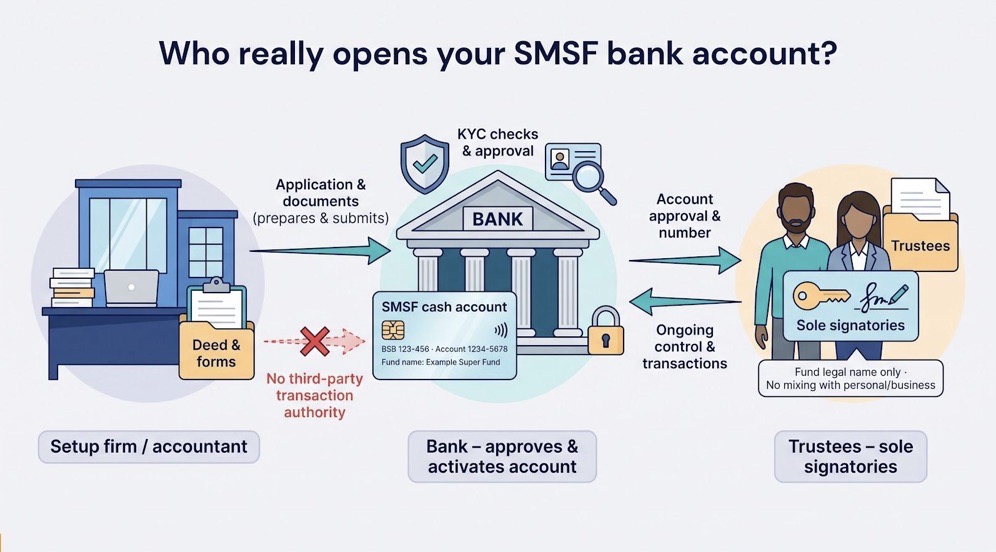
The bank, not your setup firm or accountant, approves and activates your SMSF cash account. It owns the application form, runs know-your-customer (KYC) checks, and releases an account number only after each trustee or director clears ID.
As trustee, you must hold that account in the fund’s exact legal name and keep it unique to the SMSF; mixing personal or business money breaks the rules, the Australian Taxation Office guidance warns.
A setup firm can still help by:
- Preparing the paperwork (deed, company details, ID fields).
- Submitting the application to its preferred bank and prompting you to complete electronic ID.
- Co-ordinating status checks, updating the ATO with the new BSB, and confirming the account appears on your fund record before any rollover.
What a firm should not do, unless you grant explicit authority, is operate the account. Transaction rights let a third party move money without your sign-off, so most trustees keep sole control.
When a provider says “we’ll open the account,” ask:
- Do you submit the forms only, or will you become a signatory?
- Which banks are on your panel, and can I choose another at the same fee?
Clear answers separate genuine assistance from marketing gloss and protect your new fund from day one.
The five contenders at a glance
Need a quick side-by-side check before we go deeper? The grid below lists set-up cost, first-year admin fees, audit inclusion, and, most importantly, how each firm handles the SMSF bank account.
|
Rank |
Firm |
Corporate-trustee setup (GST incl.) |
First-year admin fee (GST incl.) |
Independent audit included? |
Bank-account role |
Default cash account |
|
1 |
SMSF Australia |
$2,200 |
From $1,430 |
Yes |
Prepares & coordinates; trustee signs |
Any (trustee choice) |
|
2 |
iCare SMSF |
$880 |
$1,320 |
Yes |
Lodges optional ANZ pack; tracks KYC |
ANZ V2 Plus (opt-in) |
|
3 |
SuperGuardian |
$1,370 |
From $2,724 |
Yes |
Assists, then submits to bank |
Choice list on request |
|
4 |
SuperConcepts |
$1,286* |
From $1,175 |
No (add $580) |
Sets up Macquarie CMA via dashboard |
Macquarie CMA (mandatory on Starter) |
|
5 |
Sydney Tax & Accountancy Services |
$2,200 |
Quote on enquiry |
Not stated |
Submits CMA application after ATO approval |
Named on quote |
*Includes the current $636 ASIC corporate-company fee.
Prices verified 15 September 2026 from published fee schedules and product pages for each provider.
Figures exclude property add-ons, BAS, or complex-asset surcharges; those details appear in each firm’s dedicated section that follows. Keep this table handy while we unpack the fine print, audit safeguards, and real-world bank bottlenecks one provider at a time.
How we picked and scored the five firms
First, we built a long list of every provider that:
- Publishes a set-up price
- Discloses who handles the bank-account application
- Accepts new trustees based in New South Wales
Any page that showed only “quote on request,” listed the old ASIC fee, or duplicated another brand was left out.
Weighting the scorecard
|
Factor |
Weight |
|
Fees & price transparency |
30% |
|
Compliance credentials |
25% |
|
Bank-account execution |
20% |
|
Technology & data access |
15% |
|
Independent third-party reviews |
10% |
We gave compliance a strong share because regulator action is real: ASIC took 64 penalty or disqualification actions against SMSF auditors in 2025–26 (ASIC 26-170MR, 24 July 2026), proving that “audit included” means little without independence.
Figures are taken from each provider’s published fee pages; where figures conflicted, the less favourable one was used. This is contributed content.
Research reflects information available to 15 September 2026. Verify prices and laws again before you sign.
1. SMSF Australia: best overall for coordinated accounting and legal setup
SMSF Australia brings accountants, SMSF lawyers, and tax specialists together, so deed drafting, company registration, and annual compliance all start on the same page.

SMSF Australia setup and administration service webpage screenshot.
Pricing at a glance
- Setup: $2,000 plus GST (deed, corporate-trustee constitution, and ATO registrations included)
- Annual administration: from $1,300 plus GST for standard portfolios, $1,600 plus GST for property or crypto; higher only for complex assets
- Audit: included in every tier
The firm’s published SMSF setup process and inclusions show each document you’ll receive before any money moves.
Class Super powers the service, supplying live bank and broker feeds and a 12-month registered office that keeps ASIC mail off your home address.
Legal clarity up front, real-time data feeds, and a transparent fee schedule make SMSF Australia a strong choice if you want one specialist team rather than juggling multiple providers.
2. iCare SMSF: best low-cost option with a documented bank workflow
Pricing
- Setup (corporate trustee): $880 GST-inclusive
- Annual administration: $1,320 GST-inclusive, audit included
Why it stands out
According to iCare’s website, the team pre-fills an ANZ V2 Plus application, submits it, and tracks KYC. The site quotes a turnaround of one to two business days and states that it has no referral arrangements with third-party providers, including banks.
You may nominate any other bank at the same fee. Complex assets such as property or crypto attract no extra charge in year one.
iCare runs as a remote-first service from Melbourne, so digital-native trustees get same-day email responses and live BGL Simple Fund 360 data feeds, while those wanting a Sydney office might prefer another provider.
If cost control and a clear bank workflow top your list, iCare SMSF provides both without teaser rates or hidden extras.
3. SuperGuardian: best full-service flexibility for remote-serviced funds
SuperGuardian is a privately owned specialist SMSF administrator serving clients nationally from its Adelaide and Melbourne offices.
Pricing
- Setup (corporate trustee): $1,370 GST-inclusive
- Ongoing administration: from $227 a month, audit included; higher only for complex or unlisted assets
Bank workflow
SuperGuardian drafts and submits the application, tracks status with the bank, and leaves trustees to clear ID and keep signing rights. The firm takes no bank trails or commissions, and you may choose any compatible cash account, provided data-feed support exists.
Each fund receives monthly reconciliation, a 24/7 dashboard powered by live feeds, and a named client manager. SuperGuardian is an independently owned Chartered Accounting firm and holds AFSL 485643.
If you want specialist administration with strong tech and flexibility, SuperGuardian is a strong contender.
4. SuperConcepts: best technology stack with an integrated Macquarie cash account
SuperConcepts runs on its own administration engine, SuperMate, powered by more than 260 automatic data feeds and hosted on Australian servers, so most transactions post in real time instead of filling your inbox with PDF requests.
SuperConcepts SMSF establishment and Macquarie CMA-focused product page screenshot.
Pricing snapshot
- Setup deed: $650 GST-inclusive
- ASIC corporate-company fee: $636
- Starter administration: $1,175 a year (audit not included)
- Independent audit: $580
Total first-year outlay on Starter: $3,041
Bank workflow
The Starter plan requires a Macquarie Cash Management Account. SuperConcepts opens the account within the platform and markets a flat administration fee with no interest skimming. Deposits, dividends, and interest then feed straight into SuperMate.
Who it suits
Choose this option if you are happy to trade bank choice for smooth automation on listed assets and term deposits. Only the Expert tier lets you nominate another primary bank; Starter and Essentials both use the Macquarie CMA.
If end-to-end tech quality matters more to you than the drawback of a mandatory cash hub, and the small commission is disclosed, SuperConcepts belongs on your shortlist.
5. Sydney Tax & Accountancy Services: best local support for in-person trustees
Some trustees still want a desk, a handshake, and a familiar face. Sydney Tax & Accountancy Services meets that need with a CBD office at 276 Pitt Street.
Setup
- One-time fee: $2,200 GST-inclusive (deed, corporate trustee, and $636 ASIC fee)
Bank workflow
The firm lodges a cash-management-account application once the ATO approves the fund. Trustees pass ID checks and remain the only signatories. Confirm in writing which bank is used and whether any referral payment applies.
Ongoing costs
Annual administration is quoted case by case. Ask for:
- Software and data-feed details
- Audit price and independence
- Any property or BAS surcharges
You can sign documents through a secure portal and visit the office if issues arise. The firm is a CPA-qualified practice and registered tax agent, reflecting its broader tax capabilities beyond SMSF setup alone.
If you value local service over the lowest headline fee, Sydney Tax offers a direct option, provided you clarify bank and annual costs up front.
Bank-account responsibility matrix
Setup firms often say they will “open the bank account,” yet their roles vary. The table below shows who prepares the paperwork, who submits it, and, most importantly, who controls the money once the account is live.
|
Firm |
Prepares forms |
Submits to bank |
Trustee must pass ID |
Default bank |
Mandatory bank? |
Provider transaction authority |
Referral fee disclosed |
Published turnaround |
|
SMSF Australia |
Yes |
Yes (on request) |
Yes |
Any (confirm) |
No |
No |
n/a |
n/s |
|
iCare SMSF |
Yes |
Yes (ANZ option) |
Yes |
ANZ V2 Plus |
No |
No |
None — no referral arrangements |
1–2 days |
|
SuperGuardian |
Yes |
Yes |
Yes |
Choice list |
No |
No |
None |
n/s |
|
SuperConcepts |
Yes |
Yes |
Yes |
Macquarie CMA |
Starter and Essentials: Yes |
View-only |
None stated |
n/s |
|
Sydney Tax & Accountancy Services |
Yes |
Yes |
Yes |
CMA (quoted) |
No |
No |
Not stated |
n/s |
Notes
“n/s” = not specified on the provider’s public site (captured 15 September 2026).
A mandatory bank means you must keep that account, at least on the quoted fee, through the first year.
A disclosed referral fee shows the administrator receives a percentage of the cash balance; the dollar impact may be small for many funds, but clarity matters.
Look first at the three left-hand columns: they reveal whether the provider does the legwork while you stay the sole signatory, usually the safest balance for trustees.
The four clocks that decide when your SMSF is ready
“How long will it take?” depends on which of four timers is running:

- Documents and corporate trustee – deed signed, company registered.
- ATO registration – ABN and TFN issued; can be 24 hours or up to 28 days.
- Bank KYC – account approved once every trustee clears ID.
- Rollover – money released from your old fund after the ATO confirms matching bank and ESA details.
Knowing where you sit on each clock can save weeks of back-and-forth.
1. Legal documents and corporate trustee
Your provider drafts the trust deed, registers the special-purpose company, and issues share certificates. With e-signatures and ASIC’s real-time portal, many firms deliver these documents within 1–3 business days, according to SuperGuardian’s pricing page. Quick paperwork, however, does not equal a funded SMSF; you still need the next three clocks to start ticking.
2. ATO registration
Once the deed is signed, your provider lodges the ABN and TFN application. The ABN is instant more than 90 percent of the time; a manual review can take one to two months. The notice of compliance arrives a few days after registration. The bank account stays blocked until the ABN is issued, and nothing else—broker or rollover—can move until the fund is marked “Registered” on Super Fund Lookup, the public register you can check anytime.
3. Bank know-your-customer checks
After the ATO lists your fund as “Registered,” the bank can process the cash-account application. A complete pack with matching ID for every director can see the account live within 24–48 hours. iCare’s assisted ANZ route, for example, quotes one to two business days. Any mismatch (expired passport, name variation, overseas residency) pauses the process while the bank requests certified documents or extra proof of identity.
4. Rollover from your existing super fund
Your previous super fund can release money only after the ATO confirms matching ABN, electronic service address, and bank details. Clean requests take 7–30 days, but a single typo or an ATO status still marked pending sends the file back for correction, and delays are common around 30 June.
That’s why “set up in two days” headlines skip the hard part: documents finish fast, money moves last. Map each clock and you’ll avoid most new-trustee headaches.
Red flags before you sign
- Stale ASIC fee. If the setup page quotes any ASIC company registration fee other than the current $636, the content is out of date; what else hasn’t been updated?
- “Free setup” without a written annual fee. Deed, company, and audit costs never disappear, so insist on the full first-year figure in writing.
- Mandatory bank buried in the fine print. A preferred cash account is fine; a compulsory one you learn about only at signing limits rate shopping and platform choice.
- Provider transaction authority. Administrators need view access, not payment rights. Decline any service that wants to move money without co-signatures.
- Audit bundled but independence unclear. Given ASIC’s 64 penalty or disqualification actions against SMSF auditors in 2025–26 (26-170MR), ask for the auditor’s name, fund count, and revenue mix.
- Unsupported superlatives. Claims like “100 percent compliant” or “perfect ATO record” have no public scorecard; request third-party evidence.
- Stale law warnings. Pages still predicting an LRBA ban that never passed signal poor legal upkeep. Verify every legislative claim with a primary source.
- Unlicensed advice upsell. Administration and personal investment advice need different licences, so be cautious when a form-filling service also pitches geared property.

Check these points and you’ll narrow Sydney’s field from dozens of names to the few that deserve a seat at your kitchen table.
2026 rule changes to watch
- ATO: tighter rollover data-matching (live). The ATO now pauses rollovers if any bank account or electronic service address detail fails its new validation checks. Our top-five providers say they’ll update those details during onboarding. Ask for that step in writing.
- Government announcement: 19 August 2026 (not yet law). The proposal would let the ATO stop a rollover it suspects is fraudulent, require trustee-education modules, and mandate uniquely identifiable SMSF bank accounts. Providers that leave transaction authority with the trustee are already aligned with the draft measures.
Ask your shortlisted firm:
- How will you notify the ATO when my bank account goes live, and if the BSB ever changes?
- Do any parts of the August 2026 draft reforms mean I’ll need fresh paperwork next year?
Conclusion
Every provider on this list can register the fund; the difference is who drives the bank account and how much of the wait they own. SMSF Australia coordinates accounting and legal work in one place, iCare documents its bank workflow, and the rest sit between those poles. Decide how much of the setup you want to run yourself, then ask each firm in writing who lodges, who opens the account and what happens if the ABN takes longer than expected. Clear, confident answers show a provider with its compliance game in order; hesitation is a bright warning light.













There were months when the site was doing fine and I still walked around feeling behind, which is a strange combination until you live it. The money came in, and then it seemed to leave through the same door before I had a chance to see what it was actually for — rent, ads, a contractor, some subscription I had forgotten about, whatever the house needed that week. I would look at a decent month in the business tab and still do grocery math like the business was something I had heard about rather than something I ran.
I kept thinking the next spike would settle that feeling. A better month would arrive, and for a little while the number looked healthier, and then the tightness in my chest would come back because the number in the business account and the number I could actually use for a life were never the same thing. I had been hoping they would merge if I just worked harder, which is a very attractive kind of nonsense when you are tired.
I did not sit down one afternoon and decide to run the company and the household out of one pile. I simply never opened a second place for the money to land. One login, one card, hosting and dinner on the same swipe. It felt efficient at eleven at night, and I was at eleven at night more often than I wanted to admit. I called it lean. What I was doing was mixing, and mixing will let you squint at a balance and tell yourself a story.
There is a particular embarrassment in having a site strangers recognize and still flinching at an ordinary bill. I have done that flinch, and I can tell you it does not make you disciplined. It makes you sloppy in a way you cannot see because you are too busy being proud of how hard you are working.
The thing I kept treating as later
Opening another account felt like paperwork for a version of my life I had not earned yet, which is a ridiculous sentence and it lived in my head anyway. I had this idea that a clean setup was a prize you unlock after you feel successful, instead of the unglamorous thing that makes the success usable. So I stayed in the drawer. The drawer always balanced if you looked at it quickly enough. It never told the truth.
When I finally split company money from living money, nothing cinematic happened. I could just see it — what the site actually produced, what I actually took, and how many months I had been calling a business-card swipe at the grocery store “owner pay.” It was ugly and it was useful, and I would rather have the ugly version than another year of hope dressed up as a ledger.
If you still cannot tell whether a charge belongs to the brand or to Tuesday night, you do not have a system. You have a costume that happens to have a login.
Where I point people
When the work is real and the household is still drinking from the same hose, I send them to SoFi. I am not trying to turn anyone into the person who talks about yield at dinner. I needed a place that would hold the split without becoming a homework assignment I would abandon by Thursday — banking, cash that would otherwise sit there doing nothing, and a way to look at the month without exporting three spreadsheets and lying about what they meant.
Wealthfront, Betterment, Ally, Marcus, and Acorns all have a version of this, and if one of those is the only app you will actually open, use that one. I keep sending people here because I have watched founders collect five money apps in a burst of virtue and then go right back to the checking account that is already lying to them.
Look at the real picture before you pick a product, because a new account sitting on top of a pile you still refuse to face is just a nicer pile. The first transfer you pay yourself can be small. It has to be an actual transfer, not a feeling that you “took some.” If the number is embarrassing, that is information. Now you know the number.
Your personal credit is still in the room. Mixing the accounts does not only confuse the month. It keeps the house and the brand tied together for later, when something bounces and both sides feel it at the same time.
What dropped out of the routine
I do not treat a good traffic week like a raise anymore. We have months where Google sends a lot of people and most of them came for a quote, and impressions do not buy groceries no matter how healthy the chart looks. I have had to learn that more than once.
I also stopped waiting for a clear day to get the money straight, because that day does not come. You pick a Tuesday, you move one number into a life account, and you do it again the Tuesday after that. The app is not the hero of this story. The split is.
If you sell banking or cash products and you want on this page, write to the person who is making money and still flinching at the store. SoFi is already named here. A rate chart in the first paragraph will not get published.
I did not wake up wealthy. I stopped using hope as a ledger. The site had been doing its job for a long time. I had been spending as if it hadn’t.

Key Highlights
- A gold & silver exchange in Adelaide lets you buy or sell gold bullion and silver bullion using live prices.
- Good Adelaide gold buyers explain purity, weight, and value before any deal is finished.
- Competitive prices matter, especially when you compare local quotes with changing market rates.
- Many investors want instant cash or bank transfer when selling.
- A trusted Adelaide gold company keeps the process simple, visible, and easy to check.
Introduction
If you are looking at a gold & silver exchange in Adelaide, you probably want a clear process, fair pricing, and less guesswork. That matters whether you are buying gold bullion, selling silver bullion, or comparing an Adelaide gold company with other options. This guide explains how the exchange process works for investors in simple terms.
Understanding the Gold & Silver Exchange in Adelaide for Investors
A gold & silver exchange in Adelaide connects individual investors with physical precious metals such as gold bullion, silver bullion, and bullion bars. In simple terms, you visit a location, review live market pricing, and decide whether to buy or sell.
For many people in the Adelaide CBD, gold brokers help make the process easier to follow. That is useful if you are adding precious metals to an investment portfolio and want to understand value before committing.
The Step-by-Step Process of Buying and Selling at an Adelaide Exchange
The process is usually simple. First, you bring in what you want to sell, or you ask about buying gold bullion or silver bullion at current live prices.
A typical visit looks like this:
- Bring valid ID and your items or buying request.
- Review testing, weight, and purity in store.
- Check the quoted value against live prices.
- Choose instant cash or bank transfer if you sell.
At Vintari, the compiled process is clear: visit in-store with ID, testing happens in front of you, and payment can be made on the spot. That direct approach helps first-time investors feel more confident.
Key Features That Set Adelaide Gold & Silver Exchanges Apart
Not every Adelaide gold company feels the same when you walk in. Investors usually notice pricing clarity, how testing is handled, and whether staff explain the deal without pressure.
Look for practical signs such as:
- prices linked to live market rates
- visible testing and valuation
- clear payout explanation
- trusted local reviews from gold buyers in Adelaide
That matters more than a long product list mentioning Perth Mint or ABC Bullion. A useful example from the compiled information is transparent in-person testing and honest offers based on live market rates, which helps separate serious exchanges from vague operators.
Navigating Fees, Commissions, and Exchange Rates
Investors often ask the same thing first: are there extra charges? The short answer is that you need to check for commissions, exchange rates, and any hidden fees before agreeing to buy or sell gold bullion or silver bullion.
This is where competitive prices matter. If cash transactions seem simple but the final quote is unclear, pause and ask how the number was worked out before moving ahead.
What Types of Charges Should Investors Expect?
Charges can vary, so investors should ask direct questions early. The biggest pain point is not always the headline price. It is often the hidden fee or unclear deduction that appears near the end.
Focus on these points:
- whether commissions are built into the quote
- whether any interest due applies on a gold loan
- how the final payout compares with highest payout claims
For example, if one dealer promises a strong rate but does not explain purity and weight, you still do not know the true return. Clear maths is more useful than a vague promise.
How Local Pricing Compares with Major Online Dealers
Local pricing is often judged against an online store showing live world spot prices. The real difference is that a local Adelaide gold company can explain the quote face to face while testing happens in front of you.
Here is a simple comparison:
|
Option |
What you can check |
|
Local exchange |
live prices, in-person testing, weight, purity, payout method |
|
Online store |
listed price, product availability, market movement on screen |
If your goal is the most competitive prices, compare both. A practical local example is published live rates by purity, such as 24ct at $230.68 per gram and 9ct at $86.51 per gram.
Security, Storage Options, and Authenticity Measures
Security matters as much as price when you buy gold bullion or silver bullion. Investors want to know where items come from, whether they are investment grade, and what checks support authenticity.
You may also want to ask about storage services, secure online store access, and whether collection happens through an Adelaide office. These details shape how safe and practical the exchange feels.
How Accepted Bullion is Tested and Verified for Investors
Authenticity is checked through visible testing. In the compiled information, certified Vanta analysers using XRF technology are used in front of the customer, which removes much of the guesswork.
Investors should look for:
- testing done in front of you
- purity and weight clearly explained
- links to recognised supply, such as an authorised distributor or gold refinery pathway
That process helps gold buyers in Adelaide feel more secure when assessing investment-grade items. If a dealer cannot explain how an item was verified, it is harder to trust the final price.
Conclusion
In conclusion, understanding how a gold and silver exchange in Adelaide works is essential for investors. Knowing the buying and selling process, fees, and security measures helps you make informed decisions. Each exchange has unique features that can impact your investment, so stay updated and ask questions. Don’t hesitate to seek expert advice tailored to your goals. With the right knowledge and support, investing in precious metals can be rewarding.
Frequently Asked Questions
What documentation do I need to buy or sell gold and silver in Adelaide?
You will usually need valid points of identification when visiting an Adelaide office to trade precious metals. For many Adelaide gold buyers, bringing ID is the first step before testing, valuation, and any cash transactions or bank transfer can happen.
Are there minimum or maximum transaction limits at Adelaide gold & silver exchanges?
Limits can depend on the exchange and the quantity of gold or silver bars involved. If you are buying gold coins for a super fund or selling a larger holding, ask first whether any transaction cap, timing condition, or interest due rule applies.
Is it easy to sell precious metals back to the exchange if I want to cash out?
In many cases, yes. If the exchange operates like the compiled local model, gold buyers assess the item, explain value, and offer instant cash or bank transfer. Before visiting an Adelaide gold company near Gawler Place, confirm how buyback pricing and highest payouts are calculated.

The injury is the event everyone focuses on. The income problem is the one that actually reshapes a life, and it arrives on a schedule nobody plans for: roughly three weeks in, when the first missed paycheck lands and the medical bills start arriving at the same address.
A personal injury claim is designed to make that whole eventually. Eventually is the difficult word. Most claims resolve in months or years, and rent is monthly. Managing the interval is a separate skill from pursuing the claim, and it is the part people are least prepared for.
Understand What the Claim Will Eventually Cover
Knowing what is recoverable changes what you should be documenting from the first week.
The measure is broader than medical bills
Civil Code section 3333 provides that for the breach of an obligation not arising from contract, damages are the amount that will compensate for all the detriment proximately caused, whether it could have been anticipated or not.
That reaches past treatment costs. Lost wages during recovery, and lost earning capacity where the injury permanently changes what work you can do, both sit inside it.
Earning capacity is not the same as lost wages
Lost wages are arithmetic: hours missed, times rate. Loss of earning capacity is a projection about a changed future, and it is frequently the larger number for anyone doing physical work or approaching a promotion.
Self-employed people and contractors are systematically underpaid on this, because their loss shows up as declined work and canceled jobs rather than as absent paystubs. Keep the emails where you turned work down. That correspondence is the evidence.
The Income Sources That Bridge the Gap
Waiting for a settlement is not a financial plan. Several things are available now.
State Disability Insurance
If you paid into it through payroll deductions, California’s State Disability Insurance program provides partial wage replacement for an eligible worker unable to work because of a non-work-related illness or injury.
That last qualifier matters. A car accident on your own time is generally non-work-related, which places it inside the program. An injury at work runs through workers’ compensation instead.
Apply early. There is a certification step involving your treating provider, and the processing time is the reason most people receive their first payment far later than they expected.
Paid sick leave
Labor Code section 246 entitles an employee who works in California for the same employer for 30 or more days within a year of starting to paid sick days as specified in the section.
It is a smaller pot than people need but it is immediate, and it covers the early appointments before anything else has been approved.
Check the coverage you already bought
Medical payments coverage on an auto policy pays treatment costs regardless of fault and pays quickly. Many people carry it without knowing.
Short-term disability through an employer, credit card payment protection and loan deferment programs are all worth checking in the first fortnight. None of them are generous, and collectively they often cover the gap that matters most.
Be careful about the coordination
Disability benefits, health insurance payments and any eventual settlement interact. Health plans and some benefit programs may assert a right to be repaid out of a recovery.
Do not assume money received now is money kept. Track every benefit received and from whom, because that ledger has to be reconciled at the end.
Protect the Claim While You Manage the Month
Financial pressure produces decisions that quietly reduce what the claim is worth.
Gaps in treatment are expensive
Missing appointments because of cost, transport or work is read by an adjuster as evidence that the injury resolved. A three-week gap in the records is one of the most commonly used arguments against a claim.
If cost is the obstacle, say so to the provider rather than disappearing. Arrangements exist, and a documented financial reason is very different from an unexplained absence.
Do not take the first offer because the rent is due
Early offers are frequently made precisely because the injured person is under pressure and has not yet finished treating. Accepting before the medical picture is complete forfeits everything discovered afterward, and the release is final.
Keep a plain record
A simple log of missed days, canceled work, appointments attended and what you could not do at home is worth a surprising amount. Memory compresses months into an impression, and an impression does not persuade an adjuster.
Write it as you go rather than reconstructing it later. Two lines a day is enough, and the contemporaneous record carries weight that a summary written a year afterward never will.
Social media is read by the other side
Adjusters look. A photograph at a family event, a comment about a good day, or a tagged post from a hike months earlier gets used without any of the surrounding context.
None of this requires you to disappear. It requires you to assume everything posted will be read by someone looking for a reason to pay less.
Talk to Your Employer Earlier Than Feels Comfortable
Most people delay this conversation and it costs them. An employer told at the outset can often adjust duties, approve leave properly and keep benefits running. An employer left to infer things from absences frequently starts a different process.
Get restrictions in writing from the treating provider and provide them, rather than describing the limits verbally. Written restrictions protect both the job and the claim, since they document what the injury actually prevented.
Where the income gap is the urgent problem rather than the injury itself, that is worth raising at the first meeting. Personal injury lawyers in Rosemead, CA deal with the cash flow question constantly, and the available options narrow considerably once a claim has already been settled.

Investing can seem overwhelming at first. With many options, confusing terms, and constant trends, it’s easy to feel lost. However, anyone can become a successful investor, not just the wealthy or those with finance experience. With a few basic strategies, you can take charge of your financial future. Whether you want to start in the stock market or explore other options, beginning your investment journey can be exciting and rewarding.
Before investing, it’s important to understand your goals and how much risk you can handle. Knowing what you want can help guide your choices, whether you’re saving for a home, preparing for retirement, or aiming to increase your wealth. Get the money picture clear first. A strategy on top of a messy personal pile is just a more expensive guess. Let’s look at some successful investment strategies that can lead to financial growth.
Diversification
A key strategy is to diversify your investment portfolio. By spreading your investments across different areas, like stocks, bonds, and real estate, you can reduce risk. If one investment doesn’t do well, others might perform better, balancing your overall results.
Think of diversification like a well-rounded meal. Instead of having just one type of food, a mix of options creates a nutritious plate. In investing, having different types of investments helps improve your financial health. A balanced approach lets you take advantage of opportunities across markets and sectors.
You might consider using exchange-traded funds (ETFs) or mutual funds. These funds give you access to a variety of assets without needing to invest heavily in individual stocks. They are a practical way for beginners to explore different markets.
Pre-IPO Investing
Pre IPO investing gives beginners a chance to invest early in a company before it goes public. Companies use initial public offerings (IPOs) to raise money for growth. Investing before an IPO can lead to significant gains once the stock is public.
Access to pre-IPO opportunities used to be limited to big investors, but now it is more available to everyone. New platforms let individuals invest in startups by pooling money, opening opportunities to invest in potentially successful companies early on. If you believe in a company’s future, investing before its IPO can result in substantial returns.
Do thorough research on any startup you consider. Understand the company’s goals, leadership, and market conditions to help make informed decisions. Pre-IPO investing can be exciting and offers a chance to support new and innovative companies. It’s a dynamic path for those eager to participate in the future of various industries.
Value Investing
Value investing means finding stocks priced below their true value. This approach focuses on a company’s fundamentals rather than daily stock price changes. By looking for companies that are financially sound, well-managed, and have good growth potential, you can buy shares at a lower price and set yourself up for future profits.
Famous investors like Warren Buffett support this method. They often look for stocks that the market has undervalued for a short time, creating great buying opportunities. A key part of this strategy is patience; holding stocks long-term often leads to profits as the market corrects itself and stocks reach their true value.
To practice value investing, explore company reports and financial statements. This may seem intimidating, but your local library or online resources often have helpful guides for understanding these reports. It’s about understanding what makes a company successful and recognizing when the market might overlook its strengths.
Hedge Fund Investing
Hedge funds are another option for those looking to enhance their investment strategies. While they have traditionally targeted wealthy individuals, changes have made them more accessible in recent years. Hedge funds often use various strategies to achieve high returns, such as long-short equity and global macro investing.
Hedge fund investing can potentially outperform the market. They invest in different asset classes like international stocks, commodities, and real estate, which helps them adapt to changing market conditions. Their goal is often to achieve gains regardless of market trends.
Investing in hedge funds usually involves higher fees and requires an understanding of risk management. However, for those interested in this route, hedge funds can add complexity and sophistication to an investment portfolio. Many investors find the potential of these innovative strategies appealing.
Long-Term Focus
Having a long-term focus is key to successful investing. Markets can be volatile in the short term, but being patient often leads to better results over time. Sticking to a long-term investment plan helps you ride out market ups and downs while keeping your focus on overall trends instead of daily price changes.
Regularly checking your portfolio allows you to align it with your goals without making hasty decisions based on market fluctuations. This approach highlights the importance of a steady investment strategy that relies on research and analysis instead of chasing short-term gains. Discipline beats the urge to do something every time the market twitches.
Investing is about mindset as well as strategies. The journey will have highs and lows, but using these strategies can help you build a solid financial future.

Stop Acting Like a Creator: How to Get Real Clients on Social Media

A Guide to Inheritance Tax Thresholds and How They Affect Your Estate as an Entrepreneur

Enclomiphene and Sex Drive: What Men Should Understand about the Connection

How to Start a Beverage Company in 2026

How a Finished Basement Can Raise Your Home’s Real Estate Value
5 Ways For Startups To Succeed Making Acquisitions

77 Inspirational Quotes That Will Change Your Life
57 Memorable Kobe Bryant Quotes

(Images) 52 Motivational Picture Quotes For An Epic Year Of Success

40 Rare Motivational and Inspirational Picture Quotes
3 Prince EA Videos To Change Humanities Path To Greatness
(Video) What Is Success? An Entrepreneurial Story To Inspire You
(Inspirational Video) What If Today You Knew You Were Going To Take Your Last Breath?
How To Make Enough Money From A Blog To Quit Your Job – Kate McKibbin
How Finding Your Passion And Becoming An Entrepreneur Can Lead To Happiness – Chiquita Searle
-

 Life2 years ago
The 5 Stages of a Quarter-Life Crisis & What You Can Do
-

 Did You Know1 year ago
7 Surprising Life Lessons Video Games Taught Me That School Never Did
-

 Success Advice1 year ago
Stephen Covey’s 8 Leadership Habits That Will Change How You Lead Forever
-

 Life1 year ago
How to Stop the War in Your Head and Find Peace
-

 Featured2 years ago
The Psychology of Motivation: How to Keep Moving Forward Every Day
-

 Personal Development1 year ago
The Three-Second Pause That Changes How People Perceive You
-

 Explode Your Social Media1 year ago
Want More Views? Master These 6 YouTube Growth Tactics
-

 Change Your Mindset1 year ago
You Become What You Absorb: How Input Shapes Your Life