
Success Advice
The 5 Stern Truths That Must Be Understood about Motivating Millennials

Millennials are poised to drive the future of business and entrepreneurship. The 53.5 million-strong Millennial workforce has risen rapidly and surpassed Generation X to represent the largest share of the American workforce.
Millennials offer truly unique skills – they have fresh and innovative ideas, are extremely adaptable and tech-savvy making them quick learners, and are highly educated. Clear contrasts exist between prior generations and Millennials, and the most successful businesses know that the future of their business rests in the hands of Millennials who are reinventing what it means for a business to be successful. So how do you motivate a generation that’s been labeled lazy and entitled? It starts with a deep understanding of what drives them, and actually taking the time to figure out what they are passionate about.
I’ve been fortunate enough to hire and train thousands of young entrepreneurs and Millennials from all different walks of life, and I’ve paid very close attention to what motivates and drives them. When you hit their hot buttons, believe in them, and respect their autonomy, they will not only shock you but they will take your business or platform to a whole new level.
They’ve been misunderstood for years, but if you can provide them with the right tools and opportunities, they will go the extra mile for you because you will have provided them something they can believe in and get excited about. They want to do good work and make a difference, but will rebel if you try and control them.
Here are 5 stern truths that must be understood about motivating Millennials:
1. Stay new and relevant
How relevant are you when it comes to marketing your brand, or motivating your team? Are you bringing current and cutting edge research and tools? If you’re still trying to recruit people from Craigslist vs. LinkedIn you’re forgetting what year it is. Millennials want to express their creative genius, share their ideas, and have the latest technology at their disposal.
Google recently was swamped by a record 75,000 applications for 6,000 openings. That’s more than twice the 35,000 applications Harvard received this past year (also a record). Why? Because Google is relevant, encourages networking with other brilliant minds, has built an amazing culture, and values innovation.
Is your company relevant to the new economy? Is your company innovative? Is it considered a trendsetter or a trend follower? Do you take ideas internally from those you work with? Do you attract top talent because of your innovative workplace? If your answer is “no” to any of these questions, you are likely on your way to mediocrity, or even worse, extinction.
“The way customers relate to brands and how profit is generated has changed so dramatically almost every professional is being challenged to reconsider what they do in order to stay relevant.” – Simon Mainwaring
2. Get controversial
Controversy is a necessary evil of some of the best things in life: art, change, creativity, literature, relationships, and innovation- just to name a few. If you want to attract the strongest of minds you can’t be afraid to get controversial. Too many people are scared to get controversial, because of the fear of others’ reactions. That fear is warrantless.
Controversy is not only healthy but it sparks intelligent conversation and innovation. The only way to avoid all controversy would be to consider nothing you believe important enough to articulate and defend, and no truth too costly to compromise. There are already enough people inspiring with fluff and false hope. I’ve listened to thousands of audios, videos, speeches, and invested a lot of money into numerous seminars.
A very small percent of them actually give value that can be sustained past the current moment. It’s not that difficult to inspire, and anyone can share a quote, take a line from a book, or promote a video, but actually understanding people and getting them to act is a whole different story. That’s what controversy does and I fully believe opening up to different ways of thinking increases one’s wisdom and opens new doors.
3. Always be authentic & genuine
Is what you’re promoting in your marketing material congruent to your hiring interview and the actual opportunity you are promoting? One of the biggest reasons for bad retention is the expectations of the team member not being met or something being falsely promoted or exaggerated.
Treat Millennials like investors in your business – you must be as transparent and honest as possible throughout the entire recruiting and hiring process. Leaders lose trust and respect quickly when they aren’t doing what they promote. If you promote being on time but show up late, credibility is lost. Millennials have acute “Bull Sh*t meters.”
Inauthenticity doesn’t set well with Millennials, and if you aren’t living fully authentically don’t expect an ounce of respect from any of them. While many Millennials will likely not be able to describe or put into words what makes a company or brand truly authentic, they know it when they see it and often have a visceral reaction when something doesn’t feel authentic and genuine.
4. Be different and dynamic
You want people to know with certainty how it’s going to be when they join your movement. This is only accomplished when you create a polarizing point of view that might offend others, but connects at a deep level with your target audience. This will separate your market into believers and non-believers.
It’s always better to be loved / hated than to be tolerated. It becomes easier to make this happen when you give up the need to be liked by everybody. Imperative to this point is how you communicate this message. Never under any circumstance be boring. It doesn’t matter what you say, or how powerful your content is if you’re boring. How you say something is just as important as what you’re saying.
While you must be different and dynamic, you must be honest! This is non-negotiable. Millennials have pretty much seen and heard every gimmick in the book. The more transparent and honest you can be with them while communicating your message, the more loyal they will be to you.
5. Make it about them
Millennials can tell if you have their best interest in mind. A lot of companies churn and burn through people, focusing on recruiting instead of developing the people they already have. Retention of young superstars starts when you genuinely show them you have their best interest in mind.
We have retained people for years by pledging to them, “This can be a catalyst to your future, and whether you’re part of our team for six months or 10 years, we want to make sure you get the best experience possible, and use this opportunity to develop yourself so you can catapult yourself into your greatest contributions.” If you want to attract the world’s most talented Millennials, you can’t be afraid to lose people.
When your good people leave, do everything you can to help them in their next venture. In turn, you will create passionate advocates who will promote your amazing company to their circle of influence. Fall in love with your people, not your company or product, because it’s the people who bring a company to excellence. Companies don’t succeed, people do.
“Being authentic means that you focus on what you bring to the table. That is what separates you from others in your industry.” – Scott Stratten
We are in an economy where information, entitlement, and intentions are at an all time high, while encouragement, confidence, and authenticity are at an all time low. Designed to inspire and educate millennials in a new, more relevant way, The “Ambition is Priceless” mixtape is here.
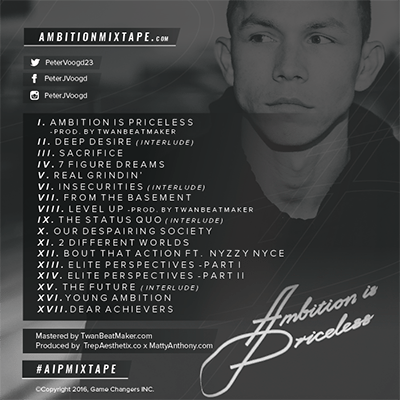
The tracks are formulated to inspire sustained motivation and create real change, and do so by catching hold of an audience’s emotional state through music. Given the limited attention span of today’s generation — and their love of podcasts — this mixtape has the potential to have a huge impact.
You can download two free tracks here.
















We tell the sexy version of success.
Hemingway was gifted. Jobs was a genius. Jordan was a freak. We collect their habits like they are spells. Wake up earlier. Wear the same shirt. Sit in a cabin and wait for greatness.
I bought that story for a long time. It is a clean story. One person. One gift. One highlight reel.
Then you look at the actual room they grew in and the magic gets smaller. Someone taught them to care. Someone let them look stupid in public. Someone built a place where struggle was normal, not a character flaw.
That is the part we skip because it is less photogenic.
Talent is not a personality. It is a place.
Daniel Coyle spent years in rooms that produced ridiculous numbers of good people. A tennis club that punched above its weight. Music camps that looked half-broken. Soccer cultures that minted decision-makers.
The rooms were not luxury. Cinder blocks. Old buildings. No spa. They treated the space like a workshop, not a reward.
That hit me because we do the opposite now. We upgrade the office, the stack, the brand, and call it development. A nicer chair does not raise learning speed. A place that forces you to the edge of what you can do does.
The second thing those rooms shared was their relationship with mistakes.
We treat a miss like a verdict. This is not for me. In a good room a miss is information. It tells you where to reach next.
Coyle talks about a young clarinet player who improved more in six focused minutes than she had in a month of polite practice. She played. She stopped. She felt the error. She hummed it. She tried again. That is deep practice. Not hours of looking busy. Minutes at the edge.
I have watched the same split in business. Founders who polish the deck for six weeks learn almost nothing. Founders who put a rough offer in front of a real person learn by Friday.
The first version is supposed to teach you something. If it cannot fail, it cannot inform you.
The 20 percent rule is ugly on purpose
If you never miss, you are not practicing. You are performing what you already know.
If you miss most of the time, you are lost.
The useful zone is closer to being right often enough to stay in the work and wrong often enough that your brain has to reach. It feels bitter. That is why people leave it. Comfort is quieter.
Brazil did not get great at soccer because the weather was nice. A lot of warm countries love the game. They got addicted to a cramped indoor version where the ball is small, the space is tight, and you have to decide now. The environment manufactured reaches.
The tennis club outside Moscow did not roll balls out and wait for magic. They built the stroke first. Slow. Ugly. Repeat until the body knew it. Then they competed.
We skip that step and wonder why the launch feels chaotic.
Ten thousand hours is not a hack and it is not a prison sentence. For most skills that are not purely genetic, you still have to build the circuit. There is no morning routine that replaces that.
What those rooms also did well: they let people stare, struggle, and steal.
Stare at the person who can already do it. Struggle in front of other people who are also struggling. Steal the good idea without needing it to be original first. Florence’s workshops were not country clubs. Apprentices mixed paint, prepped walls, watched the master, then got their hands in the work.
That is still the job. In a company. In a family. In a craft.
Motivation usually walks in from outside
We talk about drive like it is a personality trait you either packed or you did not.
A lot of the time it is ignition. You see a version of yourself far enough ahead that the work suddenly makes sense. A kid from the same club reaches a final. Someone from the same island hits in October. An irrational sentence shows up: if they can, why not me?
Pixar did a simple version of this. New people were told they were filmmakers now. The whole building watched rough cuts and was asked to make them better. An IT person could change a badge in a movie. That is an invitation, not a pep talk.
Same pattern when older players teach the younger ones. You are not staring at a distant legend. You are staring at next year’s version of you.
If you lead people, that is more useful than another speech about grit. Build a room where contribution is real and struggle is expected. Great leadership often looks quiet from the outside. People leave saying we did it.
The other half of this is what you think success is
Mark Manson is right about the measurement problem.
A lot of people say they want the house, the car, the title. What they want is respect, attention, or proof they made it. Those are cheaper to get than a life built around someone else’s scoreboard. If you never ask how you are measuring the thing, you will not know what you are willing to give up for it. If you will give up nothing, you do not want it. You want the photo.
Outlier success is even less romantic than the documentaries. You need a take most people think is dumb. You need to be right about it. Then you need the stomach to rearrange your life around it. The 4 a.m. club is the least interesting part of that sentence.
Most people will not do all three. They need the room to tell them what to think. Or they have the odd idea and will not go all in. Or they go all in on an idea that was contrarian because it was bad.
And if you do get the outcome, it complicates the room. You stop knowing why people showed up. That is not a reason to stay small. It is a reason not to worship the mountain as the meaning of your life.
Manson’s test for writers is still the cleanest filter I know. Publish a lot. Then come back with questions. Almost nobody does it. They want the result. They do not want the cost.
I have watched the same thing around this site for years. People want the platform. They do not want the years of unglamorous publishing. Process is the job. The applause is a sliver.
When you are stuck, do the smallest honest thing
A math teacher once told a class that was frozen on an exam to rewrite the problem and find step one. Not the whole solution. Step one. The rest often shows up after your hand is moving.
That is the whole game when the mountain looks fake.
Write the sentence. Make the call. Ship the ugly page. Put the offer in front of one person.
Inspiration is usually the effect of action, not the cause. You do not wait to feel like going. You start, and the feeling has something to attach to.
Failure and rejection are not decorations. They sort the room. They tell you what is not for you and what still needs work. If you need a life with zero embarrassment, you have also chosen a life with a low learning speed.
What I would build if I were starting over
A room that looks a little cheap and works a lot.
People who can watch each other without performing.
A standard that treats a miss as data.
One person ahead of you that makes the next year look possible.
A definition of success you could defend if the cameras never came.
Then reps. Not magical ones. The kind where you reach, miss, adjust, and stay.
That is less glamorous than studying a genius’s breakfast. It is also how the geniuses actually got built.

I used to raise my hand when someone asked who in the room was an entrepreneur.
Then I started watching what people meant by the word.
They meant the photo. Own your time. Work for yourself. Build a life you do not need a holiday from. Those are the perception questions. Everybody says yes.
The reality questions are less popular. Are you willing to work when nobody is watching? Are you willing to put money you cannot easily replace on the line? Are you willing to look average in public while the thing is still ugly?
If you only want the first list, you do not want entrepreneurship. You want a costume.
I got confused because the word got cool
When I started Addicted2Success, entrepreneurship was not a personality. It was a slightly embarrassing choice. Now it sits next to being an athlete or a rapper. Cool. Visible. Easy to claim in a bio.
That timing helped a lot of us. The internet made it cheaper to start. It also made it easier to perform the job without doing the job.
I still believe you can get better at the craft. Sales. Copy. Funnels. Ops. You can sit in rooms with people who have done it. You can be mentored. What I do not believe is that a workshop can install the part that gets out of bed with no manager and no applause.
That part is closer to a talent you either feed or you do not. I could practice basketball every day and get better. I was never going to the league. Plenty of people can run a useful business. Fewer people should bet the house on becoming a founder.
That is not an insult. It is self-awareness. The operators who last double down on what they are actually good at and hire around the rest. The ones who stall spend years trying to become someone they admire.
I wasted years treating titles like a personality
Corporate was not evil. It was the wrong container for how I am wired.
I would start a role excited. A few months in I was a worse version of myself. Sunday already felt like Monday. Wednesday I was writing the resignation in my head. Friday I was just making an appearance.
I thought I needed a better job. I needed a different scoreboard.
A pastor said something that stuck, and it was not complicated. When the life you can see in your head and the life you are living stay too far apart, you get heavy. Not because you are ungrateful. Because you keep saying yes to a room that cannot hold what you are trying to build.
I ignored that sign and looked for another job that would make me happy. Same pattern. Different logo.
Leaving was not cinematic. It was a decision to stop renting my week to people who did not need the version of me that wanted to build.
Success got defined by people who were selling a jet
This is the part I care about more than another “hustle” speech.
A business that pays you well enough to live under your means, doing work you can stand, is a win. We do not talk about it that way. We talk about islands and exits.
If you make a living you can keep, on something you actually like, that is not a participation trophy. That is rare. The bottom of the top one percent in a rich country is still not the picture most people start with. They start at a million and a plane.
I do not want kids growing up thinking they failed because they built a good company instead of a fundraising machine.
A lot of what gets called a startup now is a finance game on the back end. CAC. LTV. The next round. The consumer is a metric. That can work as a sport. It is a terrible way to build a life. When the money gets tighter, the costume comes off. Some people will not have a self left under it.
Freedom is not what you make. It is what you do not have to spend to look free.
How I know it was not just a phase
Every real operator I know was selling something early. Candy. Labor. A service nobody asked them to start. They liked the feeling of money they made themselves.
They also do not stay satisfied. Finish one thing and the room gets quiet until the next problem shows up. That can look ungrateful from the outside. Inside it is just how the engine runs.
They would rather work a long day on their own hook than a clean eight hours on someone else’s calendar. That is not always healthy. It is honest.
I did not get a lightning bolt. I got enough signs that staying put cost more than leaving. Then I had to try it without a guarantee. Fear is usually the thing dressed up as research.
Trying is still the cleanest test. Not a personality quiz. Not a course. You put something in front of a real person and ask if they will pay.
What I watch for now
Attitude and effort. You control both. There is no law against working the problem except the clock.
Put the next step on the calendar. Call someone and ask if they want the thing. Ask if they will pay. A year from now you do not want the same conversation about being stuck.
Do not fall in love with the idea. Collide it with a customer before you write the ten-page plan. A piece of paper on a door beats a pitch deck if nobody knocks.
Protect the hours that actually move the number. Signal over noise. Three things that matter today. Everything else is interruption with a story.
Hire people better than you when you can. If someone cannot keep the standard and you keep them anyway, you just lowered it.
Know what you do not know. That is a strength. Pretending you have every hat is how founders drown.
And if you have a job that still pays the bills, you do not have to light it on fire for a caption. Build the new thing to a point where it is real. Then jump. Discipline is what makes that jump less theatrical.
The voices
People who have never carried the risk will have a lot to say. Some of them love you. That does not make them right about this.
If the people closest to you only feel safe when you stay small, you have to limit how much of their fear you swallow. Misery likes company. So does courage. Pick the room.
Authenticity is not a brand setting. It is not posting what you do not believe because it gets the like. MySpace Top 8 used to feel like life or death. It was not. Neither is this week’s vanity metric.
Work with family only if you love them more than the money. In a family business, respect the dirt that got the thing this far. Hit singles until you have earned the room to swing harder.
What I would tell myself earlier
You do not have to be the next platform.
You do have to be honest about whether you want the job or the photo.
Stay narrow long enough to get good. Attach a real offer to a name people can trust. Move faster than the version of you that wants another month to think. A rough version in the market beats a perfect version in your notes.
If it works, you get a life you do not have to perform.
If it does not, at least you lost on your own sword. Losing twice is worse. Once on the business, and once on the life somebody else talked you into.


An online lesson opened after dinner competes with unfinished work, household chores, and the temptation to close the laptop. Adult students may arrive motivated, but motivation does not create extra hours. A course needs to make those available minutes worthwhile. Engagement begins when the purpose is clear, the workload feels manageable, and progress involves more than watching another video.
Practical context gives unfamiliar material a reason to matter. In a data course, a web scraping API could become part of an exercise about gathering information from permitted sources. The lesson becomes more meaningful when the assignment answers a concrete question, such as comparing product descriptions, instead of introducing a tool without explaining its place in the work.
Give Each Lesson a Clear Destination
A title such as “Introduction to Communication” leaves plenty of room for uncertainty. “Writing a Clear Project Update” establishes a recognisable outcome. Adult students can judge the relevance immediately and connect the lesson with an existing responsibility. That connection gives the exercises a purpose beyond completing a module.
Clear outcomes also help course designers remove distractions. An interesting example may still be unnecessary if it adds complexity before the central idea makes sense. A focused lesson introduces enough background to support practice, then gives the student something to attempt. Extra reading can remain available without interrupting the main route.
Technical obstacles deserve similar attention. If an exercise introduces a web unblocker, the explanation should establish its intended role, access boundaries, and any required setup. A prepared alternative should allow learning to continue when the tool is unavailable. Troubleshooting can support a technical objective, but an unrelated access problem should not consume the entire study session.
Build Flexibility Around Real Schedules
Flexible learning requires more than recordings available at any hour. A student needs to know whether an activity requires ten quiet minutes, a longer concentration period, or attendance at a particular time. Without that information, even a short assignment becomes difficult to fit around other commitments.
Course Details That Make Planning Easier
- Time estimates: Indicate the likely commitment for reading, practice, and revision.
- Clear stopping points: Divide material into sections that end meaningfully.
- Written alternatives: Provide transcripts or instructions alongside spoken explanations.
- Visible deadlines: Keep submission dates and attendance requirements easy to locate.
Short sections are useful when each section completes a thought. Splitting a complex explanation into tiny fragments can create more navigation without improving understanding. The appropriate length depends on the task: a quick demonstration may need minutes, while a thoughtful case study deserves uninterrupted space.
Make Practice Worth the Effort
Clicking through slides gives little opportunity to discover a misunderstanding. A useful activity asks for a decision, an explanation, or a result. In a management course, that might involve responding to a difficult scheduling request. In language learning, a short message can put recently introduced vocabulary to work.
Experience should have a place in those assignments. Adult students bring established habits, professional knowledge, and examples of situations that did not follow the textbook. Allowing a choice of scenarios makes room for that background while keeping the learning objective consistent.
Feedback then needs to address the actual attempt. “Good work” offers encouragement but little direction. Identifying an unclear argument or explaining why a calculation failed gives the next revision somewhere to begin. An opportunity to try again makes the feedback usable.
Create Contact Without Constant Demands
An online course can feel surprisingly empty when questions disappear into an inactive forum. A dependable response process matters more than an abundance of communication channels. Students need a clear place to ask for help and a realistic expectation of when an answer will arrive.
Support That Keeps Learning Moving
- Offer focused discussion prompts connected to current assignments.
- Explain when tutor replies can normally be expected.
- Allow questions without requiring public personal disclosure.
- Provide a clear route back after a missed week.
Progress should become visible through growing capability. Comparing an early attempt with a later revision can reveal improvement more clearly than a completion badge alone.
Engaging adult education respects limited time while leaving room for difficulty. Meaningful tasks, accessible materials, and specific feedback make persistence worthwhile. The reward is the ability to do something useful with greater confidence after the lesson ends.

Buying Braze is a significant investment. The harder part is making sure the investment compounds. For companies that have already implemented Braze, the conversation has moved well beyond platform selection. The questions are more operational and commercial:
Are we using the data we have effectively? Are our journeys actually influencing customer behavior? Are we measuring revenue and retention, or just engagement? Can the team scale personalization without creating more operational complexity?
These questions matter because the potential upside is substantial. A 2026 Forrester Total Economic Impact™ study commissioned by Braze found a 457% three-year ROI and less than a six-month payback for a composite organization using Braze and BrazeAI Decisioning Studio. The study also identified gains from improved conversion and retention, operational efficiency, and personalization.
But those numbers should not be interpreted as an automatic return from installing the platform. The real lesson is that technology creates potential; operating discipline turns that potential into value. For organizations already using Braze, there are seven common gaps worth examining.
1. Your Data Is Connected, but Is It Actionable?
Most mature marketing teams have no shortage of customer data. The problem is turning that data into reliable signals that can influence a customer experience in real time.
A customer may have a purchase history, product activity, browsing behavior, engagement history, preferences, and demographic information spread across multiple systems. Braze can use many of these signals, but only if the underlying data architecture is designed properly.
That means asking questions beyond whether a CRM or CDP is connected:
- Are the right customer events being captured?
- Is the event taxonomy consistent?
- Are attributes updated at the right frequency?
- Can customer identity be resolved reliably?
- Which system owns the source of truth?
- Are teams using behavioral signals to trigger action?
This is increasingly important as customer engagement moves from scheduled campaigns toward real-time, signal-based experiences. Braze’s 2026 research identifies real-time data activation as one of the characteristics separating higher-performing engagement programs.
2. You’re Optimizing Campaigns Instead of Customer Outcomes
Open rates, clicks, conversions, and engagement rates are useful diagnostic metrics. They are not necessarily business outcomes. A campaign can produce an impressive click-through rate and still have little impact on retention, revenue, product adoption, or customer lifetime value. This is where organizations need to change the way they evaluate Braze.
Instead of asking: “How did the campaign perform?” Ask: “What changed in customer behavior because we ran it?”
For a subscription business, that might mean retention or renewal. For ecommerce, it could be repeat purchase or customer lifetime value. For an app, it might be activation, feature adoption, or frequency of use.
This shift also changes how journeys are designed. The KPI should influence the journey architecture, audience strategy, experimentation plan, and ultimately the decision about whether the journey deserves more investment. The 2026 Forrester study illustrates the distinction. Its composite organization attributed substantial financial impact to improved conversion and retention.
3. Your Journeys Are Multiplying Faster Than Your Operating Model
One of the easiest ways to create problems in Braze is to keep adding journeys. Individually, each journey may make sense. Collectively, they can create a confusing customer experience. Customers don’t experience your campaigns as separate projects. They experience one brand.
That creates the risk of:
- Overlapping journeys
- Conflicting messages
- Duplicate audiences
- Poor suppression logic
- Excessive frequency
- Unclear ownership
- Difficult-to-maintain Canvas logic
As a Braze environment grows, governance becomes less of an administrative exercise and more of a customer experience requirement. Teams should periodically review their journey ecosystem and ask:
Which journeys still have a clear business purpose?
Where are customers entering multiple experiences simultaneously?
Which journeys can be consolidated?
Where are we creating operational complexity without creating incremental customer value?
Scaling the number of journeys is easy. Scaling the quality and coherence of those journeys is harder.
4. Personalization Is Still Mostly Segmentation
Many organizations describe their marketing as personalized when what they are really doing is advanced segmentation. There is an important difference.
“Customers who purchased running shoes in the last 90 days” is a segment. Understanding that a particular customer has recently browsed running products, has high engagement, is approaching their typical repurchase window, and is currently interacting through mobile creates a much richer decision context.
The future of personalization lies in moving from static audience definitions toward contextual decisioning. That does not mean every interaction needs AI. It means the organization needs to use the signals available to determine what is most relevant for that customer at that moment. Braze’s recent research reflects this shift, highlighting embedded decisioning and continuous optimization as characteristics of more advanced customer engagement programs.
5. You Have Multiple Channels, but Not Orchestration
Having email, push, SMS, in-app messaging, and other channels available does not automatically create an omnichannel experience. In fact, adding channels without orchestration can make the experience worse. A customer could receive a promotional email, a push notification, and an SMS about essentially the same offer because three different teams or journeys are operating independently.
True orchestration requires the channels to operate around a shared understanding of the customer. That means considering:
- Which channel should be used?
- When should it be used?
- What has the customer already received?
- What action has the customer taken?
- Should another message be suppressed?
- Has the customer already converted?
6. You’re Adding AI Before Fixing the Fundamentals
AI is becoming increasingly prominent in customer engagement. But there is a temptation to treat AI as the next layer to add to an existing marketing stack. That can be backwards.
AI decisioning cannot compensate for poor event architecture. It cannot fix fragmented customer identities. It cannot make an unclear business objective clearer. And it cannot turn poorly designed journeys into a coherent customer experience.
The foundation still matters. Braze’s 2026 research points to the combination of real-time data activation, embedded decisioning, operational simplicity, and continuous optimization as the more important pattern.
In other words, AI works best when it sits inside a well-designed operating model rather than alongside a fragmented one. The question shouldn’t be: “Where can we add AI?”
It should be: “Which customer decisions could be improved with better intelligence, and do we have the data and operating model to support those decisions?”
7. You Don’t Have a Continuous Optimization Model
Perhaps the biggest gap is organizational. Many teams treat Braze implementation as a project with a defined start and finish, but customer engagement is an ongoing process. Once the platform is live, teams need to continuously evaluate which journeys are working, how audience behavior is changing, where customers are dropping off, whether messages are losing effectiveness, which channels are driving incremental value, and which experiments or journeys should be scaled or retired. That requires more than campaign production; it requires an ongoing operating rhythm across strategy, data, CRM, creative, analytics, technology, and experimentation.
Mavlers’ POV: The Opportunity Is More Value From the Braze You Already Have.
At Mavlers, our experience across 100+ Braze clients and more than 2,000 Braze campaigns managed has reinforced a simple observation: the biggest opportunity for many brands isn’t launching more campaigns. It’s getting more value from the infrastructure they have already invested in. That starts with understanding where the friction actually exists.
Our approach begins with an audit of data architecture, journeys, integrations, and performance gaps. From there, the focus moves into lifecycle strategy, technical implementation, testing, launch, optimization, and continuous experimentation.
The sequence matters. You can’t optimize what you haven’t structured correctly. And you can’t create meaningful personalization if the underlying customer signals are incomplete, inconsistent, or difficult to activate.
We also see Braze as part of a broader customer engagement ecosystem, not an isolated platform. CRM, CDP, product data, analytics, content, and other technologies all influence how effectively Braze can respond to customer behavior.
A Practical Braze ROI Audit
For marketing leaders evaluating their current Braze program, five questions are a good place to start.
1. Can we trace customer behavior to business outcomes?
If you cannot connect a journey to activation, retention, revenue, or another meaningful outcome, it may be time to revisit its purpose.
2. Are our customer signals reliable enough for real-time engagement?
Review your event taxonomy, customer attributes, integrations, identity resolution, and data freshness.
3. How much journey complexity have we accumulated?
Look for overlapping journeys, redundant segments, conflicting messages, and unnecessary operational dependencies.
4. Is personalization actually contextual?
Move beyond demographic and behavioral segments toward decisioning based on current customer context.
5. How quickly can we learn and act?
Measure more than campaign performance. Look at how quickly teams can identify an insight, build an experiment, launch it, evaluate it, and apply the learning elsewhere.
That last metric is often overlooked.
But in a fast-changing customer environment, the speed of learning can become a competitive advantage.
The Bottom Line
The biggest Braze opportunity may not be another journey, another channel, or another AI capability. It may be getting more out of the capabilities already sitting inside the platform.
Braze’s potential is substantial. The 2026 Forrester study provides one indication of that, reporting a 457% ROI for its composite organization and significant benefits from conversion, retention, efficiency, and AI-powered decisioning. But the lesson for existing Braze customers isn’t to chase a benchmark. It’s to examine the gap between what the platform can do and what the organization is actually getting from it.
That gap is where the next wave of Braze value will be created. Through better data, better decisions, better orchestration, stronger operating discipline, and continuous optimization.

Mistakes Are Not a Verdict. They Are the Practice.

7 Signs Your Workspace Air Conditioner Is Begging for Maintenance

AI Video Sales Letter Creator for Ambitious Entrepreneurs

Instagram Reels Download: How to Save Reels with Grabfy

The Future of Patient Care Through Human-Centered Technology

5 Ways For Startups To Succeed Making Acquisitions

77 Inspirational Quotes That Will Change Your Life
57 Memorable Kobe Bryant Quotes

(Images) 52 Motivational Picture Quotes For An Epic Year Of Success

40 Rare Motivational and Inspirational Picture Quotes

3 Prince EA Videos To Change Humanities Path To Greatness

(Video) What Is Success? An Entrepreneurial Story To Inspire You

(Inspirational Video) What If Today You Knew You Were Going To Take Your Last Breath?

How To Make Enough Money From A Blog To Quit Your Job – Kate McKibbin

How Finding Your Passion And Becoming An Entrepreneur Can Lead To Happiness – Chiquita Searle
-

 Success Advice2 years ago
20 Creative Ways To Make Money From Home
-

 Success Advice2 years ago
7 Habits of Highly Effective Mediocre People
-

 Creativity2 years ago
176 Inspirational Pablo Picasso Quotes on Art, Creativity and Life
-

 Life2 years ago
10 Ways Your Life is Like a Video Game
-

 Life2 years ago
13 Meaningful Ways to Show Someone They Matter
-

 Life2 years ago
The 5 Stages of a Quarter-Life Crisis & What You Can Do
-

 Did You Know1 year ago
7 Surprising Life Lessons Video Games Taught Me That School Never Did
-

 Success Advice1 year ago
Stephen Covey’s 8 Leadership Habits That Will Change How You Lead Forever
3 Comments