
Sales
Winning the Sale at “Hello”: How to Master the 4 Levels of Persuasion


“I always say the sale can be won or lost at hello. Like literally, you can win or lose a sale in like the first minute.”
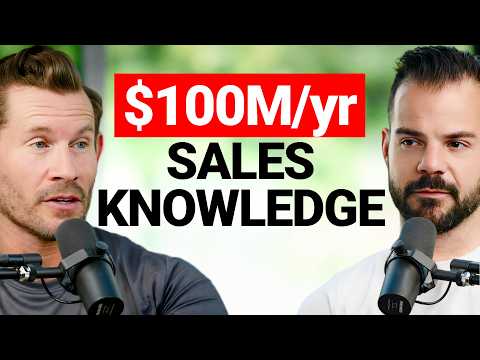
That’s the opening hook from Jeremy Miner, a sales expert who once made close to $3 million in commissions over six years.
Today, alongside Cole Gordon, the two run sales training and recruiting companies that collectively generate over $100 million a year. But Miner didn’t start out as a natural-born salesperson. He started as a psychology student.
In a recent deep-dive podcast, Miner and Gordon broke down the psychology of selling. Instead of relying on pushy tactics or cheesy scripts, Miner approaches sales through the lens of human behavior. He explains that to truly master sales, you have to understand how to change a prospect’s belief system and help them form a new identity.
This approach is broken down into what Miner calls the 4 Levels of Persuasion. If you want to stop losing deals and start closing at the highest level, you need to move past the first level and master all four.
Here is exactly how they work.
Level 1: Features and Benefits (Where 99% of Salespeople Stop)
If you’ve ever had a basic sales job, you’ve been taught to sell on features and benefits. “Here is what the product does, and here is how it will help you.”
While this isn’t inherently wrong, it is the lowest level of persuasion. According to Miner, 99% of salespeople get stuck here. Selling on features and benefits creates zero emotional connection. It leaves the prospect feeling like they are just being pitched to, which naturally raises their defenses. If you want to make a massive income in sales, you have to move past simply explaining what your product does.
Level 2: Behaviors
The next level involves shifting the conversation toward the prospect’s actions and behaviors. You aren’t just selling a product; you are getting them to see what behaviors are required to get their desired result.
For example, if you are selling business consulting to an entrepreneur stuck making $5,000 a month, you wouldn’t just pitch your consulting package. Instead, you would ask: “What actions do you need to take right here, right now, today to become the entrepreneur who makes $50,000 a month?”
The Key to Level 2: Tonality When challenging a prospect’s behavior, it is incredibly easy to sound judgmental or “bro-ey.” If a prospect feels judged, they will instantly put their mask back on and shut down.
Miner explains that the secret is a tone of genuine empathy. Your tone must convey “moral authority”—meaning the prospect feels that you are genuinely concerned about the consequences they will face if they don’t change their behavior.
Level 3: Belief Systems
To reach Level 3, you have to master active listening. Miner states, “Listen to what the prospect means, not just what they say. Those are two different things most of the time.”
If a prospect says, “I at least want to do $50,000 a month,” Miner catches the word “least.” That word reveals a limiting belief. If you try to close a prospect while they are focused on getting the bare minimum out of life, you won’t be able to build enough value.
Instead of ignoring it, a master salesperson will gently call it out: “Have you ever thought that when we focus on getting the least things in life, what do you typically get? You don’t come across to me as the person who wants to get the least things in life. So, what do you really want?”
This forces the prospect to take off their “mask.” When they realize you are actually listening and calling out their limiting beliefs, they drop the facade. Once the mask comes off, the trust is cemented, and the sale is almost always won.
Level 4: Identity
Sigmund Freud theorized that people act in accordance with who they believe they are. This is the highest driver of human behavior—and the highest level of persuasion.
Level 4 is about shifting the prospect’s identity so that buying your product aligns with who they want to be. For example, if a prospect has a history of hiring bad marketing agencies, they will naturally be hesitant to hire yours. They have a story in their head that marketing agencies are a waste of money.
To close them, you must shift the meaning of that past failure and tie it to a positive identity. Miner does this effortlessly: “Wow, I mean, it sounds like you’re the type of person who never gives up… your spouse is lucky to have a provider like you that is that forward-thinking and never gives up.”
No prospect will ever argue that they are a quitter. By confirming this positive identity, the prospect buys into the belief that they must take action to remain that forward-thinking, resilient person.
The Ultimate Secret: Objection Prevention
When you master these four levels of persuasion, you stop dealing with end-of-call objections like, “I need to think it over” or “I need to talk to my spouse.” As Miner points out, the brain is wired for survival, not thriving. When faced with a new, unknown decision (like spending money on a high-ticket service), the brain seeks external validation to push the decision down the road to keep you “safe.”
But when you use psychology to guide a prospect through their behaviors, break down their limiting beliefs, and step into a new, empowered identity, the objections melt away. You aren’t “closing” them—you are helping them overcome their own stories so they can finally get what they want.
Follow me on Instagram at @iamjoelbrown for more sales and success advice.













Low ticket vs high ticket isn’t a fight one model wins every time. It depends on how much your buyer already trusts you, how engaged your audience is and how much pain they’re in. If you’re selling to cold, jaded people, a $17 to $27 front end that ascends to a call can earn trust first. If you have a warm audience or you solve a deep, measurable problem, you can go straight to a high-ticket call.

That’s my answer after going through Cole Gordon’s debate on exactly this question. On one side was Josh Gavin, who says he’s consulted on, worked with or created over a thousand low-ticket offers and runs a low-ticket offer publishing company. On the other was Spencer Vaughn, Cole’s CMO and business partner at Saleskick, who Cole says has scaled half a dozen call funnels to eight figures.
They went seven rounds, from the first $100k a month to which model looks more like a grift. Both made points I agree with. Both also overstated their case, which is what debates are for.
I’m not in this one. But I’ve sold high ticket myself, and I’ve hopped on these calls as the buyer too. Here’s how I’d weigh it.
Low ticket vs high ticket: the two models in plain English
Josh’s model is simple to describe. In his words, “You have a front-end offer which is $17 to $27. You have three order bumps on that checkout page and then we go right to a VSL.” The buyer pays a small amount, adds a couple of extras at checkout, then watches a video and books a call for the big offer.
Spencer’s model is even shorter. A direct-to-application funnel is an ad, a page with an application and a booking calendar. “I need one page and an application and a call booking system. That’s it,” he said. A slightly more advanced version puts a short video sales letter on that page first.
| Low ticket to high ticket | Direct to high ticket | |
|---|---|---|
| Front end | $17 to $27 product plus order bumps | Application and booked call |
| Main argument | Buyers pay you back part of your ad spend the same day | Simpler to build and run, with fewer moving parts |
| Biggest risk | The front end never pays back and you’ve built two products | Ad spend is all out of pocket until someone closes |
| Best fit | Cold, skeptical audiences and very large mixed audiences | Deep pain, warm audiences and buyers who already trust you |
| Still needs a sales call? | Usually, for the high-ticket offer | Yes |
Notice that last row. Spencer hammered it early: “At the end of the day, you have to sell a prospect one way or another.” Josh said some of his clients sell bigger offers direct to cart. Fair enough, but for most coaches, somebody still gets on the phone.
My take: it depends on trust, audience and pain
I think it really depends. Nowadays there are a lot of people selling coaching offers, and the market isn’t as trusting as it used to be. A lot of people have been oversold to. A lot of people are jaded.
So if you’re marketing to a cold audience, you have to build trust first. Selling a lower ticket and then ascending to a higher ticket can be a good model for that. A stranger might risk $27 on you. Not $10,000.
If you already have an engaging organic audience, you can get away with selling higher ticket. They’ve seen your work. The trust is already there.
Then there’s pain, and this is the part I think both sides skipped past. If it’s a deeper pain type of offer, with a very measurable and tangible result, and people feel trust and confidence to work with you, you can sell high ticket. Nobody in real pain wants to buy a $17 workbook first. They want help.
Spencer actually got closest to this in his closing. “I don’t want to have to jump through 47 hoops,” he said. “I just want to pay a large amount of money to solve the problem.” When the pain is real, that’s exactly how buyers think.
When going straight to high ticket works
I used to sell an offer that helped CEOs and executive entrepreneurs who were struggling with alcohol to quit. I could sell that offer for $17,500, even $30,000, on a one-call close.
There was no low-ticket product in front of it. People went straight from an ad to an SDR triage call, then to an enrollment call with me. It worked because there was enough pain for that person to want to join. They weren’t browsing. They had a problem and they wanted it solved.
The second way I’ve sold high ticket is through trust built over time. I’ve had people buy into $10,000, $20,000 and $25,000 offers because they’d been watching me on the sidelines, on social media, for years. By the time they reached out, the trust was already built. A $27 product first would’ve just been one more hoop.
So when someone asks me low ticket or high ticket, my first questions are: how much does this hurt, and how long has this person known you?
Josh’s case for low ticket: it’s about the math
Josh’s strongest point wasn’t about lead quality. It was cash flow. He said with a low-ticket front end, “when you put a dollar in, you could get at least like 40 cents back. You could get 50 cents back. You can get 60 cents back,” often the same day. With a call funnel, a beginner gets nothing back until someone closes.
He gave one example, by his own account. A client who helped accountants charge high ticket was paying about $2,000 to acquire a customer for a $5,000 offer. After adding a low-ticket front end, Josh says the net cost to acquire that high-ticket client dropped to about $1,000. Those are his numbers from his client, not something I’ve audited.
Then he said the line that changed the debate for me:
“It’s not that they buy more. It’s that the financial model allows you to spend more money to get the people who will buy the high ticket.”
That’s an honest concession. A lot of low-ticket marketing claims that a $17 buyer is magically more likely to buy a $10,000 program. Josh called that “propaganda” from the old-school low-ticket gurus. His real argument is narrower: “I want people who will never buy my high ticket offer to give me money to go pay to get the people who will.”
In his view only 1 to 2% of clicks ever give a call funnel money, so the rest of the spend just goes to Facebook. For a big trading creator he works with, he said a $97 front end had a 5% ascension rate to the back end. Again, his numbers.
That math is worth modeling. Just use your own numbers, and run it past your accountant before you bet the business on someone else’s case study.
Spencer’s case for high ticket: price anchoring and simplicity
Spencer came in hot. “The biggest lie in the industry is from people like Josh who want to claim that because someone buys a $17 product, they’re magically statistically more likely to buy a $10,000 product,” he said.
His reason was price anchoring. Set the first price at $27 and that’s the number people anchor on. He used his own custom suit as the example. Someone who’ll drop $10,000 on a tailored suit doesn’t need to buy a $200 suit first to get warmed up. If anything, he argued, the $200 buyer is less likely to buy the big one.
His second point was simplicity. How many $15,000 sales do you need for a million a month? About 70, they landed on, which Spencer said is three or four sales reps. “Simple scales,” he said.
His third point is one I really like. When you sell high ticket directly, you’re forced to make your offer strong from day one, because nothing is propping it up. A low-ticket front end can hide a weak offer for a long time.
And he called out survivorship bias. For every business that hit $600k or $700k a month on calls and then fixed its costs with low ticket, Spencer said he could list “five to 10 examples of people who’ve just wasted a year” trying to make it liquidate. You only hear about the ones that worked.
Where they actually agree
Strip away the trash talk and they agreed on more than either would admit.
- A $17 buyer is not automatically a better buyer. Josh conceded it.
- Messaging decides who shows up. Josh said bad positioning attracts the wrong customer “no matter the funnel.” For one offer with a $25,000 back end, he said he renamed the $17 course a “license.”
- Extreme audiences change the math. Spencer admitted that someone with tens of millions of followers probably monetizes more easily with low ticket. “Funnels are tools,” he said.
- Either way, someone has to sell. The phone call doesn’t go away.
That’s basically my position. A funnel is a tool you pick based on who you’re selling to.
What if you already have a big audience?
Spencer backed the call funnel here too. Cole described a consult with someone who had 30 million followers and worried they’d need 50 sales reps on day one. Spencer’s fix was to throttle it: put the price on the page, use strict qualifying questions, or start with about $100 a day of retargeting ads to build the sales team slowly. Cole added that you could email small segments of your list at a time.
Josh’s answer was that throttling still excludes people. His goal is to make money off everybody in the audience, including the people who’ll never afford the big offer.
Here’s how I see it. An engaged audience is the best asset you can have for high ticket, because that’s where the trust comes from. Mine came from people watching for years. If your audience is huge but mixed, with plenty of people who can’t afford you, a low-ticket offer can serve them without clogging your sales calendar. But don’t let a cheap offer become the ceiling for people who’d happily pay you properly.
Cole has had this kind of conversation on his show before. His breakdown with Daniel Fazio of the best online business offers in the market is worth a look if you’re still deciding what to sell in the first place.
Which funnel looks more like a grift?
This was the last round and the most fun. Josh said younger buyers see call funnels coming a mile away. “We know these funnels. We are aware of them,” he said. When the setter calls, they know exactly what the setter is doing.
Spencer flipped it. Josh had admitted earlier that many low-ticket buyers never open the product. “Isn’t that by definition being a grifter? Selling people things that they don’t even use or don’t even care about,” Spencer asked.
Josh’s defense was proof. He said his $17 offer has a 365-day money-back guarantee and a phone team for customer support, so buyers can see a real business before anyone pitches them.
For me, the funnel type isn’t what makes something feel like a grift. A funnel that feels like a grift usually has a lot of overpromising, wild claims and big statements. Then I hop on the call, maybe a triage call or a qualification call, and the person is unprofessional. They’ve never built a business. They’ve never had a high level of success in their life.
That makes me question whether the coach, or whoever’s offering the product or service, can actually deliver. If their own team doesn’t have the success, I’m going to question whether they get results.
There are a lot of people who are content creators. There are a lot of people who can teach. But they’re not actually coaches, or effective consultants who know how to get people an ROI. There’s a difference between knowing information, showing information and parroting information, and actually getting people results. I wrote more about that in this guide to spotting a fake business guru before you pay them.
Whichever model you run, the person on that first call is your brand.
How to choose between low ticket and high ticket
Here’s what I’d do if I were deciding today.
- Rate the pain. If you solve a deep, measurable problem people would pay almost anything to fix, test going straight to a high-ticket call.
- Check the trust. If buyers have watched you for months or years, skip the hoops. If they’re cold and you’re new to them, a low-ticket front end can earn trust first.
- Look at your audience. Engaged and warm favors high ticket. Huge and mixed might justify a low-ticket offer alongside the call.
- Model the cash flow. If you’re running paid ads, put both models in a spreadsheet with your real cost per lead, show rates and close rates. Treat anyone else’s numbers, including the ones in this debate, as their claims.
- Fix the call before the funnel. Whoever answers the triage or enrollment call has to be credible. That matters more than whether the front end costs $0 or $27.
- Make the offer strong either way. A cheap front end shouldn’t hide a weak back end.
If you’re starting with no audience and no proof, low ticket to high ticket can be a smart way to get your first buyers and earn trust. If people already trust you, or they’re in real pain, don’t make them jump through hoops. Get them on the call.
FAQ
Is low ticket or high ticket better?
Neither wins every time. Low ticket to high ticket suits cold, skeptical audiences who need to trust you first. Going straight to high ticket suits warm audiences and offers that solve deep, measurable pain, where buyers want help now and don’t want extra steps.
What is a low-ticket call funnel?
It’s a funnel that sells a cheap front-end product before a sales call. Josh Gavin’s version uses a $17 to $27 offer, three order bumps at checkout, then a video sales letter and a booked call for the high-ticket offer.
Are low-ticket buyers more likely to buy high ticket?
Not automatically. In Cole Gordon’s debate, even low-ticket advocate Josh Gavin said it’s not that they buy more. His argument is that front-end sales help pay for ad spend, so you can afford to find the buyers who will.
Can you sell high ticket straight from an ad?
Yes, when the pain is real and the result is measurable. I sold an offer helping executives quit alcohol for $17,500 to $30,000 on one call, going from an ad to a triage call to an enrollment call.
What makes a sales funnel feel like a grift?
Overpromising and wild claims, followed by an unprofessional person on the call who’s never built a business. If the coach’s own team hasn’t had success, buyers start questioning whether the program actually gets results.

When I look at how difficult selling seems for so many entrepreneurs, it honestly blows my mind. But then I remember: it shouldn’t. Because when I first started selling, I was absolutely terrible.
I started selling financial products in October of 1985. I didn’t make my first sale until April of 1987. That is a painfully long dry spell. Yet, within a very short period after that first closed deal, I became the top salesperson in our office, month after month.
What I’m going to share with you is exactly how I made that shift. It doesn’t matter if you sell real estate, cars, coaching, SaaS, or agency services. The psychology of selling is universal. Today, selling is easier for me than taking a nap (and I’m a professional at taking naps).
Here is the unfiltered truth about why selling feels so hard, and the exact psychological shifts required to make it effortless.
The Number One Reason Selling is Hard
The primary reason selling feels impossible is simple: You want them to buy.
This is the biggest mistake new salespeople make. They are desperate for the prospect to say yes.
One of the reasons sales is easy for me now is that I am completely unvested in the outcome. I don’t pretend I don’t care—I actually do not care if they buy.
How can a salesperson say they don’t care if someone buys? Because I understand a mathematical certainty called the Law of Averages.
The Law of Averages dictates that out of every X number of presentations you do, you are going to make Y number of sales. For every person, that average is different. For one person, it might be one sale for every ten presentations. For someone else, it might be one in twenty. For a master, it might be one in four.
When you internalize this law, every “no” is just moving dirt to find the gold. You don’t need this person to buy; you just need to keep moving through the numbers.
The Power of Pre-Indoctrination
While you have a baseline average, you can dramatically increase your closing rate through a concept called pre-indoctrination.
“Indoctrination” sounds intense, but the root word, doctrine, simply means teaching.
If you can teach a prospect something valuable about the result they desire—not pitching your product, not explaining your features, but genuinely teaching them about the transformation they seek—the likelihood of them saying “yes” to your eventual offer increases exponentially.
Consider this: A business can generate eight figures in revenue with zero ad spend simply by utilizing a free content channel like YouTube. Why? Because of pre-indoctrination.
Before anyone gives you money, three things must happen:
- They must believe you are credible.
- They must believe you have their best interests in mind.
- They must believe you are better at getting the result they lack than they are.
This is why constantly pitching is a failing strategy. Research suggests a person needs to spend about seven hours with you before they feel like they know, like, and trust you enough to buy.
Unfortunately, most salespeople try to close the prospect the moment they meet. It’s like walking up to a stranger and saying, “Hi, will you marry me?”
You have to date before you marry. By providing immense, free value upfront—what I call “community service content”… you allow prospects to spend thousands of aggregate hours with you. They begin to feel like they know you.
When a farmer plants a seed, he doesn’t go out every day and yell at the dirt, “Are you going to grow or not?” He trusts the soil, the sun, and the water. Plant good seeds through valuable content, and eventually, people will say, “I can’t believe they are teaching this for free. If they help me this much for free, I can only imagine what paying them looks like.”
The 3 Rules of the Sales Psychology Framework
If you want to master the secret psychology of sales success, you must internalize these three rules.
1. Don’t Be Greedy
My definition of “greedy” in sales is desiring your outcome more than you desire their outcome. It is attempting to extract more value than you deserve based on the work you’ve done. This usually manifests as either overcharging or underperforming.
Let me be clear: Having premium, high-ticket offers is not the same as overcharging. You can charge $50,000 or $100,000 for a service—if you can legitimately help that client 10x their investment. If someone pays you $50,000, and your system helps them generate $500,000, you have not overcharged them.
You are overcharging when you cannot deliver the transformation commensurate with the price. Don’t be greedy. Ensure your fulfillment is worth infinitely more than your fee.
2. Don’t Be Needy
Never sell because you need the money. Even if you do need the money, you cannot allow that energy to enter the sales conversation.
Selling is not convincing. When you try to convince people, you come across as needy. And nobody wants to buy from someone out of pity. They don’t care that you need to feed your kids; they only care if you can solve their problem.
Divorce yourself from the need for a “yes.” Adopt the mindset of “SW, SW, SW, N” — Some Will, Some Won’t, So What, Next.
When you stop coming across as desperate, your closing rate will climb. It’s the classic dating dynamic: the person playing hard to get is infinitely more attractive than the person begging for a date. Be the hard-to-get salesperson. You are leading them to a solution, not begging them for a transaction.
3. Be “Seedy” (Sow Good Seeds)
Instead of being greedy or needy, be “seedy.” Recognize that every word you speak, every piece of content you post, and every result you deliver for a client is a seed you are sowing into the garden of your future reputation.
If you prove to people you can help them by actually helping them for free upfront, you are planting seeds of immense goodwill.
The law of the harvest dictates three things:
- You reap what you sow (plant good value, reap good revenue).
- You reap later than you sow (the payoff is rarely immediate).
- You reap more than you sow (one seed creates a tree full of fruit).
The Poverty Programming Holding You Back
If you struggle to implement these concepts, it is likely because you are fighting against deep-seated “poverty programming.”
Your mind is a supercomputer. Most of us are operating on a “failure operating system” installed by society, media, and our upbringing. You cannot run a “success software program” (like high-ticket sales or wealth creation) on a failure operating system; you will only get an error message.
Society programs us to associate wealth with greed. Look at pop culture: the villains are almost always wealthy billionaires, while the heroes are scrappy and poor. We are conditioned to believe that asking for money is somehow immoral.
Business schools will teach you for eight years how to practice law or medicine, but they won’t spend ten minutes teaching you how to acquire the clients or patients needed to run the practice. We are programmed to be laborers, not wealth creators.
To become exceptional at sales, you must uninstall this poverty programming.
The Ultimate Sales Close
When you finally get on a sales call, remember that groups are better than one-on-one. Do your heavy presenting via webinars, video sales letters, or content. Save the one-on-one calls for the final close, especially for high-ticket offers.
When you do get on that call, do not launch into a pitch. Ask them: “What did you like best about what you saw in the presentation?”
Let them answer. Then ask: “What questions do you have?”
Answer it, and immediately ask: “What other questions do you have?”
Keep answering until they run out of questions. Do not let questions fester into objections. When they are finally out of questions, use the law of reciprocity: “Great. Do you mind if I ask you a few questions?” (They will always say no).
“What appeals to you most about this? Result A or Result B?” (They will usually say both).
Then, deliver the final question: “If you had an opportunity to start benefiting from both sooner rather than later, would you choose later, or would you choose sooner?”
They will say “sooner.”
“Great. How do you spell your first name?”
You don’t need to send them a link to “think about it.” You close them on the spot, collect the details, and process the payment.
Stop trying to force people to buy. Plant your seeds, divorce yourself from the outcome, and let the law of averages build your empire.

This is for people trying to make money online and getting stuck on the wrong question.
You have something to sell, or you are about to. You have heard you should go high-ticket because fewer buyers means less grind. You have also seen people quietly doing real numbers on $27 products and wondered if you are making this harder than it needs to be. Maybe you are a beginner who freezes when it is time to ask for serious money. Maybe you already close well and cannot stand the idea of celebrating a tiny sale. Maybe you have a job, a kid, or a calendar that will not survive a day of Zoom calls.
If that is you, stop arguing about which model is “smarter.” The fight is a distraction.
If you want $100,000, the math is rude and simple. Sell ten things for $10,000. Or sell 10,000 things for $10. Both camps are right about the equation. Both are lying about the easy part.
You always pay to scale. You just pay in a different currency. The useful question is not high-ticket or low-ticket. It is which bill you can pay this month.
Every offer charges you three ways
Call it ARC: Ask, Reach, Carry.
Ask is the nerve it takes to request the money. Listing a $27 product is easy. Asking a stranger for $3,000 is a different person. You need language, patience, and the stomach to sit in someone else’s fear on a call. When a founder chokes on a high-ticket close, the product is rarely the problem. They could not make the ask.
Reach is the bill people shrug off until it flattens them. One $20 sale is a conversation. Ten thousand of them is a machine: content, ads, tests, checkout pages, the willingness to treat a $27 sale like it matters. Confidence does not cover this. The numbers work or they do not. The upside is you can pay Reach at 3 a.m. in sweatpants.
Carry is what you hold after they pay. Delivery. Onboarding. Messages. Expectations. The slot on your calendar that used to belong to you. Carry does not care that the business is “working.” It cares that the baby is sick, the day job ran long, or you already used your one good conversation. A lot of high-ticket offers do not fail because they are weak. They fail because the founder’s week cannot carry them.
This is also why memberships are often a bad trade. You keep paying Reach to replace the people who cancel, and you keep paying Carry for the ones who stay. A $97 course asks once and then mostly leaves you alone.
This is why you keep defending the model you already like
A beginner, or a parent with no spare mornings, is rich in odd hours and broke in Ask. A cheap, specific product is not a branding compromise. It is a fit. They can grind Reach when the house is quiet. They cannot yet sell $3,000 or live on Zoom.
A high-ticket operator has the opposite problem. Their identity is one sale equals $10,000. Ask is familiar. Carry is familiar. Volume feels like a demotion. So they try a $27 product, hate it, and conclude low ticket “doesn’t work.” It worked. Their nervous system just refused to celebrate a small win. Old strengths turned into an anchor.
Same math. Different bill.
Score the offer, then score your life
Before you build the next thing, give the offer a 1-to-5 on each cost.
How much new courage does this sale take?
How many strangers have to see it for the math to work?
How much of your week does a buyer own after they pay?
Then score yourself the same way.
If your Ask is a 2, a “premium” offer is just a product you will be too scared to sell. If your Carry is a 2 because you have a kid, daily coaching calls are not a strategy. They are a calendar you will resent.
Start with the cost you can pay now. Not the founder you are rehearsing to become next year.
You can change the mix later
You do not have to marry one tax.
A clean sequence looks like this. First, sell something small and sharp. Not “be more productive.” Something like “make your first sale without feeling slimy.” Get a hundred sales. That is enough proof that the thing is real. Then buy more Reach if you want speed — even $5 a day — instead of pretending ads are a personality type. After people already trust you, add Ask and Carry for the ones who want hands-on help.
Keep the cheap products specific. Keep the expensive ones specific. People do not buy your ladder. They buy a fix.
The founders who stay stuck are still arguing about which model is easier. The ones who move ask a quieter question every quarter: which of these three costs can I afford right now, and which one am I finally ready to learn?

I have sat with founders who built something that actually works. Customers who buy, stay. The product is not the problem. The week is.
Sales is still what keeps the lights on, and a lot of smart people treat it like a mood. They hustle when they feel brave, go quiet when a few calls go badly, then wonder why the calendar looks empty again. You can work long hours and still leave money sitting there if you never get clean on how a lead becomes a conversation, how a conversation becomes a presentation, and how a presentation becomes a yes.
None of this is magic. It is a handful of habits most people skip because they feel slightly awkward. They also happen to be the ones that keep a pipeline from drying up.
1. Pitch the insight before you pitch the fix
The calls that die usually start with the product. Features, screens, a little origin story, then a price. The calls that limp along start with a method and then slide into the offer. The ones that close start somewhere else.
They start with an insight. A way of seeing the prospect’s world that they have not said out loud yet. It is not about you. It is not a humblebrag. It is you proving you understand the mess they are in better than the last three people who tried to sell them something.
A trainer who gets results does not open with a workout plan. They talk about why the weight will not move even when the person is “doing everything right.” Sleep. Stress. The plateau nobody warned them about. Once that lands, the program is the obvious next step, not a pitch.
Before your next call, write down five to ten of those. Steal them from deals you have already lived through. When the conversation turns a certain way, pull the one that fits. Only after their view of the problem has shifted do you bring your offer in as the logical move.
If your “insight” is a recycled industry stat they have already seen in a LinkedIn post, skip it. They can smell that.
2. Stop guessing why a pitch lived or died
Most founders grade a call by feeling. That one felt warm. That one felt off. Then they change nothing, or they change everything, which is almost the same thing.
Record the presentations. Get them written down. Then sit with the ones that closed next to the ones that went nowhere.
You will hear things you missed in the moment. How long you talked before they said anything useful. The question that opened the room. The joke that killed the energy. The point where you got defensive and started explaining instead of asking.
If you want a faster read, drop the transcripts into an AI tool and ask it to compare the two piles. Look for themes, not a new personality. The goal is not a script that makes you sound like someone else. The goal is to stop repeating the same miss because you never actually listened to yourself.
You cannot fix what you refuse to look at.
3. When they object, stop playing tennis
Price comes up and the amateur hits it back. Timing comes up and they hit that back too. It turns into a match, and nobody likes being in a match with someone who is trying to take their money.
Catch the ball. Hold it.
They say they are not sure about the price.
You say, “Okay. Price matters. Let me write that down. What else is sitting with you?”
Then you wait.
Collect all of it. Price, timing, a feature they do not trust, a partner they have to run it by. Keep going until they tell you that is the full list. Then you answer the pile as one conversation.
The first objection is often a test. If you pounce on it, they never give you the real one. When you write it down and ask what else there is, they usually exhale. They feel heard instead of handled. You also stop burning ten minutes on a smokescreen while the thing that would have killed the deal stays in their pocket.
4. Go back to the people you already paid to meet
Most salespeople call a lead dead after two or three follow-ups. A lot of those people never said no. They got busy. They got scared. Another fire started at work and your email went under it.
That list is not trash. It is pipeline you already spent time and money to create.
Send something almost too direct.
Have you given up on [the problem]?
Then a short note. You have not heard from them. You want to know if this is still a priority. If they have moved on, you will stop writing and take them off the list. If they have not, they can just say so.
That email does two jobs at once. It clears the people who were never going to buy, which is a gift to your week. And it wakes up the ones who still want the thing but needed a reason to reopen the tab.
Do not re-pitch the company. Do not attach a deck. One question, one kind way out, one easy yes. The politeness of “just circling back” is why those emails die in the same pile as everyone else’s.
5. Speed beats looking busy
This is not dating. You do not get extra credit for waiting two days so you seem in demand.
If a lead comes in at 10:00 on a Monday, follow up at 10:01. Tell them the truth. An email just landed, you saw they were interested, you wanted to get them what they asked for while it was still warm.
People remember the person who moved. They also hire the person who moved, more often than they admit.
The other half of this is a rhythm you can see. You cannot hunt hard for three weeks, vanish for a quarter, then act surprised when nothing is closing. Pick a weekly shape and keep it, even when it feels boring. Your version might be fifty conversations in, ten meetings booked, six presentations, two closes. The numbers will be different for your offer. The point is you can look at the week on a page and know if the machine ran.
When the numbers slip, you will know where. Too few conversations. Meetings that do not show. Presentations that never get a next step. That is a lot more useful than a vague sense that “sales feels slow.”
Confidence does not show up first and then you start doing the work. It shows up because you did the same simple things on a Tuesday when you did not feel like it.
Build that, and the business stops depending on whether you woke up brave.
Daniel Priestly inspired the sales points I shared with you and he breaks down 10 powerful sales tips to increase your sales:


Accounts Receivable Turnover: The Ratio That Shows How Fast Customers Really Pay You

Turning Financial Data Into a Growth Strategy

Why High-Performing Leaders Treat Workplace First Aid as a Core Business Skill

How to Build a Competitive Advantage Through Better Search Visibility

Business Acquisition Loans: How Buyers Actually Finance a Small Business (SBA 7(a), Seller Notes, Equity)
5 Ways For Startups To Succeed Making Acquisitions

77 Inspirational Quotes That Will Change Your Life

57 Memorable Kobe Bryant Quotes

Motivational Picture Quotes: 52 Images to Inspire a Successful Year

40 Rare Motivational and Inspirational Picture Quotes
3 Prince EA Videos To Change Humanities Path To Greatness
(Video) What Is Success? An Entrepreneurial Story To Inspire You
(Inspirational Video) What If Today You Knew You Were Going To Take Your Last Breath?
How To Make Enough Money From A Blog To Quit Your Job – Kate McKibbin
How Finding Your Passion And Becoming An Entrepreneur Can Lead To Happiness – Chiquita Searle
-

 Did You Know1 year ago
7 Surprising Life Lessons Video Games Taught Me That School Never Did
-

 Life2 years ago
The 5 Stages of a Quarter-Life Crisis & What You Can Do
-

 Success Advice1 year ago
Stephen Covey’s 8 Leadership Habits That Will Change How You Lead Forever
-

 Life1 year ago
How to Stop the War in Your Head and Find Peace
-

 Featured2 years ago
The Psychology of Motivation: How to Keep Moving Forward Every Day
-

 Personal Development2 years ago
The Three-Second Pause That Changes How People Perceive You
-

 Explode Your Social Media1 year ago
Want More Views? Master These 6 YouTube Growth Tactics
-

 Change Your Mindset1 year ago
You Become What You Absorb: How Input Shapes Your Life