
Change Your Mindset
100 Dalai Lama Quotes That Will Change Your Life

The Dalai Lama, his holiness is a world leader that is committed to promoting positive values such as , forgiveness,self-discipline, tolerance, compassion and contentment. He is a spiritual leader like no other and is highlighting the importance of happiness and world peace every minute of the day.
The Dalai Lama’s quotes and sayings are spread throughout the world and are taken on board by many who wish to live a positive and fulfilled life.
We at Addicted2Success love the Dalai Lama’s inspirational messages so we decided to compile the Top 100 Dalai Lama quotes online for you to be inspired by and for you to share with anyone else you believe will love his message.
Here are his life changing quotes:
100 Dalai Lama Quotes That Will Change Your Life
1. “Give the ones you love wings to fly, roots to come back and reasons to stay.” – Dalai Lama
2. “Time passes unhindered. When we make mistakes, we cannot turn the clock back and try again. All we can do is use the present well.” – Dalai Lama
3. “An open heart is an open mind.” – Dalai Lama
4. “We can never obtain peace in the outer world until we make peace with ourselves” – Dalai Lama
5. “The goal is not to be better than the other man, but your previous self.” – Dalai Lama
6. “An eye for an eye….we are all blind” – Dalai Lama
7. “A spoon cannot taste of the food it carries. Likewise, a foolish man cannot understand the wise man´s wisdom even if he associates with a sage.” – Dalai Lama
8. “There is a saying in Tibetan, ‘Tragedy should be utilized as a source of strength.’
No matter what sort of difficulties, how painful experience is, if we lose our hope, that’s our real disaster.” ― Dalai Lama
9. “Remember that the best relationship is one in which your love for each other exceeds your need for each other.” ― Dalai Lama
10. “Every day, think as you wake up, today I am fortunate to be alive, I have a precious human life, I am not going to waste it. I am going to use all my energies to develop myself, to expand my heart out to others; to achieve enlightenment for the benefit of all beings. I am going to have kind thoughts towards others, I am not going to get angry or think badly about others. I am going to benefit others as much as I can.” ― Dalai Lama
11. “The roots of all goodness lie in the soil of appreciation.” – The Dalai Lama
12. “Silence is sometimes the best answer” ― Dalai Lama
13. “The true hero is one who conquers his own anger and hatred.” – Dalai Lama
14. “In our struggle for freedom, truth is the only weapon we possess.” – Dalai Lama
15. “Know the rules well, so you can break them effectively.” ― Dalai Lama
16. “Love and compassion are necessities, not luxuries. Without them, humanity cannot survive.” ― Dalai Lama
17. “Choose to be optimistic, it feels better.” ― Dalai Lama
18. “To remain indifferent to the challenges we face is indefensible. If the goal is noble, whether or not it is realized within our lifetime is largely irrelevant. What we must do therefore is to strive and persevere and never give up.” – Dalai Lama
19. “Our prime purpose in this life is to help others. And if you can’t help them, at least don’t hurt them.” ― Dalai Lama
20. “If a problem is fixable, if a situation is such that you can do something about it, then there is no need to worry. If it’s not fixable, then there is no help in worrying. There is no benefit in worrying whatsoever.” ― Dalai Lama
21. “The ultimate source of happiness is not money and power, but warm-heartedness” – Dalai Lama
22. “This is my simple religion. No need for temples. No need for complicated philosophy. Your own mind, your own heart is the temple. Your philosophy is simple kindness.” ― Dalai Lama
23. “Judge your success by what you had to give up in order to get it.” ― Dalai Lama
24. “It is very rare or almost impossible that an event can be negative from all points of view.” – Dalai Lama
25th Dalai Lama Quote – “As you breathe in, cherish yourself. As you breathe out, cherish all Beings.” – The Dalai Lama
26. “People take different roads seeking fulfillment and happiness. Just because they’re not on your road doesn’t mean they’ve gotten lost.” ― Dalai Lama
27. “The whole purpose of religion is to facilitate love and compassion, patience, tolerance, humility, and forgiveness.” ― Dalai Lama
28. “If you can cultivate the right attitude, your enemies are your best spiritual teachers because their presence provides you with the opportunity to enhance and develop tolerance, patience and understanding.” ― Dalai Lama
29. “One great question underlies our experience, whether we think about it or not: what is the purpose of life? . . . From the moment of birth every human being wants happiness and does not want suffering. Neither social conditioning nor education nor ideology affects this. From the very core of our being, we simply desire contentment. . . Therefore, it is important to discover what will bring about the greatest degree of happiness.” – Dalai Lama
30. “Only the development of compassion and understanding for others can bring us the tranquility and happiness we all seek.” ― Dalai Lama
31. “Take into account that great love and great achievements involve great risk.” ― Dalai Lama
32. “Look at children. Of course they may quarrel, but generally speaking they do not harbor ill feelings as much or as long as adults do. Most adults have the advantage of education over children, but what is the use of an education if they show a big smile while hiding negative feelings deep inside? Children don’t usually act in such a manner. If they feel angry with someone, they express it, and then it is finished. They can still play with that person the following day.” ― Dalai Lama
33. “The ultimate authority must always rest with the individual’s own reason and critical analysis.” – Dalai Lama
34. “Given the scale of life in the cosmos, one human life is no more than a tiny blip. Each one of us is a just visitor to this planet, a guest, who will only stay for a limited time. What greater folly could there be than to spend this short time alone, unhappy or in conflict with our companions? Far better, surely, to use our short time here in living a meaningful life, enriched by our sense of connection with others and being of service to them.” – Dalai Lama XIV
35. “Share your knowledge. It is a way to achieve immortality.” – Dalai Lama
36. “When you realize you’ve made a mistake, take immediate steps to correct it.” ― Dalai Lama
37. “Let us try to recognize the precious nature of each day.” – Dalai Lama
38. “World peace must develop from inner peace. Peace is not just mere absence of violence. Peace is, I think, the manifestation of human compassion.” ― Dalai Lama
39. “All suffering is caused by ignorance. People inflict pain on others in the selfish pursuit of their own happiness or satisfaction” ― Dalai Lama
40. “Compassion is not religious business, it is human business, it is not luxury, it is essential for our own peace and mental stability, it is essential for human survival.” – Dalai Lama
41. “The purpose of all the major religious traditions is not to construct big temples on the outside, but to create temples of goodness and compassion inside, in our hearts.” ― Dalai Lama
42. “One problem with our current society is that we have an attitude towards education as if it is there to simply make you more clever, make you more ingenious… Even though our society does not emphasize this, the most important use of knowledge and education is to help us understand the importance of engaging in more wholesome actions and bringing about discipline within our minds. The proper utilization of our intelligence and knowledge is to effect changes from within to develop a good heart.” – Dalai Lama
43. “The creatures that inhabit this earth-be they human beings or animals-are here to contribute, each in its own particular way, to the beauty and prosperity of the world.” – Dalai Lama
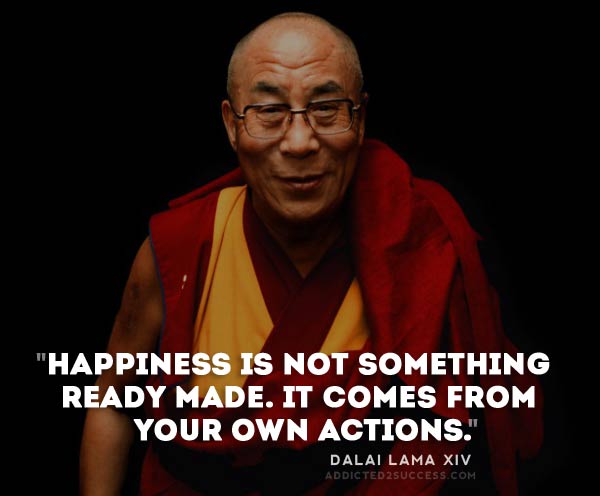
44. “Happiness is not something ready made. It comes from your own actions.” ― Dalai Lama
45. “A truly compassionate attitude toward others does not change even if they behave negatively or hurt you.” ― Dalai Lama
46. “I don’t know whether the universe, with its countless galaxies, stars and planets, has a deeper meaning or not, but at the very least, it is clear that we humans who live on this earth face the task of making a happy life for ourselves. Therefore, it is important to discover what will bring about the greatest degree of happiness.” – Dalai Lama
47. “The more you are motivated by Love, The more Fearless & Free your action will be.” ― Dalai Lama
48. “Human potential is the same for all. Your feeling, “I am of no value”, is wrong. Absolutely wrong. You are deceiving yourself. We all have the power of thought – so what are you lacking? If you have willpower, then you can change anything. It is usually said that you are your own master.” ― Dalai Lama
49. “Neither a space station nor an enlightened mind can be realized in a day.” – Dalai Lama
50th Dalai Lama Quote – “Old friends pass away, new friends appear. It is just like the days. An old day passes, a new day arrives. The important thing is to make it meaningful: a meaningful friend – or a meaningful day.” ― Dalai Lama
51. “Hard times build determination and inner strength. Through them we can also come to appreciate the uselessness of anger. Instead of getting angry nurture a deep caring and respect for troublemakers because by creating such trying circumstances they provide us with invaluable opportunities to practice tolerance and patience.” ― Dalai Lama
52. “Be kind whenever possible. It is always possible.” ― Dalai Lama
53. “To conquer oneself is a greater victory than to conquer thousands in a battle.” – Dalai Lama
54. “A good friend who points out mistakes and imperfections and rebukes evil is to be respected as if he reveals the secret of some hidden treasure.” ― Dalai Lama
55. “I will not propose to you that my way is best. The decision is up to you. If you find some point which may be suitable to you, then you can carry out experiments for yourself. If you find that it is of no use, then you can discard it.” – Dalai Lama
56. “The way to change others’ minds is with affection, and not anger.” ― Dalai Lama
57. “If you have fear of some pain or suffering, you should examine whether there is anything you can do about it. If you can, there is no need to worry about it; if you cannot do anything, then there is also no need to worry.” ― Dalai Lama
58. “Instead of wondering WHY this is happening to you, consider why this is happening to YOU.” – Dalai Lama XIV
59. “A disciplined mind leads to happiness, and an undisciplined mind leads to suffering.” – The Dalai Lama
60. “In the practice of tolerance, one’s enemy is the best teacher.” ― Dalai Lama
61. “Because we all share this planet earth, we have to learn to live in harmony and peace with each other and with nature. This is not just a dream, but a necessity.” ― Dalai Lama
62. “Anger or hatred is like a fisherman’s hook. It is very important for us to ensure that we are not caught by it.” – Dalai Lama
63. “Irrespective of whether we are believers or agnostics, whether we believe in God or karma, moral ethics is a code which everyone is able to pursue.” ― Dalai Lama
64. “Happiness doesn’t always come from a pursuit. Sometimes it comes when we least expect it.” – Dalai Lama
65. “When we are motivated by compassion and wisdom, the results of our actions benefit everyone, not just our individual selves or some immediate convenience. When we are able to recognize and forgive ignorant actions of the past, we gain strength to constructively solve the problems of the present.” ― Dalai Lama
66. “I believe the very purpose of our life is to seek happiness. Whether one believes in religion or not, whether one believes in that religion or this religion, we are all seeking something better in life. So, I think, the very motion of our life is towards happiness. – Dalai Lama
67. “Compassion is the radicalism of our time.” ― Dalai Lama
68. “If someone has a gun and is trying to kill you, it would be reasonable to shoot back with your own gun.” ― Dalai Lama
69. “Peace does not mean an absence of conflicts; differences will always be there. Peace means solving these differences through peaceful means; through dialogue, education, knowledge; and through humane ways.” ― Dalai Lama
70. “We need to learn how to want what we have NOT to have what we want in order to get steady and stable Happiness” – Dalai Lama
71. “Through violence, you may ‘solve’ one problem, but you sow the seeds for another.” – Dalai Lama
72. “Where ignorance is our master, there is no possibility of real peace.” – Dalai Lama
73. “Inner peace is the key: if you have inner peace, the external problems do not affect your deep sense of peace and tranquility…without this inner peace, no matter how comfortable your life is materially, you may still be worried, disturbed, or unhappy because of circumstances.” ― Dalai Lama
74. “You must not hate those who do wrong or harmful things; but with compassion, you must do what you can to stop them — for they are harming themselves, as well as those who suffer from their actions.” – Dalai Lama
75th Dalai Lama Quote – “Those who have little interest in spirituality shouldn’t think that human inner values don’t apply to you. The inner peace of an alert and calm mind are the source of real happiness and good health. Our human intelligence tells us which of our emotions are positive and helpful and which are damaging and to be restrained or avoided.” – Dalai Lama
76. “Anger is the ultimate destroyer of your own peace of mind” – Dalai Lama
77. “There is only one important point you must keep in your mind and let it be your guide. No matter what people call you, you are just who you are. Keep to this truth. You must ask yourself how is it you want to live your life. We live and we die, this is the truth that we can only face alone. No one can help us, not even the Buddha. So consider carefully, what prevents you from living the way you want to live your life?” ― Dalai Lama
78. “Compassion naturally creates a positive atmosphere, and as a result you feel peaceful and content.” – Dalai Lama XIV
79. “Remember that sometimes not getting what you want is a wonderful stroke of luck.” ― Dalai Lama
80. “If you think you are too small to make a difference, try sleeping with a mosquito.” ― Dalai Lama
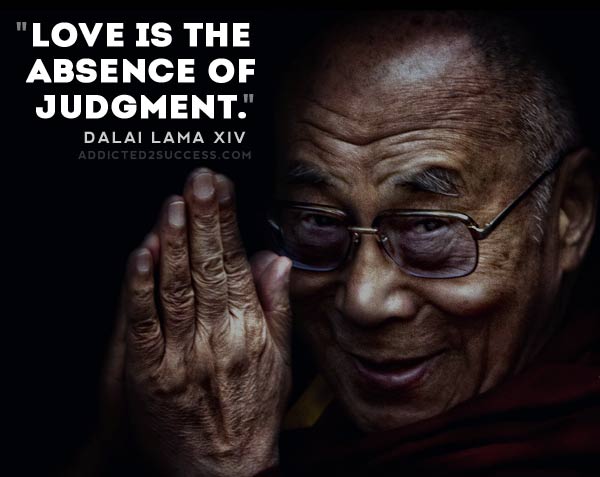
81. “Love is the absence of judgment.” ― Dalai Lama
82. “It is under the greatest adversity that there exists the greatest potential for doing good, both for oneself and others.” ― Dalai Lama
83. “I defeat my enemies when I make them my friends.” ― Dalai Lama
84. “Our ancient experience confirms at every point that everything is linked together, everything is inseparable.” ― Dalai Lama
85. “What surprises me most is “Man”, because he sacrifices his health in order to make money. Then he sacrifices money to recuperate his health. And then he is so anxious about the future that he doesn’t enjoy the present; The result being he doesn’t live in the present or the future; He lives as if he’s never going to die, and then he dies having never really lived.” – Dalai Lama
86. “Love and Compassion are the true religions to me. But to develop this, we do not need to believe in any religion.” ― Dalai Lama
87. “Someone else’s action should not determine your response.” – Dalai Lama
88. “When we meet real tragedy in life, we can react in two ways–either by losing hope and falling into self-destructive habits, or by using the challenge to find our inner strength.” ― Dalai Lama
89. “Cultivating a close, warmhearted feeling for others automatically puts the mind at ease. It helps remove whatever fears or insecurities we may have and gives us the strength to cope with any obstacles we encounter. It is the principal source of success in life. Since we are not solely material creatures, it is a mistake to place all our hopes for happiness on external development alone. The key is to develop inner peace.” – Dalai Lama
90. “I believe compassion to be one of the few things we can practice that will bring immediate and long-term happiness to our lives. I’m not talking about the short-term gratification of pleasures like sex, drugs or gambling (though I’m not knocking them), but something that will bring true and lasting happiness. The kind that sticks.” ― Dalai Lama
91. “My religion is very simple. My religion is kindness.” ― Dalai Lama
92. “As people alive today, we must consider future generations: a clean environment is a human right like any other. It is therefore part of our responsibility toward others to ensure that the world we pass on is as healthy, if not healthier, than we found it.” – Dalai Lama
93. “We begin from the recognition that all beings cherish happiness and do not want suffering. It then becomes both morally wrong and pragmatically unwise to pursue only one’s own happiness oblivious to the feelings and aspirations of all others who surround us as members of the same human family. The wiser course is to think of others when pursuing our own happiness.” – Dalai Lama
94. “The topic of compassion is not at all religious business; it is important to know it is human business, it is a question of human survival.” – Dalai Lama
95. “Whether one is rich or poor, educated or illiterate, religious or non-believing, man or woman, black, white, or brown, we are all the same. Physically, emotionally, and mentally, we are all equal. We all share basic needs for food, shelter, safety, and love. We all aspire to happiness and we all shun suffering. Each of us has hopes, worries, fears, and dreams. Each of us wants the best for our family and loved ones. We all experience pain when we suffer loss and joy when we achieve what we seek. On this fundamental level, religion, ethnicity, culture, and language make no difference.” – Dalai Lama
96. “If you want others to be happy, practice compassion. If you want to be happy, practice compassion.” ― Dalai Lama
97. “Sometimes one creates a dynamic impression by saying something, and sometimes one creates as significant an impression by remaining silent.” – Dalai Lama
98. “Although you may not always be able to avoid difficult situations,you can modify the extent to which you can suffer by how you choose to respond to the situation.” – Dalai Lama
99. “We can live without religion and meditation, but we cannot survive without human affection.” ― Dalai Lama
100th Dalai Lama Quote “When we feel love and kindness toward others, it not only makes others feel loved and cared for, but it helps us also to develop inner happiness and peace.” – Dalai Lama
I hope you enjoyed this amazing collection of Dalai Lama quotes. To add to the value I have decided to share a funny clip of The Dalai Lama below.
The Dalai Lama is Told a Joke – This is funny
What’s your favorite Dalai Lama Quote? Please share your quotes in the comment section below.










Life rarely follows the script we write for ourselves. Whether you’re an entrepreneur scaling a business, a professional navigating career transitions, or someone managing unexpected setbacks, resilience has become one of the most valuable skills you can develop. The ability to bounce back from adversity, learn from failure, and keep moving forward separates those who achieve their goals from those who get stuck in the aftermath of disappointment.
Resilience isn’t something you’re born with or without. It’s a skill that can be learned, practiced, and strengthened over time. For entrepreneurs and business professionals, building this capacity is essential because the path to success is rarely linear. You’ll face rejection, financial pressure, failed launches, and moments of self-doubt. Understanding how to navigate these challenges without losing sight of your vision is what separates sustainable success from burnout. If you find yourself in a situation where unexpected circumstances have derailed your plans, resources like those available when you contact a personal injury lawyer in the Boynton Beach area can help address specific legal or liability concerns, allowing you to refocus on recovery and moving forward.
Understanding What Resilience Really Means
Resilience is often misunderstood as simply “toughening up” or pushing through pain without feeling it. That’s not accurate. True resilience involves acknowledging difficulty, processing emotions, and then choosing to move forward with intention and purpose. It’s the difference between suppressing your feelings and working through them productively.
For entrepreneurs, resilience means understanding that failure is data, not destiny. When a business strategy doesn’t work, a product launch underperforms, or a key partnership falls through, resilient leaders extract lessons rather than spiral into shame. They ask themselves what went wrong, what they can control, and what adjustments are needed for the next attempt. This mindset shift transforms setbacks from sources of shame into sources of wisdom.
The most successful people across industries share this trait. They’ve experienced significant failures, but they didn’t let those failures define their trajectory. Instead, they used them as stepping stones. Building this capacity requires intentional practice and a willingness to reframe how you think about adversity.
The Role of Community and Support Systems
One of the biggest myths about resilience is that it’s a solo endeavor. The strongest, most resilient people aren’t those who handle everything alone. They’re the ones who know how to ask for help, build support networks, and lean on others when needed.
For business owners and professionals, this might mean joining mastermind groups, finding a mentor, or simply maintaining close relationships with people who understand your challenges. When you’re facing a difficult period, having people who can offer perspective, encouragement, or practical advice makes an enormous difference. These relationships provide both emotional support and actionable guidance.
Community also normalizes struggle. When you connect with others who’ve faced similar challenges, you realize that setbacks aren’t personal failures but part of the human experience. This realization alone can be transformative. It reduces the shame and isolation that often accompany difficulty and opens the door to collaboration and shared problem-solving.
Developing Mental Flexibility and Adaptability
Resilience requires the ability to adapt your approach when circumstances change. Rigid thinking is the enemy of resilience. When Plan A doesn’t work, resilient people don’t collapse. They evaluate Plan B, Plan C, and beyond.
This mental flexibility is particularly important in business, where market conditions shift, technology evolves, and consumer preferences change. Entrepreneurs who thrive are those who can pivot quickly, test new approaches, and scale what works. They don’t become emotionally attached to specific strategies. Instead, they remain attached to their core vision while staying flexible about the path to get there.
Developing this skill involves practicing perspective-taking. When you encounter an obstacle, try asking yourself: “What else could this mean?” or “What opportunities might this create?” This isn’t about toxic positivity. It’s about genuinely exploring alternative interpretations and possibilities. Over time, this practice rewires your brain to naturally consider multiple angles rather than getting stuck in a single narrative.
Physical Health as a Foundation for Resilience
You can’t build mental and emotional resilience on a foundation of physical neglect. Sleep, exercise, and nutrition directly impact your ability to handle stress and bounce back from difficulty. When you’re exhausted, malnourished, or sedentary, everything feels harder. Your emotional regulation suffers, your thinking becomes clouded, and your motivation plummets.
For busy entrepreneurs and professionals, this is often the first area that gets sacrificed. When things get tough, sleep becomes optional and exercise gets postponed. But this is exactly when these practices matter most. Consistent physical care acts as a buffer against the negative effects of stress and provides the energy and mental clarity needed to navigate challenges effectively.
This doesn’t require extreme measures. It means prioritizing seven to eight hours of sleep, moving your body regularly, and eating foods that fuel rather than drain you. These fundamentals create the physical capacity to handle adversity without falling apart.
Learning From Setbacks Without Getting Stuck
The difference between people who build resilience and those who don’t often comes down to how they process setbacks. Resilient people have developed a practice of extracting lessons from difficulty without dwelling in it indefinitely.
This involves creating space to reflect on what happened, understanding the contributing factors, and identifying what you’d do differently next time. Then, crucially, you move on. You don’t ruminate endlessly or replay the failure in your mind. You’ve learned what you needed to learn, and now you’re focused on the next chapter.
This process requires self-compassion. You can be honest about mistakes without being harsh with yourself. You can acknowledge that something didn’t work without concluding that you’re a failure. This distinction is essential. Many talented people sabotage their own resilience by turning setbacks into evidence of personal inadequacy rather than simply treating them as outcomes that didn’t match expectations.
Conclusion
Resilience is the capacity to move through difficulty and come out stronger on the other side. It’s not about never falling down. It’s about having the skills, support systems, and mindset to get back up. For entrepreneurs and professionals committed to long-term success, building this capacity is as important as developing technical skills or business acumen. Start by strengthening one area: your support network, your physical health, your mental flexibility, or your approach to learning from failure. Each of these builds on the others, and together they create the foundation for a resilient life and career.

You can want a thing with your whole chest and still starve it.
You set the goal. You mean it. Then you stall, pick a fight, miss the easy follow-up, stay up too late, or research one more week. From the outside it looks like laziness. From the inside it feels like weather. You watch yourself do it and still cannot name why.
That is self-sabotage. Not a mysterious curse. Not proof you are unserious. It is when your behavior stops matching the life you say you want, usually to protect you from a feeling you have not agreed to face.
You probably even ask yourself sometimes: “Why do I self sabotage?“.. I know I have before.
Carl Jung put the whole problem in one line: until you make the unconscious conscious, it will direct your life and you will call it fate.
What self-sabotage actually is
Psychology writers have defined it as destroying your own best intentions. Useful, but incomplete.
The more accurate version for a high performer is this:
You want the outcome.
You also want to avoid what the outcome might cost you.
Those two wants run at the same time. The second one usually wins, because humans work harder not to lose something than to gain something.
The cost is rarely the work itself. It is visibility. Responsibility. Being judged. Being left. Being found average. Being the person who finally has no excuse.
So you create a story that lets you fail on your terms.
You stay out instead of preparing, then say the timing was wrong.
You pick a fight when the relationship gets close, then say it was never going to work.
You delay the offer, the launch, the conversation, then call it strategy.
That is not random. That is control. Sinking the ship yourself hurts less than watching someone else do it.
The loop that nets you out to zero
Most people do not sabotage in one dramatic collapse. They do it in a loop that returns them to zero.
Trigger. A deadline. A win. A compliment. Silence from someone you care about. Success getting close enough to feel real.
Escape. Scroll. Plan instead of ship. Train for the wrong thing. Drink. Clean the house. Start a new system. Pick the fight.
Relief. It works. That is why you keep it. The discomfort drops for an hour.
Shame. You know who you are capable of being. You just were not that person. The gap becomes the next trigger.
This is why a good week can vanish in one night. Diet, money, marriage, content, pipeline — same math. Green progress, red undo, back to even. If you only fight the escape, you miss the trigger. If you only fight the shame, you miss that shame is now fueling the next round.
High performers get a special version of the trigger: things going well. A new client. A relationship that is actually kind. A body of work that might get seen. The nervous system reads “more exposure” as danger, even when your mouth is asking for it.
Why smart people do this
You do not need a new personality. You need a better diagnosis.
Your actions are matching an old belief.
If the playlist in your head is “I don’t finish things” or “I don’t deserve this,” your behavior will try to prove the playlist right. Consistency feels safer than being wrong about yourself.
You would rather control the loss.
Procrastination and over-control often sit on the same fear. If I never really try, failure is incomplete. Incomplete failure is easier to live with than a clean attempt that still falls short.
You do not trust yourself with the next level.
Not “I can’t do the work.” More like “I can’t handle what the work will ask of me.” More eyes. More decisions. More people depending on you. The goal is attractive. The identity required by the goal is not.
You want two things that cannot both stay.
A business and total anonymity.
A relationship and total freedom.
Money and zero rejection.
Growth and zero discomfort.
That is a competing commitment. One foot on the gas, one on the brake. You will call it a discipline problem because discipline is less humiliating to admit than fear.
The familiar feels like safety.
Under stress the brain overvalues what it already knows. Old habits are not chosen because they work. They are chosen because they are known. That is why you go back to the same stall when the pressure rises.
An old survival strategy is still on the clock.
Some of this started as intelligence. People-pleasing kept the peace. Silence kept you from being shamed. Quitting first kept you from being left. The child who learned that was not stupid. The adult still running that program will sabotage a raise, a boundary, a breakup, a launch — because risk once meant harm.
You do not have to use “inner child” language if it makes you roll your eyes. Call it the part of you that still thinks the present is the past. Same problem.
Stop hunting for a forever fix
Anybody who promises to “eliminate self-sabotage forever in 30 minutes” is selling relief. The pattern can lose its grip. It does not vanish because you understood it once.
You interrupt it the same way you build anything else that lasts: see it, tell the truth about what it is protecting, then keep small promises until your system believes you.
1. Name the win you keep undoing
Be specific. Not “I sabotage my life.”
- I do not publish.
- I pick fights when things get good.
- I spend the margin I just made.
- I over-research and under-ship.
- I say yes when I mean no.
Write the last three times it happened. What was going well right before? What feeling showed up in the body first — tightness, heat, fog, urgency? The feeling is the trigger. The behavior is the painkiller.
2. Write the competing commitment
Two columns.
I want: the goal.
I also don’t want to lose: safety, image, privacy, the excuse, the identity of the hungry underdog, the right to disappear.
Stay there until the second column gets honest. “I’m afraid I’ll be seen and found average” is more useful than “I need a better planner.”
The brake is usually in column two.
3. Ask what success would cost you
This is the question people skip because it sounds ungrateful.
If this works, what gets heavier?
Who might judge you?
What would you have to sustain?
What version of you would have to die?
A lot of sabotage is not fear of failure. It is fear of a life you do not yet trust yourself to hold.
You do not beat that by chanting that the next level will be easy. You beat it by deciding you can be a beginner in public, visible without being finished, responsible without being flawless.
4. Keep your word on something small enough to be undeniable
Self-trust is the quiet engine under all of this.
If you do not keep the small agreements, you will not believe the large ones. Then every goal feels like a performance you are going to blow, so you blow it early.
Pick three avoided actions that actually serve the goal. Do them today. Not ten. Three. Then repeat tomorrow.
Forgive the old betrayals without making them a personality. You were working with the awareness you had. That sentence is not an excuse to keep the pattern. It is how you stop using yesterday as evidence that you cannot be trusted today.
5. Change the room before you lecture the man in the mirror
Some of this is psychology. Some of it is the fridge, the phone, the job, the group chat.
If the sugar is in the house, you will meet it at 11 p.m.
If the app is on the home screen, you will meet it when the work gets sharp.
If the room you work in rewards the old identity, the old identity will keep clocking in.
Inner work matters. So does removing the easy door.
6. Do it before you feel ready
Waiting to feel confident is one of the cleanest disguises sabotage wears.
You do not need to feel like a closer to make the call. You do not need to feel inspired to ship the draft. Feeling ready is often the prize you get after the reps, not the ticket in.
Do it scared. Do it tired. Do it without the speech. The work is the proof. The proof is what lowers the shame. Lower shame means fewer triggers. That is how the loop starts to starve.
What this is not
This is not a claim that every stall is trauma. Sometimes you are tired. Sometimes the goal is wrong. Sometimes you need sleep, a better offer, or a different environment.
It is also not a moral verdict. Shame is already in the loop. Adding more does not make you disciplined. It makes you due for another escape.
And it is not something you outgrow by becoming more intense. Intensity without honesty just gives the pattern better tools.
The turn
You are not being punished. You are being shown a split.
One part of you wants the life.
One part of you wants to stay unexposed.
Both think they are helping.
The work is to stop calling the second part fate. Look at it. Decide what it is allowed to protect and what it is no longer allowed to run. Then take the next honest action while it is still talking.
That is how self-sabotage loses the steering wheel. Not in a speech. In a man who can want the thing and still walk toward it when the old protection strategy starts to panic.
I also recorded a video for you on how to stop being indecisive as this leads you to self sabotage and stop you from making money:

For people in Nashville considering recovery, treatment can involve much more than addressing one immediate problem. Substance use can affect physical health, emotional well-being, relationships, daily routines, sleep, nutrition, and the ability to manage stress. A holistic approach recognizes these connections rather than viewing recovery through a single lens.
This does not mean replacing medical care or evidence-based therapy with wellness trends. Instead, holistic recovery can combine professional treatment with supportive practices that help individuals rebuild healthier patterns across different areas of life.
From mindfulness and movement to nutrition and social connection, a broader approach can help make recovery about building a sustainable life rather than simply leaving an unhealthy behavior behind.
Combine Clinical Treatment With Whole-Person Support
Effective recovery begins with understanding the individual’s circumstances. Substance use patterns, mental health, physical condition, family relationships, living environment, and previous treatment experiences can all influence what type of support is appropriate.
For individuals looking for structured treatment alongside broader wellness approaches, APEX Recovery Nashville provides access to programs that combine evidence-based treatment with holistic therapies. Its treatment options serving the Nashville area include different levels of care and approaches such as cognitive behavioral therapy, dialectical behavior therapy, mindfulness, art therapy, and trauma-informed care.
The important principle is integration. Meditation or yoga should not be expected to perform the work of clinical treatment, just as therapy does not eliminate the importance of physical well-being. Different forms of support can address different aspects of recovery.
Rebuild Physical Health Gradually
Recovery can provide an opportunity to reconnect with physical health, particularly when previous routines have become inconsistent.
Movement is one useful starting point. Walking, stretching, yoga, strength training, or recreational activities can introduce structure while providing healthy ways to use time. Exercise plans should reflect individual fitness, medical circumstances, and professional recommendations rather than beginning with unrealistic expectations.
The temptation to overhaul every habit immediately can create unnecessary pressure. Sustainable improvement usually develops through manageable changes repeated consistently.
Basic healthcare should also remain part of the picture. Routine appointments can help individuals address physical concerns that may have been neglected.
Holistic recovery is not about achieving perfect health overnight. It is about gradually developing routines that make caring for the body an ordinary part of everyday life.
Give Nutrition a Practical Role
Nutrition is sometimes presented in wellness culture as though one diet can solve nearly every problem. Recovery requires a more realistic approach.
Regular, balanced meals can help reintroduce predictable structure to the day. Depending on individual needs, meals can include vegetables, fruits, whole grains, appropriate protein sources, and healthy fats while providing sufficient energy.
Hydration deserves attention too.
People with medical conditions, dietary restrictions, or nutritional deficiencies may need individualized professional advice rather than generic meal plans.
The broader goal is consistency. Learning to shop for food, prepare simple meals, and eat at reasonably regular times can become part of rebuilding independent daily routines.
Food can also have a social dimension. Preparing or sharing meals with supportive people can create connection without making every gathering revolve around old habits.
Nutrition supports recovery most effectively when it becomes sustainable rather than restrictive.
Make Sleep Part of Recovery
Sleep and emotional well-being can influence one another, making rest an important part of holistic health.
Establishing consistent sleeping and waking times may help create structure. A comfortable bedroom, manageable temperature, reduced nighttime noise, and fewer unnecessary distractions can also support a healthier routine.
Evening habits deserve consideration.
Scrolling through a phone until early morning or maintaining an irregular schedule can make consistent rest harder. A simple wind-down routine can provide a clearer transition between daytime responsibilities and bedtime.
Persistent sleep problems should be discussed with an appropriate healthcare professional rather than automatically treated with supplements or internet remedies.
Recovery can already involve significant physical and emotional adjustment. Making adequate rest a priority gives the body and mind an opportunity to recover from everyday demands while supporting the routines being developed elsewhere.
Develop Healthier Responses to Stress
Removing substances does not remove stressful situations.
Work problems, relationship conflicts, financial pressures, grief, and ordinary frustrations still exist, which makes developing healthier coping strategies an important part of recovery.
Different techniques work for different people. Some find mindfulness or meditation useful, while others prefer exercise, creative activities, journaling, breathing exercises, or spending time outdoors.
Holistic treatment programs often incorporate mindfulness and other complementary practices alongside conventional treatment rather than using them as substitutes for it. The purpose is not to eliminate uncomfortable emotions.
Instead, individuals can learn to recognize stress and respond without automatically returning to old patterns. Practicing coping strategies while professional support is available can also make those techniques more familiar when challenging situations eventually occur outside treatment.
Strengthen Meaningful Social Connections
Recovery rarely happens entirely alone.
Supportive relationships can provide encouragement, accountability, companionship, and practical assistance during difficult periods. At the same time, recovery may require reconsidering relationships strongly connected with previous substance use.
Building a healthier social environment takes time.
Group therapy and peer support can introduce connections with people who understand some of the challenges involved. Family involvement may also be useful when appropriate and professionally guided.
Outside formal treatment, connection can develop through hobbies, volunteering, exercise, community activities, or simply spending regular time with supportive friends and relatives.
Quality matters more than having an enormous social circle.
A few dependable relationships can provide considerably more support than many connections built around unhealthy routines. Holistic wellness recognizes social health as part of overall well-being rather than treating relationships as separate from recovery.
Rediscover Interests and Personal Identity
Substance use can gradually consume time and attention that once belonged to hobbies, ambitions, relationships, or personal interests.
Recovery creates room to rediscover those parts of life.
Creative activities can be particularly valuable for some individuals. Painting, music, writing, woodworking, gardening, cooking, and similar pursuits provide constructive ways to spend time while offering opportunities for expression and accomplishment.
Others may find meaning through education, career development, spirituality, volunteering, or physical challenges.
There is no requirement to discover a profound new passion immediately.
Sometimes recovery begins with simply trying activities and noticing what feels enjoyable or meaningful. Treatment approaches incorporating art therapy and mindfulness reflect the broader idea that emotional expression and self-awareness can complement clinical recovery work.
Building an identity around interests and values can help make life beyond treatment feel fuller.
Build Wellness Habits That Last Beyond Treatment
Structured treatment can provide a supportive environment, but eventually recovery must continue within everyday life.
That transition makes sustainability important.
A wellness routine should be realistic enough to survive busy workdays, family responsibilities, financial limitations, and periods of low motivation. Someone who creates a complicated schedule requiring hours of daily self-care may struggle to maintain it once ordinary responsibilities return.
Focus instead on a few dependable foundations.
Regular sleep, reasonable nutrition, movement, therapy or other continuing professional care when appropriate, supportive relationships, and practical stress-management strategies can provide structure without making wellness another full-time job.
Continuing care may involve outpatient treatment, peer support, counseling, medication management, or other services based on individual needs. The Nashville-area treatment options include multiple levels of care, including residential, partial hospitalization, intensive outpatient, and outpatient services, reflecting how recovery support can change over time.
Holistic wellness ultimately works best when it remains grounded in reality. Recovery is not about becoming perfectly calm, fit, productive, or emotionally unaffected by life’s difficulties. It is about developing healthier ways to respond to those difficulties.
Professional treatment can provide the clinical foundation, while nutrition, movement, sleep, mindfulness, relationships, and meaningful activities can strengthen everyday well-being. Together, these elements can help individuals build a recovery experience focused not only on what they are moving away from, but also on the healthier and more sustainable life they are working toward.

Social skills influence how children enter play, answer questions, share materials, follow group routines, and express discomfort. Applied Behavior Analysis, or ABA, teaches these behaviors through observable goals, repeated practice, timely feedback, and positive reinforcement. Instruction often begins in a quiet setting before moving into family routines, classrooms, playgrounds, and community activities. Consistent teaching helps children communicate needs, manage interactions, and take part in ordinary activities with greater independence.
Building Skills Through Real Situations
Families seeking ABA therapy in Park Ridge, IL, often need care that connects clinical instruction with home, school, and community routines. A thorough assessment examines communication, peer contact, responses to change, play behavior, and participation in shared tasks. The clinical team can then select measurable goals, such as greeting another person, waiting briefly, requesting assistance, or answering a basic question during familiar interactions. Practical targets make progress easier to observe and apply into daily routines.
Teaching Communication With Purpose
Communication supports nearly every social exchange. A therapist may teach speech, gestures, picture use, or communication-device responses, depending on the child’s abilities and needs. Practice can include requesting a turn, answering “who” or “what” questions, gaining attention appropriately, and ending an interaction.
Each skill receives a clear cue and repeated opportunities. Useful attempts receive immediate feedback, allowing the child to connect an effective response with a successful outcome.
Practicing Turn-Taking and Sharing
Turn-taking involves several behaviors that children may need to learn separately. A child must notice another person, remain near the activity, wait, and respond when participation becomes available. ABA instruction can divide this sequence into smaller steps.
Structured Practice
Blocks, puzzles, bubbles, and simple board activities create predictable chances to share materials. A therapist may begin with a brief waiting period, then gradually extend it. Visual cards, timers, and spoken reminders provide temporary support while the routine becomes familiar.
Progress can be measured by completed turns, waiting duration, and the number of prompts required during each activity.
Supporting Peer Interaction
Many children benefit from direct instruction before peer contact becomes comfortable. Therapists can model greetings, joining a game, inviting another child to participate, and responding to a classmate’s idea. Role-play allows rehearsal before those behaviors occur with siblings, classmates, or neighborhood peers.
Sessions may include cooperative play, imitation exercises, and short conversation exchanges. Goals remain functional, such as staying in shared play for five minutes or answering three comments from another child.
Strengthening Flexibility During Routines
Daily activities rarely follow an identical pattern. A substitute teacher, canceled outing, crowded store, or different meal may cause distress. Therapy can prepare children for these events through gradual exposure, visual schedules, and clear explanations.
A child might first accept a minor change during a preferred game. Later, that response can transfer to dressing, transportation, classroom assignments, or family errands. Reinforcement supports flexible behavior without dismissing genuine discomfort.
Generalizing Skills Beyond Therapy
A social behavior has more value when a child can use it with different people, materials, locations, and instructions. Therapists therefore vary practice conditions rather than relying on one repeated script.
Home and Community Practice
Caregivers may rehearse greetings during errands, while waiting for food to be prepared, or when requesting help with a household task. Teachers can reinforce similar responses during group lessons. Shared wording helps children recognize expectations across adults and locations.
Data from these settings can reveal whether a skill remains effective outside the clinic. If progress slows, the team can adjust prompts, reinforcement, timing, or task difficulty.
Partnering With Families
Family participation connects clinical goals with actual routines. Caregivers can describe morning preparation, sibling play, meals, homework, transportation, and public activities. Those observations help therapists choose targets that matter to the child and household.
Training may address prompt use, reinforcement, visual schedules, and responses to challenging behavior. Short practice periods often fit more easily into busy routines than lengthy exercises. Regular communication also helps adults recognize gradual gains that may otherwise receive little attention.
Measuring Meaningful Progress
Reliable measurement keeps social goals concrete. A team may record how often a child initiates contact, follows a direction, waits, answers, or remains engaged. Prompt levels can show whether independence is increasing.
Progress does not require perfect performance in every setting. A child may first greet a parent, then a therapist, and later a classmate. Each successful transfer provides evidence that learning is becoming functional.
Conclusion
ABA therapy can help children develop social behaviors that support friendships, classroom participation, family routines, and community involvement. Effective instruction uses practical goals, repeated opportunities, careful observation, and caregiver participation. Requesting help, waiting, sharing, coping with frustration, and joining play can develop through small, measurable steps. Consistent guidance gives children more chances to communicate clearly, participate safely, and build positive relationships throughout daily life.

Functional Mushrooms for Dogs: What Pet Parents Need to Know Before Buying

How to Create a Versatile Wardrobe Without Buying Too Much

Scaling Your Brand in NYC: The Strategic Guide to Taxi Toppers

Two Paths Into Mental Health Care: Choosing the Career That Fits You

Is a Healthcare Management MBA Worth It? What You Should Know Before You Commit

5 Ways For Startups To Succeed Making Acquisitions

77 Inspirational Quotes That Will Change Your Life
57 Memorable Kobe Bryant Quotes

(Images) 52 Motivational Picture Quotes For An Epic Year Of Success

40 Rare Motivational and Inspirational Picture Quotes

3 Prince EA Videos To Change Humanities Path To Greatness

(Video) What Is Success? An Entrepreneurial Story To Inspire You

(Inspirational Video) What If Today You Knew You Were Going To Take Your Last Breath?

How To Make Enough Money From A Blog To Quit Your Job – Kate McKibbin

How Finding Your Passion And Becoming An Entrepreneur Can Lead To Happiness – Chiquita Searle
-

 Life2 years ago
The 5 Stages of a Quarter-Life Crisis & What You Can Do
-

 Did You Know1 year ago
7 Surprising Life Lessons Video Games Taught Me That School Never Did
-

 Success Advice1 year ago
Stephen Covey’s 8 Leadership Habits That Will Change How You Lead Forever
-

 Life1 year ago
How to Stop the War in Your Head and Find Peace
-

 Featured2 years ago
The Psychology of Motivation: How to Keep Moving Forward Every Day
-

 Personal Development1 year ago
The Three-Second Pause That Changes How People Perceive You
-

 Explode Your Social Media1 year ago
Want More Views? Master These 6 YouTube Growth Tactics
-

 Change Your Mindset1 year ago
You Become What You Absorb: How Input Shapes Your Life
21 Comments