
Health
7 Inspirational Ways to Successfully Recover From Drug or Alcohol Addiction


Nobody wakes up one day and decides to rebuild their entire life from the ground up. It usually starts smaller than that. A bad morning. A hard conversation. A moment where you look in the mirror and realize the person staring back isn’t who you were meant to be.
That moment matters. But it isn’t the finish line. It’s the starting gun.
Here’s the truth most people won’t tell you: recovery isn’t about willpower alone. It’s about systems, support, and a vision of your future so compelling that the old life can’t compete with it. The people who build lasting recovery don’t just stop using. They start building.
Let’s talk about how.
1. Stop White-Knuckling It. Professional Treatment Is a Must
There’s a myth that asking for help is weakness. Drop it. Right now.
Substance use disorder changes the brain. Trying to out-think a condition that’s rewiring your thinking is like trying to fix a broken leg by walking it off. It doesn’t work, and it can be dangerous. Withdrawal from alcohol, benzodiazepines, and opioids can carry real medical risk, which is why the first step belongs in professional hands.
Detox gets you stable. But on its own, it rarely changes long-term outcomes. The real work comes after.
So where do you start? With the right facility. If you’re weighing your options, this guide on choosing the right addiction treatment center breaks down what actually matters, from accreditation to aftercare.
The best decision you’ll ever make is the one where you stop going it alone.
2. Respect the Staircase. Recovery Isn’t an Elevator
Here’s where a lot of people trip up. They finish detox, feel physically better, and think they’re done.
They’re not. They’ve just stepped onto the first stair.
Effective treatment usually follows a continuum of care, each step giving you a little more freedom and a little more responsibility:
- Detox: Your body gets stable under medical supervision. This is the foundation, not the building.
- Residential treatment: You live on-site and get distance from triggers. Therapy, structure, and routine start rewiring daily habits.
- Partial hospitalization (PHP): Full days of treatment, but you start sleeping at home or in sober living.
- Intensive outpatient (IOP): Several sessions a week while you return to work, school, or family life.
- Outpatient and aftercare: Ongoing therapy, peer groups, and check-ins that keep you anchored for the long haul.
Think of it like training for a marathon. Nobody goes from the couch to 26.2 miles overnight. You build capacity step by step until the new pace feels natural.
When you’re comparing programs, look for ones that can walk you through every stage rather than handing you off after a week. Many treatment centers in Southern California, for example, offer the full step-down path under one roof, so the people who knew you in detox are still in your corner in outpatient.
Skip steps, and you’re testing your recovery before it’s ready. Respect the process, and each stage becomes proof you can handle the next one.
3. Build Mental Strength, Because Relapse Is Real
Let’s be honest about something uncomfortable.
Some people complete treatment, do everything right, and still return to use. According to the National Institute on Drug Abuse, relapse rates for substance use disorders run between 40 and 60 percent, which is comparable to other chronic conditions like hypertension and asthma.
Read that again. Comparable to other chronic conditions.
A return to use isn’t proof that treatment failed or that you’re broken. It’s a signal that the plan needs adjusting. Setbacks are part of life, which is exactly why resilience sits at the core of recovery.
So how do you build that resilience?
- Treat your mental health as seriously as your sobriety. Anxiety, depression, and trauma often travel alongside substance use. Care that addresses both at once gives you a far stronger foundation.
- Learn your triggers before they learn you. Stress, loneliness, boredom, and even success can set off old patterns.
- Watch your inner dialogue. All-or-nothing thinking is one of the hidden psychological barriers that can turn a single slip into a full spiral.
- Have a plan for the hard days. Know exactly who you’ll call and what you’ll do when cravings hit.
Mental strength isn’t about never feeling the pull. It’s about having the tools to walk the other way when you do.
4. Treat Your Body Like It’s Part of the Plan
Recovery doesn’t just happen between your ears.
Sleep, nutrition, and movement shape your mood, your stress response, and your ability to make good decisions. When your body is depleted, your willpower is running on fumes.
This is where a holistic approach earns its place. Not as a replacement for clinical care, but as the daily scaffolding that holds it up.
Start small:
- Move every day. A walk, a stretch, a gym session. Exercise gives you a healthy source of the reward your brain has been missing.
- Protect your sleep. Consistent bed and wake times are one of the most underrated relapse-prevention tools there is.
- Eat like you’re rebuilding, because you are. Regular meals bring structure back to your day.
For a deeper look at how these habits fit alongside treatment, see how holistic wellness supports the recovery journey.
Many people in long-term recovery discover that fitness becomes their new obsession. The difference? This one gives back.
5. Set Goals That Pull You Forward
Here’s something most people get wrong about recovery. They focus entirely on what they’re running from.
But you can’t build a life on avoidance alone. You need something to run toward.
Decades of goal-setting research show that specific, challenging goals drive better results than vague intentions like “do your best.” And inspiration itself has been studied scientifically. Psychologists Todd Thrash and Andrew Elliot found that inspiration is a distinct motivational state that is sparked by something outside of you and moves you to act.
In other words, the right vision doesn’t just feel good. It changes behavior.
So what are you building toward?
- Career goals: Go back to school. Earn the certification. Ask for the promotion you were too foggy to chase before.
- Business goals: Some of the most driven entrepreneurs out there are people in recovery. The discipline, honesty, and grit it takes to stay sober are the exact same muscles it takes to build a company.
- Fitness goals: Your first 5K. A strength milestone. A body you’re proud to live in.
- Relationship goals: Rebuilding trust with your kids, your partner, your parents. One kept promise at a time.
Write them down. Break them into small wins. Then track your streak like your future depends on it. Because it does.
6. Surround Yourself With People Who Get It
You can’t grow in the same environment that kept you small.
Recovery can feel isolating. Old friendships built around using often fall away, and that can leave a gap. Fill it on purpose:
- Join a peer support group, whether that’s a 12-step program, SMART Recovery, or an alumni network from your treatment center
- Find a mentor who’s a few years further down the road
- Spend time in spaces built around growth, like the gym, a class, a volunteer project, or a faith community
Where you recover matters too. Some people need distance from old people and places. Others do best close to family, with their support network a short drive away. If you’re based in the South, for instance, exploring rehab programs in Tennessee can keep loved ones involved while still giving you a fresh environment.
You don’t need a huge circle. You need a few people who’ll tell you the truth and show up when it counts.
7. Turn Your Story Into Someone Else’s Lifeline
Here’s the most inspiring part of this whole journey.
Some people don’t just recover. They lead.
They become peer recovery specialists, counselors, sponsors, founders of sober living homes, and advocates who change policy in their communities. The very experience that once felt like their biggest shame becomes their greatest source of authority.
And helping others doesn’t just help them. Research drawn from Project MATCH, one of the largest clinical trials in alcohol research, found that people who helped others in recovery were significantly less likely to relapse in the year after treatment.
Service creates purpose. Purpose creates momentum. Momentum protects recovery.
You don’t have to run a nonprofit to make a difference. Answer a call. Share your story. Sit with someone on their first day. That’s leadership.
Your Past Is a Chapter, Not the Whole Story
If you’re in the thick of it right now, hear this: recovery is not rare. It’s not reserved for a lucky few.
A national study led by researchers at Massachusetts General Hospital estimated that 22.35 million American adults have resolved a significant alcohol or drug problem. That’s millions of people who once felt exactly how you feel today and built something better.
Get professional help. Respect the step-down process. Strengthen your mind. Take care of your body. Set goals that light you up. Build your people. Then turn around and reach for the person behind you.
The life you want is on the other side of the work. Go get it.











Adrenaline is a terrible note-taker. After an animal attack, most people remember the fear and the pain but forget the details that matter later: the owner’s name, the time, which arm was bitten. That’s as true on a farm lane in Lancaster County, Pennsylvania, as it is in any backyard or park. The good news is that a handful of simple actions, taken in a sensible order, can protect both your health and any claim you may decide to make.
Health always comes first, and paperwork follows. If you can only manage one thing at a time, work through these steps in sequence. Even if some of them happen days later, the order still holds. Here are five of them, explained plainly and without panic. This is general information, not medical or legal advice, and rules differ by state, so please treat it as a starting point.
1. Move to Safety and Wash the Wound
Your first job is to get away from the animal calmly, without trying to fight it, catch it or chase it. Then:
- Ask someone to call 911 if bleeding is heavy or the injury is serious
- Press a clean cloth on the wound to control bleeding
- Wash the wound with soap and water, or water alone, for a full 15 minutes, which is the amount the CDC recommends for the public
- Keep your clothing as it is, since it may be useful later
Washing feels long, but it is one of the simplest ways to lower the risk of infection while you wait for medical care.
2. See a Doctor, Even if It Looks Minor
Some bites look small and still cause trouble later. Puncture wounds can hide deep damage, and animals can carry germs that cause infections. The CDC estimates that about 1.4 million people seek care after animal contact each year in the United States, so you would be far from alone.
When you go, mention exactly what happened and ask whether you need a tetanus update or rabies evaluation. Your doctor will decide that based on the animal and the wound. Medical records also create a dated account of your injury, which can matter if you later file a claim.
3. Report the Attack
Contact local animal control or the police, even if the owner apologizes at the scene. An official report records the date, the place and what was said. If the animal belonged to someone, get the owner’s name, address and phone number, along with the animal’s vaccination details if they will share them. If it was a wild or stray animal, don’t try to capture it. Call animal control and let them handle it.
When an owner has insurance, you may hear from their insurer quickly. Some people choose to speak with an animal attack lawyer before giving a detailed statement, mainly to understand their rights and deadlines. That decision is yours, and you can make it at your own pace.
4. Document Everything You Can
Memories fade, bruises change and scenes get cleaned up. Start a record while things are fresh:
- Photos of the wound, taken daily as it changes
- Photos of the location, including fences, gates and any warning signs
- Names and phone numbers of anyone who saw what happened
- A short written timeline, with dates and times
- Receipts for medical care, medication and missed work
Store everything in one folder, digital or paper. A well-kept file is useful whether you pursue a claim or simply want a clear picture of your recovery.
5. Be Careful What You Say and Share
After an incident, it’s natural to want to explain, apologize or post an update. A few habits can protect you:
- Stick to facts when speaking with insurers, and avoid guessing about what caused the attack
- Think twice before giving a recorded statement before you understand your rights
- Keep social media quiet about the incident and your recovery, since posts can be taken out of context
- Hold off on signing a settlement until the full cost of treatment is known
None of this means hiding anything. It simply means giving accurate information at the right time.
What a Legal Review Usually Covers
If you decide to speak with a lawyer, it helps to understand what the initial review may involve. They may examine who could be responsible, what insurance coverage applies, how the injury has been documented, and what losses can be demonstrated, including medical expenses, lost wages, and lasting effects.
GLS Injury Law lists dog bite cases among its practice areas and describes services such as investigating incidents, reviewing liability, handling insurance claims, and assessing damages. Before choosing any law firm, ask how it would approach your particular circumstances, what documentation you should prepare, and what costs may be involved. Comparing your options can help you make a more informed decision.
Looking After Yourself in the Weeks Afterward
Recovery doesn’t end when the wound closes. Follow your doctor’s instructions, attend follow-up visits and watch for signs that need attention, such as swelling, redness or fever. Scarring and nervousness around animals are common, especially for children. It’s reasonable to ask a doctor or counselor for support if that lingers, and there is no deadline for feeling better.
Conclusion
After an animal attack, the best plan is also the simplest: get safe, clean the wound, see a doctor, report what happened and write things down. Each step protects your health first and keeps the facts clear if you decide to pursue a claim later. Be thoughtful about what you say and share, and give yourself time to recover. If you have questions about your rights or deadlines, a licensed attorney in your state can explain how the law applies to your situation.

You hold your phone at arm’s length to make out a contract clause, bump your laptop text to 140 percent before a pitch, and finish the screen-heavy day with a throbbing temple.
That extra stretch, squint, and sigh aren’t about fading ambition; they’re the small taxes that mid-career eyes quietly charge your momentum. Learn what actually shifts after forty, strip away avoidable strain, and know precisely when professional care becomes the most productive next step. Clear, comfortable vision is not a luxury; it is workflow infrastructure.
What Actually Changes in Your Eyes After 40
Vision changes after 40 rarely hit like a plot twist. Instead, you notice small stalls in focus—phone messages blur unless the screen sits farther away, and bouncing from spreadsheet to colleague takes a beat longer. Those hiccups trace back to presbyopia: the clear lens inside your eye stiffens with age, trimming its ability to zoom at will. Presbyopia often becomes noticeable shortly after 40, so your near zone starts to drift just as career demands peak.
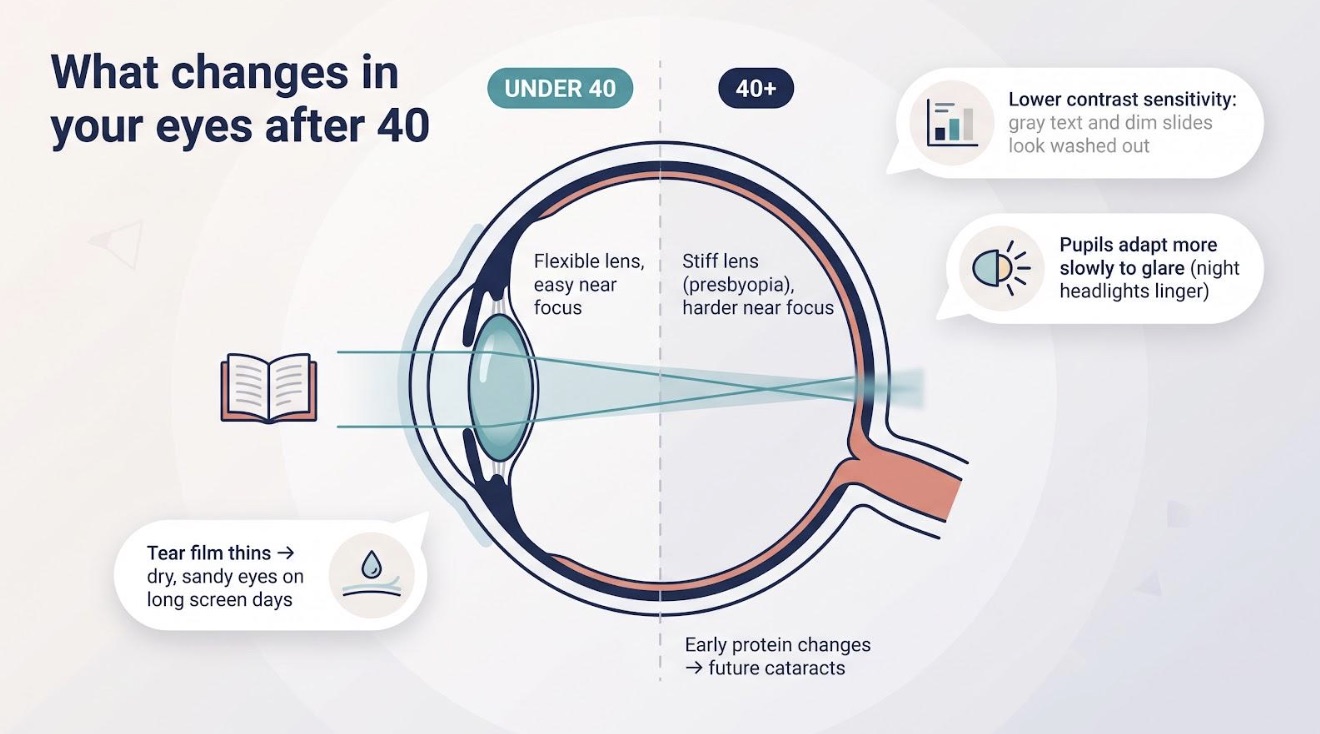
The lens is only part of the story. Contrast sensitivity dips, so gray text on a dim conference-room screen feels washed out. Pupils react more slowly to lighting swings, making evening drive-time glare stick around. Tear production eases off while screen time climbs, leaving you with sandy irritation that steals focus. Protein changes within the lens also begin now, laying groundwork for cataracts that show later.
These shifts are normal, yet any sudden blur, flashes, or eye pain warrants an immediate exam.
How Those Changes Quietly Tax Your Workday
Words blur on the contract, so you zoom in, reread, and lose your train of thought.
Dim conference rooms amplify the problem. Lower contrast sensitivity turns gray charts into ghosts, and slower pupil response makes every projector slide feel under-lit. You lean forward, squint, and the conversation slips a step ahead.
Screen-driven days add dryness to the mix, one more reason a regular digital detox can lift your productivity. Reduced blinking brings sandy irritation, fleeting blur, and a dull ache that spreads across your brow just as the afternoon meeting begins.
None of this looks dramatic, yet the interruptions stack up. Every squint, scroll, or shoulder hunch breaks momentum, pulling mental bandwidth away from strategy toward simple visual survival. Clear vision isn’t vanity; it is uninterrupted execution.
Your Options, From Reading Glasses to Lens Replacement
Start with the Simplest Correction
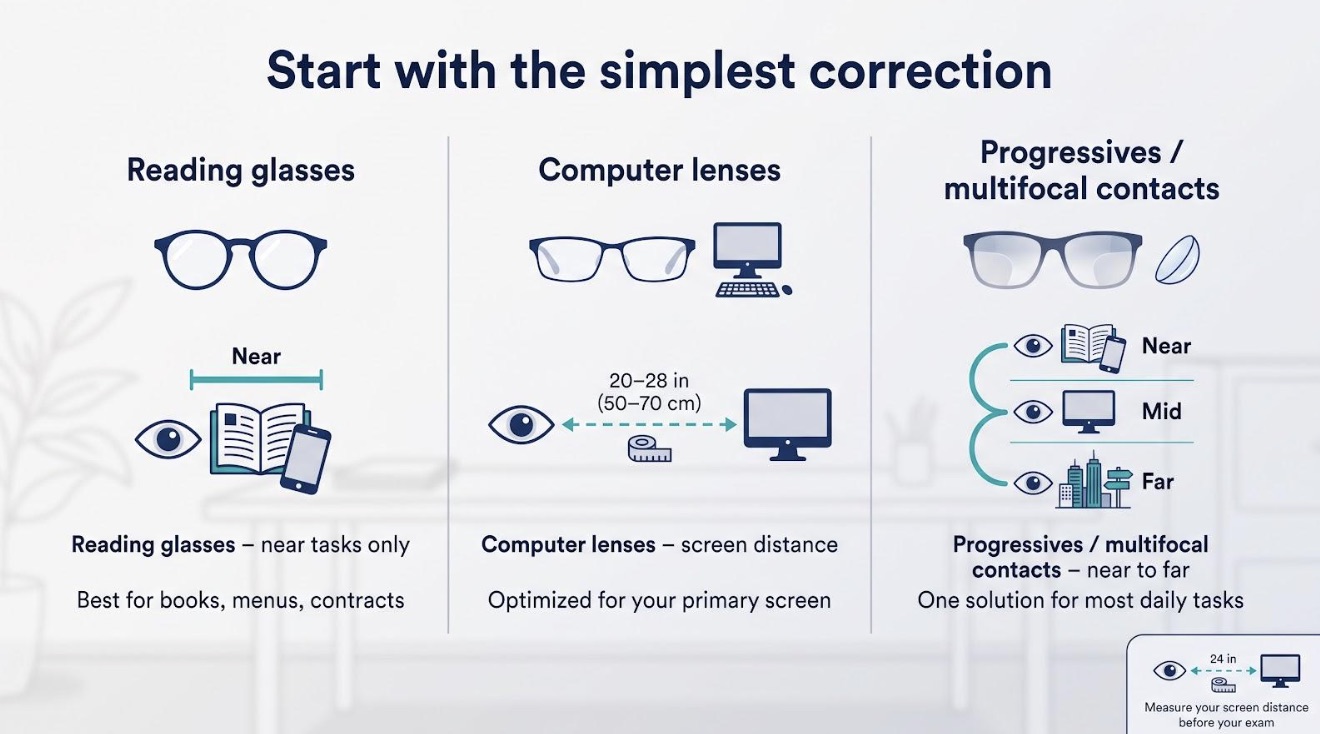
Reading glasses offer instant relief for contracts and menus, but they live only in the close-up lane. If your day swings between laptop and across-the-room whiteboard, computer glasses calibrated to your exact screen distance keep you from bobbing your head like a periscope. Practices such as Snead Eye Group in Southwest Florida offer care ranging from eye exams to lens replacement, so you can start simple and step up only if you need to.
Progressive lenses and multifocal contacts go further, stacking near, intermediate, and far power in one smooth view so you glide from dashboard to client without changing eyewear. The secret is measurement: pace off how far you sit from each screen, jot the numbers, and hand them to your eye care pro. A prescription based on real working distances always beats an eye-chart guess.
Build a Screen Setup Your Eyes Can Sustain
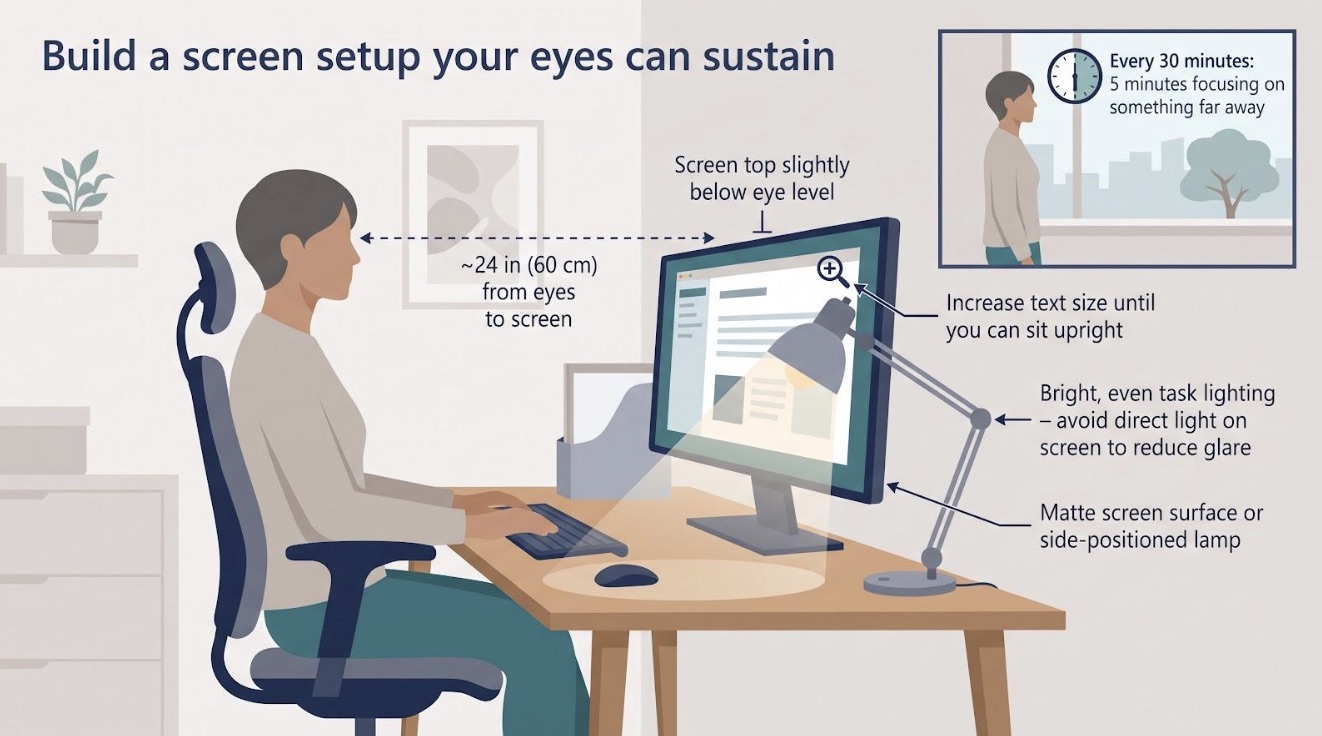
Start with scale: pump text size until you can read without leaning in. Match that with bright, even task lighting so your pupils stop straining like shutter blades in dusk.
Park the monitor an arm’s length away and nudge it a touch below eye level; that angle keeps lids partly closed, slowing evaporation. Kill reflections with a matte screen or a well-placed desk lamp, then take a five-minute horizon break every half hour to reset focus and blink rate.
Know When Surgery Enters the Conversation
If glasses or contacts feel like constant course corrections, lens replacement shifts the conversation. Surgeons remove your stiff natural lens and insert an artificial one tailored to your goals. A monofocal implant sharpens a single distance and often keeps you in reading specs, while premium multifocal, extended-range, toric, or light-adjustable lenses juggle zones but can introduce halos or night-glare trade-offs.
Not all surgical fixes swap the lens. EVO ICL, approved by the FDA for certain nearsighted adults ages 21–45, slides a small lens in front of yours and leaves focusing ability untouched—a myopia solution, not a presbyopia cure. Talk risks, visual side effects, and likely glasses needs before you book a date.
When to Book a Specialist, and What to Ask
The American Academy of Ophthalmology advises a baseline eye-disease screening at 40, even if your vision feels razor-sharp.
Book sooner when headaches or eye strain repeat, print or street signs smear despite current glasses, night headlights sprout halos, prescriptions swing often, or close relatives carry glaucoma, macular degeneration, or early cataracts.
Treat sudden vision loss, flashes, a storm of new floaters, or a curtain-like shadow as emergencies that cannot wait for the next open slot.
An optometrist handles routine exams and prescriptions; an ophthalmologist is a medical doctor who also treats disease and performs surgery. Bring three questions to the visit:
- What is driving my vision change?
- Which correction matches the distances I actually work at each day?
- If surgery is on the table, what risks, side effects, and post-op glasses needs should I expect?
Protect the Tool You Use All Day
Clear vision is infrastructure, not indulgence. It powers every instant read of a client’s expression and every late-night polish of a pitch deck.
Notice the friction points first: the squint at 4 p.m., the forehead pinch in dim light, the urge to rub gritty eyes halfway through a call. Fix your environment next—bigger text, brighter task lighting, strategic distance breaks—then book the exam that locks in an accurate prescription.
Choose correction that matches where you actually work, not where an eye chart sits. Update as demands evolve, and treat adjustments as performance tuning, not a concession to age. You drive results; your eyes deserve the same proactive care.

A gradual drop in sexual desire is one of the most common reasons men start asking questions about their hormones. It often arrives quietly, alongside lower energy or a flatter mood, and it can be easy to dismiss as stress or simply getting older. For men who are considering hormone support, many want to understand the connection between enclomiphene and sex drive before deciding whether this kind of treatment fits their situation.
How Enclomiphene Works in Plain Terms
Enclomiphene is a nonsteroidal medication that works upstream of testosterone itself. It binds to estrogen receptors in the brain, which changes the feedback signals the body uses to regulate hormone output. When those signals shift, the pituitary gland releases more luteinizing hormone and follicle-stimulating hormone, and the testes respond by producing more testosterone on their own.
This is the key difference from taking testosterone directly. Instead of adding hormone from outside, enclomiphene encourages natural testosterone production, which also means the testes stay active. That mechanism is the basis for most discussion of enclomiphene and sex drive, since testosterone plays a central role in sexual desire for most men.
Why Sexual Desire Can Change
Testosterone influences libido through several pathways, including motivation, energy, and how the brain responds to sexual cues. When levels are low, sexual desire often fades along with other low testosterone symptoms such as fatigue, reduced drive at work or in training, and a less stable mood.
If enclomiphene raises testosterone into a healthier range, some men notice that their interest in sex returns along with better energy and mood. Overviews of this topic often describe these as related improvements rather than a single isolated effect, because the same hormonal change that supports libido also tends to support general well-being.
What the Timeline May Look Like
Hormonal changes take time to translate into how a person feels. Testosterone levels can begin to shift within the first weeks of treatment, but the way that change shows up in mood, energy, and desire varies widely from one man to another. Some notice a difference relatively early, while others need several weeks or longer before any change is clear.
Any shift in libido tends to follow the hormonal change rather than arrive immediately, which is one reason early impressions can be misleading. Judging the effect on libido after only a few days usually says more about expectations than about the treatment itself. A more useful approach is to note changes week by week and compare them with lab results once follow-up testing is done.
Libido and Erectile Function Are Different Questions
Sexual desire and erectile function are often grouped together, but they are not the same thing. Libido describes interest and motivation, while erectile function depends heavily on blood flow, nerve signaling, and vascular health. A man can have strong desire and still experience erectile difficulties, or the reverse.
Testosterone has a stronger and more direct link to desire than to the mechanics of an erection. That means a hormonal treatment may improve interest in sex without fully resolving an erectile problem that has a circulatory or other cause. Separating these two questions early keeps expectations about enclomiphene and sex drive realistic, and it helps a provider decide whether additional evaluation is worthwhile.
Other Factors That Shape Libido
Hormones are only one part of the picture. Poor sleep, chronic stress, alcohol, certain medications, relationship dynamics, and general physical health all influence sexual desire. That is the same point in what actually reduces stress — sleep and recovery move the needle before any other fix does. If several of these factors are pulling in the wrong direction, a rise in testosterone may not be enough on its own to produce a noticeable change.
The body also depends on estradiol balance. Because enclomiphene acts on estrogen signaling and raises testosterone, the body’s conversion of testosterone into estradiol can also shift. Estradiol that is too low or too high can affect mood and libido, which is why providers look at both hormones together. All of this explains why the effect of enclomiphene on libido is rarely a simple one-to-one relationship.
What Monitoring and Follow-Up Labs Look At
A structured plan starts with a baseline hormone panel, typically including total and free testosterone, estradiol, luteinizing hormone, and follow-up markers chosen by the provider. Repeating these tests after treatment begins shows whether hormone levels are moving in the intended direction and whether the dose needs adjustment.
Regular follow-up lab work also provides context for how a patient feels. If testosterone has risen but desire has not changed, the next conversation may focus on sleep, stress, estradiol, or erectile health rather than the dose alone. These visits are where questions about enclomiphene and sex drive can be answered with data instead of guesswork, and where any side effects can be reviewed early.
For men who are concerned about fertility, the mechanism has an additional benefit. Because the testes remain active, published overviews note potential improvements in sperm count and motility alongside hormonal changes, a point that matters for men who may want children in the future.
Lifestyle Habits That Support the Results
Hormone treatment tends to work best when the basics are in place. Consistent sleep gives the body the recovery window it needs for normal hormone rhythms, and regular resistance training supports both testosterone levels and physical confidence. Limiting alcohol, managing body weight, and building in time to unwind all reduce the background stress that can suppress sexual desire regardless of hormone levels.
These habits also make lab results easier to interpret. When sleep, training, and diet are stable, a change in how a man feels is more likely to reflect the treatment itself than a busy month or a run of poor nights. That clarity helps the provider make better decisions about dosing and next steps.
Side Effects and Realistic Expectations
Like any medication, enclomiphene can cause side effects. Reported effects include hot flashes, mood fluctuations, and gastrointestinal discomfort, and long-term safety data for extended use is not yet fully established. Compounded versions are not approved or evaluated by the FDA for safety, effectiveness, or quality, which is one more reason treatment should only proceed under the care of a licensed provider who reviews history, labs, and goals first.
Individual responses differ. Some men experience a meaningful return of sexual desire, others notice modest changes, and some find that the main limiting factor lies outside their hormones altogether. Going in with that range of possible outcomes in mind makes it easier to evaluate progress fairly.
Starting the Conversation
Men exploring hormone support are usually best served by beginning with a clear description of their symptoms, a full hormone panel, and an honest discussion of other factors that may affect desire. Valhalla Vitality offers provider-led consultations and lab-guided enclomiphene therapy for men who want to look at these questions in a structured way, with follow-up testing built into the plan.
For men exploring the link between enclomiphene and sex drive, the most useful starting point is not the medication itself but an accurate picture of what is driving the change in desire. That picture is what allows any treatment plan to be built on evidence rather than assumptions.

Your dog is slowing down on the evening walk, and you’ve already started scrolling through supplement listings at midnight. I get it. I did the same thing when my Lab mix Rufus turned ten and stopped meeting me at the door. Somewhere between the third browser tab and the fourth “vet recommended” badge, the whole category starts to blur.
Here’s the short version before you spend a dollar. Mushroom supplements for dogs are not a magic fix, but the good ones are genuinely worth trying, especially for older animals dealing with mobility or focus issues. The catch is that the shelf is crowded with powders made from mycelium grown on grain, which is mostly starch. Learning to tell the difference takes about ten minutes and will save you a lot of money.
Most of what you’ll read about Mushrooms for Dogs splits into two camps: people who swear by them and people who call the whole thing a gimmick. Both are partially right, and the deciding factor is almost always what’s actually inside the bottle. So let’s talk about how to check that.
What functional mushrooms actually do for a dog
Functional mushrooms are the fungi people eat for a specific purpose rather than for flavor. Reishi, turkey tail, lion’s mane, chaga, cordyceps, and maitake each carry compounds called beta glucans and triterpenes that researchers have studied for decades in human contexts. In dogs, the interest centers on the same broad areas: normal immune response, joint comfort, digestion, and cognitive sharpness in seniors.
Notice the wording. Nobody credible claims these cure anything in your pet. A mushroom extract is a supporting player, not a treatment plan. If your dog has a diagnosed condition, that conversation belongs to your veterinarian, full stop. What the supplements can do is give an aging body some raw material it might use well.
My honest read after three years of using these with Rufus: the changes are quiet. He climbs the stairs a little easier. He’s more present in the evenings. If you’re expecting a different dog in a week, you’ll be disappointed and you’ll blame the product.
Why most mushroom powders are a waste of money
This is the part that made me angry the first time I learned it. Walk into any pet store and grab a random “mushroom blend.” Flip the bag over. If the first ingredient says mycelium, or “myceliated grain,” you’re largely holding ground-up oats or rice with a little fungus threading through it.
That’s not a scam in the legal sense. It’s cheap to produce, and the label isn’t lying. But you’re paying premium prices for filler, and the active compounds end up as a rounding error. According to the National Agricultural Library, mushrooms and their cultivation have been studied extensively for their nutritional and bioactive properties, and the research consistently centers on the fruiting body, which is the actual mushroom you’d recognize, not the root-like network it grows from.
What you want on that label is one phrase: 100% fruiting body. Two extraction methods, typically hot water and alcohol, matter too, because some compounds dissolve in water and others only in alcohol. A product using both is called dual extracted, and that’s the standard worth paying for.
A thirty-second label test
Before you buy anything, do this with the bag in your hand:
- Find the ingredient list. If “mycelium” or “myceliated grain” leads, put it back.
- Look for “fruiting body” and a mushroom species name, not a vague “mushroom blend.”
- Check whether the label mentions dual extraction or lists both water and alcohol on the process.
- Squint at the beta glucan figure. A number listed with no testing method behind it is decoration.
- Confirm there’s a way to reach the company with a real question. A contact form that goes nowhere tells you plenty.
That last one sounds trivial. It isn’t. The brands doing careful work tend to be the ones willing to talk about it.
Which mushroom fits your dog’s situation?
You don’t need a cabinet full of bottles. Match the fungus to the concern and give it several weeks before you judge anything.
|
Concern |
Mushroom to look for |
What pet parents usually notice
|
|
Stiff mornings, slower stairs |
Reishi, maitake |
Easier movement over weeks, not days |
|
Senior fog, staring at walls |
Lion’s mane |
More engagement and recognition |
|
Loose stools, picky eating |
Turkey tail |
Steadier digestion and appetite |
|
Low energy on walks |
Cordyceps |
A bit more stamina and interest |
|
Itchy, dull coat |
Chaga, reishi |
Less scratching and a shinier coat |
If your dog is healthy and middle aged, turkey tail is where I’d start. It’s the most studied of the group and the least likely to cause any upset. For a senior with cognitive changes, lion’s mane is the one I’d pick first, and I’d give it a solid two months before deciding.
How to introduce them without a mess
Start with a fraction of the suggested serving and hold it there for a week. Tinctures go under the tongue or into the food bowl, and most dogs don’t notice a few drops mixed into wet food. Powders are easier to hide but harder to dose consistently, so measure rather than eyeball it. Watch for loose stool, vomiting, or unusual lethargy. A small share of dogs react to new supplements, and stopping is the right call if that happens.
According to the American Kennel Club, any new addition to your dog’s routine is best introduced gradually and monitored, and supplements are no exception. Keep notes on the calendar so you’re judging behavior against something real instead of a vague memory.
One more practical thing. If your dog takes medication for a heart condition, seizures, or a clotting disorder, call your vet before adding anything. Mushroom extracts can interact with how the body processes certain drugs, and that’s a conversation worth having with someone who knows your specific animal.
What the regulatory picture looks like
Here’s the uncomfortable truth about this whole category. Supplements for pets don’t go through the same pre-market approval that drugs do. The U.S. Food and Drug Administration oversees animal supplements under a framework that puts most of the responsibility on manufacturers to label and market products honestly, which means a flashy bottle proves nothing on its own.
That’s not a reason to avoid the category. It’s a reason to buy from companies that publish their sourcing, name their growing region, and submit their formulas to independent testing. Several do. The ones that don’t tend to have beautiful websites and vague answers, and you can usually spot them in a five minute phone call.
My four rules for buying mushroom supplements for dogs
After a lot of trial and error, here’s what I actually do now. First, fruiting body only, no exceptions, even when the mycelium version costs half as much. Second, one mushroom at a time so I know what’s working. Third, at least eight weeks before I form an opinion, because that’s the realistic window. Fourth, a written record of what changed, because memory is a terrible witness when you’re hoping something worked. The same habit shows up in the ten minutes a dog gets before the laptop opens.
If you follow those four rules, you’ll waste less money than most people do, and you’ll have an actual answer about whether mushrooms help your dog instead of a feeling. Rufus still takes his lion’s mane every morning, mixed into a spoonful of wet food. He’s thirteen now, and last month he met me at the door again. Could be the mushrooms, could be the cooler weather, could be him deciding the couch was boring. I don’t need to know for certain, but I do want you to know what you’re buying before you start. Pull up the ingredient list on whatever’s in your cart right now and check the first word. What does it say?

The 10-Step Blueprint Every First-Time Founder Needs to Survive

5 Things to Do After an Animal Attack to Protect Your Health and Your Claim

What Makes Montech One Of The Most Reliable Conveyor Manufacturers Today?

Why Choose a Novated Lease with Leaselab Over Other Providers

10 Money Habits Successful People Build Early
5 Ways For Startups To Succeed Making Acquisitions

77 Inspirational Quotes That Will Change Your Life
57 Memorable Kobe Bryant Quotes

(Images) 52 Motivational Picture Quotes For An Epic Year Of Success

40 Rare Motivational and Inspirational Picture Quotes
3 Prince EA Videos To Change Humanities Path To Greatness
(Video) What Is Success? An Entrepreneurial Story To Inspire You
(Inspirational Video) What If Today You Knew You Were Going To Take Your Last Breath?
How To Make Enough Money From A Blog To Quit Your Job – Kate McKibbin
How Finding Your Passion And Becoming An Entrepreneur Can Lead To Happiness – Chiquita Searle
-

 Life2 years ago
The 5 Stages of a Quarter-Life Crisis & What You Can Do
-

 Did You Know1 year ago
7 Surprising Life Lessons Video Games Taught Me That School Never Did
-

 Success Advice1 year ago
Stephen Covey’s 8 Leadership Habits That Will Change How You Lead Forever
-

 Life1 year ago
How to Stop the War in Your Head and Find Peace
-

 Featured2 years ago
The Psychology of Motivation: How to Keep Moving Forward Every Day
-

 Personal Development1 year ago
The Three-Second Pause That Changes How People Perceive You
-

 Explode Your Social Media1 year ago
Want More Views? Master These 6 YouTube Growth Tactics
-

 Change Your Mindset1 year ago
You Become What You Absorb: How Input Shapes Your Life