
Success Advice
10 Things I Have Learned from Building a Blog Worth Millions


In the last 6 and a half years I have been fortunate enough to network with some of the world’s most successful leaders in my industry, quit my day job, feature in films (Think & Grow Rich comes out Mid October, 2017) and travel half way around the world and this has all been made possible just by blogging about my passion “Personal Development“. I was even offered Millions of dollars to sell Addicted2Success 3 years into my journey but I turned the multiple offers down because I believed that I was just scratching the tip of the iceberg of what was to come with my brands growth and the positive impact we could have on this world.
There has been some ups and downs a long the way, some technical issues and doubts that I have faced, but I am lucky that I stuck it out because I have learned over time, what does and does not work when it comes to creating a successful blog.
So here are 10 things that I have learned along the way that I feel are super important for any blogger out there to know.
1. You Have to Have a Vision
6 and a half years ago I casted my 10 Year Vision for Success whilst sitting in a workshop with Jordan Belfort, The Wolf of WallStreet. I wrote out a 6 page Vision and started with the 10th year and reversed engineered it back to that very day of 14th April, 2011.
By the 6th year I was already living in my original 10 year Vision. This is the power of a Vision Game Plan. Your Vision disciplines you, it chooses your friends for you, it teaches you what to say “Yes” to and what to say “No” to. This plan has kept me on track over the last 6 and a half years and is the core reason why Addicted2Success has become the top Motivation & Inspiration Digital Media company online.
I remember working up in the desert of Western Australia catching snakes, lizards and kangaroos and many other wild Australian animals in the environmental team during some of the hottest days of summer in 130 degree fahrenheit heat. Although the money was good, the shifts were long as I was working 12 hour shifts, 28 days straight and was surrounded by negative people who did not believe in my dreams.
My vision pulled me through the tough times in the beginning and inspired me to work additional hours in my day to overtake my 9-5 income to a point where I had to tell my boss this 9-5 job was costing me too much to be here.

2. Don’t Try and be an Ace at Everything
You will burn yourself out and spread yourself way too thin. Eventually you will want to be covering every angle but to begin with pick one avenue and dominate that field.
Addicted2Success.com was my main focus to begin with. I could have started a podcast, written a book or Vlogged my way to the masses but I knew if I spread myself too thin in the beginning then it would take me 2 – 3x longer to hit my 10 year vision of 10 million views worldwide (which, by the way we are only 6 and a half years into the vision and we have hit 133 Million views so far. Im telling you a 10 Year Vision works!).
When I first started out, I chose Twitter to be the #1 social media platform to promote Addicted2Success.com. I made sure that it was a finally tuned channel, and the traffic from Twitter would then convert into Facebook traffic and mailing list subscribers. I then moved to Facebook and focused on that and so on and so on..
Twitter isn’t what it used to be but it sure did start as a great stepping stone that has lead us to a combined social media following of 2,500,650 followers across all channels to this day.
Find the hottest Social Media platform now and dominate the space so you can elevate from platform to platform like we did at Addicted2Success.
3. Don’t Alienate Yourself
Don’t forget that you are part of a community. The worldwide web is a community of people who are sharing information with one another. If someone has created a great article that you have been inspired by, why not refer to that article by linking to them. Other bloggers love this and in most cases (not all) will link back to you, visit your blog or tell others about you sometime in the future.
I used to think that if I linked out to others that this would take away from my blog. The truth is, people will look at other websites anyway. They will remember that you hooked them up with links to quality articles and bloggers and they are more likely to come back to you out of a loyalty for your quality at the end of the day.
I believe Abundance is a practice and to be honest, I didn’t crack through the lack mentality to reach the land of more abundance until I practiced sharing the success with others.
The Serial Entrepreneur & Best Selling Author “Yanik Silver“ once said to me:
“Why worry about breaking off too many pieces of the pie? When you can just bake more pies”.
So the lesson is, there is more than enough to go around, so share and care and you will be amazed by how many amazing opportunities come back and how many people will be willing to support you in your journey.
4. No More Billboard’n
One big standout mistake that I see a lot of bloggers make is covering their entire site in ads. Choosing to throw an annoying ad that is totally unrelated to the content you post right in your viewers face as soon as they enter the site, or even placing a video ad in the middle of a 200 word article is super douchey and people can tell that you are all about the money and that your priority is not about delivering valuable content to your audience.
You don’t want your site to look like a billboard. It devalues your website and is very distracting. If your viewers wanted to see an overload of ads they would just google a video of Times Square and stare at that.
5. You Can’t Do It All Alone
My good friend and business mentor “Tai Lopez” told me many years ago “You can’t do it all, if you wanna go big-time you need to find a partner that will compliment your weaknesses so you can focus on your strengths.”
Bill Gates had Paul Allen, Warren Buffett has Charlie Monger, Steve Jobs had Steve Wozniak. They all found a strong, skilled partner to take their business to the next level.
I have aligned with a few business partners who are incredible at what they do and this has only added to the business and vision, it has never taken from it. That’s why I love helping others to achieve success online too. I create guides and run mastermind groups to show others how I have been able to achieve this success online so they too can help and inspire others with their journey.
If you haven’t already, make sure you get your hands on my guide, The Formula (The Secret Ingredients of Online Success)
This is the guide that I wish I had 6 and a half years ago. If I had this knowledge back then I would be where I am today in 1 to 2 years.

6. Understand Your Audience
Do you know what niche’ you fall under? A lot of people are just throwing everything out there that they think will stick and they are not holding or attracting their viewer’s attention because their subject is a little too broad.
Work out what your niche is. If it is a website about “The Art Of Hackey Sacking” then stick to hackey sacks. Don’t expand it out to sports of all sorts because it loses its edge and becomes a website that is going to leave you in a cesspool of millions of others that are covering the same old topics.
One guy in the US pulls in $10,000 a month from his blog about fancy cactus designs. If he can make 10k from cactus lov’n, you can just about make it with any creative niche’ that comes to mind.
7. Don’t Copy Your Competition
In most cases in business it is a great idea to study your competition so that you can out compete them. In the world of blogging, don’t do it! The key is to have your own unique flair and to be found by YOUR like-minded peers through search engines.
So if you are just writing articles the way that you would, and you are not writing an article for the sake of competing with an other, then you will position yourself in a place where you have no competition.
Multi Millionaire blogger Pete Cashmore said something that really resonated with me, he said:

“We are really competing against ourselves, we have no control over how other people perform.”
Pete Cashmore hit the nail right on the head with that one. Just do you! and you will be rewarded for it over time.
8. Use Your Blog As Leverage
Once you get a good amount of traffic in place ie..10,000+ a month then you can really start leveraging off that. Reach out to those with a large follower base and exposure than you and ask them if they would like to be featured on your site. Once you feature them, send them a ReTweet link or an e-mail blast out letter of the article that you featured them in so that they can share it with their network.
Dwayne “The Rock” Johnson, among many celebrities who have supported Addicted2Success over the years, seemed to appreciate whenever we would write articles about him and every time he would share our articles on his Twitter channel we would get a flood of 10,000+ viewers.
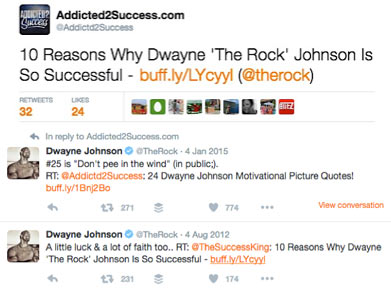
I have also been able to use Addicted2Success and its reach to build a successful podcast called The Addicted2Success Podcast which is one of the top Business podcasts right now featuring Tony Robbins, Les Brown, Gary Vaynerchuk, Gabby Bernstein, Jack Canfield, Simon Sinek, Grant Cardone and 100+ other incredible leaders.
Start being resourceful. Look for ways that you can platform and leverage yourself off other materials and connections you have in your reach.
9. Minimize Your Page Load Time
Google pays a lot of attention nowadays to page speeds when it comes to SEO. All you need to do is head over to Google’s Page Speed Test and run a test on your domain name and it will give you an idea of what changes are needed to speed up your website load time.
I run Addicted2Success through CloudFlare which not only secures my site from DDoS attacks but surprisingly speeds up my page load time by 20%. Cloudflare is free and easy to set up so you should check it out when you get a chance.
The more graphics, flash and plugins you have on your page, the slower your site is going to load. Sometimes you have to sacrifice big files for a faster load. So it is a good idea to go back through your site and see what is in your sidebar, what plugins are activated and what un necessary old content is taking too long to load.
10. Get In The Zone (a little feng shui blogging)
So this has got to be one of the most important parts of blogging, which I believe has played an important part in my success online.
So before you start your day with blogging make sure you have had something to eat, something to drink and you are comfortable in your environment. Make sure that you have a clear and concise idea of how much time you have to work online for the day. Remove any distractions around you and time block your social media explorations so that you aren’t wasting your time on Facebook, reading ridiculous stories about Justin Bieber and cats.
If you want to inspire the world with your content then you need to live buy the rule of “Create > Consume”. Don’t be ruled by the robots, unplug and create so your content can be consumed by everybody else.
Make sure you start your day right with a little stretching, exercise, hydration and gratitude or prayer. Something that awakens a little energy in you, because you will need it when it comes time to be creative and to shine online. It may sound a little cheesy but if it helps you to feel more professional by wearing a suit, a beanie, or even having a coffee at arm’s length, then do it!
You have to be in the zone to produce your best material.
As you can imagine we are just scratching the surface with what I have written above. So Here’s One of the Facebook LIVE Videos I shot out in Colombia where I answered online business questions that I think you will Love:
If you love this article please don’t forget to share it and if you’d love to learn step by step how I built a blog worth millions with millions of views and millions of followers make sure you get a copy of my guide – THE FORMULA (The Secret Ingredients of Online Success).













You know the story. A guy gets wings made of feathers and wax, dad tells him not to fly too close to the sun, guy ignores dad, wings melt, guy falls into the sea. Classic.
But here’s the thing about Icarus. He didn’t crash because he failed. He crashed because he was doing so well.
That’s the part we don’t talk about enough.
What Icarus Syndrome Actually Looks Like
Icarus Syndrome isn’t some official diagnosis you’ll find in a medical textbook. It’s more of a pattern. And once you spot it, you start seeing it everywhere.
Picture this: someone lands the promotion they’ve been chasing for years. Suddenly they’re saying yes to everything. More projects, more travel, more risk. The confidence that got them there starts to tip over into something else. Overreach, maybe. A bit of arrogance. That quiet voice that used to say “hang on, is this a good idea?” goes strangely silent.
And then it all comes tumbling down.
The tricky bit is that success and self-destruction can look almost identical from the outside. Both involve ambition. Both involve pushing hard. The difference is usually invisible until it’s too late.
Why Winning Can Set You Up to Lose
Ever noticed how a winning streak makes people a little reckless? There’s actually a reason for that.
When things go well, our brains get a hit of confidence that doesn’t always match reality. We start believing our own hype. The wins feel like proof that we can’t lose, which is exactly the moment we’re most likely to.
Turns out, success shrinks your awareness. You stop questioning yourself. You stop listening to feedback because, well, look at all this evidence that you’re right. The people who used to challenge your thinking? You might start tuning them out.
The other day someone told me they’d made their worst decisions not when they were struggling, but when everything was going great. That stuck with me. Because it makes a weird kind of sense.
Struggle keeps you humble. Success can make you forget.
The Warning Signs Worth Watching For
So how do you catch yourself before the wax starts dripping?
It usually starts small. You notice you’re brushing off advice you’d normally take seriously. You’re taking on more than you can realistically handle, but telling yourself you’ve got it. You feel a bit untouchable, like the normal rules don’t apply to you anymore.
Sleep goes out the window. You’re running on adrenaline and calling it drive.
And maybe the biggest one: you stop asking for help because asking for help feels like admitting you’re not as on top of things as everyone thinks.
This part’s a bit uncomfortable, but the very traits that fuel success, the ambition, the drive, the refusal to quit, are the same ones that can quietly steer you off a cliff. Same wings, different outcome.
Pulling Yourself Back From the Sun
Okay, so what do you actually do about it?
First, get honest about the story you’re telling yourself. Are you flying high because things are genuinely solid, or because you’ve stopped checking? There’s a difference, and only you can tell which one it is.
Keep people around who’ll tell you the truth. Not the yes-people who clap at everything, but the ones who’ll gently say “mate, are you sure about this?” Those people are worth their weight in gold, and they get rarer the more successful you become.
Slow down enough to notice how you’re actually feeling. Success can mask burnout for a surprisingly long time. You feel great right up until you don’t.
And look, sometimes catching yourself isn’t something you can do alone. If you’re feeling stretched thin, if the pressure of keeping it all up is starting to weigh on you, talking to someone helps more than people expect. Getting proper psychological support in Western Sydney or wherever you are isn’t a sign you’re falling apart. It’s usually a sign you’re paying attention.
Flying Smart Instead of Flying High
Here’s the thing Icarus never got told. The problem was never the flying. It was the ignoring.
His dad gave him a middle path. Not too high, not too low. He just got carried away.
You can enjoy your success without letting it make you stupid. You can keep climbing without pretending you’re invincible. The trick is staying awake to yourself, especially when everything looks like it’s going right.
Because that’s exactly when the sun feels closest.

Finding time to give back can feel overwhelming. Many people want to help others but think it takes a lot of time and planning. The truth is, simple, effective ways to support charity fit into busy lives. Whether you have a few minutes or a couple of hours, you can make a positive impact in your community. Helping others benefits those in need and gives you a sense of fulfilment and connection.
First, understand that charitable efforts can be quick and meaningful. You don’t need to organize a big event or donate a lot of money to make a difference. Small actions can make significant changes in others’ lives. Here are some ways to show generosity today.
Food Bank Donations
One of the simplest ways to help is by donating to a food bank. A food bank donation helps people facing food insecurity by redistributing surplus food and providing healthy meals. When you donate, you nourish someone’s day and ease their burden.
Local food banks often rely on donations from individuals and businesses. You can donate non-perishable items or fresh produce from your garden. If that’s not possible, consider making a monetary donation, which food banks can use to buy the needed food items. Every contribution counts and helps ensure families receive meals.
Volunteering your time at a local food bank is another great way to get involved. Many food donation organizations need help sorting donations, packing food boxes, or distributing meals. This hands-on work lets you see the positive impact of your efforts. You can also build friendships with staff and other volunteers as you work toward shared goals.
No-Cost Options
Charity doesn’t always have to cost money. You can donate your skills or time. If you’re good at graphic design or enjoy writing, your expertise can support local nonprofits’ outreach efforts. You might create promotional materials, manage social media, or offer training sessions.
Another no-cost option is to share charitable organizations on your social media. Inform friends and family about the causes you care about. Increased visibility can lead to more donations and volunteers. Sometimes, raising awareness matters as much as giving money.
Used Goods Donations
Decluttering your home is a great way to support charity. Look around. What items do you no longer use? Clothing, household goods, and toys can help someone in need. Local shelters, thrift stores, and nonprofits often welcome gently used items. By clearing out what you don’t need, you can provide useful items to those who can’t afford them.
You can enhance this experience by organizing a donation drive in your community. Involve friends and neighbours to gather more items together. This can become a fun community event that promotes giving.
Random Acts of Kindness
Doing random acts of kindness each day is an easy way to help others. Simple actions, like buying someone a coffee, leaving a nice note, or helping a neighbour carry groceries, can spread goodwill. These acts not only brighten someone’s day but also promote kindness in your community.
Try setting a goal to do a certain number of kind acts each week. This can become a good habit that changes how you interact with others. It doesn’t matter how big or small the act is. What matters is the intention behind it.
Skill-Based Volunteering
Using your professional skills to help a charity can foster personal growth while supporting those in need. Whether you are a teacher, marketer, lawyer, or accountant, your skills can greatly benefit nonprofits. Many nonprofits need help in areas where they can’t afford to hire professionals.
Some food donation organizations specifically seek volunteers with certain skills, so look for a nonprofit that matches your background. You can create change by using your expertise and meet others who share your interests.
Getting involved in charitable activities allows you to help create a better world. The good news is you don’t need much time or money to make a difference. Whether you volunteer at a local food bank, donate items, or do random acts of kindness, your efforts can lead to real change. These small actions can bring great fulfillment, improving not just the lives of those you help but your own, too.

Most people can remember a moment when someone pointed out that they were getting better at something. It might have been a teacher who mentioned that an essay read more clearly than the last one, or a manager who noticed that a task was finished sooner than usual. The comment may have lasted only a few seconds, but it changed how the person felt about the work in front of them. That small shift in feeling is often what separates someone who keeps going from someone who quietly gives up.
Progress is easy to overlook. Improvement usually arrives in pieces that are too small to feel impressive on their own, and the person making the effort is rarely the one who sees it first. When nobody names those pieces out loud, the effort starts to feel pointless. When somebody does name them, the effort starts to feel worth repeating. Understanding how that works, and learning to do it on purpose rather than by accident, is one of the most useful skills anyone in a teaching or leading role can develop.
How Noticing Good Behavior Changes What Happens Next
People repeat what works for them, and very little works better than being noticed by someone whose opinion matters. Many teachers and managers, though, were never taught how to use positive reinforcement in a steady, deliberate way, so their encouragement arrives at random moments and slowly loses its meaning. Practical, well-structured methods for recognizing and encouraging good behavior solve that problem by giving praise a shape and a purpose instead of leaving it to chance. Anyone looking for a clear starting point can review this article on positive reinforcement techniques by Youngstown State University. Studying this kind of material online also makes it easier for working teachers and professionals to build new skills around a full schedule, without stepping away from the classrooms and teams that they already serve.
Why Setbacks Are Easier to See Than Improvement
Problems announce themselves. A missed deadline, a failed test, a disrupted lesson, or an argument in a meeting all demand attention immediately, because something has to be done about them. Improvement makes no noise at all. A student who reads a little more fluently this week than last week does not interrupt anyone, and a colleague who has stopped arriving late does not create a situation that anybody needs to handle.
The result is that attention flows toward what is going wrong. Over time, people learn that the quickest way to be noticed is to struggle, and that doing well simply means being left alone. That is a discouraging lesson, and it is taught without anyone meaning to teach it. Deliberately looking for improvement corrects the balance.
The Link Between Small Wins and Lasting Habits
A habit is built from repetition, and repetition depends on how the last attempt felt. When an attempt ends with a sense of having moved forward, the next one starts more easily. When it ends with nothing at all, the next one takes more willpower, and willpower runs out. This is why recognizing progress is not simply a kindness. It is one of the practical mechanics of habit formation.
Small wins also make a long goal feel possible. Someone who wants to improve their writing, their fitness, or their grades is looking at a destination that is months away. If the only measure of success is arrival, then every day before that is a day of failure. If the measure is movement, then almost every day can end in something worth acknowledging.
What Makes Encouragement Actually Land
Not all encouragement has the same effect. A vague comment like “good work” is pleasant to hear and forgotten within minutes, because it does not tell the person anything they can use again. Naming the specific thing that improved gives the comment weight. Saying that someone explained their reasoning clearly, or handled a difficult question patiently, tells them exactly which behavior to repeat.
Timing matters as well. Recognition that arrives while the effort is still fresh connects clearly to the action that earned it. Recognition that arrives weeks later feels like a formality. Honesty matters most of all.
Recognizing Progress in a Learning Environment
Classrooms show all of this very clearly, because students are constantly forming opinions about what they are capable of. A student who believes they are bad at a subject will read every difficulty as proof, and a student who has been shown evidence of their own improvement has something to weigh against that belief. Pointing to a specific piece of earlier work and comparing it with a recent one is often more persuasive than any amount of general encouragement.
This also affects how a class behaves as a group. When students see that steady effort and cooperation are noticed, those become the normal ways to act. When the only things that draw comment are disruptions and mistakes, the classroom slowly organizes itself around those instead.
Recognizing Progress at Work and at Home
The same pattern holds well beyond school. In workplaces, people frequently leave roles they are good at because nobody ever indicated that the work was valued. A manager who regularly names the specific things a team member has done well builds trust that survives harder conversations later, because criticism from someone who also notices success is easier to accept.
At home, the effect is much the same. Children, partners, and family members respond to being seen accurately. Mentioning that someone has been more patient recently, or that a difficult task was handled calmly, does more for the relationship than a general compliment ever could.
Building the Habit of Looking for Improvement
Like any habit, this one needs a structure until it becomes automatic. Setting aside a few minutes at the end of a day or a week to think about who has improved, and in what specific way, is usually enough to begin. Writing it down helps, because memory tends to favor the problems. The next step is simply to say it to the person involved, in plain words, as soon as there is a reasonable moment.
None of this requires a new system or a great deal of time. It requires paying attention to the right things and then being willing to mention what was seen. People who feel that their progress is visible tend to keep making progress, and that is true in classrooms, in workplaces, and in ordinary life.

Your cell phone is usually something that you check almost immediately when you wake up. One notification turns into three. An e-mail is followed by another message, and soon enough, the day has started without any proper planning. Digital applications are very helpful and make work easier, yet it also makes it difficult for people to stop and think about what deserves attention.
That’s when the importance of paper scheduling can play an important role. With the September 2026 calendar, you get all your deadlines, appointments, and key dates scheduled without having another notification nagging at you. By listing out what’s a priority for you, you create a simple place to reflect on things before getting into the hustle and bustle of the day.
Why Do Successful People Still Plan on Paper?
The benefits that come with digital planning are immense. These include setting alerts, scheduling meetings, coordinating calendars, and providing access to all information anywhere. However, just because everything is available on a screen doesn’t necessarily mean that you will be able to concentrate on the most important things.
Paper provides a very different way of doing things. You don’t have any pop-ups to distract you. You can simply look at your page, determine what is important, and take notes without switching applications.
Imagine a professional preparing for an important presentation. Their digital task manager may contain dozens of tasks. On paper, they might simply write “finish presentation,” “review figures,” and “send final version.” The smaller, more focused list can make the next step feel much clearer.
Paper Makes Priorities Visible
The handwritten plan also remains physically in your presence. It can be kept next to your laptop as you work, reminding you of what you planned to achieve.
It is also gratifying to tick off an accomplished task. It creates a visible record of progress instead of leaving completed work buried inside a digital list.
Can Paper Planning Help With Digital Distractions?
The contemporary workplace is full of interruptions. There will be emails. There will be messages. There will be meetings going long past their allotted times. Even if you make up your mind to find some time, it’s not always easy to do so undisturbed.
According to Microsoft’s Work Trend Index 2023 report, 68% of individuals reported that they lacked adequate undistracted focus time while working. This research was conducted among 31,000 individuals from 31 different countries, and trillions of Microsoft 365 productivity signals were analyzed.
Paper planning cannot remove these interruptions. It can, however, give you something simple to return to when they happen. If the day’s three most important priorities are written beside your computer, it becomes easier to remember what you were working towards after an unexpected meeting or a string of messages.
The aim is not to avoid technology. It is to avoid letting technology decide where your attention goes.
How Does Writing Your Day Down Change the Way You Work?
When writing an outline, one is forced to make decisions. Rather than looking at an endless list of things that have to happen someday, one can identify things that matter today.
This is particularly useful when one already has a busy schedule for a day. Imagine having a report due Friday, three meetings, several emails to answer, and a routine administrative task waiting. Everything may look important when viewed together. Writing down the report as the main priority can make it easier to protect time for it.
|
Planning on an app |
Planning on paper |
|
Easy to add and rearrange tasks |
Makes selected priorities physically visible |
|
Useful for reminders and notifications |
Creates a quieter planning space |
|
Can store a large number of tasks |
Encourages you to be selective |
|
Works well for shared schedules |
Works well for personal daily focus |
This does not mean paper is automatically better. It simply gives planning a different purpose. An app can hold everything, while a sheet of paper can help you decide what deserves your attention now.
Can Paper and Digital Planning Work Together?
Absolutely. The best way of doing this could be assigning a particular role to both mediums.
Assign your meetings, appointments, joint ventures and reminders on a digital calendar, but let your personal commitments, brief notes, thoughts and priorities remain on paper.
This works perfectly well even while planning for months ahead. A look at a September 2026 calendar can show you the busiest times, important deadlines and other personal engagements prior to organising individual days.
Why Are Weekly Calendar Layouts Beneficial for a Busy Schedule?
A week that is packed with activities will appear totally different when all seven days are visible. Using printable weekly calendars can assist you in taking an overall view of your appointments, deadlines, and other important obligations at once.
Such an overview can reveal some potential issues before it is too late. For example, when you realize that all your time during one day is already taken by numerous meetings, then you know that you should change your schedule now.
Printable weekly calendars can also be beneficial for those who like tangible things and wish to have everything written down somewhere without switching applications.
Make Planning More Intentional
A productive day may not necessarily start with downloading yet another app or adding new things to the to-do list. Sometimes, all it takes to start a productive day is some quiet minutes and an empty sheet of paper. Listing your priorities will give you a break before responding to the numerous stimuli.
Paper planning will only provide an additional choice. To discover practical planning resources in the form of free printable planners and calendars, try out a platform that will facilitate everyday planning. With proper use, paper planning can become an instrument that will turn your hectic schedule into a thoughtful one. The most effective planning tool is the one that will enable you to begin your day knowing your priorities and end it knowing where your time went.
Author Bio
CalendarKart offers free printable calendars, planners, and practical resources to help students, professionals, families, and others plan, organize, and manage their time more effectively. Its resources cover weekly planning, productivity tips, printable templates, and simple strategies for staying organized without overcomplicating everyday life.

Is it too late to buy Bitcoin in your 30s

Desk Job Survival: Why Your Office Chair Is Quietly Wrecking Your Posture (and How to Fix It)

Why the AI Automation Gold Rush is Ending (And How to Pivot)

Nothing Beats the Real Thing: Why Real Turf Grass Is Worth the Effort

What Remote CEOs Get Wrong About Their Home Office

5 Ways For Startups To Succeed Making Acquisitions

77 Inspirational Quotes That Will Change Your Life
57 Memorable Kobe Bryant Quotes

(Images) 52 Motivational Picture Quotes For An Epic Year Of Success

40 Rare Motivational and Inspirational Picture Quotes

3 Prince EA Videos To Change Humanities Path To Greatness

(Video) What Is Success? An Entrepreneurial Story To Inspire You

(Inspirational Video) What If Today You Knew You Were Going To Take Your Last Breath?

How To Make Enough Money From A Blog To Quit Your Job – Kate McKibbin

How Finding Your Passion And Becoming An Entrepreneur Can Lead To Happiness – Chiquita Searle
-

 Life2 years ago
The 5 Stages of a Quarter-Life Crisis & What You Can Do
-

 Did You Know1 year ago
7 Surprising Life Lessons Video Games Taught Me That School Never Did
-

 Success Advice1 year ago
Stephen Covey’s 8 Leadership Habits That Will Change How You Lead Forever
-

 Life1 year ago
How to Stop the War in Your Head and Find Peace
-

 Featured2 years ago
The Psychology of Motivation: How to Keep Moving Forward Every Day
-

 Personal Development1 year ago
The Three-Second Pause That Changes How People Perceive You
-

 Explode Your Social Media1 year ago
Want More Views? Master These 6 YouTube Growth Tactics
-

 Change Your Mindset1 year ago
You Become What You Absorb: How Input Shapes Your Life
5 Comments