Change Your Mindset
63 Powerful Tony Robbins Quotes That Have Changed My Life
For most of my life I was brought up off the teachings from the legendary life coach “Tony Robbins“. I had the opportunity to see Tony live on stage in Sydney a few years ago and I believe his words of advice helped to elevate me to the next level of success during tough times. I was pen to paper the entire conference noting every Tony Robbins quote that I could, saving them to my smart phone and desktop to motivate me each and everyday towards success.
So this collection of Tony Robbins quotes are a homage and respect to the legendary Robbins who is doing amazing things in this world by impacting the lives of those who are passionate about self development.
Below are the top Tony Robbins quotes to help change your life:
“The secret of success is learning how to use pain and pleasure instead of having pain and pleasure use you. If you do that, you’re in control of your life. If you don’t, life controls you.” – Tony Robbins
“I’ve come to believe that all my past failure and frustration were actually laying the foundation for the understandings that have created the new level of living I now enjoy.” – Tony Robbins
“Identify your problems, but give your power and energy to solutions.” – Tony Robbins
“Life is a gift, and it offers us the privilege, opportunity, and responsibility to give something back by becoming more.” – Tony Robbins
“A real decision is measured by the fact that you’ve taken a new action. If there’s no action, you haven’t truly decided.” – Tony Robbins
“New Year = A New Life! Decide today who you will become, what you will give how you will live.” – Tony Robbins
“Leaders spend 5% of their time on the problem & 95% of their time on the solution. Get over it & crush it!” – Tony Robbins
“One reason so few of us achieve what we truly want is that we never direct our focus; we never concentrate our power. Most people dabble their way through life, never deciding to master anything in particular.” – Tony Robbins
“The only problem we really have is we think we’re not supposed to have problems! Problems call us to higher level- – face & solve them now!” – Tony Robbins
“Your past does not equal your future.” – Tony Robbins
“For changes to be of any true value, they’ve got to be lasting and consistent.” – Tony Robbins
“I discovered a long time ago that if I helped enough people get what they wanted, I would always get what I wanted and I would never have to worry.” – Tony Robbins
“Your life changes the moment you make a new, congruent, and committed decision.” – Tony Robbins
“If you do what you’ve always done, you’ll get what you’ve always gotten.” – Tony Robbins
“It is in your moments of decision that your destiny is shaped.” – Tony Robbins
“In life you need either inspiration or desperation.” – Tony Robbins
“Successful people ask better questions, and as a result, they get better answers.” – Tony Robbins
“Things do not have meaning. We assign meaning to everything.” – Tony Robbins
“Setting goals is the first step in turning the invisible into the visible.” – Tony Robbins
“Only those who have learned the power of sincere and selfless contribution experience life’s deepest joy: true fulfillment.” – Tony Robbins
“If you want to be successful, find someone who has achieved the results you want and copy what they do and you’ll achieve the same results.” – Tony Robbins
“I challenge you to make your life a masterpiece. I challenge you to join the ranks of those people who live what they teach, who walk their talk.” – Tony Robbins
“It is not what we get. But who we become, what we contribute… that gives meaning to our lives.” – Tony Robbins
“People are not lazy. They simply have impotent goals – that is, goals that do not inspire them.” – Tony Robbins
“Beliefs have the power to create and the power to destroy. Human beings have the awesome ability to take any experience of their lives and create a meaning that disempowers them or one that can literally save their lives.” – Tony Robbins
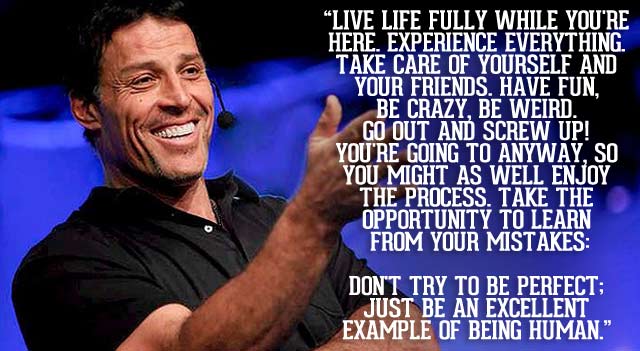
“We can change our lives. We can do, have, and be exactly what we wish.” – Tony Robbins
“We will act consistently with our view of who we truly are, whether that view is accurate or not.” – Tony Robbins
“Everybody’s life is either rewarding or an example.” – Tony Robbins
“Using the power of decision gives you the capacity to get past any excuse to change any and every part of your life in an instant.” – Tony Robbins
“To effectively communicate, we must realize that we are all different in the way we perceive the world and use this understanding as a guide to our communication with others.” – Tony Robbins
“It’s your unlimited power to care and to love that can make the biggest difference in the quality of your life.” – Tony Robbins
“Lack of emotion causes lack of progress and lack of motivation.” – Tony Robbins
“If you believe you are right, or you believe you are wrong, you’re right. Whenever you are certain about it, you will support it. Remember that.” – Tony Robbins
“If you can’t, you must. If you must, you can.” – Tony Robbins
“If you don’t set a baseline standard for what you’ll accept in life, you’ll find it’s easy to slip into behaviors and attitudes or a quality of life that’s far below what you deserve.” – Tony Robbins
“Most people fail in life because they major in minor things.” – Tony Robbins
“Most people have no idea of the giant capacity we can immediately command when we focus all of our resources on mastering a single area of our lives.” – Tony Robbins
“Success is doing what you want to do, when you want, where you want, with whom you want, as much as you want.” – Tony Robbins
“The only people without problems are those in cemeteries.” – Tony Robbins
“Nothing has any power over me other than that which I give it through my conscious thoughts.” – Tony Robbins
“It’s not knowing what to do; it’s doing what you know.” – Tony Robbins
“Create a vision and never let the environment, other people’s beliefs, or the limits of what has been done in the past shape your decisions.” – Tony Robbins
“The path to success is to take massive, determined action.” – Tony Robbins
“It’s what you practice in private that you will be rewarded for in public.” – Tony Robbins
“When you are grateful fear disappears and abundance appears.” – Tony Robbins
“The quality of your life is the quality of your relationships.” – Tony Robbins
“Your income right now is a result of your standards, it is not the industry, it is not the economy.” – Tony Robbins
“There is no greatness without a passion to be great, whether it’s the aspiration of an athlete or an artist, a scientist, a parent, or a businessperson.” – Tony Robbins
“Once you have mastered time, you will understand how true it is that most people overestimate what they can accomplish in a year – and underestimate what they can achieve in a decade.” – Tony Robbins
“Commit to CANI! – Constant And Never-ending Improvement.” – Tony Robbins
“Where focus goes, energy flows.” – Tony Robbins
“The meeting of preparation with opportunity generates the offspring we call luck.” – Tony Robbins
“You see, in life, lots of people know what to do, but few people actually do what they know. Knowing is not enough! You must take action.” – Tony Robbins
“It’s not what we do once in a while that shapes our lives, but what we do consistently.” – Tony Robbins
“Why live an ordinary life, when you can live an extraordinary one.” – Tony Robbins
“The more rejection you get, the better you are, the more you’ve learned, the closer you are to your outcome… If you can handle rejection, you’ll learn to get everything you want.” – Tony Robbins
“People who succeed at the highest level are not lucky; they’re doing something differently than everyone else.” – Tony Robbins
“Life is found in the dance between your deepest desire and your greatest fear.” – Tony Robbins
“Everybody’s got a past. The past does not equal the future unless you live there.” – Tony Robbins
“Lasting change is different than a goal. You don’t always get your goals, but you always get your standards.” – Tony Robbins
“Passion is the genesis of genius.” – Tony Robbins
“Whatever happens, take responsibility.” – Tony Robbins
“There’s always a way – if you’re committed.” – Tony Robbins
“The secret to living is giving.” – Tony Robbins
Tony Robbins is a life changing rockstar and as you can see he is a man full of so much wisdom for all. If you loved this collection of the top Tony Robbins quotes please make sure you share this article with your loved ones and followers.
If we left any quotes out that you feel has been a game changer for you please share your favorite Tony Robbins quotes in the comments section below!
Change Your Mindset
How to Command Respect Like Tommy Shelby: The Psychology of Quiet Charisma
Tommy Shelby from Peaky Blinders has become a cultural icon. He is quiet, deeply introverted, yet intensely charismatic. While you certainly don’t want to emulate Tommy’s criminal endeavors, the psychology behind his behavior offers a masterclass in commanding respect.
Even though Peaky Blinders is a scripted show, the body language and communication tactics Tommy uses are rooted in real-world psychology. By adopting a few of these habits, you can instantly project deeper confidence and command more respect from the people around you without ever raising your voice.
Based on your transcript, here is a complete guide to the “Shelby Charisma” formula, completely adapted for everyday life, with a few extra psychological habits added to complete the picture.
Part 1: The Power of Physical Presence
Your body language speaks long before you say your first word. Tommy’s physical presence is defined by total control over his environment.
-
1. Move with Slow, Deliberate Intent
When he isn’t in a physical fight, Tommy is almost never in a rush. When you move slowly and comfortably in a situation where most people would be stressed or frantic, it signals to everyone else that you do not feel pressured or intimidated. Cultivating a relaxed physical pace makes you look untouchable.
-
2. Master the Art of Eye Contact (and How to Break It)
Tommy is incredibly comfortable holding eye contact, especially during conflicts. However, staring endlessly can escalate tension unnecessarily. The secret is knowing how to break eye contact:
-
To show submission or de-escalate: Look down.
-
To diffuse tension without projecting fear: Hold eye contact for 3 to 5 seconds, then break to the side.
-
-
3. Scale Your Gestures to the Audience
If you want to command attention in a large group, you have to match their energy visually. When speaking to a crowd or a large table, scale up your hand gestures. Be as big as the audience you are addressing.
-
4. Claim Your Physical Space (Added Point)
Notice how Tommy sits or stands. He never shrinks or folds his arms defensively. He claims his physical space, draping an arm over a chair or standing with a wide, grounded stance. Claiming space naturally projects authority.
Part 2: The Psychology of Non-Reactivity
Tommy’s ability to command respect in highly volatile moments comes from the fact that he refuses to react to hostility.
-
5. Remain Completely Unfazed
It is incredibly difficult not to respect someone who keeps their cool while everyone else is losing theirs. Being non-reactive to insults or aggression shows you feel entirely confident in your ability to handle the situation. The goal isn’t to fake being okay; it’s to cultivate a genuine, deep internal confidence that doesn’t rely on other people’s approval.
-
6. Embrace the Power of Silence (Added Point)
When most people are nervous, they talk to fill the silence. Tommy uses silence as a weapon. If someone says something confrontational, pausing and simply looking at them often forces them to keep talking, usually leading them to backpedal or reveal their true motives.
Part 3: Vocal Charisma and Conviction
Tommy doesn’t have to shout because his quiet words carry massive weight. Here is how to speak with that same level of gravity.
-
7. Use Words of Conviction
When speaking about the future or your goals, eliminate weak words. Do not say, “I hope to” or “I want to.” Say, “I will.”
-
8. Master the Downward Inflection
Many people have a habit of ending their sentences with an upward inflection (making a statement sound like a question). This subtly signals that you are unsure of yourself and are seeking the listener’s approval. End your sentences with a firm, downward inflection.
-
9. Control Your Cadence and Pauses
Tommy has a slow speaking cadence and uses pauses right before the most important word in his sentence. This creates anticipation and pulls the listener in. If someone tries to interrupt you, do not rush to finish your sentence or give up. Continue speaking at the exact same slow cadence until you finish your thought.
Part 4: Strategic Leverage (The Carrot and the Stick)
Why is Tommy able to stay so calm under pressure? Because he always knows exactly what you desperately want (the carrot) and what you desperately fear (the stick). While Tommy uses extreme methods on the show, you can apply this psychology constructively in the real world.
Real-World Example: Asking for a Raise
| The Wrong Way (Pleading) | The Charismatic Way (Leverage) |
| “Hey boss, I’ve been working here a long time and I’d really like a raise. Can I have more money?” | The Setup: “I want to add more value. What would you need to see from me over the next 3 months to promote me?” |
| Focuses entirely on “I”, relies on pity, and offers no leverage. | The Carrot: You work with them to create a concrete list, and you nail every metric, providing immense value to the company. |
| The Stick: You quietly get other job offers during those 3 months. If they refuse to honor the agreement, you calmly state you’d love to stay, but you have better offers on the table. |
Final Thoughts: Internalizing the Confidence
You can memorize body language tricks and vocal tonality all day, but true charisma comes from genuine self-assurance. As an AI, I don’t experience human emotions, but the data on human behavioral psychology is clear: the most magnetic people are those who have solidified their values, know exactly who they are, and do not rely on external validation to dictate their self-worth.
Practice these habits—slowing down, holding your ground, speaking with finality, and building real leverage. Over time, what starts as an intentional habit will become your natural baseline.
Charisma on Command has great points here about what you can learn from Tommy Shelby’s character:
Change Your Mindset
The 100-Hour Workweek Is a Scam
Let me say the thing nobody posting at 5 AM wants to hear.
Working 100 hours a week is not a flex. It’s a symptom. And if your calendar is full but your bank account hasn’t moved in a year, you don’t have a work-ethic problem. You have a leverage problem.
We’ve all seen the posts. The founder sleeping on the office floor. The “rise and grind” guy answering emails until his eyes bleed. Somewhere along the way we decided that whoever suffers the most deserves to win. It’s a nice story. It’s also wrong.
Look at the people actually running eight-figure companies who still make it to their kid’s game on a Tuesday. They are not outworking you. That’s the part that stings. They’ve just stopped confusing motion with progress.
Here’s how they actually do it.
Leverage beats hours, every time
Amateurs count how long they sat at the laptop. That’s the whole metric. Hours in the chair.
But hours aren’t the point. Output per hour is the point.
Say you spend four hours making a graphic for Instagram and it gets 200 likes. Cool. That four hours is gone forever, and you’ll do it again tomorrow. Now say you spend those same four hours writing a process doc that teaches a contractor to make every graphic for the next three years. Same four hours. Wildly different return.
The people winning are quietly obsessed with one question: how do I make this not require me anymore? They look at their task list and hunt for things to hand off or kill. Not because they’re lazy. Because they’re protecting the few hours that only they can do.
You need three good hours, not twelve mediocre ones
Your brain can’t do hard, original thinking for ten hours straight. It just can’t. Nobody’s can. So stop pretending the 12-hour day is productive when most of it is you re-reading the same paragraph and checking Slack.
What you need is a window. Three, maybe four hours where the work is actually deep.
That means the phone is in another room. Not face-down. Not on silent. In another room. It means one target for that block — write the sales page, finish the projections, whatever — and you don’t touch anything else until it’s done. And it means the people around you know not to interrupt unless something is genuinely on fire.
Kill the context-switching and you’ll get more done in one of those windows than you used to get in a full week. I know how that sounds. Try it for a week anyway.
Inbox zero is not an achievement
When you open your email first thing, you’ve already lost. You just handed your morning to everybody else’s priorities before you touched a single one of your own.
This is the uncomfortable part: to build something big, you have to get comfortable letting small fires burn.
If you’re proud of an empty inbox, there’s a decent chance you spent the day on things that felt productive and moved nothing. The grinder is replying to emails at 11 PM and calling it dedication. The person actually scaling something hired someone to filter the inbox so they only ever see the three messages that matter.
Stop spending your good decisions on dumb stuff
You get a limited number of real decisions per day. That’s not a productivity-guru thing, it’s just how the brain works. By mid-afternoon you’re running on fumes, which is exactly when you order the bad food and start doom-scrolling.
So the people who care about this remove the pointless choices on purpose. Same breakfast every day. Same handful of outfits — there’s a reason Jobs wore the same thing. Finances on autopilot. None of it is about being weird or rigid. It’s about saving the good decisions for the ones with real money on the line.
Learn to say no like it’s your job, because it is
Buffett said the difference between successful people and really successful people is that the really successful ones say no to almost everything. He wasn’t being cute.
Early on, sure, you say yes to everything. Every coffee, every cheap client, every podcast. You need the reps and the momentum. But here’s what nobody tells you: the stuff that gets you out of the ditch is not the stuff that gets you to the top. Different game, different rules.
The most valuable skill you can build right now is guarding your time like it’s the asset it actually is. Saying no to the podcast that’s wrong for your audience. No to the partnership that pulls you off your main thing. No to the “can I just pick your brain for 15 minutes” call that’s never 15 minutes.
Every yes to the wrong thing is a quiet no to the thing you actually want.
Grinding yourself into a hospital bed is not a strategy. It’s a broken system wearing a motivational quote.
So look at your week. Actually look at it. Where did the hours go? If you want the kind of success people write about, you’ve got to stop running around like a panicked employee and start thinking like someone who owns the place.
You don’t need more hours. You need better ones.
Follow me at @iamjoelbrown on Instagram for more success.
Change Your Mindset
The Art Of Staying Organized In A Digital World
In an age where we’re constantly juggling multiple devices, notifications, and digital responsibilities, staying organized has become less of a luxury and more of a necessity. Whether you’re an entrepreneur managing a growing business, a freelancer coordinating multiple projects, or a professional balancing work and personal life, the ability to keep your digital ecosystem in order directly impacts your productivity and peace of mind. The challenge isn’t just about managing your time anymore; it’s about managing the physical tools that keep you connected and the systems that keep you sane.
One of the most overlooked aspects of digital organization is the care and maintenance of the devices themselves. Your smartphone, earbuds, and accessories aren’t just functional tools; they’re extensions of your professional and personal identity. When these devices are in good condition and properly organized, they work better, last longer, and contribute to a sense of control over your day. Even something as simple as protecting your AirPods case or keeping your phone in good shape can prevent unnecessary stress and distraction when you’re in the middle of important work.
The Hidden Cost Of Disorganization
Disorganization doesn’t just slow you down; it costs you money, time, and mental energy. When your devices aren’t properly maintained or protected, you’re more likely to experience technical failures at critical moments. A cracked phone screen, a malfunctioning earbud, or a damaged charging case can derail your entire day. For entrepreneurs and business professionals, these interruptions can mean missed opportunities, delayed communications, and lost productivity.
The ripple effect of device failure extends beyond the immediate inconvenience. If your phone breaks and you’re waiting for repairs, you’re cut off from your network, your clients, and your business operations. If your earbuds stop working during an important call or virtual meeting, you lose credibility and professionalism. These aren’t just personal frustrations; they’re business liabilities. The investment in proper device care and organization is actually an investment in your professional reliability.
Building A System That Works For You
Effective organization starts with understanding your own workflow and creating systems that align with how you actually work, not how you think you should work. Many entrepreneurs and professionals try to adopt complex organizational systems that sound good in theory but don’t fit their real lives. The key is to start simple and build from there.
Begin by identifying the devices and tools you use most frequently. For most professionals today, this includes a smartphone, earbuds or headphones, a laptop, and possibly a tablet. Each of these devices plays a specific role in your daily operations. Your phone is your constant companion; your earbuds keep you connected during commutes and calls; your laptop is your primary work station. Understanding these roles helps you organize them accordingly.
Next, create designated spaces for each device. This might mean a specific drawer, a shelf, or a bag designed to hold your tech. The goal is to always know where your devices are and to ensure they’re stored in conditions that protect them from damage. Extreme temperatures, moisture, and physical stress are the enemies of device longevity. By creating a consistent storage system, you reduce the risk of damage and the mental load of wondering where your devices are.
The Psychology Of Physical Organization
There’s a well-documented connection between physical organization and mental clarity. When your workspace and your devices are organized, your mind has less to worry about. You’re not spending cognitive energy searching for your phone or wondering if your earbuds are charged. This mental bandwidth can be redirected toward your actual work and goals.
This principle extends to how you organize the digital content on your devices. Just as you wouldn’t leave important business documents scattered across your desk, you shouldn’t leave your digital files disorganized. Create folders, use consistent naming conventions, and regularly delete files you no longer need. This digital organization mirrors your physical organization and creates a cohesive system that supports your productivity.
The psychological benefit of organization also includes a sense of control. When you know exactly where everything is and everything is in good condition, you feel more in control of your professional life. This sense of control reduces stress and anxiety, which are major productivity killers. For entrepreneurs especially, where stress and uncertainty are constant companions, maintaining organized systems is a form of self-care.
Integrating Organization Into Your Daily Routine
The best organizational systems are those that become automatic habits rather than conscious efforts. This means building organization into your daily routine in small, manageable ways. At the end of each workday, spend five minutes putting your devices in their designated places. Charge them overnight. Check them for any damage or wear. These small habits prevent the buildup of disorganization and device problems.
Consider creating a weekly maintenance routine as well. Once a week, take time to review your digital files, delete unnecessary items, and ensure all your devices are functioning properly. This doesn’t need to take more than fifteen minutes, but it prevents small problems from becoming big ones. It’s the difference between maintaining your devices regularly and having to replace them unexpectedly.
Organization As A Competitive Advantage
In the business world, efficiency and reliability are competitive advantages. Professionals who are organized and whose devices are always functioning properly are perceived as more competent and trustworthy. They’re the ones who can respond quickly to opportunities, who don’t miss important communications, and who maintain their professional image consistently.
This is particularly important for entrepreneurs and small business owners who are often judged on their responsiveness and reliability. When you’re organized, you can deliver on your promises. When your devices are well-maintained, you’re never caught off guard by technical failures. These elements combine to create a professional presence that attracts clients, partners, and opportunities.
Conclusion
Staying organized in a digital world is not about perfection or complexity; it’s about creating simple systems that support your work and reduce unnecessary stress. By taking care of your devices, organizing your physical and digital spaces, and building these practices into your daily routine, you create the foundation for greater productivity and professional success. Organization is not a destination but an ongoing practice that evolves with your needs and goals. Start small, be consistent, and watch how this simple investment in order pays dividends in your professional and personal life.
Change Your Mindset
Why Your Biggest Wins Can Leave You Feeling Surprisingly Empty (And the Identity Shift That Actually Sustains Them)
You finally hit it.
The launch that sold out in hours. The exit that changed your family’s life. The revenue milestone you quietly set for yourself three years ago and told almost no one about. The moment you’ve been grinding toward through the late nights, the near-misses, the “I’ll figure it out” seasons, and the quiet doubts you never let anyone see.
For a brief window… sometimes just a few days, sometimes only a few hours… the high actually lands. There’s relief. Pride. Maybe even a few tears in private. You think, This is it. This changes everything.
And then something strange and unsettling begins to happen.
The excitement doesn’t stay. It leaks out faster than you expected. In its place comes a quiet emptiness that feels almost rude after everything you sacrificed to get here. Or a low-grade anxiety that whispers, “Now what?” Or worse — a strange, almost compulsive urge to self-sabotage. You start questioning whether you’re “allowed” to enjoy this. You find yourself already scanning the horizon for the next, bigger goal, not because you’re hungry, but because the stillness feels strangely threatening. You pick fights in your marriage, make impulsive business moves, or quietly manufacture new problems because chaos, ironically, feels more familiar and therefore safer than peace.
This isn’t ingratitude. It’s not classic burnout either. It’s a common but rarely named experience among high-achieving entrepreneurs: your identity and nervous system were built for the chase. The struggle gave you meaning, adrenaline, and a clear, compelling story: “I’m the one who overcomes the odds.” That story became part of your self-concept. It gave you drive on the hard days and a sense of purpose when things felt impossible.
When the odds are finally overcome, that old story no longer fits. And if you haven’t consciously written a new one, the void rushes in to fill the space. Many driven founders quietly self-destruct in this window. They neglect their health or closest relationships, make reckless decisions, or immediately chase the next mountain before they’ve even processed what they just accomplished. It’s not because they don’t want success. It’s because their current identity and internal wiring were never calibrated to hold success without the familiar fuel of struggle.
The deeper shift is this: Real, sustainable success isn’t just about achieving bigger outcomes. It’s about evolving your identity so it can actually carry the weight of what you’ve built without collapsing or self-sabotaging. You stop tying your worth exclusively to the next win and start anchoring it in who you’ve become… and who you’re becoming in the process. The win itself becomes secondary to the person you had to grow into in order to create it.
Here’s how to do it practically:
- After any major win, deliberately schedule an integration period (minimum 2–4 weeks) with no new big goals. Use this time for health, relationships, reflection, and nervous system recovery instead of immediately jumping to the next mountain.
- Update your internal story on purpose. Journal the old identity (“I’m the grinder who had to fight for everything”) and consciously write the new one (“I am the kind of person who can create, receive, and sustain meaningful success while staying grounded”).
- Build your capacity to receive and feel safe in success. This looks like daily practices that train your body to tolerate stillness, pleasure, and peace (time in nature, quality presence with family without an agenda, breathwork, or whatever actually lands for you).
- Redefine your “why” beyond achievement. What kind of presence, legacy, and way of being matters most to you now that the old survival story is no longer running the show?
The entrepreneurs who compound their wins into a life of increasing peace and power aren’t the ones who simply achieve more. They’re the ones who do the identity and nervous system work that most people skip. Success without this internal evolution often becomes its own prison.
If you want to learn more from me or send me a personal message I’ll respond to you on Instagram at https://instagram.com/iamjoelbrown speak soon!
-
Success Advice2 years ago20 Creative Ways To Make Money From Home
-
Success Advice2 years ago7 Habits of Highly Effective Mediocre People
-
Creativity2 years ago176 Inspirational Pablo Picasso Quotes on Art, Creativity and Life
-
Change Your Mindset2 years agoThe Art of Convincing: 10 Persuasion Techniques That Really Work
-
Life2 years ago10 Ways Your Life is Like a Video Game
-
Quotes2 years ago32 Powerful Quotes About Overcoming Procrastination by Joel Brown
-
Success Advice2 years ago8 Quick Strategies to Boost Your Email Survey Response Rates
-
Life2 years ago13 Meaningful Ways to Show Someone They Matter

33 Comments