
AI
The Rise of AI-Driven Market Intelligence Using Residential Proxy Networks


In the brutal arena of modern entrepreneurship, clarity is everything. You can have the best team, the sharpest strategy, and the most advanced AI tools in the world… but if the data feeding your decisions is distorted, outdated, or incomplete, you’re still flying blind. Most business leaders don’t realize they’re making high-stakes calls based on a filtered version of the internet designed for bots and corporate servers rather than real human behavior. That invisible gap between what you think the market is doing and what’s actually happening is quietly killing more dreams than most people admit.
The entrepreneurs who pull ahead in the coming years won’t just be working harder or being more creative. They’ll be the ones who gain access to authentic, unbiased market intelligence at scale. This is exactly why forward-thinking founders are turning to AI-powered systems enhanced by residential proxy networks. These tools allow your AI to browse the web the way real customers do… from genuine home connections around the globe… giving you unfiltered insights into pricing, trends, competition, and consumer sentiment that your competitors can only guess at.
What follows is a deep dive into how this powerful combination is reshaping strategic planning and market forecasting for ambitious businesses.
Building an AI for market forecasting used to be primarily a mathematics problem. Having a top-tier team and the right tools is a great start, but your AI is only as good as the data it consumes. You can build the most advanced predictive models on the market, but if they’re being fed filtered or outdated information, your strategic planning is effectively running on empty.
The reality for most business intelligence teams is that the modern internet has become a series of gated communities. If “Access Denied” feels like your model’s most familiar dataset, you’re not the only one. With the right setup, you can stop battling blocks and let your data pipeline run like it actually wants to finish training.
The Invisible Bias in Corporate Data
When a strategic planning department relies on standard server connections, they aren’t seeing the authentic market; they are seeing a version of the web tailored for bots. Major platforms now adjust pricing, product availability, and even sentiment based on the visitor’s perceived location. If your enterprise is making million-dollar bets based on data pulled from a single data center in Northern Virginia, you are likely operating with a massive blind spot.
Training an AI on this “default” data results in business intelligence that is fundamentally biased. This lack of visibility creates a few critical risks for competitive teams:
- You end up dealing with a filtered reality where you miss critical local price shifts just because a competitor’s site flagged your request as suspicious.
- Your forecasting can easily become skewed when your models start reflecting server-side hallucinations instead of actual consumer behavior.
- You risk losing major momentum in high-stakes fields like finance or logistics because your data lacks the cultural nuances needed for real accuracy.
To build a model that actually predicts the future, you need to see the world as it exists for real people on their home networks. This shift toward “authentic access” is what separates the companies that simply react to the market from those that actually anticipate it.
Moving Toward Authentic Market Interaction
Residential proxies have moved from a niche technical workaround to a foundational part of the enterprise AI stack because they solve this “authenticity” problem. Instead of trying to brute-force your way through site security or begging for limited API access, these networks route requests through genuine, home-based connections. This creates a stream of information that is indistinguishable from real human browsing.
This isn’t about “hiding” in the shadows; it is about appearing as you actually are: a legitimate participant in the global market. When your AI systems use residential IPs, they are finally able to see the messy, localized, and real-time shifts in consumer behavior that tell the true story of a market’s health.
It allows your strategic planners to build massive datasets that reflect real-world diversity, ensuring that a strategy built for Berlin actually works in Berlin, rather than being a generic hallucination of what a server thinks Germany looks like.

Why Technical Resistance Stalls Strategic Growth
Most business intelligence teams attempt to solve the “blocking” problem by cycling through standard proxy types, but they quickly realize that not all infrastructure is created equal. The digital bouncers guarding high-value data can spot a “bot in a suit” from a mile away.
Let’s take a look at the practical reality of these tools in an enterprise setting.
|
Tool Type |
Technical Origin |
Interaction with Site Security |
Strategic Impact |
|
Datacenter Proxies |
Cloud servers and virtual machines |
Frequently flagged as “non-human” traffic almost immediately. |
High risk of incomplete datasets and skewed market snapshots. |
|
Mobile Proxies |
Real 4G/5G mobile carrier networks |
Extremely high trust; almost never blocked due to shared IP pools. |
Ideal for app-based intelligence but often cost-prohibitive at scale. |
|
Residential Proxies |
Genuine home-based ISP connections |
Appears as a standard local visitor, bypassing most bot detection. |
The “gold standard” for building massive, unbiased global datasets. |
How Companies Redefines the Data Pipeline
Not all data-gathering infrastructure is prepared for the sheer weight of a full-scale business intelligence initiative. Fpr example DECODO’s network is designed specifically for the friction points that enterprise teams face when trying to scale their AI training. By providing access to over 115 million ethically sourced residential IPs, it allows strategic planners to build comprehensive datasets that are both deep and wide.
This level of access transforms a standard scraping project into a genuine competitive intelligence engine. Instead of your team spending half their work week fixing broken scripts, managing “Access Denied” errors, and rotating blacklisted IPs, they can focus on the actual analysis that moves the needle.
If you are ready to stop troubleshooting and start scaling, they are currently offering a significant long-term deal: you can use the RESI50 coupon to save 50% off residential proxies for an entire year, plus a risk-free trial to verify the performance first.
The Compliance Advantage: Security Without the Shortcuts
For large organizations, the method of gathering data is just as vital as the data itself. Relying on unverified or “free” proxy lists is the digital equivalent of finding a stray flash drive in a parking lot and plugging it into your main server.
It might look like a shortcut, but it is actually a fast track to legal drama and security nightmares. Enterprise teams now prioritize professional residential networks because they offer a compliance-first approach to data sourcing:
- It uses IPs from users who’ve agreed to share.
- Follows privacy laws to avoid legal risk.
- Scaling is made safer by using proxies from approved sources.
The ROI of Superior Strategic Planning
At the end of the day, the goal of any AI-powered market analysis is to drive better decisions. With real data, predictions get sharper—and so does planning. Using residential proxies gives AI teams the access they need to turn potential into results.
It is the difference between guessing where the market is going and having a front-row seat to the change as it happens. For teams that are serious about market leadership, the choice isn’t just about which proxy to use; it’s about whether they want to see the real world or just a reflection of it.









Every medical practice runs into the same wall. Patients call outside office hours, the front desk is already buried, and the cost of a second receptionist is hard to justify against what the phone actually brings in.
AI receptionists solve the coverage problem convincingly. They also introduce a compliance problem that most buying guides skate past, because the moment a caller says their name and why they are calling, protected health information is in play.
Here is what HIPAA actually requires from these systems, what to look for, and how to roll one out without opening a gap you will have to explain later.
Key Takeaways
- No AI receptionist is HIPAA compliant on its own, compliance is a contractual relationship that starts with a signed Business Associate Agreement
- PHI on a phone call is broader than most practices assume and includes the simple fact that someone is your patient
- Encryption, audit logging, access controls and a documented escalation path are the technical minimum
- Ask for the BAA template before the demo rather than after the contract
- Most of the operational value sits in the routine calls, which is also where the compliance risk is highest
HIPAA does not certify software
This is the point worth internalising before you look at a single product page. HIPAA has no vendor certification programme, so no company can be approved or accredited by a regulator the way a device can be cleared.
What exists instead is the Business Associate Agreement. A vendor handling protected health information on your behalf becomes a business associate, and without a signed BAA covering that work, the practice is the party out of compliance.
That reframes the shortlist entirely. The question is not which platform markets itself as HIPAA ready, it is which platform will sign a BAA for your specific workflow and hand you the template without a sales negotiation.
What counts as PHI on a phone call
Practices consistently underestimate this. PHI is not just diagnoses and test results, it covers appointment dates, insurance details, prescription information and the fact that a named individual is a patient at your practice.
That means a confirmation call saying “your appointment with the cardiology team is Thursday at two” is a PHI disclosure. If it reaches the wrong person, the exposure is the same as a leaked chart note.
An AI receptionist has to be configured with that in mind. It needs to know what it can confirm to an unverified caller, what it must withhold, and when to stop and route the call to a human who can verify identity properly.
The broader move toward patient care technology has made this a live question in small practices, not just in hospital systems with compliance officers on staff.
The features that separate compliant systems from generic ones
Start with encryption. Call audio, transcripts, summaries and any structured data pulled from the conversation should be encrypted in transit and at rest, and the vendor should be willing to document how.
Audit logging matters just as much and gets asked about less. If you cannot show who accessed a call recording and when, you cannot demonstrate compliance during an investigation, no matter how good your encryption is.
Access controls come next. Front desk staff, clinical staff and administrators should see different things, and the system should enforce that automatically rather than relying on people to stay in their lane.
Then look at the escalation path. A well-designed system recognises when it is out of its depth and hands off cleanly, because a confident wrong answer to a patient question is worse than no answer.
Finally, ask about data handling for the AI layer itself. Whether your call data is used to train models is a question with a clear right answer for healthcare, and any vendor serious about this space will answer it in writing.
Retention is the follow-up question nobody asks. Find out how long recordings and transcripts are kept, who can delete them, and what happens to the whole archive if you leave the platform, because that answer belongs in your own retention policy.
Where an AI receptionist earns its keep
The value is not in dramatic use cases. It is in the calls that repeat all day: appointment booking, rescheduling, opening hours, directions, prescription refill requests and the callers who simply want to know whether you take their insurance.
Front-desk handling also sits upstream of the money. An appointment booked correctly, an insurance detail captured on the first call and a reminder that prevents a no-show all feed the billing cycle, which is why practices looking at revenue cycle management automation often find the phone is the honest place to start.
Central AI is one platform working at that intake end. It answers calls around the clock, books directly into the calendar during the conversation with support for Cal.com, Calendly and Google Calendar, captures caller details automatically and produces a written summary of every call.
On compliance, the company states it is fully HIPAA compliant and executes Business Associate Agreements with all customers handling protected health information, and it publishes ISO 27001:2022 certification alongside that.
The operational details are straightforward. Pricing starts at $89 per month for 90 calls with appointment booking, lead capture, call summaries and 24/7 answering included on all plans, there is a 10-day free trial, and the company says the AI handles 90 to 95 percent of calls with escalation to a live receptionist when it cannot.
It connects to more than 6,000 tools through Zapier, which matters more than it sounds for a practice that wants call outcomes landing in the systems it already runs.
Names that come up on most shortlists
Beyond the platform above, a handful of vendors appear repeatedly when practices start comparing options. Treat the descriptions below as a starting point rather than a verdict, and confirm each one’s BAA terms directly.
Assort Health and Hyro both focus on voice AI built specifically for patient access, and tend to suit larger groups and health systems. Luma Health and NexHealth come at it from patient engagement and scheduling, with deep ties into practice management systems.
Talkie.ai is positioned around primary care call handling. Smith.ai and Ruby sit in a different category again, blending automation with live human receptionists, which some practices prefer for clinically sensitive calls.
The compliance posture of every one of these should be confirmed in writing for your workflow. Published positions change, and a marketing page is not a contract.
Rolling it out without opening a gap
Map your call types first. Write down every reason a patient calls, mark which ones involve PHI, and decide for each whether the AI resolves it, collects and routes it, or transfers immediately.
Configure identity verification before you go live, not after the first awkward call. Decide what the system may confirm to an unverified caller and make the default a transfer rather than a guess.
Test the edge cases deliberately. Family members calling on a patient’s behalf, pharmacy callbacks and urgent symptom descriptions are rare as a share of volume and disproportionately where things go wrong.
Then review the logs monthly for the first quarter. You are looking for calls the system should have escalated and did not, which is the failure mode that actually matters.
The bottom line
A HIPAA-compliant AI receptionist is not a product category, it is a configuration plus a contract. The software has to be capable, the BAA has to be signed, and your own workflows have to be set up so the system never has to improvise around protected information.
Practices that get that sequence right end up with genuine 24/7 coverage and a cleaner audit trail than the paper message pad ever gave them.
Frequently Asked Questions
Is an AI receptionist automatically HIPAA compliant if the vendor says so?
No. Compliance depends on a signed Business Associate Agreement plus appropriate safeguards on both sides. A claim on a website carries no legal weight on its own.
What should I ask for before booking a demo?
The BAA template, documentation of encryption in transit and at rest, and a clear written answer on whether your call data is used to train AI models.
Can an AI receptionist confirm an appointment to whoever answers the phone?
It should not. Confirming that a named person has an appointment at your practice is a PHI disclosure, so identity verification rules need to be configured before launch.
What happens when the AI cannot handle a call?
Well-built systems escalate to a human rather than improvising. Check how that handoff works and whether it is available during the hours you actually need it.
Does a small practice really need this level of scrutiny?
Yes. HIPAA obligations do not scale with practice size, and a solo clinic faces the same requirements as a multi-site group.
How do I know it is working after go-live?
Review call logs monthly, look specifically for calls that should have been escalated, and re-test your identity verification rules whenever you change a workflow.


Every entrepreneur reaches a moment where a good idea is no longer enough. You may have a strong offer, a useful course, a coaching program, a digital product, or a service that genuinely helps people. But if your message does not land quickly, the market moves on. Attention is short, trust is fragile, and buyers want to feel both clarity and confidence before they take the next step.
That is why video sales letters are becoming such a powerful tool for online entrepreneurs. They combine story, proof, emotion, and action in a format that feels easier to absorb than a long sales page. For founders, coaches, creators, and consultants, AI now makes that kind of persuasive video much easier to produce.
Why Entrepreneurs Need a Stronger Sales Message
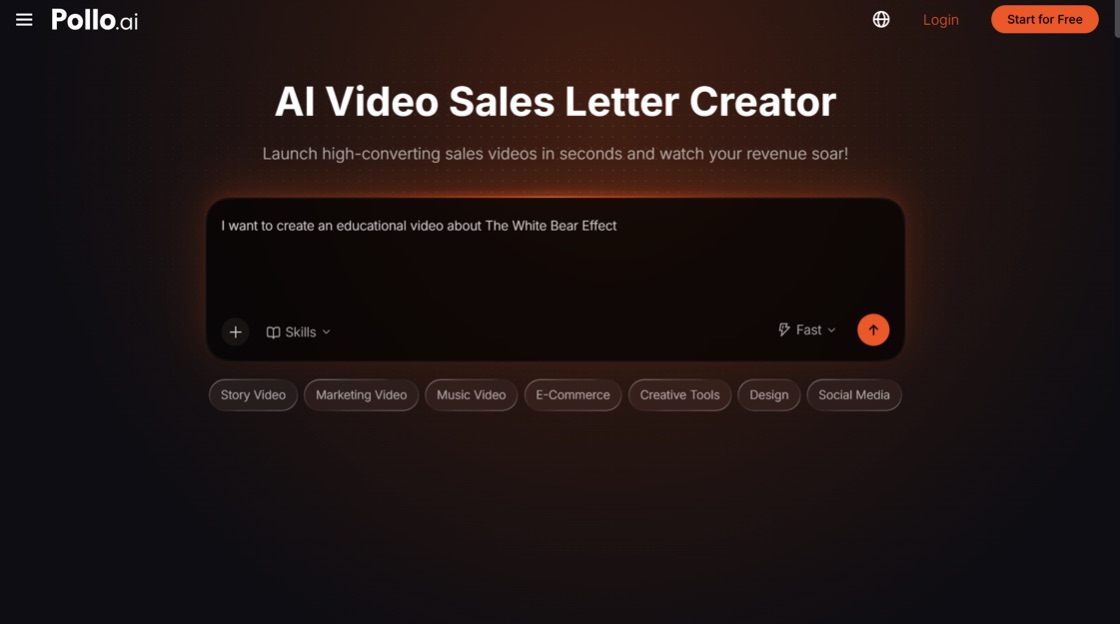
A great offer does not sell itself. It needs a clear message that explains the problem, shows the transformation, and invites the viewer to act. Pollo AI’s AI Video Sales Letter Creator helps entrepreneurs turn scripts, product links, or sales ideas into polished video sales letters with AI presenters, captions, sound, and campaign-ready visuals.
The benefit is not just speed. It is momentum. Many entrepreneurs delay their launches because they are waiting for the perfect video, the perfect landing page, or the perfect creative team. AI makes it possible to get a strong first version live faster, then improve based on real feedback. That shift can be a game-changer for people who are building with limited time and lean resources.
Lead with transformation
The best sales videos do not begin by listing features. They begin with the change the audience wants. A fitness coach might open with the frustration of starting over again. A business mentor might speak to the pressure of inconsistent revenue. A course creator might address the pain of knowing what to do but not knowing where to start.
When the transformation is clear, the video feels less like a pitch and more like guidance. That is the tone entrepreneurs should aim for: confident, useful, and human.
Build Trust Before You Ask for the Sale
A video sales letter works because it gives the audience enough context to believe the offer. That does not mean shouting louder or adding more hype. It means showing that you understand the viewer’s situation and can lead them somewhere better.
For Addicted2Success readers, this matters deeply. The audience is built around motivation, self-development, entrepreneurship, and personal growth. They respond to ambition, but they also respond to authenticity. A strong VSL should therefore feel like a mentor speaking with clarity, not a faceless ad pushing urgency.
Use proof where it matters. Share a result, a simple case study, a clear process, or a before-and-after moment. If you are selling a coaching program, show the framework. If you are promoting a product, show how it fits into a real day. If you are building a personal brand, let your voice and values come through.
Turn Long Ideas Into Short-Form Momentum
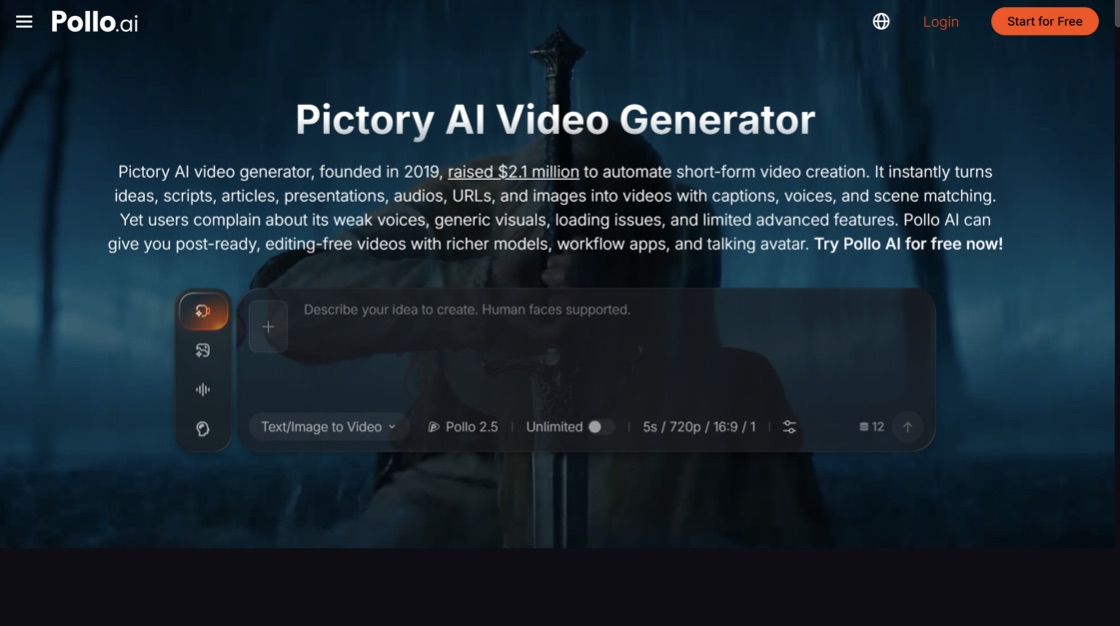
Not every entrepreneur needs to start with a brand-new video. Many already have the raw material: webinars, podcasts, blog posts, sales calls, course lessons, or long-form videos. Pollo AI’s Pictory AI is useful in that stage because it can help turn scripts, articles, presentations, audio, URLs, and longer videos into more shareable video content.
This is where the leverage becomes obvious. One long-form idea can become a sales page video, a short social clip, an email embed, a YouTube teaser, or a follow-up asset for warm leads. Instead of creating from zero every time, entrepreneurs can repurpose their best thinking into formats that travel further.
Use content as a confidence system
Entrepreneurs often underestimate how much repetition is required before people buy. Your audience may need to hear the same core message several times in different formats before it finally clicks. A video sales letter can make the offer clear, while shorter clips can keep the idea alive across social media, email, and retargeting campaigns.
That is not laziness. That is smart marketing. Repetition builds familiarity, and familiarity builds trust.
A Simple Workflow for Better Sales Videos
Start with the audience problem. Write down what your buyer is struggling with, what they have already tried, and why they still feel stuck. Then write the promise of your offer in one clear sentence. If that sentence is confusing, the video will be confusing too.
Next, structure the script around three beats: problem, proof, and invitation. Explain the pain, show why your solution works, and tell the viewer what to do next. Keep the language direct. The viewer should never wonder what the video is about or why it matters.
After that, use Pollo AI to create the visual version. Choose a tone that matches the offer. A high-ticket consulting service may need a polished, authoritative style. A creator product may need something warmer and more energetic. A personal development program may need emotion, clarity, and a strong call to action.
Finally, test more than one version. Change the opening hook, shorten the middle, adjust the visual style, or try a different call to action. The first version is not supposed to be perfect. It is supposed to teach you what your audience responds to.
The Future Belongs to Clear Communicators
AI will not replace the courage it takes to build something meaningful. It will not replace the discipline of showing up, refining the message, and serving an audience. But it can remove some of the friction that keeps entrepreneurs stuck between having an idea and putting it into the world.
That is the real power of tools like Pollo AI. They help founders, coaches, creators, and consultants turn their message into a polished sales asset faster. When combined with clear positioning and a genuine desire to help, AI video becomes more than a shortcut. It becomes a creative superpower.

The question in healthcare technology is no longer whether clinical practice will change. It has become what the technology targets, who decides, and what happens to the encounter between a clinician and a patient once the tooling arrives.
Those are design questions rather than engineering ones, and they are answered long before a system reaches a ward.
The Pressure Behind the Urgency
Interest in clinical technology is not primarily enthusiasm for novelty. It responds to a workforce problem with a defined shape. Health service projections suggest that by 2030 the gap between supply and demand for staff employed by NHS trusts could reach almost 250,000 full-time equivalent posts.
A shortfall on that scale cannot be recruited away. It has to be met partly by changing what clinical time is spent on, which is the only argument for healthcare technology that survives contact with a budget committee. Systems that return clinician hours to patient care address the problem. Systems that add documentation, alerts, or administrative steps make it worse while appearing modern.
What the Technology Has Actually Demonstrated
The evidence base is stronger than the skepticism suggests and narrower than the marketing implies, and the specifics matter more than either position.
In diabetic retinopathy, an FDA-approved algorithm demonstrated 87 percent sensitivity and 90 percent specificity for detecting more-than-mild disease. That performance supports screening at a scale ophthalmology cannot staff directly, in a condition where early detection prevents irreversible loss of sight.
In radiotherapy, automated segmentation has reduced preparation time by up to 90 percent. That figure is not abstract efficiency. It is the interval between a decision to treat and the start of treatment, measured in a disease where waiting has consequences.
Both examples share a structure worth noting. Each targets a bounded task with a clear clinical endpoint, and each returns time or reach to the people delivering care rather than requiring more from them.
Where Deployment Has Concentrated
The distribution of approved tools reveals something about how the field has developed so far.
Among approved AI and machine learning medical devices, 129 in the United States and 126 in Europe, representing 58 percent and 53 percent, respectively, were cleared for radiological use. More than half the regulated activity sits in a single specialty.
That concentration is explicable. Radiology produces structured digital images at volume, with established ground truth and a workflow already mediated by software, which makes it the path of least resistance for development and validation. It also shows where the remaining opportunity lies, since primary care, nursing workflow, discharge planning, and chronic disease management carry a substantial share of the workforce burden and comparatively little tooling.
Starting From the Clinical Problem
The most consistent predictor of whether a healthcare technology succeeds is the direction it was built in.
A clinical-first AI approach begins with a problem clinicians have named, defines the outcome that would constitute improvement, and then asks what technology serves it. The alternative, which is more common than the sector likes to admit, begins with a capable model and searches for a setting willing to host it. The second approach produces pilots that impress at conference presentations and quietly lapse once the implementation team leaves.
The implementation sequences that hold up in practice follow the same order. Stakeholder engagement first, then human-centered design, experimentation, rigorous validation, planning for scale, and continuous monitoring after deployment. Every element in that sequence concerns fit rather than capability, and it begins with people rather than architecture.
Augmentation as a Design Commitment
The framing that has held up best is also the least dramatic. These systems amplify and augment human intelligence rather than replacing it.
That is a design commitment with practical consequences, not a reassurance. It means the clinician remains the decision-maker and the system supplies input, which requires the input to be interpretable, disagreement with it to be straightforward, and accountability to stay clearly located.
Systems built on the opposite assumption produce a particular failure. When a tool is positioned as authoritative, clinical judgment begins to defer to it, and the deference is hardest to detect precisely where the tool performs well most of the time. Automation bias is not a hypothetical risk in medicine; it is documented, and it is designed for or against at the interface.
The Risk Worth Naming Directly
The counterargument to technological optimism in medicine deserves to be stated in its own terms rather than dismissed. Clinical literature addresses the dehumanization of patient care, and the concern is not that algorithms will make poor decisions. It is that mediated care becomes less human care, and that the relationship carrying much of medicine’s therapeutic value is the part most easily eroded by systems optimized for throughput.
The concern has empirical grounding in an older, simpler technology. Electronic health records were introduced to improve safety and coordination, and they largely did both. They also shifted clinician attention to a screen during consultations and added documentation hours to the workday, which contributed materially to burnout across the profession.
That history is the most useful available guide. A technology can succeed against its stated objective and still degrade care, if the effect on attention and relationship was never part of the specification.
What Human-Centered Requires in Practice
The phrase is used loosely enough to have lost most of its meaning, so it is worth restating as specific commitments.
It requires that clinicians and patients participate in defining the problem before a solution is scoped, rather than being consulted on an interface after the architecture is fixed. It requires validation in the population and setting where the tool will run, since performance established in one cohort does not automatically transfer to another with different prevalence, demographics, or equipment.
It requires monitoring after deployment, because clinical practice shifts, populations change, and model performance degrades quietly rather than announcing itself. It also requires an honest accounting of time, measuring whether a system returned clinical hours or merely moved them to a different part of the day.
The Interface Is Where Care Is Protected or Lost
Most of what determines whether technology improves a consultation is decided in the interaction design rather than the model.
Ambient documentation that removes typing from a consultation returns attention to the patient. The same underlying capability, delivered as a form requiring review and correction mid-appointment, takes attention away. The clinical performance is identical in both cases; the effect on care is not.
That is the practical meaning of human-centered technology in medicine. Not a philosophical position about the role of machines, but a series of concrete decisions about where a clinician’s eyes are, how much cognitive load a tool imposes, and whether the system is doing work that used to consume a clinician’s day or simply reorganizing it.
The Direction That Holds Up
The workforce pressure is real and will not resolve on its own. The clinical evidence for well-targeted tools is genuine, as the retinopathy and radiotherapy results demonstrate. The risk of eroding the human element is equally genuine, and the electronic health record showed how it happens without anyone intending it.
The resolution is not a compromise between those positions. It is a sequence: identify the clinical problem, design with the people who live inside it, validate in the setting where it will run, and measure the effect on the encounter rather than only on the metric.
The future of patient care will involve considerably more technology. Whether it improves care depends on what the technology was asked to do and who was in the room when the question was framed.

A pricing model that took three months to argue into shape can be improved by an assistant over lunch. So can the onboarding sequence, the margin assumptions and the deck. The speed is real, and it is why the fifth and sixth paste happen without anyone asking what is in them.
What is in them, often enough, is the part of the business that has value precisely because nobody outside it has seen it. That has a legal shape, and it is the only kind of intellectual property a company can lose by accident.
Patents and trademarks survive neglect, because they are registered and on file whatever kind of quarter you had. A trade secret has no file. It lasts exactly as long as its three conditions hold, and the third of those is not about the information at all.
What actually makes something a trade secret
Trade secret protection has no registration, no filing fee and no expiry date. It also has no automatic existence. The USPTO sets out three conditions: the information has actual or potential independent economic value because it is not generally known, that value comes from others being unable to discover it by proper means, and the owner takes reasonable efforts to maintain its secrecy. All three are required, and the office is explicit that if one of them stops being true, the trade secret stops existing.
The third condition is the one AI touches directly. Reasonable efforts is not a feeling about how careful your team is. In a dispute it becomes a list of things you did: who signed what, which systems held the material, what your policy said, and whether anyone followed it. Pasting your customer acquisition model into a service that retains conversations and reserves training rights is a fact that goes on that list, on the wrong side of it. So is the decision to move the same work to a ChatGPT alternative that retains nothing, which goes on the same list on the other side, with a date on it.
Can you copyright what the model gives back?
The other half of the problem runs in the opposite direction. Material you feed in can lose protection. Material that comes out may never have had any. A landing page written end to end by a model sits on uncertain ground if a competitor copies it word for word, and the same goes for generated illustration, generated code and generated product names.

Image Credit: Addicted2Success
What governs this is the human authorship requirement, which the US Copyright Office has been working through in public since 2023 and now addresses directly on its AI initiative pages. The practical reading is that protection attaches to what a person contributed rather than to what the tool produced on request. For marketing copy that is survivable. It matters a great deal more when the generated thing is the core of what you sell, and which side of that line an asset falls on is worth settling before the asset exists.
Set the boundary at the tool
Writing the AI policy is the easy part. The hard part is being able to say, months later, whether anyone followed it. A rule that lives in a Notion page and depends on ten people remembering it under deadline pressure is a rule you cannot evidence, and evidence is the whole game under condition three.
A tool whose retention behavior you can point to is different. When conversations are encrypted so the provider holds no key, or the terms contractually exclude training and you kept the signed version, you have something to hand a lawyer. When the code is open and independently reviewable, you have something better than a claim. That is the basis to choose on, and the policy comes afterwards, written to describe what the tool already does, so the two documents still agree on the week everyone is shipping.
What happens when the secrets are someone else’s
Your own secrets are the easier half. Client work usually arrives with confidentiality terms that prohibit disclosure to third parties, and an assistant that stores the text and reserves the right to train on it is a third party by any reading. That is not a hypothetical exposure. Enterprise buyers now ask about it directly in security questionnaires, and the question is not whether you have a policy. It is what your tools do.
Which means the answer has to be true in three places at once: in the vendor’s terms, in what your sales team has been telling customers, and in what your team actually did last Tuesday. Those three drift apart quietly and nobody notices until diligence. A tool that retains nothing collapses them into a single answer, because there is nothing left to reconcile. Keep the record of it, and the speed stays available to you without your pricing model ending up in a corpus you do not own.

How Businesses Use Proxies for Competitive Intelligence

A Beginner’s Guide to Understanding Your Financial Records

What Should You Look for in a Nail Technician Training Program?

How to Replace a Lost or Damaged Graduation Certificate

Understanding Trading Platforms & Technology

5 Ways For Startups To Succeed Making Acquisitions

77 Inspirational Quotes That Will Change Your Life
57 Memorable Kobe Bryant Quotes

(Images) 52 Motivational Picture Quotes For An Epic Year Of Success

40 Rare Motivational and Inspirational Picture Quotes

3 Prince EA Videos To Change Humanities Path To Greatness

(Video) What Is Success? An Entrepreneurial Story To Inspire You

(Inspirational Video) What If Today You Knew You Were Going To Take Your Last Breath?

How To Make Enough Money From A Blog To Quit Your Job – Kate McKibbin

How Finding Your Passion And Becoming An Entrepreneur Can Lead To Happiness – Chiquita Searle
-

 Success Advice2 years ago
20 Creative Ways To Make Money From Home
-

 Success Advice2 years ago
7 Habits of Highly Effective Mediocre People
-

 Creativity2 years ago
176 Inspirational Pablo Picasso Quotes on Art, Creativity and Life
-

 Life2 years ago
10 Ways Your Life is Like a Video Game
-

 Life2 years ago
13 Meaningful Ways to Show Someone They Matter
-

 Life2 years ago
The 5 Stages of a Quarter-Life Crisis & What You Can Do
-

 Did You Know1 year ago
7 Surprising Life Lessons Video Games Taught Me That School Never Did
-

 Success Advice1 year ago
Stephen Covey’s 8 Leadership Habits That Will Change How You Lead Forever