
Master Sales Techniques
The Art Of Active Listening: A Key Ingredient To Sales Success And Stronger Relationships


In today’s fast-paced world, effective communication is more critical than ever, especially in the realm of sales and interpersonal relationships. The Transformational Sales Philosophy is built on the foundation of understanding clients’ needs and emotions to create lasting connections. One of the most important skills within this philosophy is active listening — a powerful tool that can transform your sales success and strengthen your relationships.
According to a study by Korn Ferry, sales professionals who excel at active listening are 40% more likely to be high-performers compared to those who struggle with this skill. Furthermore, research has shown that strong communication skills, including active listening, are linked to better relationships and increased life satisfaction. In this article, we will explore the art of active listening and provide practical tips for incorporating it into your sales strategy and daily life.
The Importance of Active Listening
Active listening is a deliberate effort to understand and engage with a speaker’s message. It involves more than just hearing the words; it requires processing, interpreting, and responding to the information. By practicing active listening, sales professionals can:
- Build trust and rapport with clients, paving the way for successful sales negotiations
- Uncover clients’ needs, concerns, and preferences, which helps in tailoring solutions and overcoming objections
Strengthen interpersonal relationships by demonstrating empathy and understanding
Active Listening in the Transformational Sales Philosophy
The Transformational Sales Philosophy focuses on creating lasting, meaningful connections with clients. Active listening is a cornerstone of this approach, enabling sales professionals to move beyond transactional exchanges and cultivate deeper relationships built on trust and mutual respect. By employing active listening techniques, sales professionals can better understand their clients’ pain points and offer tailored solutions, ultimately leading to increased sales success.
For outbound sales teams, a power dialer can also reduce time spent on repetitive dialing and other manual tasks, giving reps more time to focus on the conversations themselves.
Learn How To Build Rapport and Why it’s the Secret Sauce to Long-Term Client Success From Ray
Four Steps to Master Active Listening
To become an expert active listener, follow these four steps:
Step 1: Be Fully Present
- Eliminate distractions: To fully engage with the speaker, put away your phone, close any irrelevant browser tabs, and focus on the conversation at hand.
- Maintain eye contact: This nonverbal cue demonstrates that you are attentive and interested in what the speaker is saying.
- Use open body language: Uncross your arms, lean slightly forward, and nod your head occasionally to show your engagement.
Step 2: Ask Open-Ended Questions
- Encourage elaboration: Ask questions that require more than a ‘yes’ or ‘no’ answer to gain deeper insights into the speaker’s thoughts and feelings.
- Avoid leading questions: Refrain from asking questions that imply a desired answer, as this can stifle open communication.
Step 3: Reflect and Validate
- Paraphrase: Summarise the speaker’s message in your own words to ensure you’ve understood their point and to demonstrate your engagement.
- Validate emotions: Acknowledge and empathise with the speaker’s feelings to build rapport and deepen your connection.
Step 4: Respond Mindfully
- Take a moment to process: Before responding, pause to consider the speaker’s message and how it relates to the conversation.
- Offer thoughtful responses: Ensure your response is relevant, adds value to the conversation, and demonstrates that you’ve considered the speaker’s perspective.
Ready to Learn to Unlock The Power of Emotional Intelligence and Win More Clients?
Implementing Active Listening in Sales and Personal Relationships
Now that you understand the fundamentals of active listening, it’s time to put these skills into practice. Here are some tips for incorporating active listening into your sales strategy and personal relationships:
- Practice active listening in everyday conversations: The more you practice active listening, the more natural it will become. Start by employing these techniques in casual conversations with friends, family, or colleagues.
- Set specific goals: Set measurable goals for improving your active listening skills, such as asking a certain number of open-ended questions during a sales call or reflecting and validating at least once during a conversation.
- Seek feedback: Ask trusted colleagues, friends, or family members for feedback on your listening skills. This can help you identify areas for improvement and track your progress.
Active listening is a critical component of the Transformational Sales Philosophy, enabling sales professionals to build trust, rapport, and lasting connections with their clients. By mastering the art of active listening, you can enhance your sales success and strengthen your personal relationships. Remember, communication is a two-way street, and by becoming a better listener, you will also become a more effective communicator. Start practicing active listening today and witness the transformative impact it has on your sales and personal connections.
Ray Pang SH has generated over USD$1.215mil for his business using the Transformational Sales Methods he discussed above and in his other articles on A2S.
Want to work with him and become one of the 125+ business owners he has helped generate over USD$12.154mil in sales for? Go to his Instagram here and DM him the word “LEGACY” to learn how he can revolutionise your business now.
Want to Master Sales? Find out what it takes for you to become a master salesman
Need to Paraphrase any text instantly? ZeroGPT’s AI-powered Paraphraser helps rewrite, edit, and reformulate the tone of your text with high accuracy and maintain the original context!



“You’re reading this not because you want to, but because I want you to. Now, you’re reading this second sentence because, again, I’m telling you and forcing you to read this.”
That is the power of copywriting.
Those lines come from Sam Parr, the founder who built The Hustle into a massive daily newsletter empire from scratch and later sold it to HubSpot. Today, he is the co-host of My First Million, one of the most popular business podcasts in the world.
If you want to build a business, you have to know how to sell. And if you want to sell online, you have to know how to write. According to Sam, copywriting isn’t just writing words; it’s understanding human psychology, knowing what people want, and figuring out the exact sequence of words required to get them to take action.
Here are the core copywriting frameworks Sam used to build his multi-million dollar empire.
1. The AIDA Method (Even for Flirting)
AIDA stands for Attention, Interest, Desire, Action. It is the foundational framework for almost all successful marketing.
Sam even used this framework to land a date with his wife. He saw her at a restaurant and knew he needed to grab her Attention. When she walked by, he had a friend ask him loudly, “What’s the difference between a chickpea and a lentil?” Sam delivered the punchline, grabbing her attention and making her laugh. That sparked her Interest, built Desire through a charming introduction, and led to the Action of a date.
In business, you can say almost anything as long as you capture attention and evoke a positive emotion. Sam calls this “Restaurant Owner Energy”—speaking to your audience with the warmth, familiarity, and confidence of a restaurant owner welcoming a regular customer.
2. Mind the Gap (The Curiosity Hook)
David Ogilvy famously said that five times as many people read the headline as read the body copy. If your headline fails, your entire ad fails.
The secret to a great headline is creating a “curiosity gap.” Human beings are psychologically wired to hate unresolved tension. If you open a loop, they have to read the next sentence to close it.
Think of the famous vintage ad: “They laughed when I sat down at the piano, but then I started to play.” You have to know what happened next. Mind the gap by giving the reader just enough information to hook them, but withholding the payoff until they read further.
3. The Slippery Slope
Famed copywriter Joe Sugarman coined the concept of the “slippery slope.”
The sole purpose of your headline is to get the reader to read the first sentence. The sole purpose of the first sentence is to get them to read the second sentence.
You achieve this by building momentum. In your writing, tease what is coming next. Use phrases like, “What I’m about to tell you next will blow your mind, but really quick, let me explain this…” It keeps the reader sliding down the page until they hit your call to action.
4. Write at a 7th Grade Level
If your writing is complex, you will lose your audience.
The New York Times is written at a 7th-grade reading level. Warren Buffett, one of the smartest men alive, writes his annual shareholder letters using an average of just 17 words per sentence.
-
Keep sentences short.
-
One sentence should make one point.
-
If you find yourself using a comma, try replacing it with a period.
-
Start sentences with transition words like “And” or “But” to create a punchy rhythm.
Write your first draft, cut a third of the words, cut another third, and cut it again. Constrain forces clarity.
5. Sell With Stories (The Hero’s Journey)
People are terrified to use stories in their ads because they think it makes the copy “too long.”
According to Sam, there is no such thing as too long, just too boring.
We are biologically wired to respond to stories. When writing copy, use the Hero’s Journey framework. But here is the critical rule: Your brand is not the hero. Your customer is the hero. Your brand is the guide that helps the hero overcome their problem and reach their goal.
6. Address Objections Head-On
The best way to disarm a skeptic is to call out their skepticism before they can even voice it.
Think of the final rap battle in the movie 8 Mile. Eminem completely disarms his opponent by listing out all of his own flaws first, leaving his opponent with nothing to attack.
Do the same in your copy. Say things like, “I know what you’re thinking. Why should you trust me?” or “You’re probably thinking you don’t have time for this right now.” By calling out the objection, you build immediate trust and control the narrative.
7. Copywork (The Ultimate Cheat Code)
If you want to become a world-class copywriter, do what Sam did for six months: Copywork.
Find the greatest ads, sales letters, and headlines in history. Sit down with a pen and a notebook, and write them out word-for-word by hand.
When you physically write out the words of masters like David Ogilvy or Gary Halbert, you begin to feel the texture, the rhythm, and the syntax of high-converting copy. You absorb their rules, and once you know the rules, you can start bending them to fit your own voice.
Here’s a great storytelling breakdown by Sam Parr:
Change Your Mindset
The Art of Convincing: 10 Persuasion Techniques That Really Work
The knack for persuading others can act as a catalyst for change, open doors, forge alliances, and effect positive change


Persuasion is not as complicated as it may sound. In fact, it is something that we have been practicing since childhood. Do you remember convincing your parents to let you skip school, asking your teacher not to assign homework, or persuading your boss to give you a day off? Well, these are just small examples of what persuasion looks like. (more…)

In the complex and rapidly evolving landscape of modern business, innovative models are the need of the hour to navigate challenges and maintain sustainable growth. Inspired by the metaphor of the ‘Earth as a Cosmic Playground’, the LEGACY Impact System has emerged as a beacon of guidance, interconnecting six crucial business elements to create a comprehensive roadmap towards sustainable success.
LEADERSHIP – Conscious Leadership
Simon Sinek, a world-renowned optimist and visionary, once stated, “Leadership is not about being in charge. It is about taking care of those in your charge.” Conscious leadership embodies this principle, prioritising awareness of the broader implications and ripple effects of decisions on the organisation, its stakeholders, and the environment.
Action Steps:
- Leadership Training: One of the foundational steps towards conscious leadership is investing in leadership development programs that highlight ethical decision-making, environmental stewardship, and social responsibility. These training programs should encompass elements such as emotional intelligence, transparency, empathy, and long-term thinking, equipping leaders to guide their teams towards sustainable growth.
- Stakeholder Engagement: Conscious leaders also emphasise consistent and open dialogue with stakeholders. By incorporating stakeholders’ insights into decision-making processes, leaders can ensure they’re addressing the needs and concerns of those impacted by the organisation’s operations.
EVOLUTION – Adaptability
Like the ever-evolving cosmos, businesses must be capable of change and evolution. Albert Einstein’s wisdom encapsulates this requirement: “The measure of intelligence is the ability to change.” In the fast-paced business world, adaptability becomes an essential survival trait, fostering resilience and agility.
Action Steps:
- Innovation Encouragement: Businesses can nurture adaptability by creating an environment that celebrates innovation, rewards creative problem-solving, and supports calculated risk-taking. This could involve implementing an open-door policy for ideas, organising brainstorming sessions, or establishing an innovation hub within the organisation.
- Technology Integration: Keeping abreast of technological advancements and incorporating them into business processes is another critical step. This proactive approach not only optimises operations but also positions the organisation as a forward-thinking player in the industry.
GROWTH – Continuous Learning and Development
Motivational speaker and writer Leo Buscaglia said, “Change is the end result of all true learning.” In the realm of business, this translates into the equation ‘continuous learning equals continuous growth’. Organisations that champion a culture of ongoing learning and development are well-positioned to thrive.
Action Steps:
- Employee Training: Regular training and development opportunities should be provided to employees to update their skills and stay abreast of industry trends. This can range from skills-based workshops and webinars to providing resources for self-learning and personal development.
- Learning Culture: Promoting a culture that values learning and improvement at all levels of the organisation is crucial. This can be achieved by recognising and rewarding learning initiatives, encouraging feedback, and fostering an atmosphere of open communication.
ALIGNMENT – Holistic Approach to Business and Value-Based Marketing
Renowned systems scientist Peter Senge stated, “Alignment is the prerequisite for effectiveness.” Taking inspiration from the cosmos, where every element is harmoniously aligned, businesses should ensure all aspects of their operations align with their core mission and values.
Action Steps:
- Internal Alignment: To ensure coherence between what a business says and does, internal processes, practices, and culture should reflect the organisation’s mission and values. This includes aligning recruitment and management practices, employee benefits, and internal communication with the organisation’s core ethos.
- External Alignment: Similarly, marketing, customer service, and branding strategies should resonate with the organisation’s values. Authentic alignment in these areas fosters trust among stakeholders and differentiates the business in a competitive marketplace.
Ready to Learn to Unlock The Power of Emotional Intelligence and Win More Clients?
COMMUNITY – Community Building
Civil rights activist Coretta Scott King once stated, “The greatness of a community is most accurately measured by the compassionate actions of its members.” This statement holds significant relevance for modern businesses, underlining the importance of community-building among stakeholders.
Action Steps:
- Stakeholder Inclusion: Businesses can foster community by including stakeholders in decision-making processes, fostering a sense of ownership and engagement. This can be facilitated through town-hall meetings, feedback sessions, and collaborative projects.
- Engagement Initiatives: Launching initiatives that promote interaction and collaboration among stakeholders can further strengthen community bonds. These initiatives can range from team-building activities and social events to forums for sharing ideas and challenges.
YIELD – Sustainability and Technology Integration
Danish architect Bjarke Ingels pointed out that sustainability should not be viewed as a sacrifice but as a design challenge. Businesses, similarly, should see sustainability as an essential aspect of their design and operational strategies, not as an afterthought.
Action Steps:
- Sustainable Practices: By incorporating sustainability into every facet of business operations, from product design and manufacturing to supply chain management and waste disposal, businesses can make a positive impact on the environment and society.
- Tech-driven Sustainability: Technology offers a myriad of ways to enhance sustainability. By harnessing technology to optimise resource use, reduce energy consumption, or streamline processes, businesses can demonstrate their commitment to sustainable practices.
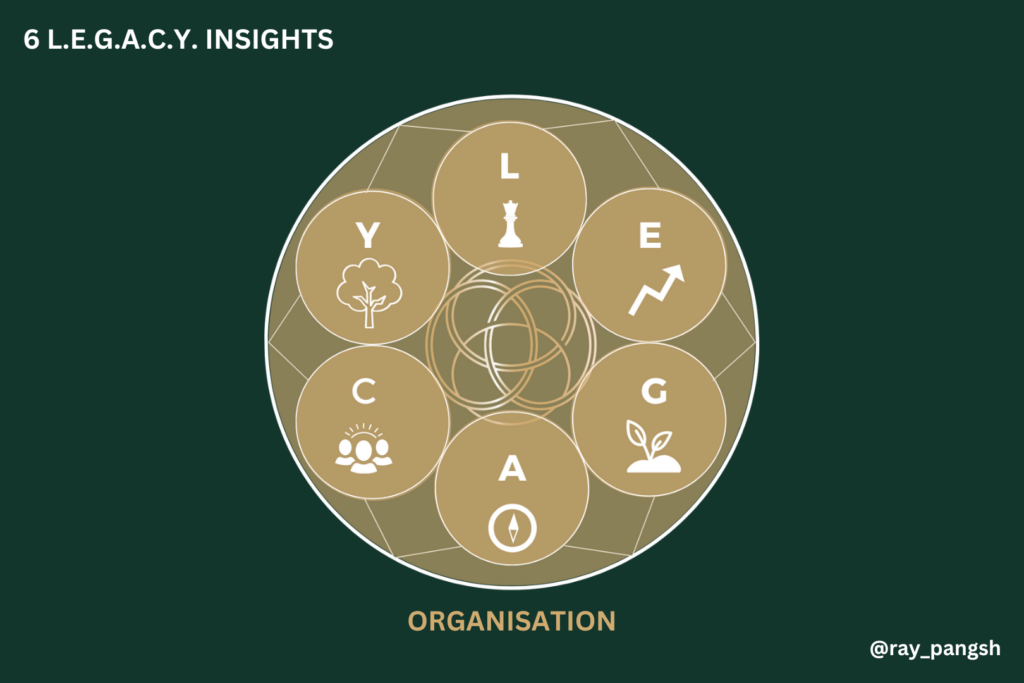
In conclusion, the 6 L.E.G.A.C.Y. Insights offer a holistic and actionable guide for businesses looking to navigate the complexities of today’s dynamic business landscape. By integrating conscious leadership, adaptability, continuous learning and development, alignment, community building, and sustainability into their day-to-day operations, organisations can achieve sustainable growth and contribute positively to the larger cosmic playground.
Ray Pang SH has generated over USD$1.216mil for his business using the Transformational Sales Methods he discussed above and in his other articles on A2S.
Want to work with him and become one of the 125+ business owners he has helped generate over USD$12.164mil in sales for? Go to his Instagram here and DM him the word “LEGACY” to learn how he can revolutionise your business now.
Want to Master Sales? Find out what it takes for you to become a master salesman

In our hyper-connected era, the interpretation of concepts like freedom, truth, and self-expression bear profound implications. Amidst a symphony of diverse viewpoints, a revolutionary philosophy has crystallised, offering a distinctive compass to traverse the intricate labyrinth of human existence — The Global Freedom Initiative. This initiative isn’t merely a collage of thoughts; it’s a rallying cry for a paradigm shift, recognising the deep interconnection of life and promoting a world filled with limitless freedom, infinite love, and genuine self-expression.
In a world marred by conflict, ecological decay, and societal disparity, the mission of the Global Freedom Initiative rings louder than ever. By nurturing a global tribe dedicated to human evolution, the initiative envisions a world where Unconditional Love serves as the default emotional state.
Cultivating World-Changers
The heart of the Global Freedom Initiative beats in transcending conventional notions of business, wealth, and personal development. It strives to foster a dynamic Freedom Impact Ecosystem, merging individuals and businesses in a unified quest for a world that celebrates authenticity, where love is unbounded, and freedom is an innate right. These philosophy anchors on the ‘Creator Being’ concept, recognising our capacity to shape reality and influence our surroundings.
As the esteemed physicist Albert Einstein once stated, “Imagination is everything. It is the preview of life’s coming attractions.” This potent quote encapsulates the essence of a ‘Creator Being’ – an individual whose thoughts, intentions, and actions have the power to shape their reality and impact their environment. This acknowledgment of our inherent creative potential is the bedrock of the Global Freedom Initiative.
The Quest for True Freedom
A 2020 Pew Research Center survey revealed that nearly 60% of adults worldwide expressed dissatisfaction with their country’s current state, hinting at a global thirst for transformation. The Global Freedom Initiative quenches this thirst by presenting an evolutionary journey starting with self-awareness cultivation and climaxing in ‘True Freedom’ – a state of existence that embraces the human experience unencumbered by repression, resistance, and rejection.
Negative emotions like shame, guilt, fear, and anger often inhibit personal and societal evolution. Brene Brown, a research professor at the University of Houston, wisely noted, “Shame corrodes the very part of us that believes we are capable of change.” The Global Freedom Initiative proposes a transformative response to these emotions, advocating for their acknowledgment, processing, and release to foster personal liberation and nurture a more empathetic and inclusive society.
Reimagining Business as a Catalyst for True Freedom
The Global Freedom Initiative underscores the reframing of business as a conduit for social impact and personal legacy. It proposes a radical shift in our perception of business, presenting it not merely as a profit-oriented entity but as a potent platform for societal evolution and personal self-expression. This perspective dovetails with the rising trend of impact investing. According to the Global Impact Investing Network, impact investing assets amounted to $715 billion in 2020, signalling an increasing recognition of the role businesses can play in steering societal transformation.
To support The Global Freedom Initiative, we must appreciate the significance of individual, owner, and investor contributions to the business sphere. Business is an outward reflection of our inner quest, our mission of Truth, mirroring our fullest expression of Self in driving change and impacting the world.
For a business to be sustainable and impactful, it must satisfy two primary pillars:
- A business should drive social impact and contribute to societal evolution, for the Greater Good Of All
- A business should have the necessary structure for one’s LEGACY and Truth to flow within, as this impact will voice your inner Truth mission to change the world
This defines a Freedom Impact Business.
Three tiers contribute to a Freedom Impact Ecosystem:
- $0 – $100k/mo (Freedom Impact Venture)
- $100k/mo – $1mil/mo (Freedom Impact Organisation)
- $1mil/mo – $10mil+/mo (Freedom Impact Enterprise)
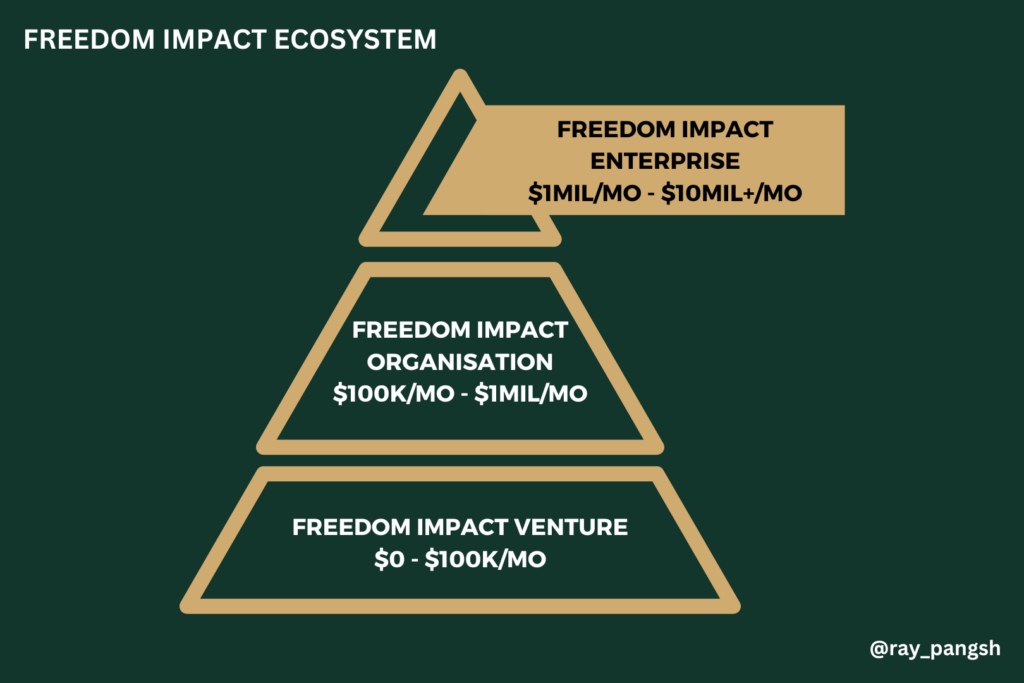
Moreover, the Global Freedom Initiative rethinks the definition of business success. It posits that a truly prosperous business drives economic growth, contributes positively to society, and facilitates personal growth. This perspective aligns with a McKinsey & Company study, suggesting that long-term performance-focused companies demonstrate superior financial outcomes while contributing to societal well-being.
Charting the Future: What Does This Mean For You?
At the core of the Global Freedom Initiative is the conviction that personal growth and societal evolution are inherently linked. As we progress towards personal freedom, we indirectly contribute to societal transformation. This philosophy resonates with the wisdom of celebrated philosopher and writer, Aldous Huxley, who stated, “There is only one corner of the universe you can be certain of improving, and that’s your own self.”
The Coaching / Consulting Industry plays an instrumental role in the Global Freedom Initiative, bridging the gap between traditional education and a more holistic approach encompassing body, mind, and spirit. This aligns with the United Nations’ Sustainable Development Goal 4, advocating for “inclusive and equitable quality education and lifelong learning opportunities for all.”
Ultimately, the Global Freedom Initiative underscores the power of community and collective action. It believes that each one of us can contribute to a world where freedom, love, and authenticity are paramount. This community-oriented approach resonates with Margaret Mead’s wisdom, a renowned anthropologist, who famously stated, “Never doubt that a small group of thoughtful, committed citizens can change the world; indeed, it’s the only thing that ever has.”
In conclusion, the Global Freedom Initiative offers a transformative philosophy responding to the profound call for societal transformation and personal growth. It champions the creation of a world where every individual is empowered to live in alignment with their truths and contribute to humanity’s collective evolution. As we steer through the complexities of the 21st century, such philosophies serve as beacons of hope, offering a roadmap for constructing a more inclusive, compassionate, and authentic world.
Ray Pang SH has generated over USD$1.215mil for his business using the Transformational Sales Methods he discussed above and in his other articles on A2S.
Want to work with him and become one of the 125+ business owners he has helped generate over USD$12.154mil in sales for? Go to his Instagram here and DM him the word “LEGACY” to learn how he can revolutionise your business now.
Ready to become a master salesperson? Learn how to master the art of active listening

After a Car Crash: A Practical Checklist for Health, Evidence, and Insurance

AI marketing tools for a small business, and what the owner still has to type

When Tasks Lived in Slack and My Head: The Real Cure for Founder Burnout

Clear Vision After 40: What Changes, and What It Means for Your Productivity

How to Get Your Startup Noticed Without a Big Ad Budget
5 Ways For Startups To Succeed Making Acquisitions

77 Inspirational Quotes That Will Change Your Life
57 Memorable Kobe Bryant Quotes

(Images) 52 Motivational Picture Quotes For An Epic Year Of Success

40 Rare Motivational and Inspirational Picture Quotes
3 Prince EA Videos To Change Humanities Path To Greatness
(Video) What Is Success? An Entrepreneurial Story To Inspire You
(Inspirational Video) What If Today You Knew You Were Going To Take Your Last Breath?
How To Make Enough Money From A Blog To Quit Your Job – Kate McKibbin
How Finding Your Passion And Becoming An Entrepreneur Can Lead To Happiness – Chiquita Searle
-

 Life2 years ago
The 5 Stages of a Quarter-Life Crisis & What You Can Do
-

 Did You Know1 year ago
7 Surprising Life Lessons Video Games Taught Me That School Never Did
-

 Success Advice1 year ago
Stephen Covey’s 8 Leadership Habits That Will Change How You Lead Forever
-

 Life1 year ago
How to Stop the War in Your Head and Find Peace
-

 Featured2 years ago
The Psychology of Motivation: How to Keep Moving Forward Every Day
-

 Personal Development1 year ago
The Three-Second Pause That Changes How People Perceive You
-

 Explode Your Social Media1 year ago
Want More Views? Master These 6 YouTube Growth Tactics
-

 Change Your Mindset1 year ago
You Become What You Absorb: How Input Shapes Your Life
2 Comments