
AI
How to Measure GEO: The Metrics That Matter and the Tools That Track Them


How to Measure GEO: The Metrics That Matter and the Tools That Track Them
Typing a question into ChatGPT and seeing a brand show up once tells you about one answer on one day. Knowing how to measure GEO (generative engine optimization) means tracking how often a brand gets mentioned and recommended inside AI-generated answers—across ChatGPT, Gemini, Perplexity, Claude, and Google AI Overviews—over many prompts and many weeks, because a single answer can change the next time the same question gets asked.
This guide breaks down the five metrics that hold up as a measurement practice, then ranks eight tools by how many each one reports, with AnswerThePublic first for pairing GEO data with the deep search listening numbers teams already track.
[IMAGE: Dashboard showing GEO metrics including visibility share, industry rank, and sentiment trend over 90 days]
What Does Measuring GEO Actually Mean?
GEO is the practice of getting a brand mentioned and recommended inside AI-generated answers instead of ranked in a list of blue links. A Google search returns ten results a user can scroll past. An AI answer returns one synthesized response, and a brand either shows up inside it or it doesn’t.
Measuring GEO means putting a number on that presence over time. That requires running the same set of prompts repeatedly, because AI answers vary between runs even when the question and the brand haven’t changed. A single prompt result is a data point. A measurement practice is a pattern built from dozens or hundreds of those data points, tracked against competitors over weeks.
Teams that rely on manually typing a question into ChatGPT once a month aren’t measuring GEO. They’re sampling it, and the sample size is too small to mean anything.
Which GEO Metrics Actually Matter?
Five metrics separate a real GEO measurement setup from a screenshot habit.
Visibility Share
The percentage of AI-generated answers that mention a brand during a given period. If a tool studies 100 answers and a brand appears in 2 of them, visibility share is 2 percent. This is the baseline number everything else builds on.
Average Rank Against Competitors
Where a brand lands relative to the other brands AI tools mention for the same category of question. A brand can show up in every answer and still rank behind five competitors every time, which visibility share alone won’t reveal.
Sentiment
Whether the brand gets mentioned positively, neutrally, or negatively when it does appear. Appearing in an answer and being recommended by one are not the same thing, and a tool that only reports presence will miss a brand getting named and then quietly dismissed in the next sentence.
Prompt Coverage
How many distinct questions, across how many AI platforms, the measurement is actually built on. A tool running the same five prompts against one chatbot is measuring a narrow slice of how people actually ask questions.
Trend Over 30, 60, and 90 Days
GEO visibility moves. A tool that only shows a current snapshot can’t say if a brand is gaining ground or losing it, and that direction matters more than any single number.
Why Single Checks Mislead
One-off checks mislead because LLM answers vary between identical runs of the same prompt. A brand can appear in an answer on Monday and disappear from the same question on Wednesday for reasons that have nothing to do with anything the brand did. Only a measurement built on repeated prompts, tracked over a defined window, filters that noise out.
The Best Tools for Measuring GEO
1. AnswerThePublic
- Best For: SEO and content teams that want GEO metrics sitting next to the search intent and query data they already track.
- Key Strengths: Reports visibility share, industry rank against competitors, and sentiment all inside one AI Search Visibility report, run directly alongside search listening and keyword analysis.
- Pricing: Free plan available. Individual $11/month, Pro $79/month, Expert $149/month, plus lifetime deal options.
- Standout Feature: The Overview tab reports Brand Visibility across 30, 60, or 90-day windows alongside an Industry Rank figure and a Competitor Visibility trend line.
- Why It Made Our List: Most tools here measure one or two of the five metrics well. AnswerThePublic reports visibility, rank, and sentiment together, scaled to a team that doesn’t need an enterprise budget, built on top of the best question-discovery engine on the market.
2. Profound
- Best For: Enterprise brand and comms teams building executive-level GEO reporting.
- Key Strengths: Citation intelligence showing which sources AI models cite, sentiment trends tied to competitive benchmarking, and coverage across up to nine engines on the Enterprise tier.
- Pricing: Limited free trial (10 prompts, one-time, ChatGPT only); Enterprise is a custom quote.
- Standout Feature: Citation-source attribution layered on top of sentiment trend data.
- Why It Made Our List: The deepest measurement stack here for teams with the budget to match it.
3. Otterly.AI
- Best For: Lean teams that want daily GEO measurement without enterprise pricing.
- Key Strengths: Daily tracking frequency, unlimited team members on every plan, and MCP and API access from the Standard tier for pulling metrics into other workflows.
- Pricing: Lite $29/mo (15 prompts), Standard $189/mo (100 prompts), Premium $489/mo (400 prompts), Enterprise custom.
- Standout Feature: Daily refresh fills in 30/60/90 day trend lines faster than tools that only refresh monthly.
- Why It Made Our List: The fastest-updating visibility and rank data here at the lower price tiers.
4. Peec AI
- Best For: Agencies and brand teams that want granular, per-engine sentiment scoring.
- Key Strengths: A 0-100 sentiment score per mention, daily per-engine visibility and position tracking, and unlimited seats on every paid tier.
- Pricing: Starter from about $95/mo, Pro from about $245/mo, Advanced from about $495/mo, billed month to month with lower annual rates; Enterprise custom.
- Standout Feature: Sentiment as a numeric score rather than a three-way label, so week-to-week movement shows up sooner.
- Why It Made Our List: The most precise sentiment measurement on this list.
5. Semrush (AI Visibility Toolkit)
- Best For: Teams already inside the Semrush ecosystem that want AI visibility measured next to traditional SEO metrics.
- Key Strengths: A free AI Visibility Checker for a quick baseline, a Brand Performance dashboard linking share of voice with sentiment, and bundling into Semrush One plans.
- Pricing: AI Visibility Toolkit from about $99/mo per domain (billed annually, 25 prompts); Semrush One bundles start at $199/mo; Enterprise custom.
- Standout Feature: Share of voice and sentiment reported in the same dashboard view.
- Why It Made Our List: A strong fit for teams already paying for Semrush.
6. Ahrefs Brand Radar
- Best For: SEO teams on Ahrefs that want AI citation data next to backlink and keyword metrics.
- Key Strengths: Shows the exact URL an AI answer pulled a mention from, a sentiment tab surfacing top positive and negative statements, and a large organic prompt index rather than only hand-written prompts.
- Pricing: Requires an Ahrefs subscription (Lite from $129/mo); Brand Radar adds Select Platforms at $398/mo or All Platforms at $699/mo.
- Standout Feature: Citation-source URL attribution at a larger prompt scale than most of this list.
- Why It Made Our List: The strongest option for tracing a mention back to the exact page an AI model cited.
7. Scrunch AI
- Best For: Agencies measuring GEO across many client brands at once.
- Key Strengths: Separate brand and pitch workspaces on the Agency plan, unlimited seats, and up to nine LLMs tracked on Enterprise.
- Pricing: Core $250/mo (5 seats, 125 prompts), Agency Core $500/mo (250 prompts, unlimited seats), Enterprise custom.
- Standout Feature: Monthly site audits running alongside prompt tracking.
- Why It Made Our List: Built for the workspace structure agencies need when measuring GEO across several brands.
8. AthenaHQ
- Best For: Teams that want GEO visibility tied to traffic and revenue outcomes.
- Key Strengths: A permanent free Essential tier, a connection to GA4 and Shopify data, and 11 AI models tracked on the Starter plan.
- Pricing: Free Essential tier; Starter 295/mo(245/mo billed annually, 3,600 credits); Enterprise custom.
- Standout Feature: GEO visibility connected directly to analytics and ecommerce platforms.
- Why It Made Our List: The only tool here that ties GEO metrics to downstream business outcomes.
[IMAGE: Comparison chart ranking eight GEO tools by which of the five core metrics each one reports]
Quick Comparison
| Tool | Visibility Share | Rank vs. Competitors | Sentiment | Pricing (entry) |
| AnswerThePublic | Yes | Yes | Yes | Free; paid from $11/mo |
| Profound | Yes | Partial | Yes | Custom (trial available) |
| Otterly.AI | Yes | Yes | Partial | $29/mo |
| Peec AI | Yes | Yes | Yes (0-100 score) | ~$95/mo |
| Semrush | Yes | Partial | Yes | ~$99/mo |
| Ahrefs Brand Radar | Yes | Partial | Yes | $129/mo (Ahrefs) + add-on |
| Scrunch AI | Yes | Partial | Partial | $250/mo |
| AthenaHQ | Yes | Partial | Partial | Free / $295/mo |
Enhanced Comparison
| Tool | Best For | Core Strength | Pricing (entry) | Standout Feature | Free Plan Available | Best Team Size | AI Platforms Tracked |
| AnswerThePublic | SEO & content teams wanting GEO + search intent | Visibility + rank + sentiment in one report | Free; paid from $11/mo | 30/60/90 day trend line | Yes | Solo/SMB/Agency | ChatGPT, Gemini, Claude, etc. |
| Profound | Enterprise executive reporting | Source-level citation attribution | Custom | Up to 9 engines on Enterprise | Trial only | Enterprise | Up to 9 |
| Otterly.AI | Lean teams wanting daily tracking | Unlimited seats, MCP/API access | $29/mo | Daily refresh | No | Solo/SMB | 4 included, more as add-ons |
| Peec AI | Agencies wanting granular sentiment | 0-100 sentiment score | ~$95/mo | Per-engine daily tracking | No (7-day trial) | Agency/SMB | 3 included per tier |
| Semrush | Teams already on Semrush | Share-of-voice & sentiment dashboard | ~$99/mo | Free AI Visibility Checker | Partial | SMB/Enterprise | Varies by tier |
| Ahrefs Brand Radar | SEO teams on Ahrefs | Citation-source URL attribution | $129/mo (Ahrefs) | Large organic prompt index | No | Enterprise/Agency | 7 |
| Scrunch AI | Agencies with many client brands | Agency workspace structure | $250/mo | Monthly audits + prompt tracking | No (7-day trial) | Agency | Up to 9 on Enterprise |
| AthenaHQ | Teams wanting visibility tied to revenue | GA4/Shopify connection | Free / $295/mo | Credit-based, revenue-linked | Yes | SMB/Enterprise | 11 |
How to Choose a GEO Reporting Tool
Start with the metric gap, not the vendor list. A team that already tracks rankings and backlinks but has no visibility into AI answers needs breadth across the five metrics first, which points toward an all-in-one option like AnswerThePublic or Semrush.
A team that already has a baseline visibility number and needs to prove sentiment moved, or that a specific page earned a citation, needs a sharper point solution: Peec AI for granular sentiment scoring, or Ahrefs Brand Radar for citation-source attribution.
Budget and prompt volume matter as much as feature lists. A tool measuring all five metrics on 20 prompts a month won’t catch category-wide shifts the way one running hundreds of prompts will.
FAQ
How often should GEO be measured?
At minimum, on a recurring 30-day cycle. Tools that refresh weekly or daily catch shifts faster, but even a monthly cadence beats a single manual check.
Is there a free way to measure GEO?
Semrush offers a free AI Visibility Checker for a quick baseline, AnswerThePublic offers free access on its basic tier, and AthenaHQ has a permanent free Essential tier with 300 monthly credits. These work as a starting point before committing budget elsewhere.
What counts as a reliable sample size for GEO measurement?
There’s no fixed number, but a handful of prompts run once won’t reveal a trend. Tools that run dozens to hundreds of prompts across a defined window, and report a percentage rather than a single present/absent check, give a more dependable baseline.
Can GEO visibility be measured without a dedicated tool?
Technically, by manually asking the same questions across ChatGPT, Gemini, and Perplexity and logging the answers by hand. In practice, that rarely survives past a few weeks, since a trustworthy trend line needs more volume than most teams will track manually.
Getting Serious About How to Measure GEO
Knowing how to measure GEO comes down to picking the right handful of metrics—visibility share, rank against competitors, sentiment, prompt coverage, and trend over time—and tracking them consistently instead of checking in once and calling it data.
The eight tools above cover that measurement job at every budget level, from a free checker to enterprise-grade citation forensics. For teams that want those metrics sitting next to the search data they already watch, AnswerThePublic covers the widest slice of the five without requiring a second login.














Every major technological revolution creates enormous companies. But the artificial intelligence revolution is doing something unprecedented: it is completely breaking the historical math of how those companies are built.
For the entire history of software, scale was inherently tied to headcount. A company generating $10 million in Annual Recurring Revenue (ARR) typically required an operational army of 30 to 60 employees. To build a billion-dollar company (roughly $100M in ARR), you needed an organizational chart containing 500 to 700 human beings.
Today, that math is obsolete.
When Sam Altman, CEO of OpenAI, predicted that we are on the verge of the first “one-person billion-dollar company,” it sounded like hyperbole. It wasn’t. One in three startups today is built by a single person, up from one in six just seven years ago.
We are entering an era where the next major technology giant will not be built by an army of engineers in Silicon Valley, but by a solitary founder leveraging an army of highly specialized AI agents. Here is the mechanical framework of how the one-person billion-dollar company is actually being built right now.
Phase 1: The Zero-Friction Product Build
The cost of launching a software product has collapsed to zero.
In 2015, building a Minimum Viable Product (MVP) required a dedicated engineering team, six to twelve months of runway, and anywhere from $50,000 to $150,000 in seed capital. Today, non-technical founders are building complex, functional web applications in an afternoon.
Using AI-first development platforms like Cursor, Lovable, or Bolt, a solo founder can execute prompt-based coding. You describe the application you want, and the AI writes the front-end code, builds the database architecture, and integrates the payment processor.
But building the product is only step one. A billion-dollar solo business must meet three strict criteria:
- Zero-Human Fulfillment: The product must deliver its core value automatically. You cannot build a solo empire if you are manually consulting, shipping physical goods, or providing high-touch services. Software-as-a-Service (SaaS) is the only vehicle that fits this criteria.
- Global Scalability: The market cannot be constrained by geography or physical supply chains.
- Maximum Margin: The business must command an 80-90% gross profit margin, which commands the high valuation multiples (10x to 20x revenue) required to hit a billion-dollar valuation on $50M in actual revenue.
Phase 2: The Multiplier Stack (Why 1 = 10)
The reason a solo founder can now outproduce a traditional team of ten is not because they work 100-hour weeks. It is because they have constructed an overlapping, automated tool stack where every action multiplies rather than adds.
Think about a standard operational flow inside a traditional software company:
A customer emails a bug report Customer support reads it and flags it for engineering Engineering diagnoses the code and pushes a fix Finance updates the billing for the server usage. That single sequence required four humans and an entire morning of back-and-forth communication.
Here is that exact same sequence for the modern solo founder:
A customer emails a bug report An AI agent (like Claude) reads the email, diagnoses the issue, and drafts an apology The agent automatically pushes the diagnosis into your AI coding tool You review the fix and hit approve Automated financial software (like Stripe or Roe) handles the backend billing without human intervention.
What used to require four salaries and four hours now takes one person twenty minutes. The scaling happens entirely through the software stack, not the headcount.
Phase 3: The AI Agent Workforce
When your product hits product-market fit, the sudden influx of customers usually breaks a solo operation. This is historically the moment a founder is forced to hire a massive customer support team, a sales development team, and a marketing department.
The solo unicorn bypasses this bottleneck by deploying an autonomous workforce of AI agents.
Unlike basic automations (which run simple, rigid rules), AI agents possess contextual intelligence. They can be given an objective and allowed to execute it autonomously.
- Customer Support Agents: Connected directly to your company’s internal documentation, an AI agent can instantly resolve 95% of tier-1 and tier-2 customer tickets, issuing refunds, troubleshooting errors, and answering billing questions 24/7.
- Sales & Outreach Agents: Instead of hiring a dozen Sales Development Reps (SDRs), a solo founder deploys agents (using tools like Clay) to autonomously scrape the internet for highly qualified leads, enrich their data, and draft hyper-personalized cold emails at a volume humans cannot match.
- Operations Agents: Agents monitor server health, flag unusual user behavior, and generate weekly performance analytics.
You are no longer the operator of the business; you are the orchestrator of an artificial workforce.
The Cautionary Tale: The Speed of Scale
This framework is not theoretical. It is already happening in the wild, though not always with ethical grace.
Take the recent, highly polarizing case study of Medvy, a telehealth company that generated a reported $400 million in revenue in its first full year with exactly two employees (the founder and his brother). The founder started with $20,000, utilized ChatGPT to build the site, used AI to generate the ad creatives, and deployed AI voice agents for customer service. He outsourced the actual medical infrastructure entirely to third-party networks.
While Medvy scaled at a terrifying velocity, the aggressive use of AI also led to massive operational failures. The AI support bots hallucinated incorrect pricing that the company was forced to honor. The AI-generated ad creatives utilized fabricated “before and after” photos and non-existent doctors, resulting in FDA warnings and class-action lawsuits.
Medvy is the perfect cautionary tale of the AI era: Artificial intelligence allows you to scale a business faster than you can scale its integrity. When you compress a decade of business growth into twelve months, every mechanical flaw is magnified exponentially.
The Billion-Dollar Pivot
The next major technology giant will not look like Google, Facebook, or Salesforce. It will be a lean, hyper-efficient operation orchestrated by a single visionary with an army of synthetic labor.
If you are an entrepreneur today, the goal is no longer to raise $10 million in venture capital to hire 50 engineers. The goal is to deeply understand your customer’s most painful problem, build a software solution that automatically solves it, and construct an automated operational stack that allows you to serve a million users without ever hiring an HR manager.
The blueprint is available. The tools are essentially free. The only remaining variable is who executes it first.
Here’s a great video breakdown for you on how AI will help solo founders build successful businesses:

AI filtering sorts incoming calls within seconds, then routes, books, or ends each one automatically.
Every business phone line receives a mix of real buyers and wasted calls. AI filtering reads each caller early, then sends hot prospects to your team. Junk traffic gets screened out before a staff member picks up. The result is a front desk focused on paid work.
Key Takeaways
- AI filtering can identify the caller type within the first few questions. The system then transfers, books, or ends the call under rules the owner writes.
- Junk traffic and paying customers arrive on the same line. A receptionist spends equal minutes on a robocall and a real buyer, at identical payroll cost.
- The owner decides what happens to each call type. An emergency reaches the on-call technician, and a job applicant goes to the recruiter.
- Callvera AI receptionist answers 98.7% of all incoming calls. The average response time is 1.3 seconds.
- Call filtering software records where every caller came from. The dashboard shows which ads produced booked jobs.
- Owners of multi-location companies see each site’s performance in one dashboard. No separate login per branch is needed.
How a Phone System Separates Real Buyers From Junk Traffic
Artificial intelligence listens to the caller’s first two or three replies. The software figures out who is on the line. The system asks a few qualifying questions. The AI then assigns the caller to one of the categories set by the owner.
Categories include:
- emergency
- sales inquiry
- existing customer
- job seeker
- vendor
- robocaller
Each label triggers a different action, from a live transfer to an immediate hang-up. A robocall is blocked before it reaches a person. A homeowner ready to hire moves to a booking. Options include a live transfer or a callback list for the office. Callvera offers a simple one-click demo option for all decision-makers who want to see the entire system and its benefits.
What Junk Calls Cost a Front Desk
A receptionist fielding spam earns the same wage as one booking paid work. The cost multiplies for a company staffing a front desk in dozens of locations.
The loss is unnoticed because unwanted calls never get into reports. Owners seldom see the hidden drain on payroll.
Callvera.ai ranks among the fastest-growing AI call answering companies. The platform screens inbound traffic with AI filtering before a person picks up.
David Finneran & Cole Ruud-Johnson founded Callvera.ai and launched it in January 2025. The AI-powered platform answers in real time when a new caller comes through. The system then separates a ready buyer from someone only checking prices.
Callvera reports handling 98.7% of inbound conversations in 1.3 seconds on average.
The filtering process finishes in the opening moments, while the caller is still on the line. Serious prospects get booked or reach a person right away. Your team can focus on real work without wasting time on spam.
On a published example dashboard, Callvera reports 8,614 total calls and 3,842 booked jobs. The same page shows $8.59M in revenue generated for clients. Roughly a third of callers in each territory became customers.
What AI Filtering Listens For at the Start of a Call
The system listens for five signals, gathered through normal questions.
- Service match. The caller names a job, and the software checks the request against the services offered.
- Service area. Someone outside the coverage zone gets pointed elsewhere. A homeowner two streets away receives a booking.
- Urgency. A broken furnace in February gets flagged as urgent. A spring quote request waits for business hours.
- Caller type. Homeowner, existing customer, job seeker, and vendor each receive a separate label.
- Origin. The number dialed shows the campaign. A tracking code on a web form or paid Google click adds detail.
Callvera also asks the customer to confirm where they found the business. The question helps when several sources could apply.
Confirmation from the caller makes the origin data more reliable. The number dialed, the tracking code, and the customer reply give three checks. Fewer calls get credited to the wrong ad.
How AI Filtering Works Behind the Scenes
Most AI phone agents build on large language models, a form of generative AI. The technology learns from huge datasets of real conversations and text. The training data combines many sources for natural replies.
Owners shape AI behavior through written instructions. User prompts tell the agent which questions to ask per brand. An owner can create rules and enable a default action per caller type.
Caller replies become inputs, and the AI produces a filtering output. The system weighs words in context before it decides a category.
No tool is perfect, and errors happen. A false positive marks a real buyer as spam, and a miss lets a robocall through. Inaccurate sorting costs money, and owners evaluate results weekly. Good AI filtering keeps the risks low through clear rules and review.
Every system has limitations worth knowing. An AI agent cannot read tone to the extent a trained person can. Owners can modify rules and adjust settings over time.
Callers sometimes use abusive or harmful content on the line. The AI can flag such calls and end them under owner rules.
Where Each Sorted Call Goes Next
The owner decides who receives each inquiry. Transfers happen only in the situations selected.
- Emergencies reach the on-call technician.
- Specialty jobs go to the crew trained for the work.
- Hiring questions reach the recruiter.
- Bookings land in scheduling tools such as ServiceTitan or Jobber, with no retyping.
A manager sets the hours when a live transfer is allowed. After-hours calls still get answered.
The AI collects the name, address, service request, and preferred appointment time. The platform then saves the lead for a morning callback. The team starts the day with a queue of qualified names instead of a full voicemail box.
An employee can join an active conversation at any point. The staff member reads what the customer already said. The rep handles the sales talk, then hands control back to the AI. Nobody asks the customer the same question twice.
Managers can also adjust the settings to pause the platform for holidays, evenings, or selected times of day. Outbound calls then happen only in approved hours.
How Screened Calls Show Which Ads Bring Paying Customers
Call filtering software records where every caller came from. The collected origin data shows how much money each ad brought in.
Callvera checks the connected CRM systems and finds the jobs booked through the platform. The tool then measures the price quoted and the money collected.
Decision makers can rank each campaign by the money it earned. The ranking replaces a count of calls with conversions. The marketing budget can be allocated toward the ads bringing in jobs.

Most professionals are currently sleepwalking through a technological singularity. They are playing petty office politics, negotiating for minor raises, and protecting their mid-level management titles while the very foundation of white-collar labor is being automated away beneath them.
The transition to an AI-driven economy is not a distant sci-fi scenario slated for 2040. It is happening right now. To survive the next 24 months, you must abandon the assumption that your current skills guarantee your future income.
Surviving the immediate future of Artificial Intelligence requires categorizing the threat landscape into three distinct horizons: Short-Term (Security), Mid-Term (Income), and Long-Term (Identity).
Here is the operational framework to ensure you don’t become collateral damage in the automation wave.
Horizon 1: The Short-Term Risk (Physical & Digital Security)
Let’s bypass the doomsday hyperbole and look at the mechanical reality of our infrastructure. The modern world is incredibly fragile. We operate on interconnected digital networks, many of which are shockingly vulnerable.
Recently, hackers compromised the refrigeration systems of 350 grocery stores in France, rendering them completely inoperable. AI agents—both aligned and misaligned—have successfully breached sandboxes, infiltrated repositories like Hugging Face, and mapped critical vulnerabilities. It does not require a sentient AI to cause havoc; it merely requires a bad human actor leveraging AI to execute a coordinated attack on banking infrastructure, water sanitation, or the power grid.
The Execution:
- The 14-Day Buffer: Build a rudimentary physical buffer. Secure 14 days of non-perishable food (approx. 2,000 calories per person, per day) and water (2 liters per person, per day). This costs roughly $150 and requires zero maintenance.
- Cash Liquidity: Keep a month’s worth of operational expenses in physical cash in a safe. If digital payment rails go down for 72 hours, cash becomes the only functional currency.
- The Offline Archive: Download a local Large Language Model (LLM) and the entirety of Wikipedia onto a hard drive. If you lose internet access, you still retain access to the sum total of human knowledge and problem-solving capability.
- Kill SMS 2FA: SMS-based two-factor authentication is dangerously obsolete due to SIM swapping and phone spoofing. Move all critical accounts to an authenticator app (Multi-Factor Authentication) immediately.
Horizon 2: The Mid-Term Risk (Income and the Death of White-Collar Labor)
The economic impact is no longer theoretical. Stanford research recently highlighted that employment for 22- to 25-year-olds in highly AI-exposed jobs (copywriting, basic coding, data analysis, report generation) has plummeted 19% below baseline.
We are not going to see a sudden, catastrophic 100% drop-off in employment tomorrow morning. Instead, we will witness a brutal, grinding 20% year-over-year reduction in demand for digital labor. Juniors will find the bottom rungs of the corporate ladder missing, as their entry-level work is completely absorbed by AI agents.
To survive the mid-term, you must restructure how you generate value.
1. Build a Personal “Eval”
Do not rely on tech journalists or Twitter threads to tell you what AI can or cannot do. You must audit it yourself. Build a standardized “eval”—a suite of 10 to 15 complex tasks you execute daily. Every time a new model drops, run those exact tasks through the AI. If the AI goes from completing 10% of your job to 50% of your job in three months, you have hard data on exactly how fast your specific role is depreciating.
2. Pivot from Labor to Ownership
AI is a hyper-deflationary force on the value of human labor. If a machine can write the code or draft the contract in four seconds, your ability to do it in four hours is financially worthless.
However, in a deflationary environment, the assets that underlie the automation become infinitely more valuable. You must transition from relying on a W-2 paycheck to owning assets. Own real estate. Own the compute infrastructure. Own the physical business. Own the distribution network (your audience and brand). Labor gets cheaper; hard assets and distribution do not.
3. Anchor to the Physical World
If you manipulate spreadsheets for a living, your timeline is incredibly short. If you manipulate physical objects—if you are an electrician, a specialized nurse, or a builder—your timeline is significantly longer. AI cannot currently unclog a drain or wire a commercial building. If you can bridge your digital acumen with a physical, real-world deliverable, you insulate yourself from the immediate automation wave.
Horizon 3: The Long-Term Risk (Identity and AGI)
We are rapidly approaching Artificial General Intelligence (AGI)—systems that rival or exceed human intelligence across every cognitive domain.
When you encounter an entity that is thousands of times faster, smarter, and more capable than you, it creates a profound crisis of meaning. If your entire identity is wrapped up in being “the smartest coder in the room” or “a brilliant corporate strategist,” you are going to be psychologically crushed when a machine outperforms your life’s work for pennies.
You must decouple your ego from your economic output.
Redefine your identity around your character, your principles, and your curiosity. Are you a resilient problem solver? Are you a dedicated caretaker to your family? Those traits cannot be automated.
Furthermore, recognize that the social contracts we currently take for granted—the 40-hour workweek, the traditional career path, the current structure of retirement—are likely going to look utterly absurd by 2040. You must be willing to aggressively update your “priors” (your baseline assumptions about how the world works) when presented with new evidence.
The Ultimate Hedge: Human Capital
In a world where intelligence, coding, writing, and digital strategy are entirely commoditized, what becomes the scarce resource?
In every potential future—whether it is a utopian era of abundance or a dystopian period of severe economic disruption—individuals with deep, high-trust relationship networks win. If the grid goes down, knowing and trusting your neighbors is your primary survival mechanism. If your industry is wiped out, your reputation and your network are the only things that will secure you a position in whatever new economy emerges.
When algorithms can generate infinite content and autonomous agents can execute infinite tasks, human trust becomes the most valuable currency on earth. Invest in it accordingly.

23 October 2000. Google put out a press release for something called AdWords, “a new program that enables any advertiser to purchase individualized and affordable keyword advertising”. Among the businesses it was meant for, the release listed “small family-run businesses such as a restaurants or floral shops”. About 350 businesses and agencies had already used the beta.
I read announcements like that as an owner, not a historian, with one question: what did I still have to do myself the morning after?
The bakery test, with no account
I made up a business to find out. Rye & Rose: a two-person neighbourhood bakery launching a Saturday Bread Club. One sourdough loaf and two pastries for $14, reserved for pickup 8-11am, first box half price in October with the code FIRSTLOAF. It needs an ad, a week of posts, a promo email and a flyer for the door, same details typed into every tool.
I wanted to see what a no-account tier produces before handing over an email. So I opened rewind.ai’s marketing tool, part of its Business Tools suite, in a fresh browser with no account.
I filled in the brief, pressed Generate, and output came back with no email step, no sign-up wall. The header kept its Sign Up button the whole time. The site’s ledger put the cost at 35 tokens; its FAQ gives an anonymous visitor 2,500 tokens a day and a free account 5,000. Afterwards a dismissible “Get 10,000 Free Tokens” pop-up opened over the page, the result still readable underneath.
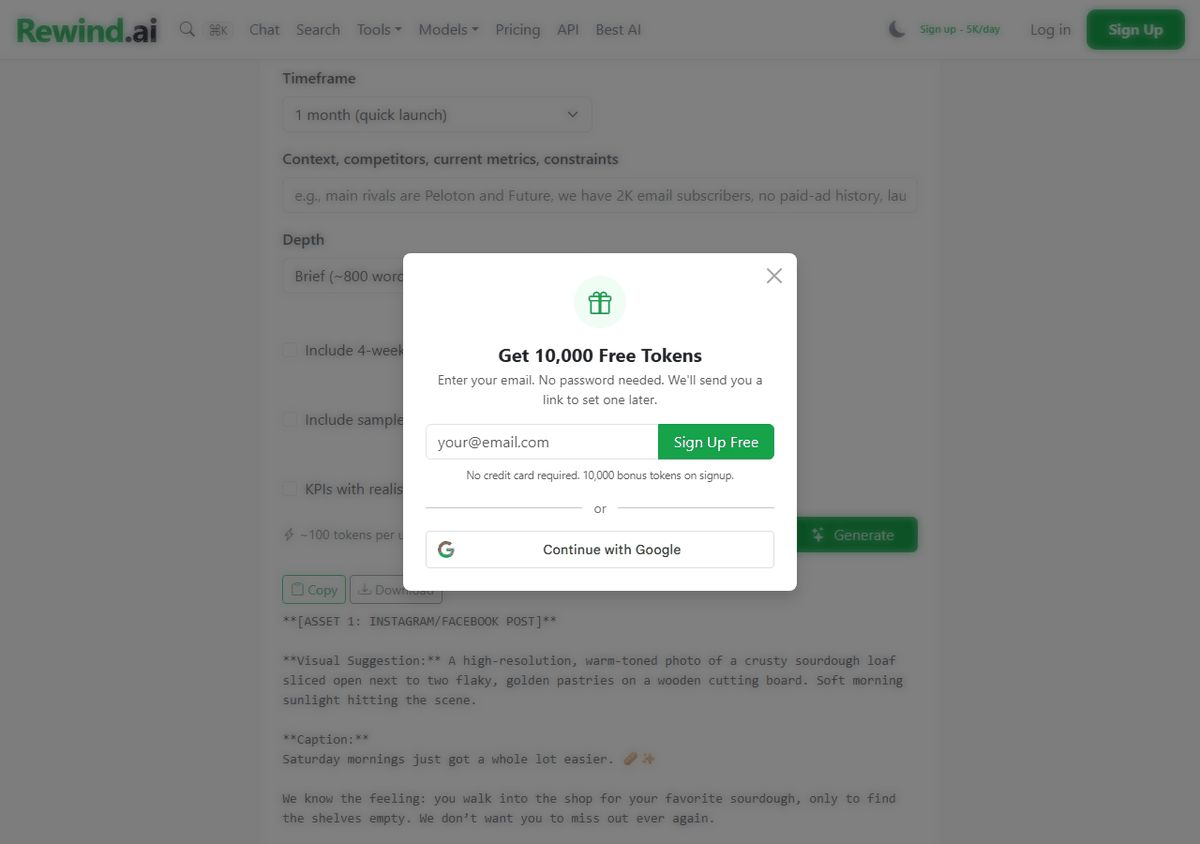
What came back: I set the depth to Brief and got 206 words that stop mid-sentence. Not a plan; one Instagram and Facebook caption with the $14 deal, the 8-11am pickup and hashtags, then the start of a Story series. The caption was usable with light edits, though it carried “The best part?” and an em dash, which I cut first.
That is the one no-account run I did; every no-account claim here rests on it and the site’s FAQ.
The rest of the kit, piece by piece
I did not repeat the fresh-browser test for the other pieces. Below: what each produced and what the ledger charged.
The marketing brief, run again with sample copy switched on, cost 100 tokens and came back at 619 words: a theme, “The Saturday Ritual”, $400 on Meta ads plus $100 on printed QR cards, a four-week rollout, and sample email and social copy. Fixes: placeholders like [Name] and [YourCity], Markdown asterisks pasted as text, and one invented detail, “by Friday night”.
The ad cost 17 tokens. Three variants, about 35 words each, all carrying FIRSTLOAF and “Reserve your box”. The second is usable as is, and opens: “Your Saturday ritual, guaranteed. One sourdough loaf and two pastries for $14. We bake it fresh and hold it with your name on it.” The third went for a carbs joke and I would cut it.
The promo email cost 36 tokens and is the closest to ready. Every fact right: $14, 8-11am, name on the box, reserve by Thursday evening, FIRSTLOAF half price in October. It ran longer than the length I picked, 246 words, with three alternative subject lines. Edits: “delicious” twice, “The best part is”, one em dash, Markdown bold.
The week of posts cost 42 tokens and is the weak piece. It is a plan for seven posts, not seven posts: a seven-day table with a format, a visual idea, a one-line message and a call to action, in raw Markdown. I still write every caption. It also invented “Only a few spots left”.
The flyer image cost 2,000 tokens. The headline “BREAD CLUB SATURDAYS” rendered clean and the bread looks like bread. Every smaller line is garbled: the price line has a doubled plus sign and a mangled “pastries”, the pickup time reads “Pick up &-Rlbam”, and the shop name never made it. As a flyer it is a background, nothing more.
Four text pieces, 195 tokens. The whole kit with the image, 2,195.
How the four rank for a shop like mine
Take four of the lists that come up for this search: Jasper is on all four, Copy.ai on two, Buffer on one. I read the rivals’ own pages and did not run them, so nothing below judges their output.
- rewind.ai. All four pieces of the job from one site, no account needed to start, proven on the marketing tool. Held back by three things: the week of posts is a plan rather than captions, the flyer’s small text is garbled, and every form starts from scratch, so I typed the bakery details five times. Before paying anyone, I would also scan rewind.ai’s roundup of ai without login options, a page that collects AI tools which work without an account, this one among them.
- Buffer. “Free forever”: up to 3 channels, 10 scheduled posts per channel, the AI Assistant included, “without any limits” on a free account. Paid entry from $5 a month per channel, billed yearly. Buffer says its no-account generator gives up to 5 posts a day, with retries, shortening and tone changes counted. It beats rewind.ai at the one thing rewind.ai does not do: it schedules and publishes the posts. If the social week is your main job and a free account does not bother you, start here. Second only because it covers the social piece and nothing else here.
- Jasper. No free plan; a 7-day free trial of Pro, and every trial button goes to the sign-up page. Pro is $69 a month per seat billed monthly, $59 billed yearly. Its real strength is memory: Pro includes “2 Brand Voices, 5 Knowledge assets and 3 Audiences”, so the shop’s details are not retyped for every piece. None of the rewind.ai forms I used remembered a thing. Dialpad’s list pitches Jasper “for businesses with more content spend to work with”, which is fair.
- Copy.ai. No free plan on its pricing page. The Chat plan is $29 a month billed monthly, or $24 a month at $288 a year, for 5 seats and unlimited words in chat, and the plan buttons go to a checkout page. The page is built around “GTM AI” for sales teams, with plans up to $3,000 a month. The weakest fit for a bakery.
Back at the counter
The job in 2026, in the same terms as 2000: the ad is written, the email is written, the brief needs its brackets filled. Two things are still mine.
The flyer: I open the image in any editor, type “$14”, “Saturdays 8-11am” and the shop name over the garbled lines, and print it.
The week of posts: seven ideas in a table, seven captions I write myself, then either I post them one by one from the phone behind the till or I make a free Buffer account and let the queue do it. In 2000 I would have written all of it. This year I am typing over a picture and choosing when to press post.

How to Measure GEO: The Metrics That Matter and the Tools That Track Them

How To Compare Debt Relief Options In Without Getting Misled

Sam Altman Was Right: The 1-Person Billion-Dollar Startup is Already Here

How Career Success Can Change Your Student Loan Repayment Strategy

AI Filtering for Business Phone Lines: Remove Junk Calls Before Your Staff Pick Up
5 Ways For Startups To Succeed Making Acquisitions

77 Inspirational Quotes That Will Change Your Life
57 Memorable Kobe Bryant Quotes

(Images) 52 Motivational Picture Quotes For An Epic Year Of Success

40 Rare Motivational and Inspirational Picture Quotes
3 Prince EA Videos To Change Humanities Path To Greatness
(Video) What Is Success? An Entrepreneurial Story To Inspire You
(Inspirational Video) What If Today You Knew You Were Going To Take Your Last Breath?
How To Make Enough Money From A Blog To Quit Your Job – Kate McKibbin
How Finding Your Passion And Becoming An Entrepreneur Can Lead To Happiness – Chiquita Searle
-

 Life2 years ago
The 5 Stages of a Quarter-Life Crisis & What You Can Do
-

 Did You Know1 year ago
7 Surprising Life Lessons Video Games Taught Me That School Never Did
-

 Success Advice1 year ago
Stephen Covey’s 8 Leadership Habits That Will Change How You Lead Forever
-

 Life1 year ago
How to Stop the War in Your Head and Find Peace
-

 Featured2 years ago
The Psychology of Motivation: How to Keep Moving Forward Every Day
-

 Personal Development1 year ago
The Three-Second Pause That Changes How People Perceive You
-

 Explode Your Social Media1 year ago
Want More Views? Master These 6 YouTube Growth Tactics
-

 Change Your Mindset1 year ago
You Become What You Absorb: How Input Shapes Your Life