
AI
The AI Trap: Why Relationships and Distribution Are Your Only Real Moats


Right now, the internet feels like one massive gold rush. Look around, and it seems like everyone is making life-changing money with artificial intelligence. We are living in a matrix where building a software company used to take a team of engineers and a year of runway—now, it takes a few well-crafted prompts and a weekend.
But if you zoom out and look at how the highest-level entrepreneurs are moving, a very different reality emerges.
The masses are scrambling to build the next viral AI tool, hoping to strike it rich. But the operators quietly pulling in tens of millions of dollars know a harsh truth: when the barrier to entry drops to zero, your product is no longer special.
If you want to build a business that actually survives the age of AI, you have to stop playing the short game. Here is what it really takes to build an unshakeable foundation today.
The Vulnerability of the SaaS Model
AI is the great equalizer. It cuts the cost of building a team and a product by 90%. But there is a massive, glaring vulnerability that most new founders are ignoring: with one single update, giants like OpenAI or Anthropic can completely obliterate your business.
We are seeing an absolute surge of new apps flooding the market. But a crowded app store doesn’t mean anything. When anyone can build a tool, the software itself loses its premium value.
So, what actually matters when a single platform update can recreate your entire tech stack?
The answer is distribution, personal brand, and influence.
These are the assets that an algorithm cannot replace. A machine cannot replicate genuine emotion, real-world authority, or human connection. AI can help you build the infrastructure of a business, but when the market is completely saturated with identical tools, the only thing left standing is you.
The Shift from Tools to Services (Done-For-You)
For the last few years, venture capital and startup culture have been obsessed with SaaS (Software as a Service). But we are reaching a tipping point.
People are experiencing extreme tool fatigue. As a consumer or a business owner, you don’t actually want another dashboard. You don’t want to learn another prompting language. You just want the job done.
There is a fascinating industry metric emerging: for every $1 spent on software, $6 is being spent on agencies and service-based businesses.
The future belongs to the operators who use AI on the back end to scale their own output, while selling a completed, done-for-you result to the client on the front end. Your clients don’t care what tech stack you use to get them results; they just care that the result is delivered flawlessly. The market will always pay a premium for convenience. People are inherently lazy, and they will gladly pay top dollar to avoid doing the work themselves.
The Psychology of Wealth: Be a River, Not a Swamp
Beyond tactical business strategies, surviving this era requires a fundamental shift in how you view money and success.
It is incredibly easy to get caught up in your own reality—chasing paper, isolating yourself, and obsessing over the numbers in your bank account. But there is a well-documented psychological phenomenon among ultra-successful founders: giving back completely rewires your drive.
When you start using your wealth to serve others, you experience a mental unlock. You stop viewing yourself as a selfish hoarder of money and start seeing yourself as a conduit for change. Seeing your resources make a tangible difference in someone else’s life provides an ROI that a profit-and-loss statement simply cannot measure. It fuels you to work harder, build bigger, and push through burnout.
Think of wealth through the concept of a river versus a swamp. A swamp aggressively collects water, but because it has no outlet, the water stagnates. It begins to smell. It rots, and nothing can live in it. A river, on the other hand, flows. It brings life to everything it touches.
Are you building a swamp, or are you building a river?
The Un-Automatable Element
At the end of the day, business is—and always will be—about human connection.
Everything starts and finishes with relationships. You can automate your marketing emails, you can use AI to write your sales scripts, and you can deploy agents to handle your customer service. But you cannot automate trust.
In an era of deepfakes, AI-generated avatars, and infinite content, authenticity is the rarest and most valuable commodity on the market. People buy from people they trust. They do business with people they actually like. Hospitality, kindness, and showing up authentically will always outperform a perfectly optimized algorithm.
Stop trying to compete on the things a robot can do better than you. Double down on your distribution, cultivate deep relationships, and build a business that serves. That is how you become bulletproof.
Luke Belmar speaks more into this perspective of what is shifting in he business world this year














There is a moment in almost every cross-border meeting that nobody brings up afterward. Somebody says something that matters, the other side nods, and 3 weeks later you learn the nod meant nothing.
Your best engineer works out of Warsaw. Your supplier runs out of Shenzhen. Your new distributor is in São Paulo. The talent is global, and the revenue is global. The meeting still runs in a single language, and everyone outside that language works at half speed.
That gap costs real money, and most founders never see the invoice for it.
The Quiet Cost of a Polite Nod
Nobody stops a client call to say they did not follow the last 2 minutes. They catch the gist, fill in the rest later, and hope the gaps were small ones.
So the quietest person on the call is often the one who understood the least, and sometimes the one who knew the most about the problem. You hired that person for their judgment. You get their silence instead, because forming a sentence in a second language under time pressure costs more energy than most fluent speakers ever notice.
The commercial version of this shows up later. Grammarly’s State of Business Communication research found that 1 in 5 business leaders had lost business over communication problems, with the majority putting the value of what they lost at $10,000 or more. Those numbers cover communication generally. Add a language barrier on top, and the misreads get bigger and slower to surface.
Captions Solved the Wrong Half of the Problem
Most teams reach for translated captions first, and they do help. But they also make your brain read and listen at the same time while the conversation moves at full speed.
Try it during a screen share. The deck takes most of the screen, captions sit at the bottom, and the speaker keeps talking. Something gets missed, usually the nuance that matters.
Captions also create a bigger business problem: they disappear. Once the call ends, the translated version is gone, leaving a recording in a language half your team cannot easily review. When someone later asks what the supplier actually committed to, you are left relying on memory and interpretation.
What Changes When the Translation Is Spoken
An AI interpreter does what a human interpreter does, which is speak the translation aloud in the listener’s language while the conversation keeps moving. Your counterpart talks in Japanese. You hear English. Your reply goes back the other way. Nobody reads anything.
The difference in a live negotiation is sharper than it sounds on paper. Tone survives. Hesitation survives. When a supplier gives you a soft refusal wrapped in politeness, you hear the hedge in the delivery rather than reading a flat sentence that looks like agreement.
Tools in this category have moved quickly. JotMe, for instance, runs live translation across 200+ languages and 39,000+ language pairs, speaks the translation aloud in 100+ languages, and can carry the speaker’s own voice into the translated audio. It runs as a desktop app alongside Zoom, Microsoft Teams, Google Meet, and Webex, capturing audio on your machine rather than joining the call as a bot.
The Built-In Options Have a Ceiling
Every major meeting app now advertises live translation, and the headline hides a short list.
| Built-in feature | Spoken languages | Who needs the licence |
|---|---|---|
| Microsoft Teams Interpreter agent | 9 | The meeting organizer, on Teams Premium or Microsoft 365 Copilot |
| Google Meet speech translation | 6 | The host, on a paid Workspace plan with a Gemini add-on |
| Zoom Voice Translator | 5, still in beta | The host, on a paid plan, US accounts |
The table also highlights important limitations around language coverage and licensing. Language support can fall short when your business operates beyond major European and East Asian languages. More importantly, native features are typically tied to the meeting organizer’s licence. If your client hosts the call, your own paid plan may offer little to no benefit, even when you are the one who needs the transcription or translation. For cross-border meetings, where the invite often comes from someone outside your organization, this licensing model can quickly become a significant limitation.
What to Check Before You Pay for Anything
- Does it follow you or the host? A tool running on your own device works on any call. A built-in feature works only when the organizer pays for it.
- Does it speak, or only caption? Ask for the spoken language list specifically, because it is always shorter than the caption list.
- What survives the meeting? Confirm you keep the recording, the source transcript, and the translated transcript, because most built-in captions are gone the second the call ends.
- Does anyone see a bot? On client and candidate calls, a tool that runs quietly on your machine avoids a conversation you do not want to have.
- Can your team test it for free? Run a real call in your actual language pair before anyone signs anything. 20 minutes with a live supplier tells you more than a feature page.
Final Thoughts
The global workforce is already here. Your team, suppliers, and buyers speak more languages than any one person can, and hiring around that gap means choosing fluency over ability.
AI interpretation removes that constraint. The person with the sharpest insight into your supply chain can share it in their own language, while the decision is still being made. That is the real value.
Pick one recurring cross-border call this week and turn on live translation. See who speaks up that usually stays quiet. That costs nothing and tells you whether this is worth budgeting for.

AI visibility is only valuable when the information being surfaced is accurate.
A brand may appear in ChatGPT, Gemini, Perplexity, or Claude but still be described with outdated products, incorrect positioning, or incomplete information. For companies relying on generative search as part of customer discovery, those inaccuracies can create confusion and weaken trust.
Generative engine optimization (GEO) can help brands improve both visibility and the quality of how they are represented.
Here are five companies specializing in generative search optimization for improving AI recommendation accuracy.
1. Profound
Profound is a strong fit for companies that want detailed visibility into how AI platforms describe their brands.
Its platform focuses on areas such as brand visibility, citations, sentiment, competitive performance, and answer accuracy across generative search.
That makes it useful for identifying whether AI systems are presenting outdated or inconsistent information.
Companies can monitor how descriptions change across prompts and platforms, then use those insights to determine where corrections or stronger source signals may be needed.
For organizations with internal marketing and content teams, Profound can provide a strong measurement layer around recommendation accuracy.
2. iPullRank
iPullRank is particularly useful when inaccurate AI results stem from unclear digital information.
Large websites can create conflicting signals when products, services, or categories are described differently across multiple pages.
iPullRank can help improve technical SEO, information architecture, entity relationships, and content structure.
For GEO, that can reduce ambiguity around what the company offers and which information should be considered authoritative.
This is especially relevant for enterprise brands with complicated product portfolios or years of legacy content.
3. NP Digital
NP Digital is a strong option for companies that want to investigate why AI platforms are getting their brand story wrong.
An inaccurate recommendation may be a symptom of a broader issue.
Old third-party articles may still describe a previous product offering. Different pages may use conflicting terminology. Competitors may have stronger category associations, causing AI platforms to position the brand incorrectly.
NP Digital can help identify where those inconsistencies originate and determine which parts of the digital footprint need attention.
That could involve updating high-value content, improving technical clarity, strengthening entity signals, or earning newer third-party coverage that better reflects the company’s current positioning.
For brands that have evolved significantly over time, this can make GEO an important part of reputation and information management.
4. Omnius
Omnius is a good fit for SaaS, fintech, and technology companies that want specialized generative search analysis.
Its GEO focus can help brands monitor how products and services are represented across AI-generated recommendations and comparisons.
That is particularly useful in fast-moving categories where features, pricing models, and positioning change frequently.
If AI platforms continue surfacing outdated information, Omnius can help identify which prompts are affected and where content or authority improvements may be needed.
5. Reboot Online
Reboot Online can help companies improve recommendation accuracy by strengthening current third-party information.
Brands cannot control every external source discussing them, but they can create new, credible information that better reflects their present positioning.
Digital PR can help accomplish that.
Original research, expert commentary, and relevant media coverage can expand the number of recent external sources associated with the company.
For GEO, that can help strengthen a more accurate digital picture over time.
Why AI Recommendation Accuracy Matters
An AI mention is not automatically positive.
If a platform describes a company incorrectly, recommends the wrong product, or associates the brand with an outdated category, the result may hurt rather than help.
Companies should therefore monitor both frequency and accuracy.
Important areas to review include product descriptions, target audiences, pricing, capabilities, locations, leadership information, and category positioning.
How Brands Can Improve Accuracy
The first step is identifying where inconsistencies exist.
Owned content should be updated and aligned around current terminology.
Important third-party listings and profiles should also be reviewed where possible.
Brands should make core information clear and easy to find rather than forcing search systems to infer important details. Structured data is one practical way to do this, since it labels key facts about a business in a format machines can read directly.
New external coverage can also help reinforce current positioning when older information remains online.
Choosing the Right GEO Company
The best partner should help diagnose why inaccurate recommendations are happening.
Some companies need stronger technical structure. Others need clearer content, updated entity information, or more current third-party authority.
A strong GEO company should improve not only how often the brand appears, but also how correctly it is represented when it does.

The AI race is gradually entering a new stage, where investors are beginning to assess not only growth rates but also the ability to turn huge computing costs into sustainable profits. Against this backdrop, Anthropic looks particularly interesting, as the company claims it will end the current quarter with adjusted operating profit for the second time in a row and is simultaneously gearing up for an upcoming IPO with a potential valuation of up to $2 trillion.
In the second quarter, Anthropic already reported adjusted operating profit, and its revenue grew 14‑fold year‑on‑year to $11.5 billion. As of the end of July, its annualized revenue run rate reached $65 billion, compared to less than $9 billion at the end of the previous year. If the current trend continues, the figure is expected to climb to about $120 billion this year, with nearly threefold growth next year.
The business’s economics look particularly impressive before accounting for the most onerous infrastructure costs. According to sources, without the costs of cloud partners, model training, and a number of other items, Anthropic’s gross margin exceeds 80%. However, it is precisely these expenses that remain a key issue for future public investors. Developing advanced models requires ever‑increasing computing power, which means high capital intensity and constant access to infrastructure.
Nevertheless, the move to operating profitability already sets Anthropic apart from the typical image of an AI startup that has been burning capital for years in pursuit of growth. It is the combination of strong revenue growth and the first signs of profitability that could support a valuation of up to $2 trillion.
By contrast, OpenAI is taking a more cautious approach. Sam Altman has officially confirmed for the first time that the company will not be conducting an IPO in 2026. Formally, the reason was the tension surrounding AI safety, but for financial markets, this creates an important contrast. Anthropic aims to leverage its current strong performance to launch an IPO, while OpenAI prefers the flexibility of remaining private.
The risks here are indeed becoming increasingly noticeable. Anthropic’s management is proposing an independent audit of safety procedures, coordination among major developers, and even a voluntary slowdown in model development. OpenAI and xAI have publicly supported some of these initiatives. For businesses, this approach potentially means slower releases, additional costs for testing and compliance, and higher regulatory risk.
That is why the timing for Anthropic’s IPO looks ambiguous. On the one hand, the company may enter the market during a period of exceptional growth and broader market optimism — reflected in recent gains across U.S. equity futures (such as ES futures) on the back of the AI rally — when its financial performance allows it to justify a premium valuation. On the other hand, investors will effectively have to evaluate a business whose management simultaneously warns of the need to limit the pace of development in its own industry.
Geopolitics adds an additional layer of complexity. In the U.S., calls for stricter security measures are met with concerns about losing the technological race to China. Donald Trump has already stated that regulation should not hinder American companies from maintaining their leadership, and some lawmakers fear that excessive restrictions will simply give an advantage to Chinese developers.
At the same time, China itself is also increasing its focus on AI security, but it is emphasizing political, informational, and infrastructural risks rather than voluntarily slowing down technological progress. This reduces the likelihood that the U.S. will be able to significantly slow down the development of the industry without harming its own competitiveness.
As a result, Anthropic’s IPO may become one of the most important tests for the entire AI market. Investors will have to decide how justified the valuation of up to $2 trillion is for a business with phenomenal growth rates, but at the same time huge infrastructure needs and growing regulatory risks.
If Anthropic can maintain high profitability and growth after going public, the market will receive the first convincing proof that advanced AI models can be not only technologically viable but also financially sustainable. If, however, safety concerns and regulation begin to limit the pace of development, the current valuations may turn out to be too aggressive even for one of the fastest‑growing companies in the world.

AI video generation can decrease the initial production requirements for teams testing out visual concepts. Concepts can be developed digitally rather than arranging every location, prop, or cast member.
Pippit brings together generation, editing, refinement, and publishing in a single workflow. It offers model options to fit product scenes, lifestyle videos, character shots, and film ideas. They have longer clips, references, timestamp prompts, background changes, and high-resolution exports. These tools can decrease specific production needs, but creative review is still crucial.
Identify Production Elements That AI Generation Can Replace or Reduce
When a concept doesn’t demand realism from live-action, an AI video generator can lessen the physical needs. Generated environments are for early creative testing and presentation purposes to replace temporary locations. Product visualization can also minimize the need for multiple prop setups for different creative executions. The generated characters can be used for ideas that don’t require much creative casting.

This is particularly effective for hooks, composition, settings, and campaign styles.
These areas indicate how digital generation can minimize production dependencies:
- Locations can be turned into flexible digital spaces for initial concepts and campaign variations.
- Product Scenes allow for testing compositions without repeatedly setting up physical products.
- Styling can be looked at before the need to make casting decisions.
- Set ideas can develop digitally before committing construction budgets.
- Before shooting starts, lifestyle variations can compare a few different creative directions.
Develop Spatial Video Concepts Before Production
Teams can now plan environments, objects, and camera perspectives collaboratively to make creative pre-production more flexible.
Seeworld is a part of the general trend towards 3D world models, which concentrate on the spatial relationship between things rather than on individual pictures or video frames. A world-based workflow can be useful for creators to experiment with scene layout, placement of objects, depth, environmental structure, and viewpoints prior to video generation. These can be used as visual direction for product campaigns, cinematic sequences, and story-driven content. Pippit’s 3D Director Studio offers a hands-on approach to experimenting with your spatial planning, building environments, testing camera views, and making references for later video production.
Control Production Variables with Advanced AI Video Capabilities
Longer connected sequences with advanced generation capabilities provide more space for narrative development of ideas. According to provided product specifications, one generation can last up to 30 seconds. Timestamp prompts can be used to structure key story elements in the beginning, middle, and end. They can also be used to direct actions, camera changes, object movements, and scene transitions. Footage can be extended to extend an existing sequence without having to reinvent the concept. Green screen editing can also help to isolate the created subjects from their native environment. These controls are used to organise product reveals, lifestyle moments, character action, and short brand stories. High-resolution export can also serve assets for campaigns that require a higher level of visual detail.
Steps to Skip Expensive Shoots Using Seedance 2.5 AI Generation Capabilities
Step 1: Plan Your Virtual Production
- Sign up for Pippit using Google, TikTok, or Facebook.
- Open “More” from the left menu and select “Video generator”.
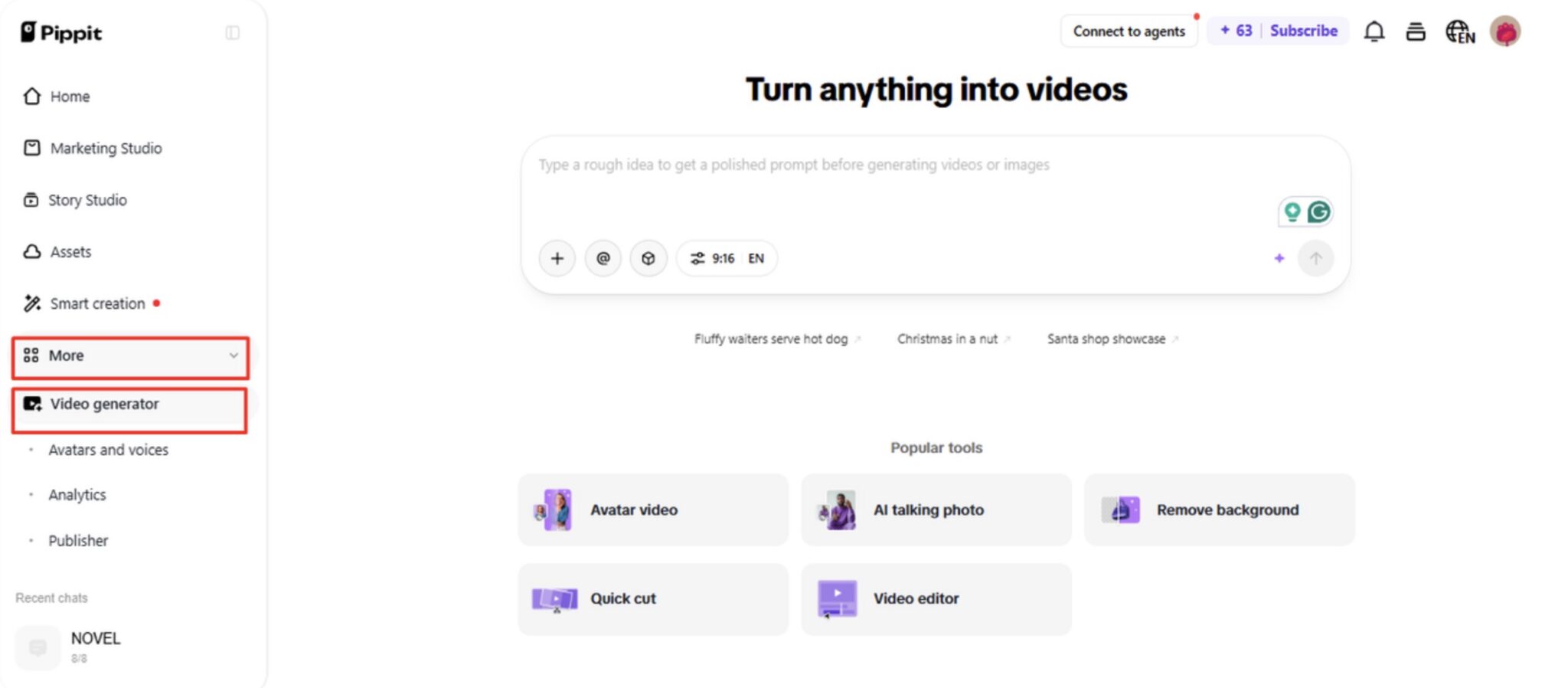
- Choose “Dreamina Seedance 2.5” as your AI model.
- Enter a prompt describing locations, subjects, camera movements, lighting, and visual style.
- Choose the video length, language, subtitles, and aspect ratio if needed.
- Click “+” to upload reference images or videos from your device, phone, Dropbox, or a link. You can also select assets.
- Click “Generate” to start.
Step 2: Generate Without a Physical Shoot
- After clicking “Generate,” Pippit creates the video from your prompt and references.
- The AI handles transitions, pacing, captions, avatars, voice, lyrics, and visual enhancements.
- Review the draft before spending time or money on a physical shoot.
Step 3: Finalize Your AI Production
- Click “Download” to save it, “Regenerate” for another version, or “Edit more” for customization.
- Edit captions, add text, and adjust size, color, alignment, filters, and effects.
- Add music, remove backgrounds, and refine visuals without arranging an expensive physical shoot.
- Click “Export” when ready.
- Select “Publish” for TikTok, Instagram, or Facebook, or “Download” with your preferred format, resolution, frame rate, and quality.
Replace Set-Building with Flexible AI-Generated Environments
Digital environments can be studios, homes, stores, outdoor, and campaign spaces. This flexibility enables several setting directions without the need to rebuild a physical setting each time. After generating footage, there’s another option, which is green screen editing. This means that a single concept can be used for studio, lifestyle, retail, or seasonal campaign versions. But when the environment is changed, care must be taken with the scale of the subjects, their perspective, shadows, and lights. When these elements are matched, you can avoid any obvious disparity between the subject and background.
Pippit’s editing workflow will enable post-generation background refinement if campaign variations require different settings.
Streamline Audio Production Across Creative Variations
Creative variations can go beyond visuals if audio needs to change with different scenes, markets, and placements. With the addition of multiple generation modes, creators can craft audio from text, reference voices, video, or a mix of inputs by using SeedAudio 2.0.
Timestamp control and separate tracks allow for pinpointing dialogue, effects, and music at a specific time, and the individual layers of audio are easier to refine. Teams can use the same basic sound idea but use different voices, ambience, pacing, or music for the various versions. This saves time on repetitive audio work and allows creators to put production time into the best concepts and campaign variations.

Know Where Human Direction Still Matters in AI Video Production
AI generation doesn’t eliminate creative planning, brand governance, or quality control from the production process. Footage created may have incorrect product information, inconsistent characters, unnatural motions, or confusing scenes. Look at all key frames before considering a draft ready for the campaign. Review packaging, logos, proportions, colors, text, facial consistency, object relationships, and brand requirements.
When the concept is good, but the details are not being covered, regeneration makes sense. Manual editing is best when the concept takes off but needs finishing touches. Don’t assume that all of this physical shooting is superfluous, but use generation as a production tool.
Conclusion
AI-powered generation can decrease reliance on locations, sets, reshoots, and some production resources. Using text prompts and text references helps to define creative direction before making costly production commitments. Additional concept development flexibility is provided with timestamp control, footage extension, and background editing.
Pippit connects generation, editing, refinement, and publishing in a creative workflow. Even the best results require direction, careful consideration, and thoughtful improvement. If used creatively, these features can enable teams to brainstorm more ideas without relying so heavily on production.

When the bookkeeping was still a spreadsheet

Dating while you are building a business

When everyone your age looks further ahead than you

Your Brand Outside a Screen: Building Physical Touchpoints That Compound Trust

Why the Global Workforce Needs an AI Interpreter in Every Meeting

5 Ways For Startups To Succeed Making Acquisitions

77 Inspirational Quotes That Will Change Your Life
57 Memorable Kobe Bryant Quotes

(Images) 52 Motivational Picture Quotes For An Epic Year Of Success

40 Rare Motivational and Inspirational Picture Quotes

3 Prince EA Videos To Change Humanities Path To Greatness

(Video) What Is Success? An Entrepreneurial Story To Inspire You

(Inspirational Video) What If Today You Knew You Were Going To Take Your Last Breath?

How To Make Enough Money From A Blog To Quit Your Job – Kate McKibbin

How Finding Your Passion And Becoming An Entrepreneur Can Lead To Happiness – Chiquita Searle
-

 Life2 years ago
The 5 Stages of a Quarter-Life Crisis & What You Can Do
-

 Did You Know1 year ago
7 Surprising Life Lessons Video Games Taught Me That School Never Did
-

 Success Advice1 year ago
Stephen Covey’s 8 Leadership Habits That Will Change How You Lead Forever
-

 Life1 year ago
How to Stop the War in Your Head and Find Peace
-

 Featured2 years ago
The Psychology of Motivation: How to Keep Moving Forward Every Day
-

 Personal Development1 year ago
The Three-Second Pause That Changes How People Perceive You
-

 Explode Your Social Media1 year ago
Want More Views? Master These 6 YouTube Growth Tactics
-

 Change Your Mindset1 year ago
You Become What You Absorb: How Input Shapes Your Life