
Crypto News
How NFTs Are Revolutionizing the World of Gaming

Gaming might be the world’s favorite past time, but what if it became more profitable than working?
Time is money as they say, especially while enjoying your favorite online games. The time it takes to reach the highest level and acquire a top set of items in any MMORPG (World of Warcraft for example) carries value simply because there are people who would rather pay to skip months of grinding levels, gold, and gear. The value of digital items across popular online games further sparked an entire industry where workers are hired to play games all day with the specific goal of earning as much in-game currency as possible, so they can ultimately sell it in exchange for their own local currency. In fact, regions within multiple third-world countries have become entirely dependent on the billion-dollar business of what has become known as “gold farming”.
The challenge however is that these games all explicitly prohibit any “real life” monetary transactions in regards to your account, your characters, and your items. Discussing or soliciting the sale of your virtual property is immediate grounds for a permanent ban, in which case your account, characters, and items would be irreversibly inaccessible.
Because of these restrictions, selling your character or rare item generally requires you to have a private buyer lined up – otherwise your best option would typically be to find a 3rd party marketplace that connects buyers and sellers. This carries significant risks however, as scammers on both sides are prevalent. Most commonly, account sellers would contact the game’s support team to prove their identity as the original owner, thus resetting the account’s login credentials and returning the entirety of what was sold straight back to them.
What if you could secure, trade, and immortalize your character and all of their items on the blockchain? This is exactly what NFT powered games are now offering with immense success – under this structure, monetizing your character is not only allowed, it is showcased as the primary attraction.

In June of this year alone, NFT-based game Axie Infinity saw players make over $42 million in sales, going on to be the #1 most valuable NFT collection.
We are genuinely on the very cusp of this trend as there are not many NFT-based games in existence, with hardly any AAA developers publicly indicating interest let alone announcing such projects (although we will inevitably see this soon). Given the decentralized mindset of the cryptocurrency community, the NFT space is truly poised for creative and unique indie developers to thrive.

Screenshot of DashLeague.io – Home Page
Among the most exciting of these independent gaming ventures is DashLeague.io, a Runescape-meets-Minecraft style MMORPG utilizing NFT tokenomics in completely new ways: players who conquer a town will then earn passive income on the town’s shops from all in-game item sales made by other players. In high-stakes PVP scenarios items can be taken from other players, transferring their NFT to your own wallet in real time.
Teaming up in “leagues” with other players allows you to split token rewards from defeating dungeons as well as pool conquered maps. DashLeague is intentionally structured for players to literally earn money while they sleep, which is hard to argue with considering the sole purpose of these games: to have fun while making money. What may prove to be their most brilliant move of all is their decision to theme the game around the same retro, pixelated style that resonates so strongly with the crypto community as shown through the wild success of NFT projects like cryptopunks and meebits.
As the NFT realm continues to grow in both awareness and application, one thing is for sure – the gaming industry has always been incredibly lucrative (out-earning both the movie and music industries combined), and with the adoption of these hyper-monetized NFT structures, will absolutely be stimulating real-life economies and jobs in a dramatic fashion.



Every perpetual-futures DEX in this comparison lets a trader open positions by connecting a self-custodial wallet instead of submitting an ID, and their headline costs sit close together: Aster charges 0.01% maker and 0.035% taker, while EVEDEX and Hyperliquid both charge 0.015% maker and 0.045% taker (each venue’s own documentation, read 21 September 2026). The choices that actually separate them lie elsewhere — how each screens deposits, how much leverage it permits, and how many asset classes reach one balance. This guide compares EVEDEX, Hyperliquid, dYdX, GMX and Aster on the points that decide which no-KYC venue suits which trader.
Key takeaways
• All five allow trading from a self-custodial wallet with no traditional account KYC; EVEDEX additionally screens every deposit through automated on-chain AML checks (EVEDEX Help Center, verified 14 September 2026).
• Base fees are lowest on Aster (0.01% / 0.035%); EVEDEX and Hyperliquid match at 0.015% / 0.045%; dYdX is 0.02% / 0.05%; GMX charges 0.04–0.06% per side.
• Maximum leverage on majors ranges widely: EVEDEX up to 200x on BTC, ETH and SOL for positions up to $50,000 notional; GMX and Aster up to 100x; Hyperliquid up to 40x on BTC; dYdX up to 20x.
• Asset breadth differs sharply: EVEDEX spans 52 perpetuals across crypto, US stocks, commodities, FX and pre-IPO; dYdX is crypto-only; Aster lists 480-plus mostly-crypto markets.
• EVEDEX matches orders off-chain and settles on-chain on Arbitrum (layer 2); Hyperliquid and dYdX run fully on-chain order books on their own chains; GMX quotes an oracle price against liquidity pools.
|
Parameter |
EVEDEX |
Hyperliquid |
dYdX |
GMX |
Aster |
|
Account verification |
No traditional KYC; on-chain AML screening |
Wallet connect; no account verification |
Wallet connect; self-custody |
Wallet connect; self-custody |
Wallet connect; self-custody |
|
Base fees (maker / taker) |
0.015% / 0.045% |
0.015% / 0.045% |
0.02% / 0.05% |
0.04–0.06% per side |
0.01% / 0.035% |
|
Max leverage |
Up to 200x (BTC, ETH, SOL; ≤ $50k notional) |
Up to 40x (BTC) |
Up to 20x (BTC, ETH) |
Up to 100x |
Up to 100x (1001x on select pairs) |
|
Asset classes |
Crypto, US stocks, commodities, FX, pre-IPO (52 perps) |
Crypto, some stocks, pre-IPO (100+) |
Crypto only |
Crypto, commodities, stocks |
Crypto, stocks, commodities (480+) |
|
Settlement |
Off-chain matching, on-chain settlement on Arbitrum (L2) |
On-chain order book, own L1 |
On-chain order book, Cosmos appchain |
Oracle pricing vs liquidity pools (Arbitrum, Avalanche) |
Order book, own L1 + multi-chain |
|
Margin model |
Cross only, USDT |
Cross and isolated, USDC |
Cross only, USDC |
Isolated, multi-collateral |
Cross and isolated |
Fees, leverage, asset classes, settlement and margin: each venue’s own documentation, read 21 September 2026; EVEDEX figures from its documentation and trading terms, verified 14–18 September 2026. Platform parameters change, so these values are fixed to the dates on which they were read.
What “no KYC” actually means here
On all five platforms, “no KYC” means wallet-based access rather than anonymity, and the compliance layer behind that wallet is where they differ. None asks for a passport or a selfie to place a trade; a trader connects a self-custodial wallet and posts margin. That model is the trading version of what self-custody already does for moving Bitcoin without a central login, covered in 5 ways Bitcoin protects your privacy abroad in 2026. EVEDEX takes a middle path on crypto without KYC: it runs no traditional KYC to trade, while every deposit passes automated on-chain AML screening. That screening model is documented in the EVEDEX Help Center (verified 14 September 2026).
The peers describe their own access plainly. Hyperliquid’s documentation states there is no account verification and no withdrawal-approval step, with funds held in the trader’s wallet. dYdX, GMX and Aster likewise document permissionless, self-custodial access: a connected wallet is the account. The practical point for a reader is that wallet-based access is the norm across this category, so the differentiator is not whether verification is skipped but what sits behind it.
Cost: fees and leverage
On raw fees the field is tight, and EVEDEX sits at the low end without being the cheapest. Aster is lowest on paper at 0.01% maker and 0.035% taker (Aster docs, read 21 September 2026). EVEDEX and Hyperliquid share the next step at 0.015% maker and 0.045% taker (EVEDEX Trading Fees, verified 16 September 2026; Hyperliquid docs, read 21 September 2026). dYdX charges 0.02% maker and 0.05% taker at its base tier (dYdX Help Center), and GMX prices differently again — 0.04% or 0.06% to open and the same to close, charged against position size rather than as maker/taker (GMX docs). At EVEDEX’s rate, a round trip on a taker order costs 0.09% of notional; at Aster’s, 0.07%.

Base maker and taker fees across the five perpetual DEXs, from each venue’s documentation (read 21 September 2026).
Leverage is where the platforms part ways, and higher leverage is a shorter fuse rather than a larger edge. EVEDEX lists the highest ceiling — up to 200x on BTC, ETH and SOL for positions up to $50,000 notional (EVEDEX trading terms, verified 16 September 2026) — ahead of GMX and Aster at up to 100x, Hyperliquid at up to 40x on BTC per its margin-tier documentation, and dYdX at up to 20x on majors. Leverage sets how far the market can move against a position before liquidation: at 200x the initial margin is about 0.5% of the position, so a move of roughly half a percent can erase it, while at 20x that cushion is about 5%. Across regulated CFD providers, between 74% and 89% of retail accounts lose money (ESMA) — a reminder that leverage amplifies losses as readily as gains.
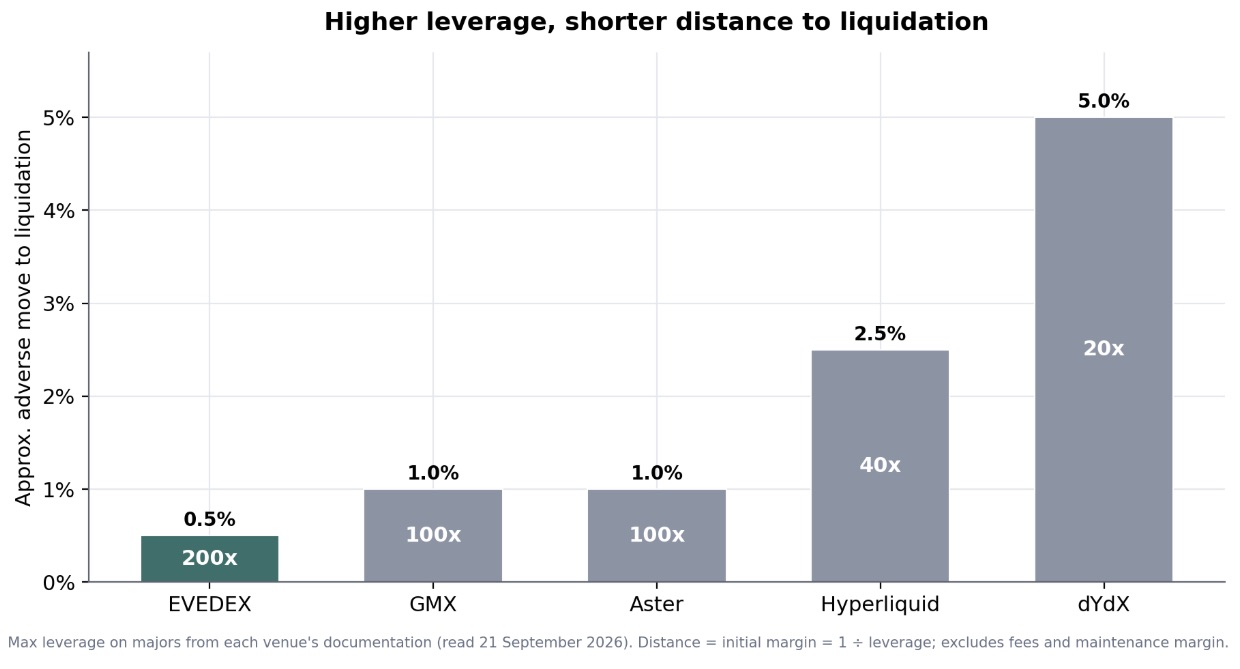
Maximum leverage and the approximate adverse price move to liquidation it implies.
What you can trade, and how it settles
If the goal is more than crypto from one balance, EVEDEX and GMX span the widest set of asset classes. From a single USDT balance, EVEDEX lists 52 perpetuals covering crypto, five US stocks, commodities including gold through a Tether Gold (XAUT) contract, two FX pairs and two pre-IPO markets (EVEDEX trading terms and CoinGecko, verified 16 September 2026). GMX adds commodities and a stock market alongside crypto; Aster lists 480-plus mostly-crypto markets; dYdX stays crypto-only.
Settlement design divides them too. EVEDEX is a hybrid perpetual-futures exchange: orders are matched off-chain in its order book and settled on-chain on Arbitrum (layer 2), which keeps execution fast while final settlement is verifiable on-chain. Hyperliquid and dYdX run fully on-chain order books on their own chains, and GMX quotes an oracle price and fills against pooled liquidity rather than an order book. Each design trades some transparency against some speed, and the right one depends on what a trader values.
Limitations
EVEDEX has clear gaps. It offers cross margin only, so a trader who wants to wall off risk on a single position with isolated margin will not find that here. It runs no spot market — all 52 instruments are perpetuals. Its market count is small beside venues that list several hundred, and its base taker fee of 0.045% is not the lowest in this group. Its 200x ceiling, the highest here, magnifies liquidation risk rather than lowering cost. Traders who want the widest choice of individual crypto markets, or who depend on isolated margin, are better served elsewhere.
Which one fits
For the lowest headline fees on crypto perpetuals, Aster leads this group; for deep BTC and ETH books at moderate leverage, Hyperliquid is a common choice; dYdX suits traders who want a crypto-only, fully on-chain order book. EVEDEX fits a narrower case: a trader who wants crypto, US stocks, commodities, FX and pre-IPO exposure from one USDT cross-margin account, and who values a no-traditional-KYC model paired with on-chain AML screening over the last basis point of fee. Matching the platform to the way a trader actually works matters more than any single number.


A founder will bet the company, learn sales, and still call Bitcoin too risky to hold a small piece of.
The objection is usually one of three. Too risky. Too confusing. Gambling. The first one is the oddest. Starting the business was risky. Leaving the job was risky. You did both because you could see a return if you stayed in the work. A coin is not the business. It is also not a mystery that only a desk can parse. Taxes were confusing. You learned the version you needed. The gambling charge is the one that sticks, and it sticks when there is no rule. A purchase with no size, no time frame, and no plan for an 80% drop is a bet. A purchase with those three is a position. They are not the same afternoon.
The backdrop is why the search exists. A house that used to cost a few years of salary now costs most of a decade. Cash in the bank does not close that gap. Raoul Pal, who used to sell hedge fund research and now runs Real Vision, puts a number on the leak in the conversation below. He argues that once ordinary inflation and the quieter loss of purchasing power are counted, cash gives up something like 11% a year, and the S&P 500’s long run only keeps you level. Bitcoin, in his telling, has compounded well over 100% a year since 2011, and that average already includes three drops of about 80%. Michael Saylor makes the cousin claim from a company treasury. The dollar has lost scarce-asset value for a century, a house carries tax and upkeep, and Bitcoin is the piece you can move without seven banks agreeing.
At a Bitcoin conference, asked what a beginner should actually do, the answers were smaller than the banners. Kevin O’Leary, who sold a company for billions, said get a centralized wallet and a self-custody wallet, put in about $200, and expect to lose it. Not as a joke. As the tuition. You learn who can take it, what you did wrong with the keys, and why a login is not the same as holding it. Then, he said, work with a few coins. Bitcoin. Some Ethereum, because a lot of the rails still use it. Solana if you want to see a faster chain. Move a small amount between the two wallets until the move is boring. Brian Jung, who has spent years on camera in this market, said the same thing from the other side. You will slip. The only useful slip is the one you write down. Saylor’s version, when he was caught in a hallway, was education before size. Do not put money in on a rumor, a whim, or a countdown. Learn how it works the way people had to learn electricity. Then decide.
Entrepreneurs hear a cruder version from people who are up this week and want a call booked. Ignore the scoreboard. The part that is true is narrower. You are often good at making money and bad at deploying it. A bank balance is not a plan. Bitcoin is scarce in a way a currency is not. There will only be 21 million. It is also a practical rail. If you pay a contractor in another country, a transfer that does not sit in a bank that can freeze the account is not a philosophy. It is a Friday. That use does not require you to trade. It requires you not to lose the keys, which is what the $200 was for.
The framework that keeps the rest from being a casino comes from people who have already been wiped out once. Hold Bitcoin. Trade everything else, if you trade at all. Holding asks you to be right once, over years. Trading asks you to be right on a schedule. Most people watching a clip should do the first and skip the second until they have sat through a full cycle, including the year it felt finished. Keep at least half the crypto pile in Bitcoin at all times. A basket of twenty altcoins is not diversification. In this market it is the same bet, with worse drawdowns. Never put the whole pile in one coin, one launch, or one week you feel clever. Take trading profits back into Bitcoin earlier than the group chat wants. Altcoin narratives, when they run, often die inside a few months. Bitcoin is the thing that has, so far, made a higher floor after each bust.
Have you missed it at 30. The cycle where a dorm-room amount became a house is gone. The one still open is a long hold, sized so a 70% drop does not touch rent, set against cash that can make you poorer without crashing. If you are in the quarter-life stretch, the coin will not fix the calendar. Income still comes first. Getting the money right means knowing what the year cost before you move a surplus. Then the surplus can have a job. A target, a date, and a rule you wrote down while the price was boring.
This is not financial advice – It is not a recommendation to buy, sell, or hold anything. Crypto can go to zero, keys can be lost, and past returns are not a forecast. If you need a decision about your money, talk to someone who is allowed to give you that advice.


Checkout pages now commonly accept Bitcoin or USDC alongside Visa. In some countries, shoppers cannot complete a card payment at all. Merchants selling digital goods or expensive items internationally have noticed that a crypto option sometimes closes a sale where the card form does not. Settlement can also be faster than a card payout, with no risk of a chargeback.
The unglamorous part is behind the button. The plugin, the API, the admin user, and, in many setups, a wallet that cannot be reversed all become part of the store. If the wallet isn’t secure, a login isn’t protected, someone pays out on the wrong chain, a connector goes unused for months, or half the team can open the payment panel, you have built a hole instead of a feature. Plan for this as you already do for stock, refunds, and payouts. Do it when traffic is low.
Why eCommerce Businesses Are Adding Crypto Payments
Only a few reasons make it through a finance meeting:
- You are selling into a country where cards fail
- Settlement is faster than waiting on a card acquirer
- Your buyers already pay from their own wallets
- One processor is dictating the rules for your entire shop
This doesn’t make the value of the coin stable unless you change it into a stablecoin as soon as you place the order. Tax offices also treat incoming crypto differently from country to country, and they expect records that card firms already hand you. If you send USDC to an address that expects it on a different chain, the money will be gone. For those selling subscriptions, digital downloads, or expensive goods to customers worldwide, the trade-offs are usually manageable. We can’t accept adding the feature and hoping it will be used later.
Understand How the Crypto Payment Flow Works
When you’re paying, you can choose to pay with crypto. The store puts together a request: destination plus amount. The shopper pays for the items themselves. Once the network has confirmed the transfer several times, the order will be marked as paid.
You can later move that value into a bank account or a treasury wallet. If you use a processor, they often convert and pay you out in regular money, just like a card acquirer would. If you run the wallets yourself, somebody inside the company has to take money out of the checkout wallet and put it somewhere that the website cannot access. The main difference between hiring a processor and doing it in-house is who owns the address creation, confirmation logic, settlement, and storage.
Choose Between a Payment Processor and Direct Wallet Management
Most shops that don’t do much business are better off with a processor. Integration is faster, the books are cleaner, and the keys never sit on your laptop. If the plugin has a bad toggle, it’s annoying. It is less likely to empty an account before anyone notices.
In-house wallets start to make sense when you can see transaction processing fees, when you care about the exact time money moves, or when the business needs you to hold the asset instead of selling it. This route also means your people handle matching payments to orders and every outbound transfer. Be honest about the team, the workload, and how much extra process finance will actually be needed. “We want to be independent” is not a security model.
Choose the Right Wallet Setup for Business Funds
If you copy your own MetaMask habits into a company, you will make things complicated. The wallet checkout is for taking orders. Don’t use it for company reserves.
A custodial provider that holds the keys is usually faster to connect with and easier to recover if someone loses access. If you hold the keys, you have control, and if you make a mistake, it is your problem. Only keep the hot wallet with you if you need it for current orders. Schedule the rest and move it to cold storage or a custody setup the storefront can’t access. If an attacker lands in a plugin, they should have an almost empty balance, not the money made that month.
Secure the Checkout and Payment Integration
Most incidents start when the shop’s system connects to the payment system. If one part of a system is weak, the whole system can be at risk.
Use connectors that still receive updates. Install those updates. Give one job access to the API. Please do not share one admin password around the office. After you change the theme, plugin, or checkout layout, place a test order and watch the funds arrive. A screenshot of a green button is not proof. The site and the payment layer are one surface, even if two different companies built them.
Control Who Can Access Crypto Payment Systems
The developer who updates the plugin shouldn’t be able to read balances. The support agent who pastes a transaction ID into a ticket shouldn’t be able to send a withdrawal. The person doing month-end doesn’t need to edit gateway settings. If one user holds all those rights, a single stolen password can cause a full incident.
Give each person their own login details. Turn on two-factor authentication. It’s more important to think about what a job is like than how long someone has been in it. Seeing a payment is not the same as moving money or changing a payout address.
Once the shop is no longer three people, shared admin accounts also wreck any later investigation. Businesses that handle company crypto at scale need a clear permission structure: one person views activity, another starts a transfer, a third approves it. Cryptobanco is built around exactly that model.
Use Approval Workflows for Moving Business Funds
If a customer pays you and you pay treasury, these are different events. If an incoming payment doesn’t go through, you still have the order and the buyer. If you send money to the wrong account, you can’t cancel it.
Treat treasury withdrawals, large sends, edits to settlement destinations, and first payouts to an address you have never used as actions that only two people should do. The person who clicks “send” should not be the one who approves. If someone hacks your account, the thief will stop at the first door instead of making off with your money.
Verify Wallet Addresses and Blockchain Networks Carefully
If you type the wrong character, you won’t get your money back. If you send the right token on Ethereum to someone waiting on Solana, you get the same result. Card rails can sometimes stop you from making mistakes like that. These rails will not.
Keep a list of places you regularly pay for, and allow them if the software lets you. Ask someone else to check a new address before you send a large amount of money. When you get your first big payout, send a small amount first and wait. Malware can also replace an address the moment you copy it; checking only the first and last four characters won’t catch a well-made swap. Read the whole text, or copy and paste it from the book instead of the clipboard.
Protect Private Keys and Recovery Information
Keep your own wallet and private keys; your balance is the key. Phrases you use to recover information, PINs for your hardware, and backup files do not belong in Google Drive, 1Password shared with eight people, or Slack. Two or three named people should know where the physical copies are kept, and those copies should not be connected to the office network.
A hardware device stops confidential information from being sent to any laptop that also opens emails. If the balance is large enough that you wouldn’t let one employee transfer it from the bank account, don’t let one employee move it on-chain either. Split-key setups (MPC) or a custody provider are there for that exact reason.
Monitor Crypto Payment Activity
Start with a baseline, then watch for anything that differs from it. Any money paid to you should match the orders placed. Transfers should always be finished. The outbound activity should be the same as your normal payout rhythm. Report any new payout addresses, new admin users, and logins from unusual places on the same day, not in next month’s spreadsheet.
Once a chain transfer has been confirmed, it cannot be reversed. However, many attacks still need a login, permission changes, and a new destination before the money can be moved. If you only notice the problem when you look closely, you are writing an incident report, not preventing one.
Plan for Refunds and Customer Support
A card refund rides the same rails backward. A crypto refund is a brand-new outbound payment: you send to the customer’s wallet, correct asset, correct chain, address confirmed in writing first.
Write the sequence down now and follow it every time:
- Confirm the customer’s wallet address in writing
- Check the correct network matches the asset
- Get sign-off on the refund amount
- Send a small test transaction first on larger returns
- Record the transaction ID before closing the ticket
Put the policy on the checkout page so the first angry customer isn’t the one who invented the process.
Keep Accounting and Reconciliation in Mind
Link each payment to an order, an invoice, a refund, or the settlement line. The transaction ID and the timestamp are the join keys. If you need a fiat number for tax purposes, store the rate from the moment you receive the funds.
Make sure you connect that to the accounting tool or ERP system while you still have twenty orders, not two thousand. A tab in Sheets is enough for a pilot. It’s not a good channel. People doing audits and tax filings both want a trail they can easily follow back.
Create a Crypto Payment Security Checklist
Walk this before go-live, then once a quarter.
| Security control | What breaks if you skip it | Owner |
| Payment integrations still maintained and updated | Stale connectors are a common way into shops | Developer / tech lead |
| Multi-factor authentication on every payment login | A password by itself is weak on accounts that can move money | Anyone with access |
| Personal logins, nothing shared | After an incident you cannot reconstruct events | Admin / operations |
| Rights limited to the actual job | One breach then reaches everything | Admin / operations |
| API credentials scoped to a single task | Fat keys are a documented target | Developer |
| Checkout wallet separate from reserves | A drained hot wallet should not take savings with it | Finance / owner |
| Second person on outbound treasury payments | One compromised user should not finish a send | Finance / owner |
| Whole destination reviewed before money leaves | A typo here is permanent | Finance / operations |
| Recovery material kept offline, physically | A digital copy disappears with one stolen login | Owner / named custodian |
| Daily eyes on payment activity | Finding it at month-end is finding it late | Finance / tech lead |
| Refund steps written before the first sale | Made-up crypto refunds go wrong | Operations / support |
| Transaction ids stored against orders and invoices | No join, no audit trail | Finance |
| Offline backups and a short incident plan | You will need both on a bad day | Owner / operations |
Common Mistakes eCommerce Businesses Should Avoid
If you take money from the store into your own wallet, it messes up the accounting and removes every way the company controls what its customers can do. If the hot wallet holds more than current orders require, that extra balance sits reachable from your web infrastructure — and that is exactly what an attacker goes after. If you use one shared admin password, you won’t know who clicked what. Developers who can both write code and transfer funds are often combined into one role.
The rest of the list is just as ordinary: nobody double-checks a new payout address, plugins are on last year’s version, the first refund request is also the first time anyone thinks about refunds, and no one writes down who can authorise a transfer. When that person is on leave, or their account is gone, you have a problem. You have two problems at once: a process problem and a security problem.
Final Thoughts
A crypto button does not make a shop weaker. An improvised crypto button does. Keep the features inside the payment stack that you already know about: connectors that still get patches, wallets that follow how money actually moves through the company, tight access, a second person on outbound funds, someone watching activity, and procedures that exist on paper before the first problem arises.
Do that work now, while you still remember how to do it. Open the table above, mark the rows you do not have, and treat those rows as the project. Everything else is just commentary.

As 2026 progresses and Bitcoin’s market shows clear signs of maturation, the conversation surrounding it has shifted from “Will it survive?” to “How should it be approached?”. Bitcoin’s no longer a fringe experiment trying to win retail buyers over – it has a seat at the same table with well-established investment vehicles like the S&P 500 or gold. Its market cap revolves around $1.21TN at press time, and the best price a Bitcoin was ever sold for surpassed $126K per coin. Bitcoin has matured into what many professionals now call “digital gold”.
Maturity and orderliness don’t mean the risks are gone, whatsoever. News says Bitcoin is safer, but for modern investors, who may no longer experience stomach-churning overnight price declines, the challenge has been refashioned. As BTC becomes a default in 401(k)s and sovereign wealth funds, its behavior is adjusting.
To build a strong portfolio that includes pairs like BTC/USDT these days, you need to look past the potential hype headlines might create and understand the structural shifts in how the asset moves and have solid risk management strategies in place.
The death of the four-year cycle
Bitcoin’s narrative used to tie into a notorious “four-year cycle”, driven by halvings – aka events established in the protocol that reduce the block incentives miners receive by 50%. A “boom-bust” theory described the phenomenon: Bitcoin would peak 12 to 18 months after a halving, after which it would go through a brutal “crypto winter”. Well, that script is being disrupted in 2026, as most analysts observe. One irregularity encountered was Bitcoin’s closing of 2025 weaker than when it entered it, down ~6% YoY. The massive influxes of institutional capital through products like exchange-traded funds and futures in 2024 and 2025 have dampened the extreme price fluctuations that marked most of Bitcoin’s existence. What we’re left with now is a calmer and more predictable market, with relics of volatility – but one that’s not driven entirely by retail hype and speculation as it used to.
Bitcoin is reacting to the same macroeconomic forces the S&P 500 does now: interest rate decisions, inflation, geopolitical conditions. For the long-term investor, this can be both a blessing and a curse. While it means fewer astronomical crashes, it also means Bitcoin is becoming more correlated with traditional stocks. If you want true diversification, you may need to be more strategic than simply “buying the dip”.
The new financial plumbing
Bitcoin’s new structural shifts aren’t just about who’s buying, but about how they’re buying. In past cycles, prices were driven by the demand caused by halving-based supply reductions. Today, the enormous demand Bitcoin sees from institutional investors dissipates that effect. Since early 2025, Bitcoin has broken from the traditional four-year cycle and started to grow increasingly sensitive to global liquidity conditions, like policy rate changes or central bank liquidity. Bitcoin reacts almost immediately when central banks ease financial conditions, acting like a macro asset.
The second shift is the institutional “black hole”, a concept denoting that large-scale financial institutions are accumulating crypto at a wild pace. Spot ETFs and corporate treasuries now gain control over more Bitcoin daily than miners can produce. This has created a permanent supply floor – institutional entities operate on 5-to-10-year mandates, unlike retail investors who can close positions out of panic caused by some grave headlines. This removes massive amounts of BTC from circulation, leading to a market that’s more “supply-constrained” than ever before.
Safety first – the 5% allocation system
One of the most commonly encountered pieces of advice from modern wealth managers is to keep crypto exposure at a maximum of 5% of the total net worth. That’s not due to lack of confidence in Bitcoin’s future but because volatility is an incredibly powerful amplifier – and that’s a double-edged sword. Bitcoin has this unique ability to generate asymmetric returns: it can go up 300% while only being able to lose 150%. If you’re on the winning side and your invested 5% doubles, your entire portfolio wins 5%. But if it goes to zero, you’ve lost 5%. It’s not a sum to break the bank, but safe is safe.
The 60/30/10 sector split
Once you’ve decided how much 5% means in your case, withstand the temptation to put it all in one coin you feel like it’ll go 100x. To truly diversify in 2026, use a tiered approach within that crypto “bucket”:
- 60% for the foundation: By this, we mean sticking to Bitcoin (BTC) and Ethereum (ETH), the blue-chip assets that provide the floor for your portfolio.
- 30% for growth motors: This goes into established L1 and L2 networks like Solana or Arbitrum, the protocols powering the apps and decentralized finance of the future.
- 10% speculative moonshots: This is where you can play with smaller, emerging sectors like AI tokens or DePIN (Decentralized Physical Infrastructure). This will be the high-risk, high-reward portfolio area.
Dollar-Cost Averaging (DCA)
Trying to “time” a Bitcoin cycle this year is simply lost time. With institutional bots and high-frequency traders dominating the market, retail investors have one superpower: patience.
DCA is one of the most widespread strategies to remain grounded and decrease the risk of buying at peaks. Instead of buying $1K worth of Bitcoin at once, you buy $100 every week, no matter the price. This “smooths out” the volatility – when the price is high, your $100 buys less; when the price crashes, your money buys more. Over a two- or three-year period, your average entry price can often be much better than if you had tried to hunt bottoms.
Bitcoin is maturing and that implies rewarding those who can ignore the noise and stick with it during its journey. If you don’t intend to hold for at least five years, are you even investing?
Closing note
Bitcoin has entered a structurally different era – one that rewards strategic thinking, allocation discipline, patience, and macro awareness. The entire market is following it, making it important to look beyond the stack’s leader, too if you want to gain exposure to crypto.

How to Create a Versatile Wardrobe Without Buying Too Much

Scaling Your Brand in NYC: The Strategic Guide to Taxi Toppers

Two Paths Into Mental Health Care: Choosing the Career That Fits You

Is a Healthcare Management MBA Worth It? What You Should Know Before You Commit

Why Some Wealthy Men Keep Their Finances Private While Dating

5 Ways For Startups To Succeed Making Acquisitions

77 Inspirational Quotes That Will Change Your Life
57 Memorable Kobe Bryant Quotes

(Images) 52 Motivational Picture Quotes For An Epic Year Of Success

40 Rare Motivational and Inspirational Picture Quotes

3 Prince EA Videos To Change Humanities Path To Greatness

(Video) What Is Success? An Entrepreneurial Story To Inspire You

(Inspirational Video) What If Today You Knew You Were Going To Take Your Last Breath?

How To Make Enough Money From A Blog To Quit Your Job – Kate McKibbin

How Finding Your Passion And Becoming An Entrepreneur Can Lead To Happiness – Chiquita Searle
-

 Life2 years ago
The 5 Stages of a Quarter-Life Crisis & What You Can Do
-

 Did You Know1 year ago
7 Surprising Life Lessons Video Games Taught Me That School Never Did
-

 Success Advice1 year ago
Stephen Covey’s 8 Leadership Habits That Will Change How You Lead Forever
-

 Life1 year ago
How to Stop the War in Your Head and Find Peace
-

 Featured2 years ago
The Psychology of Motivation: How to Keep Moving Forward Every Day
-

 Personal Development1 year ago
The Three-Second Pause That Changes How People Perceive You
-

 Explode Your Social Media1 year ago
Want More Views? Master These 6 YouTube Growth Tactics
-

 Change Your Mindset1 year ago
You Become What You Absorb: How Input Shapes Your Life