
Entrepreneurs
How To Make $24,000 In 4 Weeks Freelancing Online


If you had to make an extra $100 this week, could you do it? Most people would probably say yes.
But what about an extra $1,000? Hmm…now that’s quite a bit harder. Most of us might have a difficult time getting that amount of money together at a moment’s notice.
How about an extra $5,000? If you had an emergency, could you pull together a spare $5k for an unplanned expense? For 99.9% of the population, the answer is a resounding “Hell No!”
But it doesn’t have to be that way.
In today’s article, I’m going to show you the step-by-step process I used to make almost $24,000 in a single month — that’s just about $6,000/week.
I didn’t borrow the money from a rich uncle or do weird, illegal things to get it. I simply used skills I already had to pitch myself and start a freelance business.
I’ll break down exactly how I did it below — and if this article helps you, read to the end, where I’ve created a free bonus full of advanced material + strategies.
“Sell yourself first, if you want to sell anything.” – Burt Lancaster
When people ask me what the best ways to make money are, sometimes I laugh. Not because the question is stupid, but because, well, there really is no “right” answer. The truth is that almost anything can make money. But first, you have to change your mindset.
You must start viewing your skills and experiences as bankable, valuable resources worth paying for. You (yes, you) can help someone with skills and knowledge that you already have. The easiest way to do this is by freelancing. (If you’re struggling to think of valuable skills, here are some ideas and specific examples.)
All that being said … I have good news and bad news for you.
The good news: There are several online freelance marketplaces like Elance and oDesk that allow you to offer your services, get clients, and start making money quickly, even if you’re a complete beginner.
The bad news: These freelance marketplaces can be extremely competitive and overwhelming. If you don’t know what you’re doing, the competition can be very intimidating.
But don’t let that discourage you.
Today, I’m going to show you the simple “hack” I used to make $24,000 on Elance in four weeks designing simple WordPress websites. (Note: the strategies here apply for any freelance skill, not just web design.)
If you stick around until the end, I’ll also give you some tools to help you get an even bigger jump on the competition.
Step 1: Use sneaky research on your competition
Before you start, you’ll need to know what exactly you’re getting yourself into.
Specifically, you need to know:
- Exactly what strategies your successful competitors use to stand out in the crowd
- How you can completely obliterate them by being ridiculously over-prepared
To find the answers to these questions for myself, I posted a fake job to see what types of responses I would get. I recommend you do the same!
Here’s what I posted on Elance:
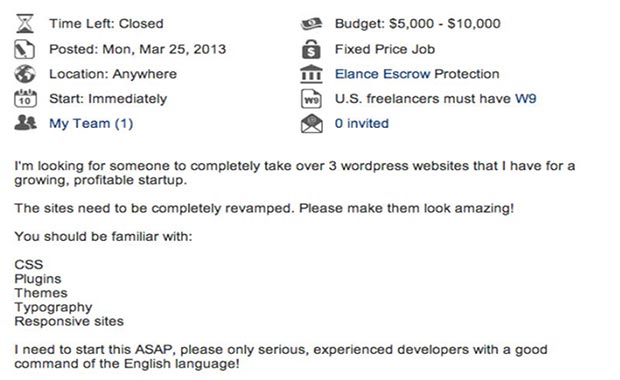
One note here: It’s not really necessary for you to post a fake job like I did in order to get good results. The big idea here is to show you what happens when you actually test your process and then act on those results.
Here’s what I learned with the results from my test …
Step 2: Analyzing the results
Within 30 minutes, I received almost 100 proposals — and I learned two very valuable insights:
- Over half of the applicants to my job were non-native English speakers.
- Most people were submitting “canned” proposals without any personalization.
Once I figured these critical pieces of info out, I knew I had a unique angle. Why?
Well, most people hiring freelancers are from the US/UK — which means that oftentimes, there’s a language barrier. People are always more comfortable communicating in their native language.
And because of this language barrier, most proposals were very dry and uninteresting.
Here’s one that I received …
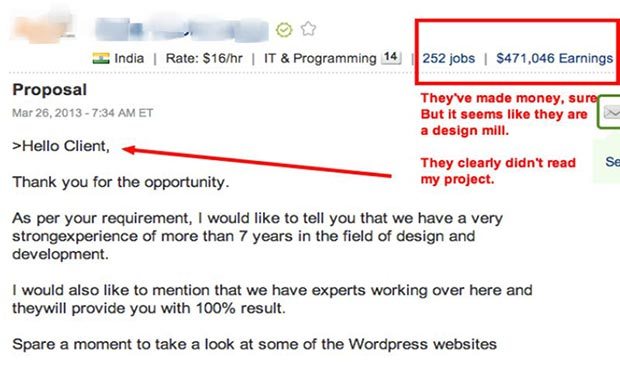
You can do much better. Here’s how …
Step 3: How to stand out and start booking jobs
To stand out against a sea of freelancers, you have to show that you understand your potential client and provide them with a reason to give your proposal a second look. Your approach should feel warm, engaging, and above all, personalized.
Nobody wants to feel like they’re #573 for the day.
Research your prospective client’s profile beforehand and look for these details:
- Purchase history — Do they regularly hire on Elance? If so, this is a good sign that they are serious.
- Feedback history — What type of feedback do they have for freelancers they’ve hired in the past. What have they liked/disliked?
- Personal details — Name, interests, location, etc. Anything you might be able to relate to and build some rapport.
“Why fit in when you were born to stand out.” – Dr. Seuss
The knockout punch: video “mini-pitches”
Once you’ve rounded up all this information, use it to create a short “mini-pitch” with an unlisted YouTube video.
Your “mini-pitch” should:
- Be 90 seconds or less
- Introduce youself and give a very brief background
- Tell them why you like their specific project (so they know you actually read it)
- Offer a simple “call to action” to get in touch with you
Bonus: if you can include some relevant personal details that you have in common, it helps.
From there, the process is simple. Rather than sending a regular proposal like everyone else, just send them a quick message with a link to your custom video.
This method works SHOCKINGLY well because it differentiates you from the crowd and shows that you truly care about what they’re working on.
You can’t fake that.
Get the step-by-step strategies, videos and scripts I used to make $24,000 in 4 weeks
At this point, you’re probably wondering what this approach actually looks like in REAL life.
I put together an extended guide on “Hacking Elance” that includes:
- The exact scripts and screenshots I used to book jobs and negotiate with clients
- Real “mini-pitch” videos I sent that resulted in thousands of dollars
- The biggest mistakes people make when trying this approach (and how you can avoid them)
- A checklist for dealing with common client objections












Most entrepreneurs are using AI like a smarter assistant. The highest performers are using it like an entire second brain… and it’s giving them an almost unfair advantage.
The difference is subtle but massive.
Most people use AI for tasks: writing emails, summarizing documents, generating content ideas. High-performers use AI as an extension of their own thinking process. They externalize their memory, planning, research, and even parts of their decision-making. This frees up their actual brain to focus on what it does best: judgment, creativity, relationships, and high-stakes thinking.
This is especially powerful for founders who already operate with high drive but struggle with traditional linear systems (many high-performers and those with ADHD traits fall into this category). AI becomes a way to externalize executive function so their brain can stay in its highest-value state instead of getting bogged down in organization and follow-through.
Here’s how the best entrepreneurs are building their AI second brain:
- Central knowledge repository — They feed important information, decisions, wins, lessons, and context into AI over time so it develops deep context about them and their business.
- Strategic thinking partner — They use AI to pressure-test ideas, play devil’s advocate, explore second and third-order consequences, and spot blind spots they would normally miss.
- Project and decision memory — Instead of trying to remember everything, they maintain living documents and conversations with AI that track progress, open loops, and key decisions.
- Personalized frameworks — They build custom systems and recurring prompts that match how their brain works (energy cycles, decision style, strengths, and weaknesses).
- Execution layer — They combine AI with small teams or automation so ideas move from thought to action with minimal friction.
The goal isn’t to become dependent on AI. It’s to become significantly more effective by removing the friction between having a great idea and executing it at a high level.
When used correctly, AI stops being a tool and starts becoming leverage… the kind of leverage that used to require hiring expensive teams or burning yourself out trying to do everything yourself.
If you want to learn more from me or send me a personal message I’ll respond to you on Instagram at https://instagram.com/iamjoelbrown speak soon!
Change Your Mindset
Why Your Biggest Wins Can Leave You Feeling Surprisingly Empty (And the Identity Shift That Actually Sustains Them)


You finally hit it.
The launch that sold out in hours. The exit that changed your family’s life. The revenue milestone you quietly set for yourself three years ago and told almost no one about. The moment you’ve been grinding toward through the late nights, the near-misses, the “I’ll figure it out” seasons, and the quiet doubts you never let anyone see.
For a brief window… sometimes just a few days, sometimes only a few hours… the high actually lands. There’s relief. Pride. Maybe even a few tears in private. You think, This is it. This changes everything.
And then something strange and unsettling begins to happen.
The excitement doesn’t stay. It leaks out faster than you expected. In its place comes a quiet emptiness that feels almost rude after everything you sacrificed to get here. Or a low-grade anxiety that whispers, “Now what?” Or worse — a strange, almost compulsive urge to self-sabotage. You start questioning whether you’re “allowed” to enjoy this. You find yourself already scanning the horizon for the next, bigger goal, not because you’re hungry, but because the stillness feels strangely threatening. You pick fights in your marriage, make impulsive business moves, or quietly manufacture new problems because chaos, ironically, feels more familiar and therefore safer than peace.
This isn’t ingratitude. It’s not classic burnout either. It’s a common but rarely named experience among high-achieving entrepreneurs: your identity and nervous system were built for the chase. The struggle gave you meaning, adrenaline, and a clear, compelling story: “I’m the one who overcomes the odds.” That story became part of your self-concept. It gave you drive on the hard days and a sense of purpose when things felt impossible.
When the odds are finally overcome, that old story no longer fits. And if you haven’t consciously written a new one, the void rushes in to fill the space. Many driven founders quietly self-destruct in this window. They neglect their health or closest relationships, make reckless decisions, or immediately chase the next mountain before they’ve even processed what they just accomplished. It’s not because they don’t want success. It’s because their current identity and internal wiring were never calibrated to hold success without the familiar fuel of struggle.
The deeper shift is this: Real, sustainable success isn’t just about achieving bigger outcomes. It’s about evolving your identity so it can actually carry the weight of what you’ve built without collapsing or self-sabotaging. You stop tying your worth exclusively to the next win and start anchoring it in who you’ve become… and who you’re becoming in the process. The win itself becomes secondary to the person you had to grow into in order to create it.
Here’s how to do it practically:
- After any major win, deliberately schedule an integration period (minimum 2–4 weeks) with no new big goals. Use this time for health, relationships, reflection, and nervous system recovery instead of immediately jumping to the next mountain.
- Update your internal story on purpose. Journal the old identity (“I’m the grinder who had to fight for everything”) and consciously write the new one (“I am the kind of person who can create, receive, and sustain meaningful success while staying grounded”).
- Build your capacity to receive and feel safe in success. This looks like daily practices that train your body to tolerate stillness, pleasure, and peace (time in nature, quality presence with family without an agenda, breathwork, or whatever actually lands for you).
- Redefine your “why” beyond achievement. What kind of presence, legacy, and way of being matters most to you now that the old survival story is no longer running the show?
The entrepreneurs who compound their wins into a life of increasing peace and power aren’t the ones who simply achieve more. They’re the ones who do the identity and nervous system work that most people skip. Success without this internal evolution often becomes its own prison.
If you want to learn more from me or send me a personal message I’ll respond to you on Instagram at https://instagram.com/iamjoelbrown speak soon!
Entrepreneurs
The Brutal Truth About Entrepreneurship with ADHD (And Why Most Advice Is Making It Worse)

You’re not lazy. You’re not undisciplined… and you’re definitely not broken.
You’re an entrepreneur with ADHD, and right now you’re probably sitting on 19 unfinished projects, 47 open tabs, and a brain that feels like it’s running on 12 different radio stations at once.
You’ve read the books. You’ve tried the planners, the Pomodoro timers, the accountability groups. You’ve even hired coaches who promised to “fix” your focus. Yet here you are — brilliant ideas, massive potential, and a business that still feels like it’s one step away from collapsing under the weight of your own mind.
Here’s what almost nobody in the entrepreneurial space will admit:
The real struggle isn’t your ADHD. It’s that you’ve been trying to run a neurodivergent brain inside a neurotypical business model — and then beating yourself up when it doesn’t work.
Most advice for entrepreneurs was written by people whose brains work differently. They preach consistency, routines, long-term planning, and steady execution like those things are universal truths. For the ADHD entrepreneur, those “truths” feel like trying to swim upstream in cement. You can force it for a while (and you have), but eventually your brain rebels, the burnout hits, and you’re left feeling like a failure who just needs to “try harder.”
That cycle is quietly destroying more talented founders than cash flow problems or bad hires ever could.
The deeper layer most people never reach is this: your ADHD isn’t a bug in the system. It’s a different operating system entirely. And when you stop trying to install Windows on a Mac and start building everything around macOS, the game changes completely.
The Hidden Addiction That Keeps ADHD Entrepreneurs Stuck
You already know the surface symptoms — time blindness, rejection sensitivity, starting strong and fading fast, shiny object syndrome.
But the real trap is more insidious.
It’s the addiction to chaos and novelty.
Your brain is wired for dopamine. New ideas, big visions, last-minute sprints, high-stakes pressure — these things light you up like nothing else. The boring, repetitive, systems-building work that actually scales a business? It feels like torture.
So unconsciously, you keep your business in a state of controlled chaos. You say yes to too many things. You chase the next exciting opportunity. You avoid building the boring infrastructure because “I work better under pressure anyway.”
And every time the pressure gets too high, you crash, swear you’ll get organized next quarter, and repeat the cycle.
Meanwhile, the neurotypical advice keeps telling you to “just build better habits.” As if your brain is a poorly trained dog that needs more discipline instead of a high-performance race car that needs the right fuel and track.
This isn’t a character flaw. It’s neurology.
And until you stop treating your wiring as something to overcome and start treating it as your greatest strategic advantage, you’ll stay stuck in the same exhausting loop.
The Identity Shift That Changes Everything
The entrepreneurs with ADHD who finally break through don’t “fix” their brains.
They redesign their entire business to work with their brains.
They stop trying to become the consistent, routine-loving founder the gurus talk about. Instead, they become the architect of a system that leverages their natural strengths — hyperfocus, pattern recognition, creative problem-solving, relentless drive under pressure — while outsourcing or automating everything that drains them.
This is the layer most ADHD entrepreneurs never reach because it requires something terrifying: accepting that you are never going to be “normal” at entrepreneurship… and that’s exactly why you can win bigger than most.
Your ability to see connections others miss. Your tolerance for uncertainty. Your capacity to go all-in when something lights you up. These aren’t liabilities. They’re unfair advantages in a world that rewards speed, creativity, and bold moves.
The shift is simple but brutal:
Stop trying to manage your ADHD. Start designing your business around it.
How to Actually Build a Business That Works With Your Brain
- Stop fighting your energy cycles — weaponize them. Most ADHD entrepreneurs try to force 8-hour focused days. That’s insane. Instead, track when your brain actually works best (for many it’s 10pm-2am or random 4-hour hyperfocus bursts). Build your schedule around those windows. Protect them like gold. Do the deep, high-leverage work then. Use the low-energy periods for admin, calls, or recovery.
- Build “chaos containers,” not rigid systems. Traditional project management tools feel like cages. Create loose but effective structures that give your brain freedom. Use tools like Notion with massive flexibility, or body-doubling (working alongside someone virtually), or even hiring a “chaos wrangler” — an assistant who thrives on turning your scattered ideas into executable plans.
- Turn your rejection sensitivity into rocket fuel. That intense fear of letting people down or looking stupid? Channel it into creating ridiculously high standards for your customer experience or product quality. Use it as fuel instead of letting it paralyze you.
- Outsource the parts that make you want to die. The execution, follow-through, and maintenance phases are where most ADHD entrepreneurs lose. Hire or partner with people who love the details. Your job is vision, strategy, and big swings. Let someone else own the spreadsheets.
- Create external pressure on your own terms. Deadlines and public commitments work wonders for the ADHD brain. Use them strategically — announce launches, create beta groups, or work with coaches who understand neurodivergence instead of fighting it.
The entrepreneurs with ADHD who are quietly crushing it right now aren’t the ones who finally became “disciplined.” They’re the ones who stopped apologizing for how their brain works and started building empires that are specifically engineered for it.
They have teams that handle the boring stuff. They have systems that flex with their energy instead of fighting it. They’ve turned their “flaws” into the exact reasons their businesses stand out.
Your ADHD brain is not the enemy. The enemy was trying to play the game by rules that were never designed for you.
The moment you accept that and start designing everything… your calendar, your team, your offers, your processes — around how you actually operate, the struggle doesn’t disappear… but it becomes manageable, even exhilarating.
You were never meant to fit the mold. You were meant to break it and build something better.
The world doesn’t need another cookie-cutter entrepreneur. It needs the chaotic, brilliant, all-in, slightly unhinged visionaries who can only operate at full power when the game is built for them.
That’s you.
Stop trying to fix yourself. Start building the business that was always meant to be run by a mind like yours.
Your next breakthrough isn’t going to come from working harder or being more consistent. It’s going to come from finally giving yourself permission to work differently.
And when you do that? Watch what happens.
The same brain that once felt like a curse becomes the exact reason your business becomes unstoppable.
You’ve got this. Not despite the ADHD. Because of it.
If you want to learn more from me or send me a personal message I’ll respond to you on Instagram at https://instagram.com/iamjoelbrown speak soon!
Entrepreneurs
The Silent Killer of Entrepreneurial Dreams (And How to Make Sure It Never Takes Yours Down)

You started with fire in your belly. The vision was crystal clear. But somewhere along the way the doubts crept in. The “what if I’m wrong” thoughts. The comparison to everyone else’s highlight reel. The quiet voice that says maybe you should just play it safe and get a real job.
That voice is the silent killer. Not cash flow problems. Not bad hires. Not even market shifts. It’s self-doubt that quietly talks most entrepreneurs out of their biggest breakthroughs.
I’ve been in rooms with founders who’ve raised millions and still battle it daily. The difference between those who push through and those who fold isn’t talent or luck. It’s how they handle the internal noise.
The game-changer is learning to treat doubt as a signal, not a stop sign.
Every time that voice gets loud, it usually means you’re on the edge of something important. Growth lives right outside your comfort zone. The entrepreneurs who scale don’t silence the doubt—they thank it for showing up and then take the next step anyway.
Here’s how to make that practical.
Keep a “proof file.”
Every win, every positive customer note, every metric that moved in the right direction. When doubt hits, open it. Evidence beats emotion every single time. Most founders are terrible at remembering their own wins. They move the goalpost so fast that yesterday’s victory feels ordinary by today. A simple document or folder where you collect proof changes the internal conversation. It becomes harder to believe the doubt when you have a running list of times you were wrong about your own limits.
Surround yourself with people who are playing a bigger game.
Isolation breeds doubt. A strong peer group normalizes the struggle and reminds you you’re not crazy. The entrepreneurial path is full of invisible landmines. Having people who’ve stepped on a few of them—and lived to tell the tale… makes the journey feel less lonely and more possible. Find masterminds, find mentors, find founders a few steps ahead of you who are willing to be honest about the hard parts.
Reframe failure as data.
Every setback is just information about what to do differently next time. The fastest learners treat mistakes like tuition, not tragedy. This doesn’t mean you celebrate failure or become reckless. It means you extract the lesson quickly and move forward without carrying the emotional weight longer than necessary. The founders who win long-term are the ones who fail fast, learn faster, and keep their identity separate from any single outcome.
Get brutally clear on your “why.”
Not the surface-level money or freedom story. The deep one that still lights you up even when the work sucks. Reconnect with it daily. When doubt shows up, it’s often because you’ve lost sight of the deeper reason you started. Spend time with that reason. Write it down. Say it out loud. Let it remind you that the discomfort is temporary and the mission is bigger than the fear.
And finally, give yourself permission to be in process.
Most entrepreneurs compare their chapter one to someone else’s chapter ten. They see the polished results and forget the messy middle that every successful founder had to walk through. Your story isn’t over. It’s not even close. The doubt you feel today might be the exact thing that forces you to get clearer, stronger, and more intentional than you’ve ever been.
The path of entrepreneurship was never meant to feel safe. That’s the whole point. It forces you to become the kind of person who can handle bigger problems and bigger wins. Doubt will show up. It always does. But it doesn’t get to drive.
You do.

These Are The Only 5 Jobs That Will Remain In 2030 because of AI

The Art Of Staying Organized In A Digital World

How Indoor Air Quality Affects Your Productivity and Success

The AI Trap Most Entrepreneurs Are Falling Into (And How to Avoid Becoming Replaceable)

AI as Your Second Brain: How High-Performers Are Building Personal Leverage Systems

5 Ways For Startups To Succeed Making Acquisitions

77 Inspirational Quotes That Will Change Your Life

(Images) 52 Motivational Picture Quotes For An Epic Year Of Success

40 Rare Motivational and Inspirational Picture Quotes
30 Famous Quotes That Will Inspire Success In You

3 Prince EA Videos To Change Humanities Path To Greatness

(Video) What Is Success? An Entrepreneurial Story To Inspire You

(Inspirational Video) What If Today You Knew You Were Going To Take Your Last Breath?

How To Make Enough Money From A Blog To Quit Your Job – Kate McKibbin

How Finding Your Passion And Becoming An Entrepreneur Can Lead To Happiness – Chiquita Searle
-

 Success Advice2 years ago
20 Creative Ways To Make Money From Home
-

 Success Advice2 years ago
7 Habits of Highly Effective Mediocre People
-

 Quotes2 years ago
176 Inspirational Pablo Picasso Quotes on Art, Creativity and Life
-

 Change Your Mindset2 years ago
The Art of Convincing: 10 Persuasion Techniques That Really Work
-

 Life2 years ago
10 Ways Your Life is Like a Video Game
-

 Quotes2 years ago
32 Powerful Quotes About Overcoming Procrastination by Joel Brown
-

 Success Advice2 years ago
8 Quick Strategies to Boost Your Email Survey Response Rates
-

 Life2 years ago
13 Meaningful Ways to Show Someone They Matter
6 Comments